
Fitch Downgrade Spurs Gold Surge
The catalyst behind this surge was Fitch’s unexpected decision to downgrade the United States’ highly coveted triple-A credit rating to AA+. The move by Fitch cited concerns over the country’s fiscal deterioration and rising government debt burden in the next three years. As confidence in the economy waned, investors flocked to the safety of gold, driving its demand higher.
Trading Derivatives carries a high level of risk to your capital and you should only trade with money you can afford to lose. Trading Derivatives may not be suitable for all investors, so please ensure that you fully understand the risks involved, and seek independent advice if necessary. A Product Disclosure Statement (PDS) can be obtained either from this website or on request from our offices and should be considered before entering into a transaction with us. Raw Spread accounts offer spreads from 0.0 pips with a commission charge of USD $3.50 per 100k traded. Standard account offer spreads from 1 pips with no additional commission charges. Spreads on CFD indices start at 0.4 points. The information on this site is not directed at residents in any country or jurisdiction where such distribution or use would be contrary to local law or regulation.
In the past, a credit rating downgrade had sent markets into a frenzy. However, this time, the initial reaction seemed calmer. Nonetheless, experts are keeping a close eye on the unfolding situation, recognizing the potential impact on the markets going forward.
Gold, denominated in U.S. dollars, has long been favored as a safe-haven investment during times of economic uncertainty and stress.
Traders Eyeing Non-Farm Payrolls Data
As the greenback strengthened following solid data on U.S. manufacturing and construction in June, gold experienced a 1% drop and hit a three-week low. Despite this temporary setback, all eyes are now fixated on the non-farm payrolls report set to release on Friday, which will be a crucial indicator of the U.S. economy’s health. Expectations are that job numbers will rise by 200,000 in July, following a solid increase of 209,000 in June.
Global Central Bankers Aim to Manage Inflation
U.S. central bankers, while expressing hope in managing inflation without harming job opportunities, have acknowledged that higher interest rates will be necessary for some time. The rise in interest rates poses a challenge for gold investors, as it increases the cost of holding the precious metal, which bears no yield and requires money for storage and insurance.
WGC Predicts Drop in India’s Gold Demand
In addition to the U.S. economic situation, the World Gold Council (WGC) brings focus to India’s gold market. The WGC predicts that India’s gold demand for 2023 may experience a 10% decline from the previous year, reaching the lowest levels in three years. The country’s retail purchases are being dampened by record-high gold prices. The reduced gold imports may have broader implications, as it could narrow India’s trade deficit and provide support for the Indian rupee.
Short-Term Outlook: Bearish, but Fitch Downgrade is New Bullish Wildcard
As investors navigate uncertain economic waters, the gold market remains a key focal point. With global events and economic indicators at play, traders must stay vigilant for potential bullish or bearish outcomes in the precious metal market.
Technical Analysis
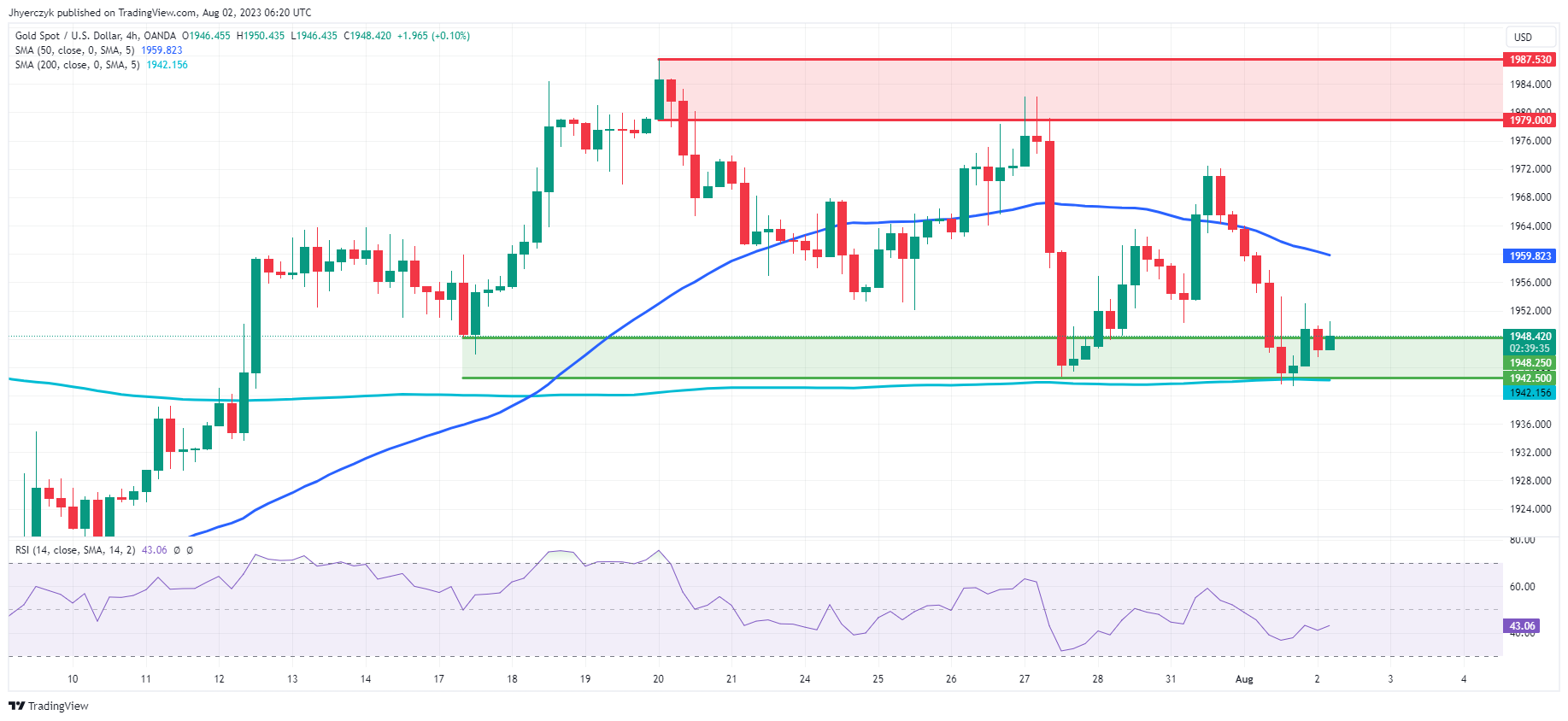
However, the price is below the 50-4H moving average (1959.82), indicating some bearish pressure. The 200-4H moving average (1942.15) serves as strong support. The 14-4H RSI reading of 43.06 suggests weaker momentum.
The main support area lies between 1942.50 and 1948.25, while the main resistance area extends from 1979.00 to 1987.53. Traders should closely monitor these levels for potential trading opportunities.
 Chat now!
Add a Comment