

U.S. Oil Inventory Dynamics
U.S. crude oil inventories were projected to drop by 5.5 million barrels for the week ending Sept. 1, an indicator of tightening supplies. This projection comes from market sources referencing data from the American Petroleum Institute (API). Confirmatory data from the U.S. Energy Information Administration (EIA) will be released at 15:00 GMT on Thursday.
Extended Supply Cuts Boost Prices
Oil prices saw a boost earlier in the week after major oil producers, Saudi Arabia and Russia, chose to prolong their voluntary oil supply cuts until the end of the year. Saudi Arabia slashed its oil production by 1 million barrels per day, whereas Russia reduced its output by 300,000 barrels per day. These decisions came in addition to the earlier production cut in April, agreed upon by several OPEC+ producers, scheduled to run till the end of 2024. It’s also noteworthy that both nations have committed to monthly reviews of these cuts based on prevailing market conditions.


Trading Derivatives carries a high level of risk to your capital and you should only trade with money you can afford to lose. Trading Derivatives may not be suitable for all investors, so please ensure that you fully understand the risks involved, and seek independent advice if necessary. A Product Disclosure Statement (PDS) can be obtained either from this website or on request from our offices and should be considered before entering into a transaction with us. Raw Spread accounts offer spreads from 0.0 pips with a commission charge of USD $3.50 per 100k traded. Standard account offer spreads from 1 pips with no additional commission charges. Spreads on CFD indices start at 0.4 points. The information on this site is not directed at residents in any country or jurisdiction where such distribution or use would be contrary to local law or regulation.
Short-Term Market Responses
The anticipation of dwindling U.S. crude oil inventories, coupled with the continued production cuts from Saudi Arabia and Russia, caused oil prices to rally. Brent crude futures climbed to $90.60 a barrel, and U.S. West Texas Intermediate (WTI) crude futures reached $87.54. The present Brent futures trade near a nine-month high, suggesting the market is pricing in a short-term supply crunch.
Economic Factors and Concerns
However, the global economy presents potential headwinds for oil. The U.S. dollar’s recent surge might impact oil demand, as a robust dollar renders crude oil more costly for those dealing in other currencies. Furthermore, looming rate-hike fears and uncertainties surrounding the economic landscape are acting as counterweights. Analysts also caution that the upcoming maintenance period for U.S. refineries in September-October could curb demand.
Forecast: Mixed Signals Ahead
While the short-term view might appear bullish due to shrinking inventories and supply cuts, several factors could dampen the upward trajectory. These include the U.S. dollar’s strength, potential oil supply boosts from nations like Iran, Venezuela, and Libya, and upcoming refinery maintenance schedules. Consequently, traders should remain alert to both bullish and bearish pressures in the coming weeks.
Technical Analysis
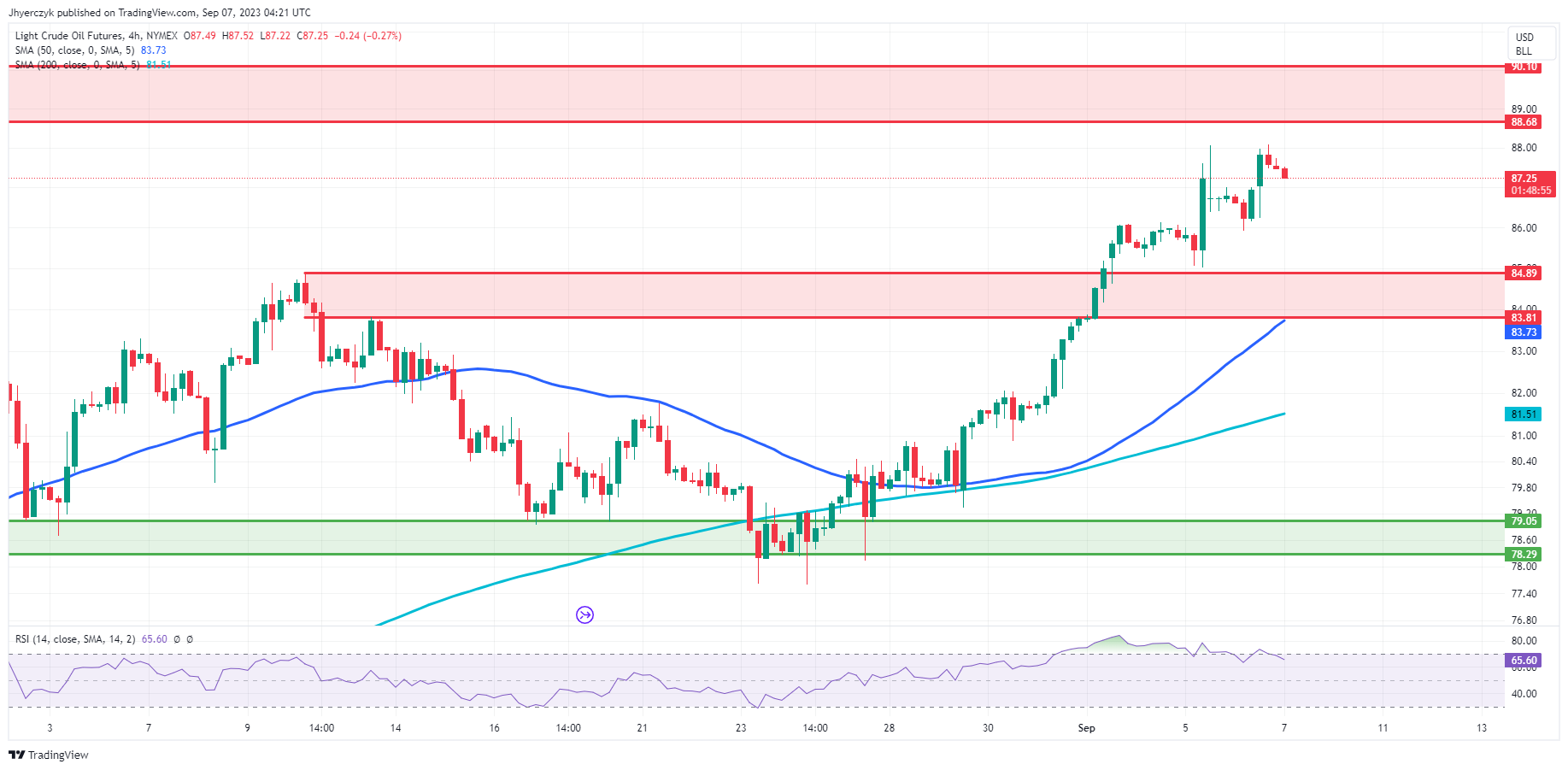
While the price is currently sandwiched between the main support zone of $84.89 to $83.81 and the resistance area of $88.68 to $90.10, its position above both crucial moving averages solidifies the prevailing bullish sentiment in the market.
 Chat now!
Add a Comment