

Thursday Overview
On Thursday, the EUR/USD rose by 0.41%. Following a 0.38% gain on Wednesday, the EUR/USD ended the day at $1.05468. The EUR/USD fell to a low of $1.04999 before reaching a high of $1.05518.
German Factory Orders in Focus
After disappointing German trade figures on Thursday, German factory orders will be in focus today. Economists forecast factory orders to increase by 1.8% in August. Orders unexpectedly tumbled by 11.7% in July.
Trading Derivatives carries a high level of risk to your capital and you should only trade with money you can afford to lose. Trading Derivatives may not be suitable for all investors, so please ensure that you fully understand the risks involved, and seek independent advice if necessary. A Product Disclosure Statement (PDS) can be obtained either from this website or on request from our offices and should be considered before entering into a transaction with us. Raw Spread accounts offer spreads from 0.0 pips with a commission charge of USD $3.50 per 100k traded. Standard account offer spreads from 1 pips with no additional commission charges. Spreads on CFD indices start at 0.4 points. The information on this site is not directed at residents in any country or jurisdiction where such distribution or use would be contrary to local law or regulation.
German factory orders are unlikely to shift the ECB interest rate path from the higher-for-longer outlook. German manufacturing accounts for less than 20% of Germany’s GDP. However, the trend of weak economic indicators from Germany will elevate fears of a prolonged recession. A German recession would weigh on demand for the EUR.
Beyond the economic indicators, investors should monitor ECB commentary. A deviation from the higher-for-longer guidance will likely draw interest.
US Jobs Report to Take Center Stage
Later today, the US Jobs Report will take center stage. Mixed labor market numbers this week have created uncertainty about labor market conditions. The US Jobs Report will likely define the Fed interest rate path and dictate near-term EUR/USD trends.
Economists forecast average hourly earnings to increase by 0.3% in September and nonfarm payrolls to rise by 170k. Significantly, economists predict a fall in the US unemployment rate from 3.8% to 3.7%.
A pickup in wage growth and tighter labor market conditions will likely support a more hawkish Fed rate path. Tight labor market conditions push wages higher, fueling consumption and demand-driven inflation. Higher borrowing costs force firms to cut costs and consumers to curb spending.
With the US Jobs Report in the spotlight, investors should consider the Fed’s response to the report. FOMC voting member Christopher Waller is on the calendar to speak today.
Short-Term Forecast:
Macroeconomic and monetary policy divergence remains tilted in favor of the US dollar. One final rate hike remains on the table. However, the US Jobs Report will likely dictate the Fed rate path and near-term EUR/USD trends. Weak numbers may deliver a EUR/USD breakout to $1.07.
EUR/USD Price Action
Daily Chart
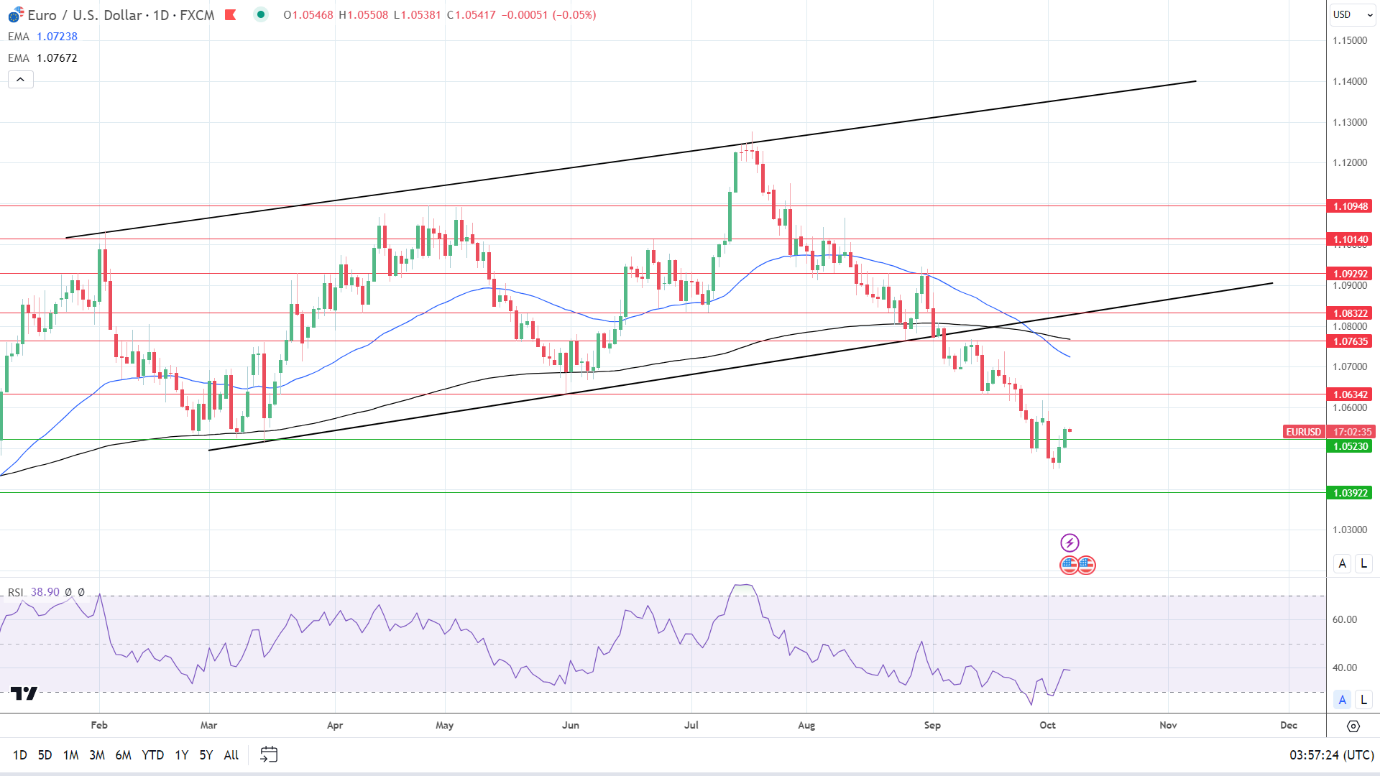
The EUR/USD remained below the 50-day and 200-day EMAs, reaffirming bearish price signals.
A EUR/USD break below the $1.05230 support level would give the bears a run at the current week’s low of $1.04482. A better-than-expected US Jobs Report would likely contribute to a EUR/USD sell-off.
However, weaker-than-forecast numbers and dovish Fed comments would support a EUR/USD move to the $1.06342 resistance level.
The 14-period Daily RSI at 38.98 suggests a EUR/USD break below the $1.05230 support level before entering oversold territory.
4-Hour Chart
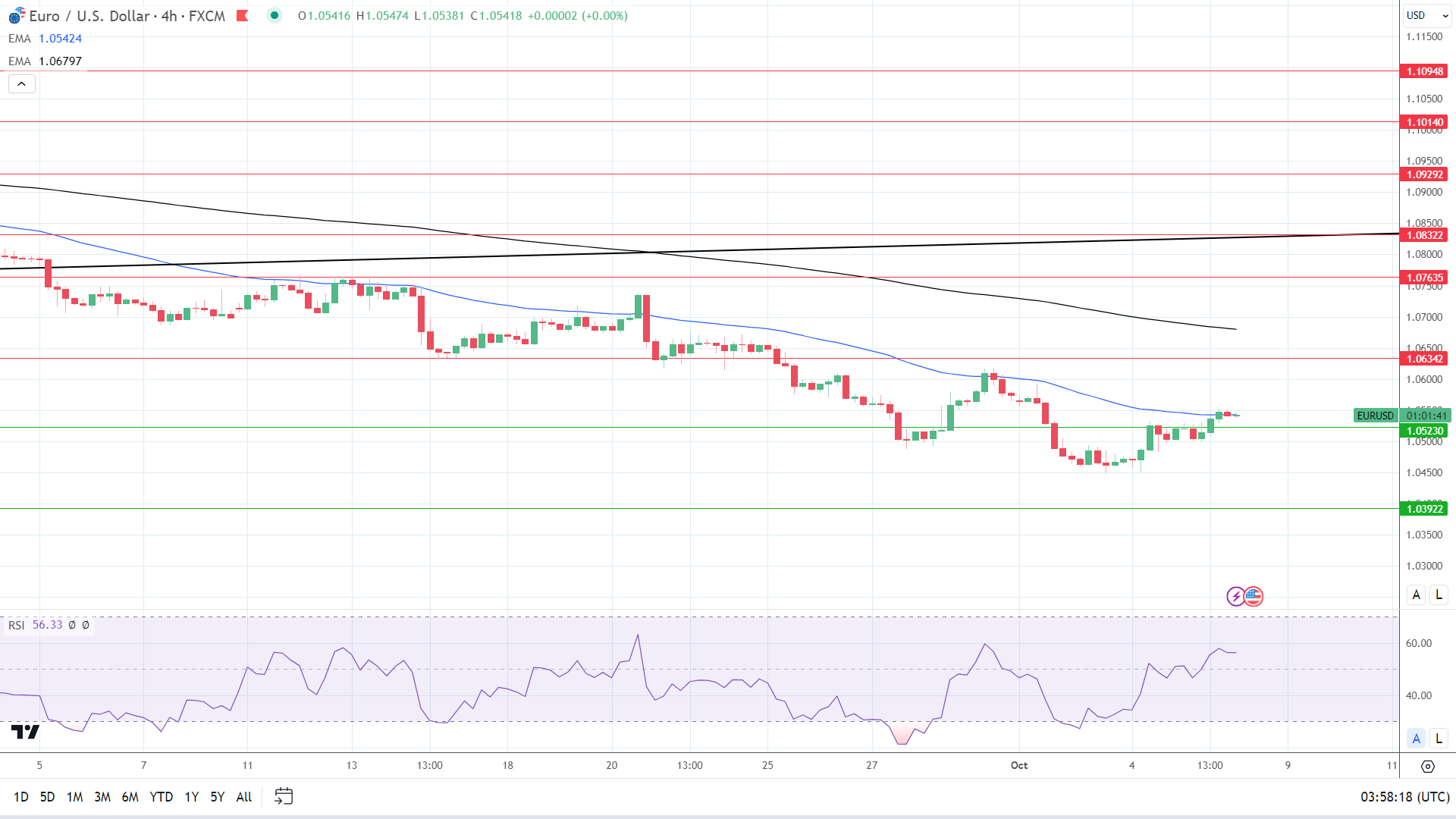
The EUR/USD hovers below the 50-day and 200-day EMAs, reaffirming the bearish price signals. A EUR/USD move through the 50-day EMA would give the bulls a run at the $1.06342 resistance level.
However, a EUR/USD break below the $1.05230 support level would bring the $1.03922 support level into view.
The 14-period 4-Hourly RSI at 56.31 suggests a EUR/USD return to $1.06 before entering overbought territory.
 Chat now!
Add a Comment