

Current Oil Market Dynamics Amid Middle East Tensions
Global benchmark Brent crude futures experienced a 4.1% surge in early Asian trade on Monday, touching a high of $88.15 per barrel, rebounding from last week’s close of $84.58. Despite this sharp rise, Brent remains below its recent one-year high of $97.69, recorded on September 28.
Meanwhile, at 05:01 GMT, November WTI crude oil is trading $85.86, up $3.07 or +3.71%. This is down from an intraday high of $87.24.
Trading Derivatives carries a high level of risk to your capital and you should only trade with money you can afford to lose. Trading Derivatives may not be suitable for all investors, so please ensure that you fully understand the risks involved, and seek independent advice if necessary. A Product Disclosure Statement (PDS) can be obtained either from this website or on request from our offices and should be considered before entering into a transaction with us. Raw Spread accounts offer spreads from 0.0 pips with a commission charge of USD $3.50 per 100k traded. Standard account offer spreads from 1 pips with no additional commission charges. Spreads on CFD indices start at 0.4 points. The information on this site is not directed at residents in any country or jurisdiction where such distribution or use would be contrary to local law or regulation.
The current upswing in prices comes in the wake of a massive attack launched by Hamas on Israel over the weekend.
Immediate Market Reaction and Underlying Factors
Initially, traders seemed to react to the increased geopolitical tensions, as Hamas militants from their Gaza stronghold targeted southern Israel. However, the price hike is moderate compared to the gravity of the situation. This suggests that market participants currently view the conflict as holding limited potential to disrupt global oil supplies in the short term.
Statements from OPEC and Middle East Producers
Adding another layer of complexity, oil ministers from Bahrain, Iraq, Kuwait, Oman, Saudi Arabia, and the United Arab Emirates met on the sidelines of the U.N. MENA climate week event in Riyadh. They reaffirmed their commitment to “collective and individual voluntary adjustments” in oil production. OPEC+ made no changes to its output policy and will keep existing supply cuts in place until 2024.
Economic Indicators and Their Impact
For the broader economic context, U.S. job growth surged by 336,000 in September, vastly outpacing economists’ expectations. While a strong U.S. economy may support near-term oil demand, the robust job numbers also strengthen the U.S. dollar and fuel speculation of another Federal Reserve rate hike in 2023, potentially dampening global demand for oil.
Short-Term Market Forecast
Considering these multifaceted influences, crude’s current pricing suggests that the market is carefully balancing geopolitical risks with economic fundamentals. Should the situation in the Middle East escalate further, with a particular focus on any involvement from Iran, we could see substantial volatility in oil prices. For now, heightened risks and market uncertainty appear to be bullish for oil in the near term.
Broader Geopolitical Implications
The recent attacks threaten to upend the delicate balance of power in the Middle East, potentially impacting everything from U.S.-brokered defense deals to Iranian oil exports. Any continuation of the conflict will also likely pause ongoing efforts to normalize relations across Middle Eastern countries. Given the current geopolitical landscape, an extended conflict could trigger wider implications, adding further upward pressure on oil prices.
By encapsulating the complex dynamics of the current oil market, traders and investors alike should be prepared for increased volatility in the short to medium term.
Technical Analysis
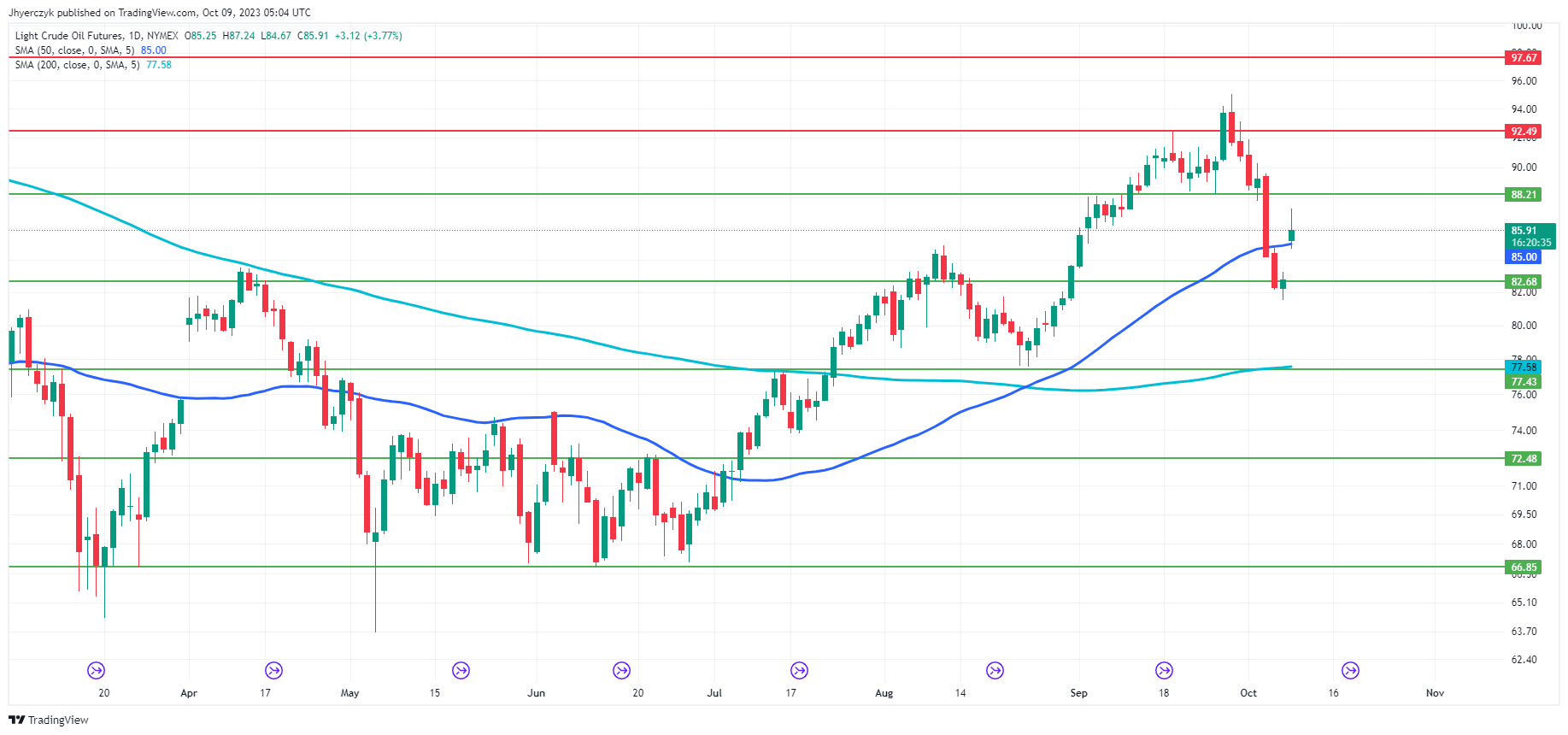
The commodity is trading above its main support at $82.68, but still below the minor resistance at $92.49, making it a critical juncture for traders watching for a breakout or a pullback.
Based on these indicators and given the commodity’s position relative to the moving averages and key support and resistance levels, the market sentiment appears to be bullish.
 Chat now!
Add a Comment