

Geopolitical Factors at Play
After a slump of more than 3% in Monday’s session, oil prices regained some ground in Asian markets on Tuesday. December Brent crude futures rose 36 cents to $87.81 a barrel, while January contracts edged up 29 cents to $86.64. U.S. West Texas Intermediate (WTI) for December followed suit, increasing 34 cents to $82.65 a barrel. These gains were primarily driven by mounting concerns over supply, as the geopolitical unrest in the Middle East, particularly Israel’s escalated attacks on Gaza, stoked fears.
Federal Reserve and Market Sentiment
Investor caution prevails as the market awaits the outcome of Wednesday’s U.S. Federal Reserve meeting. Previous losses were largely influenced by investor sentiments leaning towards a bearish outlook before the central bank’s decisions. This is noteworthy as the oil market usually responds dramatically to Federal Reserve policy shifts, given their direct impact on domestic fuel demand.
Trading Derivatives carries a high level of risk to your capital and you should only trade with money you can afford to lose. Trading Derivatives may not be suitable for all investors, so please ensure that you fully understand the risks involved, and seek independent advice if necessary. A Product Disclosure Statement (PDS) can be obtained either from this website or on request from our offices and should be considered before entering into a transaction with us. Raw Spread accounts offer spreads from 0.0 pips with a commission charge of USD $3.50 per 100k traded. Standard account offer spreads from 1 pips with no additional commission charges. Spreads on CFD indices start at 0.4 points. The information on this site is not directed at residents in any country or jurisdiction where such distribution or use would be contrary to local law or regulation.
Supply Risks and Global Outlook
ING analysts have pointed out that disruptions to Iranian oil flows are a considerable risk, especially if tensions escalate into a full-scale invasion involving Iran. This could lead to a lost supply ranging between 500,000 and 1 million barrels per day if the U.S. decides to enforce sanctions rigorously. Similarly, uncertainty over Venezuela’s elections and the possibility of the U.S. revoking its recent sanctions relief contribute to the precariousness of the supply chain.
China’s Economic Slowdown
In contrast to geopolitical factors, weaker-than-expected economic indicators from China have ignited concerns over slowing demand from the world’s second-largest oil consumer. The official purchasing managers’ index fell below the 50-point threshold, indicating contraction rather than expansion. This could potentially impact oil prices negatively, as China is a significant player in global oil demand.
Short-Term Forecast: Mixed Outlook
Portfolio investors seem to have resumed offloading petroleum assets, according to John Kemp at Reuters, shifting from Middle East conflict fears to concerns over rising interest rates affecting the global economy. In summary, the outlook remains mixed. While supply constraints arising from geopolitical tensions provide bullish signals, slowdown signs from China and uncertainties surrounding Federal Reserve decisions contribute to a bearish undercurrent.
Technical Analysis
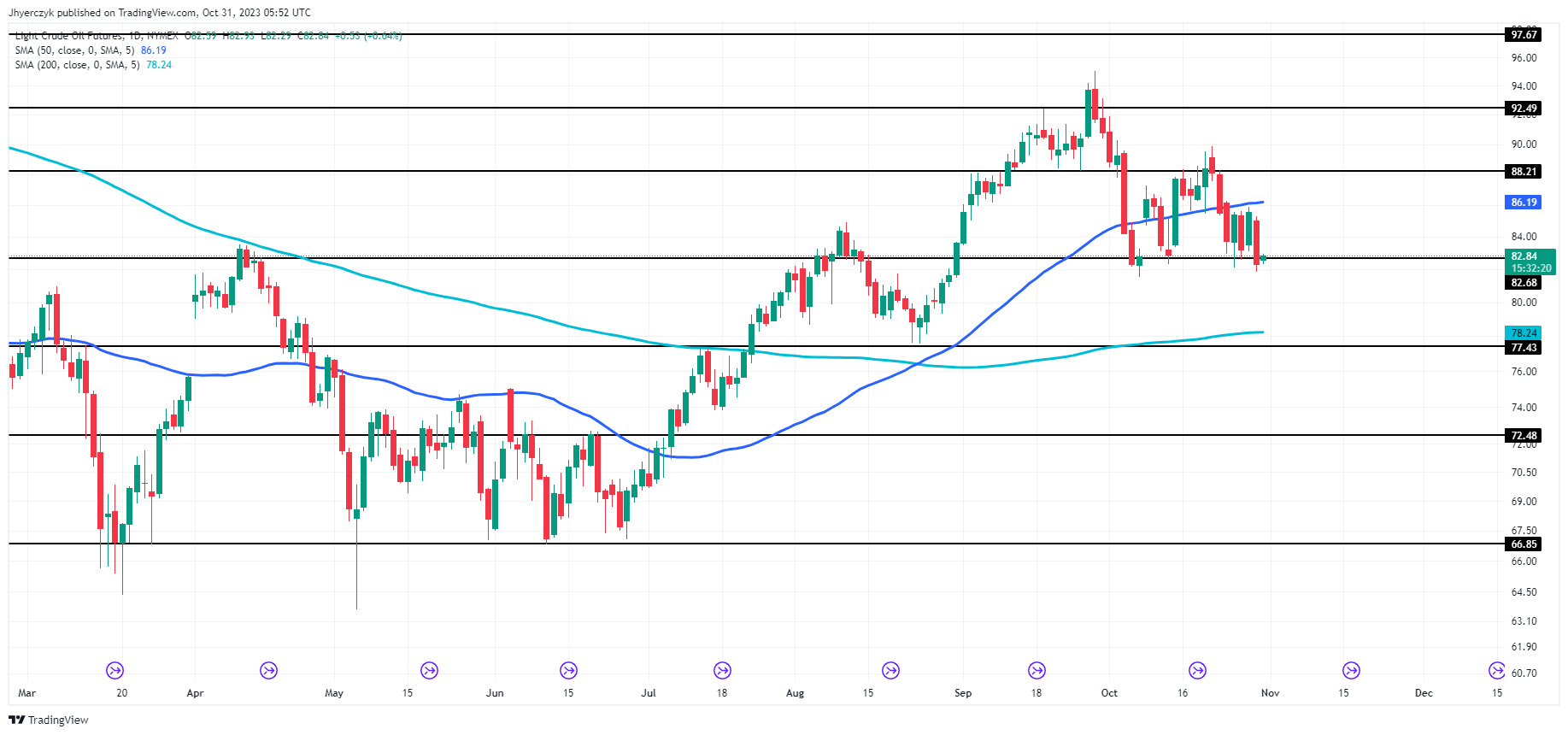
The asset is trading above its 200-day moving average of $78.24, indicating a longer-term bullish trend, but below the 50-day moving average of $86.19, which could signal short-term weakness.
Overall, the market sentiment appears cautiously bullish, with the asset finding some footing above key support levels but facing headwinds from the short-term moving average.
The latest price action suggests sellers are in control with the 200-day moving average at $78.24 the next likely target.
 Chat now!
Add a Comment