

Rebounding Oil Prices
International benchmark Brent and U.S. benchmark WTI crude oil futures are showing signs of recovery on Thursday, attempting to rebound from the week’s significant losses. At 06:20 GMT, February Brent futures traded at $74.55, up by 0.34%, while January WTI futures were at $69.62, marking a 0.35% increase. This recovery follows a dip to a six-month low in the previous session, indicating a volatile market.
Inventory Shifts and Production Changes
The latest EIA report highlights a notable decrease in U.S. crude oil stockpiles, marking the first production drop since July. Contrasting with the decline in crude inventories, which fell by 4.6 million barrels, gasoline and distillate inventories rose. This increase, particularly the 5.4 million barrel surge in gasoline stocks, suggests heightened refiner output.
Trading Derivatives carries a high level of risk to your capital and you should only trade with money you can afford to lose. Trading Derivatives may not be suitable for all investors, so please ensure that you fully understand the risks involved, and seek independent advice if necessary. A Product Disclosure Statement (PDS) can be obtained either from this website or on request from our offices and should be considered before entering into a transaction with us. Raw Spread accounts offer spreads from 0.0 pips with a commission charge of USD $3.50 per 100k traded. Standard account offer spreads from 1 pips with no additional commission charges. Spreads on CFD indices start at 0.4 points. The information on this site is not directed at residents in any country or jurisdiction where such distribution or use would be contrary to local law or regulation.
OPEC+ and Global Supply Concerns
Oil prices have experienced a roughly 10% decline since OPEC+ announced voluntary output cuts of 2.2 million barrels per day. OPEC’s production in November also fell, driven by reduced shipments from Nigeria and Iraq, alongside sustained cuts by Saudi Arabia and others. High-level discussions between Russian and Saudi leaders further indicate ongoing efforts to stabilize oil prices.
China’s Influence on the Market
China’s market activities significantly impacted global oil dynamics. November saw China’s crude oil imports falling to a four-month low, driven by high inventory levels and weakening economic indicators. Moody’s recent downgrade warnings for several Chinese state-owned entities reflect broader economic concerns, influencing the global demand outlook.
Short-Term Market Outlook
Considering these factors, the short-term outlook for the oil market appears bearish. The contango market structure for Brent and WTI suggests less immediate concern about supply shortages. Additionally, the increase in U.S. gasoline inventories and China’s reduced oil import demand contribute to a cautious market sentiment, potentially leading to further price fluctuations.
Technical Analysis
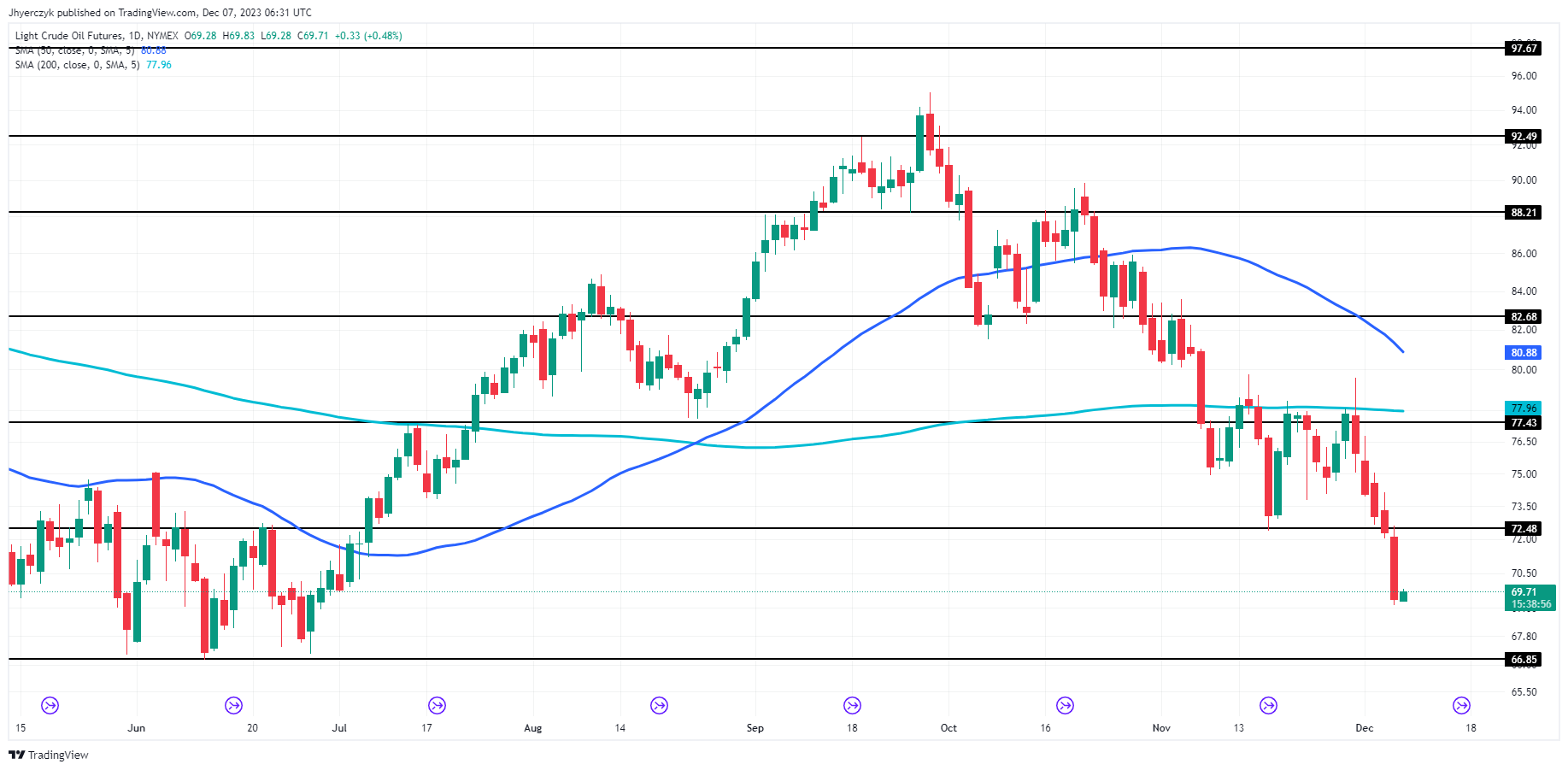
The current price is positioned between the minor support level of $66.85 and the minor resistance level of $72.48.
Considering these factors, the current market sentiment leans towards bearish, but with a possibility of short-term bullish movements if the price breaches the minor resistance level of $72.48. However, the current downside momentum suggests the most likely near-term target is $66.85.
 Chat now!
Add a Comment