

Oil Prices See Modest Rise Ahead of Key U.S. Jobs Report
International benchmark Brent crude and U.S. benchmark West Texas Intermediate (WTI) crude oil are edging higher early Friday. This cautious rise comes as traders await the U.S. Non-Farm Payrolls report, a potential influencer for the Federal Reserve’s upcoming policy meeting. Despite some recovery fueled by calls from Saudi Arabia and Russia for OPEC+ members to join output cuts, oil benchmarks are still on course for a seventh consecutive weekly decline.
Market Dynamics and OPEC+ Intervention
Both Brent and WTI crude futures have experienced their steepest weekly losses in five weeks, with current trading showing Brent at $75.65 and WTI at $70.75. The decline to their lowest levels since late June reflects market concerns about oversupply. This bearish sentiment is further underscored by the market’s contango structure, with front-month prices trading lower than those in future months. Some short sellers are covering their positions, viewing the market as oversold, leading to a slight rebound.
Trading Derivatives carries a high level of risk to your capital and you should only trade with money you can afford to lose. Trading Derivatives may not be suitable for all investors, so please ensure that you fully understand the risks involved, and seek independent advice if necessary. A Product Disclosure Statement (PDS) can be obtained either from this website or on request from our offices and should be considered before entering into a transaction with us. Raw Spread accounts offer spreads from 0.0 pips with a commission charge of USD $3.50 per 100k traded. Standard account offer spreads from 1 pips with no additional commission charges. Spreads on CFD indices start at 0.4 points. The information on this site is not directed at residents in any country or jurisdiction where such distribution or use would be contrary to local law or regulation.
OPEC+’s Struggle for Solidarity Amid Global Supply Concerns
Saudi Arabia and Russia, leading figures in OPEC+, have urged for collective output cuts to stabilize the global economy. Despite OPEC+’s agreement on a 2.2 million barrels per day cut, actual production reduction is anticipated to be significantly lower. The lack of adherence to commitments among some OPEC+ members adds to the market’s uncertainties.
Global Demand Outlook: China and India
Concerns over China’s economic health continue to pressure the market, with Chinese crude oil imports showing a significant year-on-year decline in November. This reduction in demand is attributed to high inventory levels and weak economic signals. Similarly, India, another key oil consumer, witnessed a drop in fuel consumption in November, further contributing to the bearish sentiment.
Short-Term Forecast: Bearish Amid Supply Surplus and Demand Woes
In summary, the short-term outlook for the oil market remains bearish. The combination of a global supply surplus, weak demand from major consumers like China and India, and the uncertainty around OPEC+ commitments all contribute to this outlook. The forthcoming U.S. Non-Farm Payrolls report and its potential impact on the Federal Reserve’s decisions are key factors that traders will closely monitor in the coming days. Especially since these decisions could have an impact on the greenback and consequently on foreign demand for dollar-denominated oil.
Technical Analysis
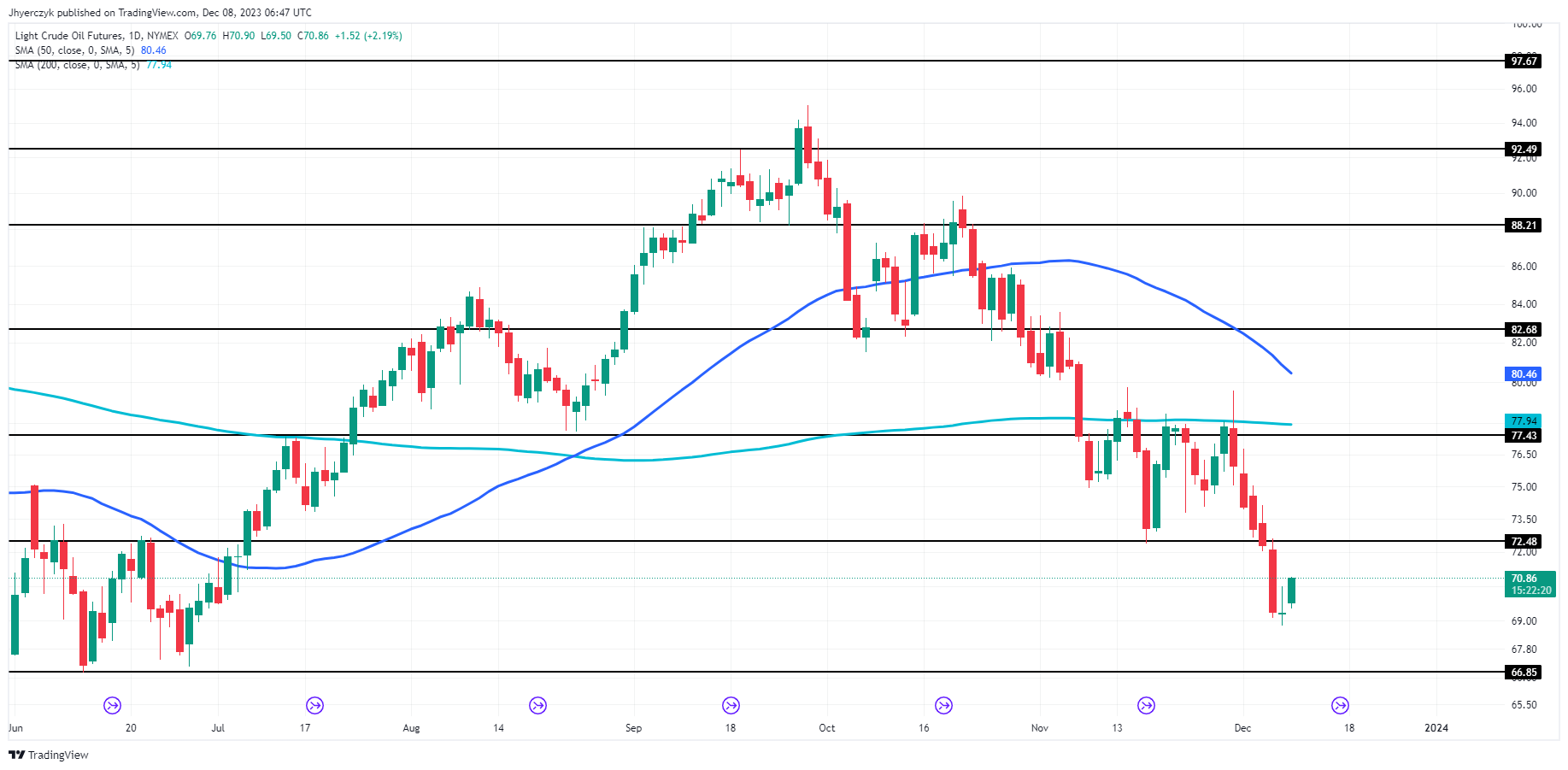
The current price is also situated between the minor support at 66.85 and minor resistance at 72.48. The proximity to the minor resistance level suggests a test of this threshold could be imminent. If the price breaks through this resistance, it could signal a shift towards a bullish sentiment.
However, until such a break occurs, the prevailing market sentiment for light crude oil futures remains bearish, influenced by its position relative to the moving averages and current resistance levels.
 Chat now!
Add a Comment