

Downward Dollar Gains Momentum, Testing the Monthly Low
The US dollar has been on a downward trajectory since early July, declining as nervousness in the job market surfaced via a rising unemployment rate. This, coupled with marginally lower inflation data has contributed to an overwhelming view that the Fed will look to September to get its rate cutting cycle underway, possibly using Jackson Hole as the platform to communicate such a preference.
Markets anticipate just under 100 basis points (bps) worth of rate cuts are likely to materialize before the end of the year which may be complicated by the US election in November. In an attempt to demonstrate the central bank’s independence, there is a risk that the Federal Open Market Committee (FOMC) may opt to keep rates unchanged in November, leaving just September and December as live meetings. Risk appetite continues to recover after the 5th of August volatility spike, warranting a closer look at major currency pairs and the Aussie dollar in particular.
Retail trader data indicates that 53.75% of traders hold net-long positions, with a long-to-short ratio of 1.16 to 1.
Daily Sentiment Change:
- Net-long traders: 2.65% increase
- Net-short traders: 4.65% increase
Weekly Sentiment Changes:
- Net-long traders: 31.03% decrease
- Net-short traders: 65.32% increase
Our analysis typically adopts a contrarian stance to crowd sentiment. The current net-long trader position suggests potential continued decline in AUD/USD prices. However, the reduction in net-long positions compared to yesterday and last week indicates a possible reversal of the current downward trend, despite the overall net-long trader stance.
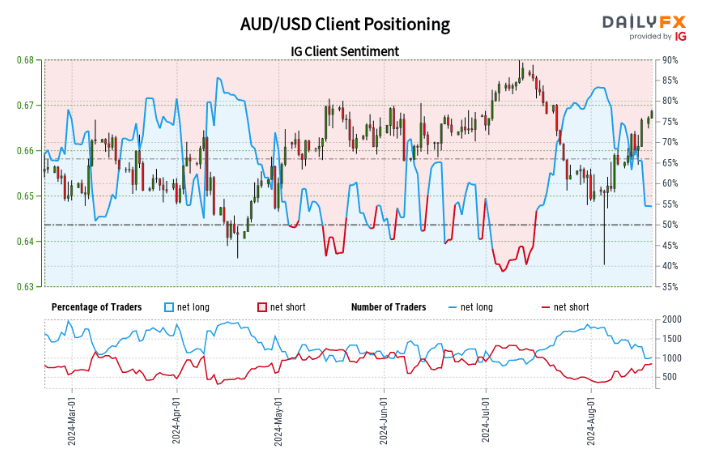
Retail trader data shows 29.24% of traders in net-long positions, with a short-to-long ratio of 2.42 to 1.
Daily Sentiment Change:
- Net-long traders: 2.91% increase
- Net-short traders: 0.09% increase
Weekly Sentiment Changes:
 Chat now!
Add a Comment