
EUR/USD stays near 1.0515 in Monday’s European session even though the preliminary Eurozone HCOB Purchasing Managers’ Index (PMI) data for December has come in better than forecasted. The PMI report showed that overall business activity improved to 49.5 from 48.3, suggesting that the private sector activity contracted at a slower pace. An improvement in the overall activity came from higher service sector output, which returned to the expansion territory after contracting in November. The Services PMI, which gauges activity in the services sector, surprisingly expanded to 51.4 from 49.5. Economists expected the Services PMI to have declined at a slightly faster pace to 49.4. The Manufacturing PMI contracted at a steady pace to 45.2, slower than estimates of 45.0. A figure below 50.0 is taken as a contraction in economic activities.
The German and French Composite PMIs have also come in better than expected, mainly due to a sharp improvement in the service sector activity. However, the Composite PMI remained below the 50.0 threshold, a figure that separates expansion from contraction.
The overall scenario supports more interest rate cuts from the European Central Bank (ECB) and weighs on the Euro (EUR).
The ECB cut its Deposit Facility rate by 25 basis points (bps) to 3% on Thursday, accumulating a total of 100 bps interest rate reductions this year. Given that Eurozone inflation has come under control and officials are worried about growing economic risks, market participants expect the ECB to deliver another 100 bps reduction in its key borrowing rates by June 2025.
A significant number of ECB policymakers, including President Christine Lagarde, have backed further policy easing and a gradual move towards the neutral rate, which they expect to be around 2%. “Will cut rates further if incoming data confirm that disinflation is on track”, Lagarde said at an Annual Economics Conference in Monday’s European session. Lagarde’s dovish remarks on the policy outlook were backed by the assumption that “Inflation momentum for services has dropped steeply recently.”
French central bank Governor Francois Villeroy de Galhau told France’s BFM business radio on Friday: “There will be further rate cuts next year.” When asked about interest rate projections, he said, “I note that we are collectively rather comfortable with the financial markets’ interest rate forecasts for next year.”
For more guidance on interest rates, ECB President Christine Lagarde will deliver a keynote speech and participate in a panel at the Bank of Lithuania’s event on European economic and political resilience.
On the political front, French President Emmanuel Macron appointed Francois Bayrou as the new prime minister on Friday. He replaced Michel Barnier, who lost a no-confidence vote because he failed to pass the budget, which included tax hikes worth 60 billion Euros to cut the fiscal deficit. Bayrou, who is expected to face similar challenges in his administration, is scheduled to meet leaders of the Far Right and left wing on Monday and Tuesday, respectively, according to Reuters.
Technical Analysis: EUR/USD stays above 1.0500
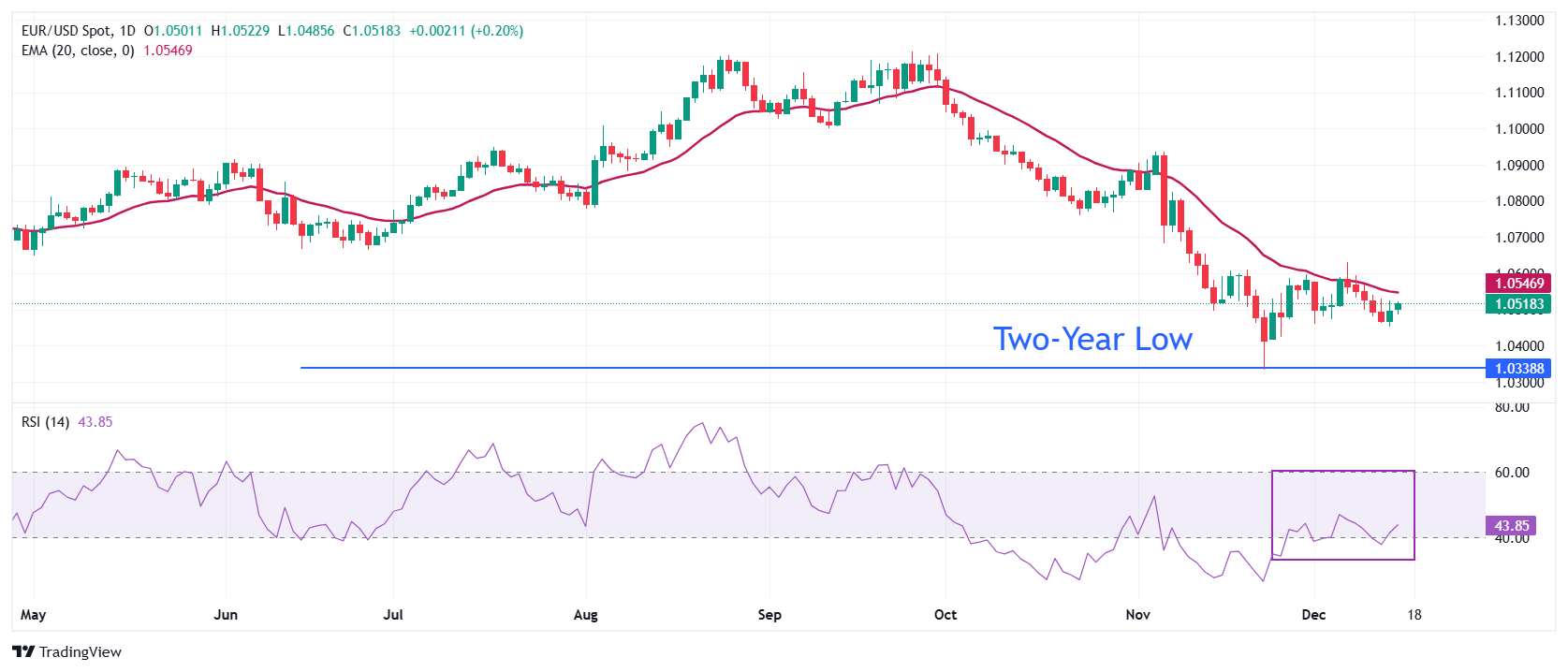
EUR/USD trades above the psychological figure of 1.0500 but continues to struggle around the three-day resistance near 1.0535. The major currency pair remains below the 20-day Exponential Moving Average (EMA) around 1.0545, suggesting a bearish near-term trend.
The 14-day Relative Strength Index (RSI) revolves around 40.00. The bearish momentum should trigger if the RSI (14) falls below 40.00.
Looking down, the two-year low of 1.0330 will provide key support. Conversely, the 20-day EMA will be the key barrier for the Euro bulls.
 Chat now!
Add a Comment