

It was a busy Wednesday morning session on the Asian economic calendar. Economic data from Australia drew interest ahead of trade data from China.
The Australian economy expanded by 0.2% in Q1 versus a forecasted 0.8%. In Q4, the economy grew by 0.6%. Year-over-year, the economy grew by 2.3% versus a forecasted 2.7%. In Q4, the economy expanded by 2.6%, year-over-year.
According to the ABS,
- Household spending rose 0.2% in Q1, contributing just 0.1 percentage points to GDP.
- Significantly, the household savings ratio declined to 3.7%, the lowest since 2008, suggesting weaker consumer spending ahead.
- Net trade weighed on growth. While exports increased by 1.8%, imports rose by 3.2%, detracting 0.2 percentage points from GDP.
With the GDP numbers giving the RBA reason to hit the pause button on the monetary policy tightening cycle, economic indicators from China also disappointed.
China’s USD trade surplus narrowed from $90.21 billion to $65.81 billion in May versus a forecasted $71.60 billion. Significantly, exports tumbled by 7.5% year-over-year, with imports down by 4.5%. Economists forecast exports to rise by 8.0% and imports to fall by 8.0%.
The latest trade data from China followed the private sector PMI numbers for May that sent mixed signals. Considering the slump in exports and the latest manufacturing sector PMIs, investors will hope for the Chinese government to kickstart the economy. Stimulus news would be a boon for riskier assets and the AUD/USD and NZD/USD.
AUD/USD Reaction to China Trade Data
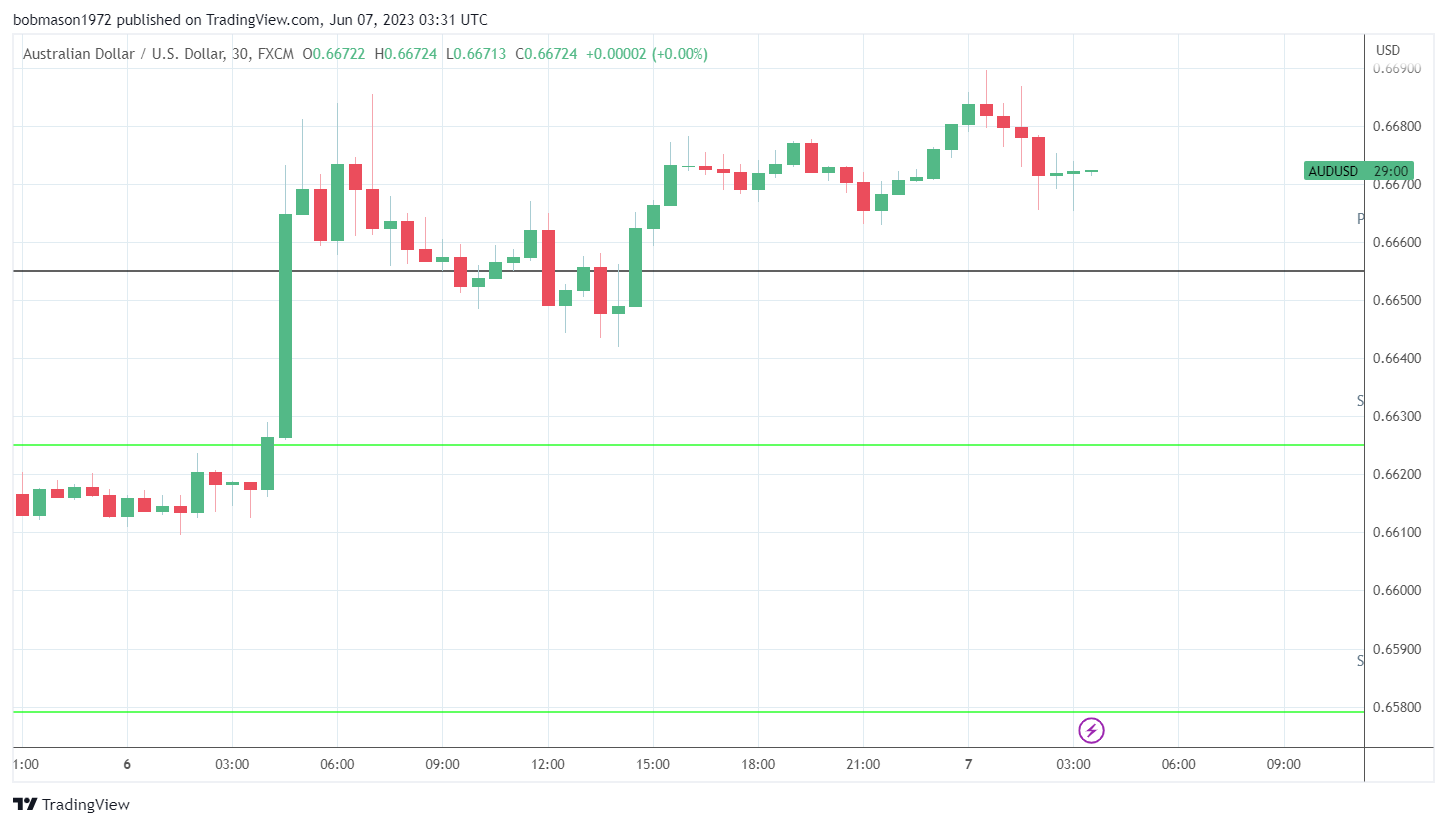
Before the GDP and trade figures, the AUD/USD fell to an early low of $0.66630 before rising to a pre-stat high of $0.66897.
However, in response to the stats, the AUD/USD rose to a post-stat high of $0.66869 before falling to a low of $0.66653.
This morning, the AUD/USD was up 0.02% to $0.66724.
 Chat now!
Add a Comment