

EUR/USD trades cautiously near more than four-month low around 1.0700 in Monday’s European session. The major currency pair remains on tenterhooks as the election of Republican Donald Trump as US President has strengthened the US Dollar’s (USD) outlook in the long run. The US Dollar Index (DXY), which gauges Greenback’s value against six major currencies, edges higher to near 105.00.
Trump vowed to raise import tariffs and lower taxes in his election campaign, which would add to United States (US) inflationary pressures and boost debt levels. According to a November 6-7 Reuters poll, 62% of respondents – including 94% of Democrats and 34% of Republicans – said that Trump’s policies likely “will push the US national debt higher.”
Trump’s tax cut proposals could add $7.5 trillion to the nation’s debt over the next decade, according to the nonpartisan Committee for a Responsible Federal Budget.
This week, investors will pay close attention to speeches from a slew of Federal Reserve (Fed) officials to get fresh cues about the likely monetary policy action in December. According to the CME FedWatch tool, there is a 65% chance that the central bank will cut interest rates again by 25 basis points (bps) to 4.25%-4.50% in December. This would be the second quarter-to-a-percent interest rate cut by the Fed in a row, as it also reduced its key borrowing rates last week.
On the economic front, investors will focus on the US Consumer Price Index (CPI) data for October, which will be published on Thursday. The impact of the inflation data is expected to be nominal on the interest rate outlook as Fed officials are confident about the disinflation trend towards the bank’s target of 2%. However, a significant deviation from the consensus could impact the same.
Technical Analysis: EUR/USD remains lower near 1.0700
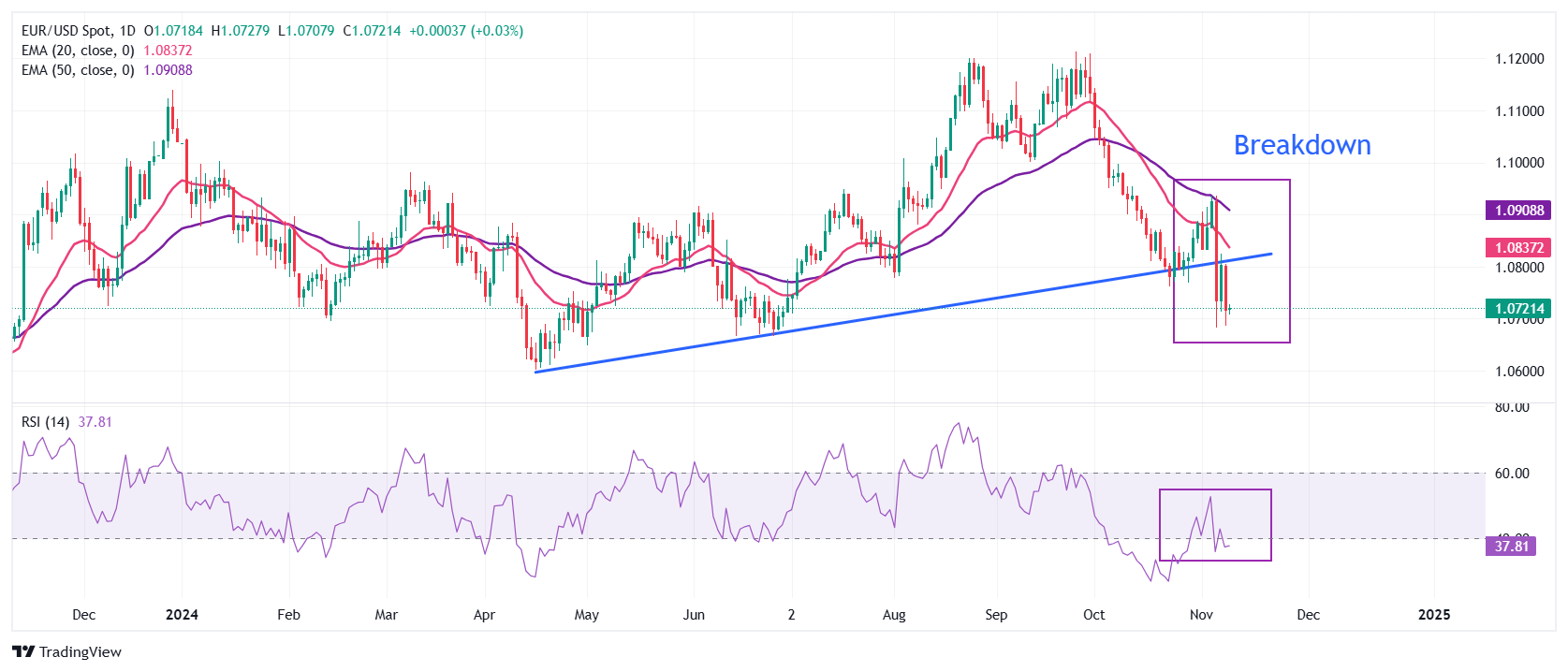
EUR/USD trades in a tight range near the more than four-month low around 1.0700. The near-term trend of the major currency pair remains bearish as the 20-day and 50-day Exponential Moving Averages (EMAs) near 1.0840 and 1.0910, respectively, continue to decline.
The 14-day Relative Strength Index (RSI) wobbles near 40.00. A bearish momentum would resume if the RSI (14) slides below that level.
The upward-sloping trendline around 1.0800, plotted from the April 16 low at around 1.0600, will act as a key resistance zone for Euro (EUR) bulls. Looking down, the shared currency pair could decline to the year-to-date (YTD) low of 1.0600.
 Chat now!
Add a Comment