

Friday Overview
The EUR/USD declined by 0.03% on Friday, ending the week down 0.70% to $1.08682. A bullish start to the Friday session saw the EUR/USD rise to an early high of $1.08938. However, risk aversion sent the EUR/USD to a midday low of $1.08448 before steadying.
People’s Bank of China Cuts Loan Prime Rates
China was in focus this morning. Investors will consider the latest PBoC move to support the ailing economy. The PBoC reduced the one-year loan prime rate (LPR) by 10 basis points. However, the PBoC left the five-year LPR unchanged.
Trading Derivatives carries a high level of risk to your capital and you should only trade with money you can afford to lose. Trading Derivatives may not be suitable for all investors, so please ensure that you fully understand the risks involved, and seek independent advice if necessary. A Product Disclosure Statement (PDS) can be obtained either from this website or on request from our offices and should be considered before entering into a transaction with us. Raw Spread accounts offer spreads from 0.0 pips with a commission charge of USD $3.50 per 100k traded. Standard account offer spreads from 1 pips with no additional commission charges. Spreads on CFD indices start at 0.4 points. The information on this site is not directed at residents in any country or jurisdiction where such distribution or use would be contrary to local law or regulation.
Economists expected the PBoC to reduce the one-year and five-year loan prime rates by 15 basis points each to 3.40% and 4.05%, respectively.
Beijing needs to deliver a substantial stimulus package to ease market jitters about the Chinese economy and contagion. Failure to convince the markets will likely pressure the EUR/USD over the nearer term.
German Producer Price Numbers a Litmus Test
It is a relatively quiet start to the week for the EUR/USD. However, German producer prices for July will provide direction. The current weak demand environment has weighed on producers, with intense competition to attract new orders sending producer prices south.
While falling producer prices ease consumer price inflationary pressures, falling prices reflect the macroeconomic environment and raise the threat of an extended recession. The combination would leave the ECB in a holding pattern, a bearish price scenario.
Economists forecast German producer prices to fall by 0.2% in July after a 0.3% decline in June. Significantly, economists expect producer prices to decrease by 5.1% year-over-year versus +0.1% in June. Numbers aligned with or worse than the year-on-year forecast would be bearish for the EUR/USD.
Hotter-than-expected numbers would signal a possible shift in demand and ease fears of a deep recession.
With inflation still the hot topic among central bankers, investors should track ECB chatter. However, no ECB Members are on the calendar to speak today, leaving commentary with the media to move the dial.
On Friday, ECB Chief Economist Philip Lane said the Eurozone should avoid a deep or sustained economic recession, lifting the EUR/USD from session lows. However, prelim private sector PMIs would need to send a similar message on Wednesday to signal the beginning of a recovery.
Quiet US Economic Calendar Puts the Jackson Hole Symposium in Focus
There are no US economic indicators to influence the afternoon. After hotter-than-expected US economic indicators from last week, Fed chatter will need consideration.
We expect EUR/USD sensitivity to Fed commentary as investors consider the Jackson Hole Symposium, which will draw interest on Thursday and Friday. With sentiment toward Fed monetary policy still hawkish, the dollar is at risk of a sharp pullback on dovish Fed comments. However, market risk sentiment will also provide direction.
Risk aversion and a flight to safety would drive demand for the dollar as a safe haven currency.
EUR/USD Price Action
Daily Chart
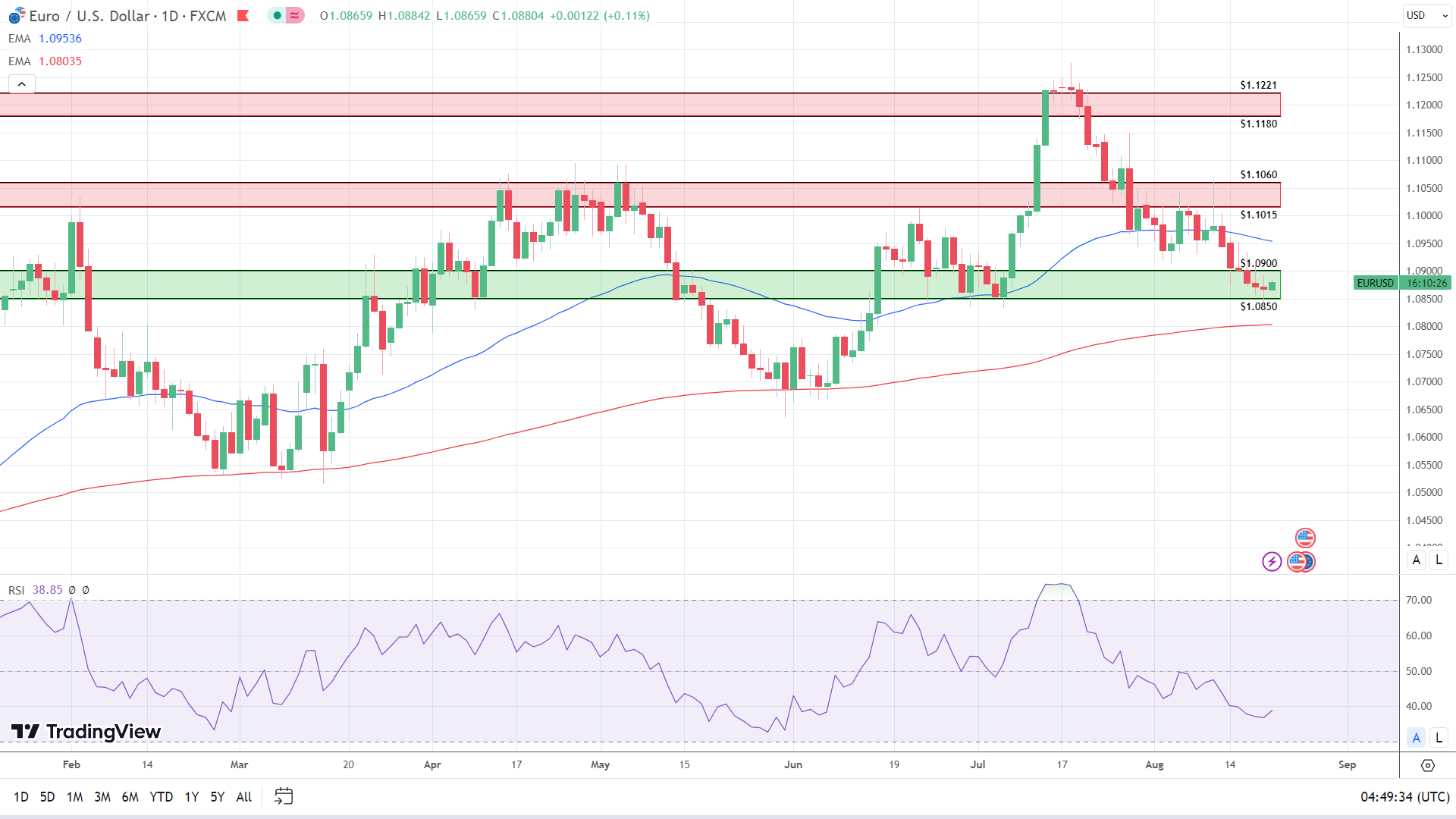
The Daily Chart showed the EUR/USD sitting above the lower level of the 1.0900 – $1.0850 support band. After six consecutive days in the red, the EUR/USD sat below the 50-day EMA while holding above the 200-day EMA, sending bearish near-term but bullish longer-term price signals.
Looking at the 14-Daily RSI, the 38.85 reading reflects bearish sentiment. The RSI aligns with the 50-day EMA, signaling a fall through the $1.0900 – 1.0850 support band to target the 200-day EMA and $1.08. However, a EUR/USD break out from the upper level of the $1.0850 – $1.0900 support band would bring the 50-day EMA into play.
4-Hourly Chart
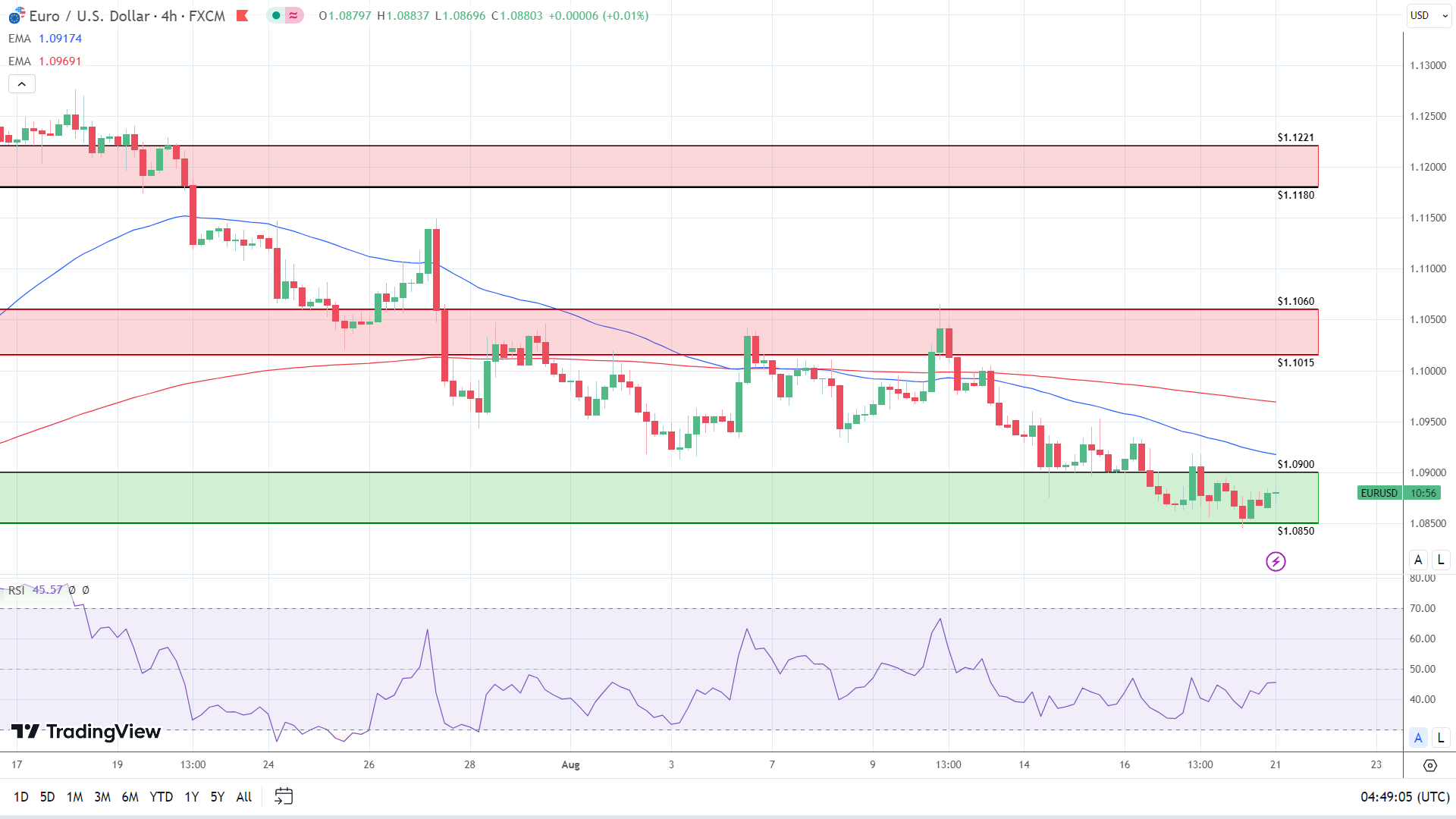
Looking at the 4-Hourly Chart, the EUR/USD sits within the $1.0900 – $1.0850 support band. After the August 7 bearish cross, the EUR/USD remains below the 50-day and 200-day EMAs, affirming bearish near and longer-term price signals.
The 14-4H RSI at 45.57 reflects bearish sentiment, with selling pressure outweighing buying pressure. Significantly, the RSI signals a fall through the $1.0900 – $1.0850 support band to target $1.08. However, a move through the upper level of the $1.0900 – $1.0850 support band would bring the 50-day EMA into play.
Price action today hinges on the German producer prices and central bank speeches.
 Chat now!
Add a Comment