
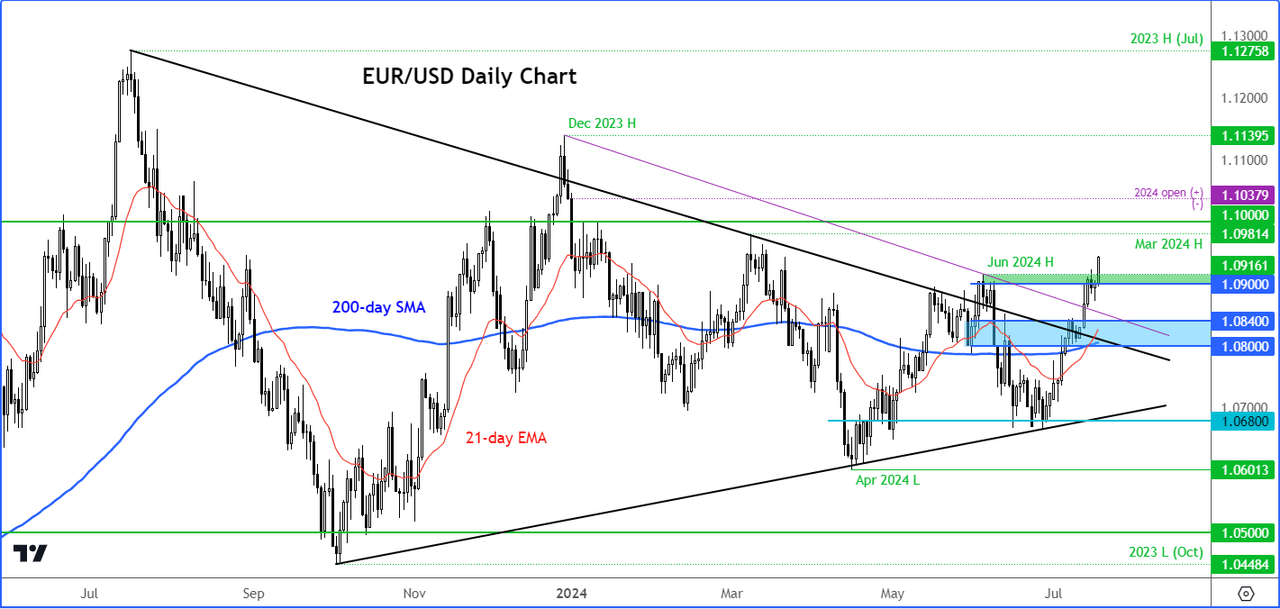
EUR/USD struggles to build on Wednesday’s gains and trades in a tight channel at around 1.0850 in the European session on Wednesday. Market participants await key inflation data releases from the Euro area and the US.
The Relative Strength Index (RSI) indicator on the 4-hour chart holds above 60, suggesting that the bullish bias remains intact. On the upside, the 200-day Simple Moving Average (SMA) aligns as a key resistance level at 1.0870. Once the pair flips that level into support, 1.0900 (round level) could act as interim resistance before 1.0940 (100-day SMA).
On the downside, first support could be seen at 1.0800 (round level) before 1.0750 (static level) and 1.0700 (round level, static level).
EUR/USD fluctuates in a tight channel at around 1.0850 after closing the third consecutive day in positive territory on Wednesday. The near-term technical outlook suggests that the bullish bias remains intact but buyers could hesitate to bet on an extended uptrend unless the pair manages to clear the key technical hurdle at 1.0870.
The Euro gathered strength against its rivals on Wednesday after the data from Germany showed that the Gross Domestic Product (GDP) expanded by 0.2% on a quarterly basis in the third quarter, coming in better than the market expectation for a 0.1% contraction. Additionally, annual inflation in Germany, as measured by the Consumer price Index (CPI) rose to 2% in October’s flash estimate from 1.6% in September, further boosting the Euro.
On the other hand, mixed macroeconomic data releases from the US made it difficult for the US Dollar (USD) to stay resilient against its rivals. The ADP Employment Change arrived at 233,000 for October to beat analysts’ estimate by a wide margin, while the first estimate of the annualized GDP growth for the third quarter came in at 2.8% and fell short of the market consensus of 3%.
Later in the day, the Harmonized Index of Consumer Prices (HICP) data from the Eurozone and the Personal Consumption Expenditures (PCE) Price Index figures from the US will be featured in the economic calendar. Investors are likely to ignore these readings. The US GDP report showed on Wednesday that the PCE Price Index rose 1.5% in Q3, down from 2.5% in Q2. Hence, the monthly PCE inflation reading for September is unlikely to trigger a reaction.
Toward the end of the European session, month-end flows could ramp up market volatility and cause major pairs to move irregularly.
 Chat now!
Add a Comment