
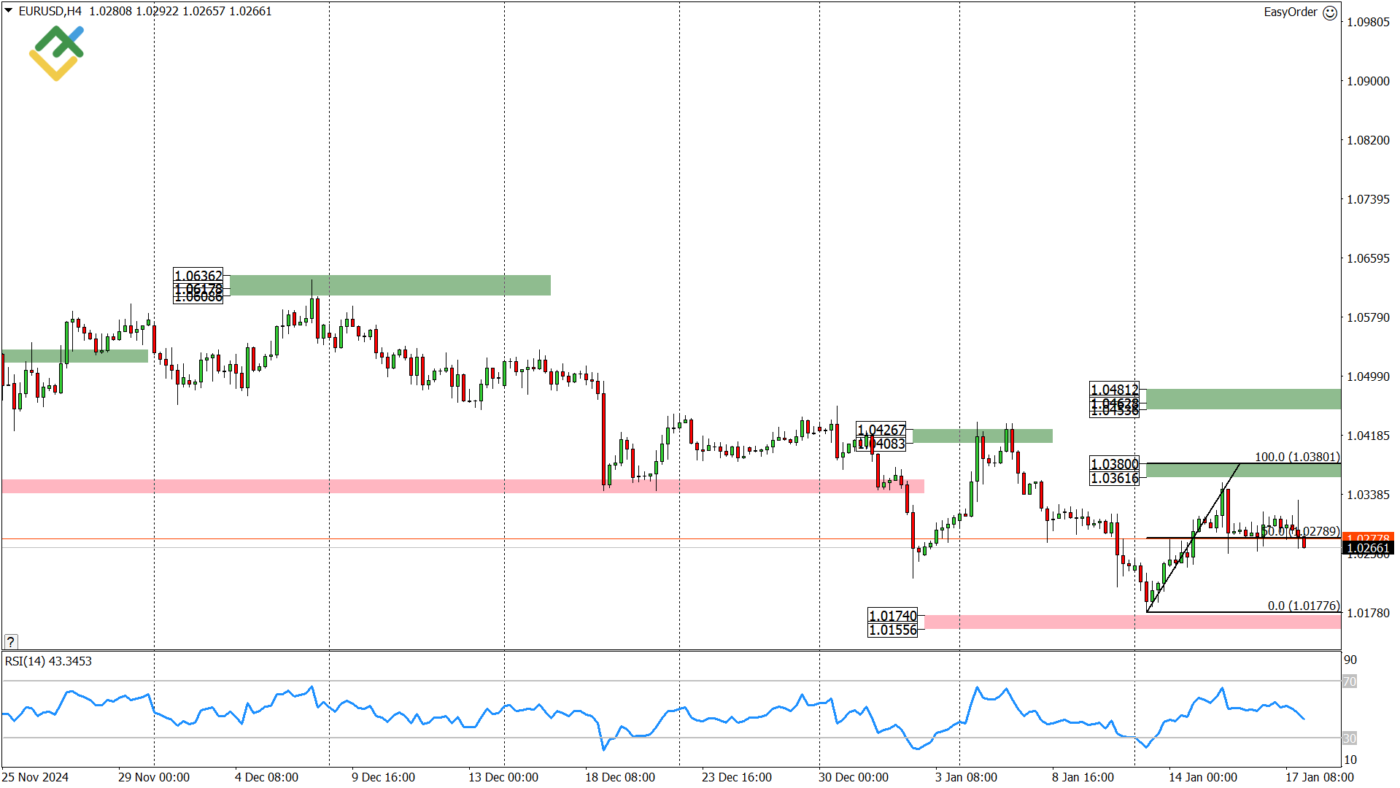
EUR/USD edges lower to near 1.0480 during the Asian session on Monday as the US Dollar Index, which measures the value of the US Dollar against its six major peers, recovers from its monthly low at 107.22, reached on Friday.
The Relative Strength Index (RSI) indicator on the 4-hour chart rises toward 70, suggesting that EUR/USD has more room on the upside before turning technically overbought in the near term.
On the upside, 1.0500-1.0510 (round level, Fibonacci 78.6% retracement of the latest uptrend) aligns as next resistance before 1.0540 (static level) and 1.0600 (beginning point of the downtrend).
In case EUR/USD retreats below 1.0440 (Fibonacci 61.8% retracement, 50-day SMA) and starts using this level as resistance, buyers could be discouraged. In this scenario, 1.0400-1.0390 (Fibonacci 50% retracement, 200-period SMA) and 1.0350 (Fibonacci 38.2% retracement) could be seen as next support levels.
Following Thursday’s indecisive action, EUR/USD gathered bullish momentum and touched its highest level since December 18 at 1.0470 in the early European session on Friday. Although the pair retreated to the 1.0450 area, the technical outlook suggests that the bullish bias remains intact.
In the early trading hours of the Asian session on Friday, US President Donald Trump said in an interview that he would rather not have to use tariffs on China. This comment allowed market mood to improve and made it difficult for the US Dollar (USD) to find demand.
While speaking at the World Economic Forum late Thursday, however, Trump said that he will do something about the trade deficit with the EU, adding that EU tariffs were making it very difficult for them to bring products into Europe. In case Trump hints at ramping up tariffs on European imports, the Euro could struggle to preserve its strength.
On Friday, preliminary January HCOB Manufacturing and Services PMI report for Germany and the Eurozone will be watched closely by market participants. The market reaction to these data is likely to be straightforward, with better-than-expected prints supporting the Euro and vice versa.
In the second half of the day, S&P Global PMI data will be featured in the US economic calendar. In case the Composite PMI unexpectedly drops below 50 and points to a contraction in the private sector’s economic activity, the USD could come under renewed selling pressure heading into the weekend.
 Chat now!
Add a Comment