

The Japanese Yen (JPY) struggles to capitalize on the previous day’s modest gains and oscillates in a narrow range against its American counterpart during the early European session on Friday. The near-term bias, meanwhile, seems tilted in favor of the JPY bulls amid the Bank of Japan’s (BoJ) more hawkish stance. In fact, the BoJ remains on track for more interest rate hikes, while other major central banks, including the US Federal Reserve (Fed), are seen lowering borrowing costs further.
Apart from this, the recent decline in the US Treasury bond yields and a slight deterioration in the global risk sentiment seem to underpin the safe-haven JPY. This, along with subdued US Dollar (USD) price action, keeps the USD/JPY pair on the defensive near the 150.00 psychological mark ahead of the US Nonfarm Payrolls (NFP) report. The crucial data could offer fresh cues about the Fed’s rate-cut path, which, in turn, will drive the USD and influence the currency pair in the near term.
USD/JPY needs to break below the 100-day SMA pivotal support for bears to seize control
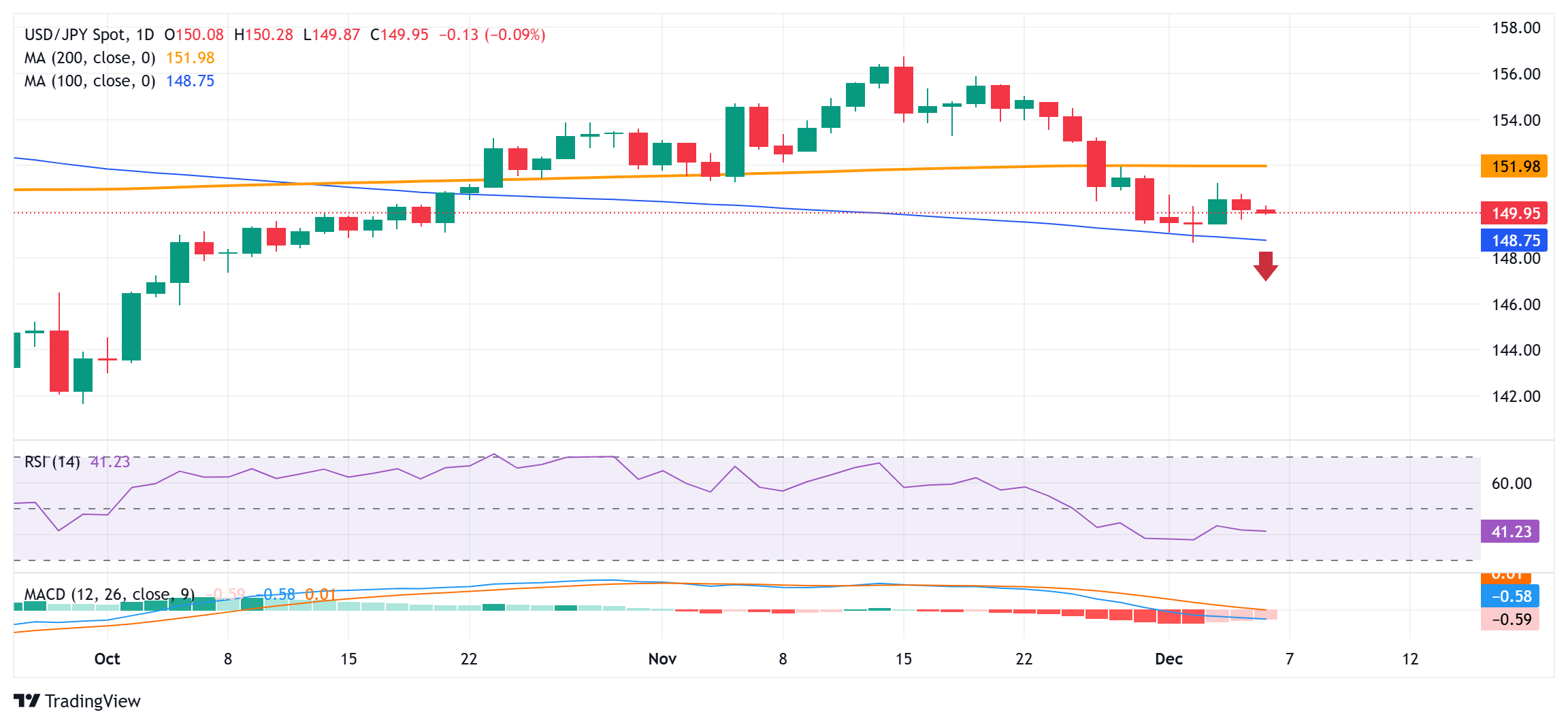
From a technical perspective, the overnight swing low, around the 148.65 region, now seems to protect the immediate downside ahead of the 149.00 mark and the 100-day SMA, currently around the 148.80 region. The latter should act as a key pivotal point, which if broken decisively will be seen as a fresh trigger for bearish traders. Given that oscillators on the daily chart are holding in negative territory, the USD/JPY pair might then slide to the 148.10-148.00 region en route to the 147.35-147.30 zone and the 147.00 round figure.
On the flip side, attempted recovery might now confront some resistance near the 150.55 region. This is followed by the 150.70 hurdle, the 151.00 round figure and the weekly high, around the 151.20-151.25 zone touched on Wednesday. A sustained move beyond the latter could lift the USD/JPY pair to the 152.00 mark, or the very important 200-day SMA. Some follow-through buying will suggest that the recent corrective decline from a multi-month high touched in November has run its course and shift the bias in favor of bullish traders.
 Chat now!
Add a Comment