

Wall Street Weighs Israel-Hamas Conflict Amid Market Uncertainties
U.S. stock futures were firm early Monday as Wall Street grappled with escalating geopolitical tensions in the Israel-Hamas conflict. Dow Jones, S&P 500, and Nasdaq futures all posted minor gains, with traders cautiously optimistic amid a tumultuous global backdrop.
As of 08:57 GMT, Dow Jones Industrial Average futures have ticked up to 33,870, a gain of 69 points or +0.20%. Meanwhile, S&P 500 Index futures are trading at 4,377.75, up 9 points or +0.21%, and Nasdaq 100 futures are positioned at 15,228.25, climbing 41.25 points or +0.27%.
Trading Derivatives carries a high level of risk to your capital and you should only trade with money you can afford to lose. Trading Derivatives may not be suitable for all investors, so please ensure that you fully understand the risks involved, and seek independent advice if necessary. A Product Disclosure Statement (PDS) can be obtained either from this website or on request from our offices and should be considered before entering into a transaction with us. Raw Spread accounts offer spreads from 0.0 pips with a commission charge of USD $3.50 per 100k traded. Standard account offer spreads from 1 pips with no additional commission charges. Spreads on CFD indices start at 0.4 points. The information on this site is not directed at residents in any country or jurisdiction where such distribution or use would be contrary to local law or regulation.
Market Rebounds and Geopolitical Influence
Initial market reactions on Monday were bearish, driven by the renewed hostilities in the Middle East. However, stocks rebounded later in the day. The Dow Jones surged by 197 points, or 0.6%, while both the S&P 500 and Nasdaq Composite also closed higher. This rebound came as a Hamas official signaled willingness for a truce and President Joe Biden announced efforts to mitigate further escalation. The oil market, a key indicator of geopolitical stress, also experienced a rally.
Impact on the Economy and Earnings
Amid the conflict, the market seems to be realigning its focus on domestic matters. John Augustine, Chief Investment Officer at Huntington National Bank, pointed out that the U.S. economy is stable, and upcoming earnings reports are anticipated to be strong. The geopolitical headlines, although unsettling, seem to be taking a back seat to more robust economic and corporate indicators.
Monetary Policy and Market Response
Fed officials’ latest comments hinting at a pause in rate hikes seemed to alleviate some concerns among investors. This dovish tone from the Federal Reserve, along with gains in long-term U.S. Treasury bonds, helped ease the pressures that had been mounting on equities. Consequently, Wall Street’s “fear gauge,” the CBOE volatility index, settled at a relatively low level of 17.70.
Short-Term Forecast: Cautiously Bullish
While the market is clearly influenced by the Israel-Hamas conflict and Federal Reserve policies, domestic factors like the U.S. economy and corporate earnings are expected to play a more significant role in the short term. Traders should remain cautiously bullish, keeping an eye on geopolitical developments and upcoming economic data.
By reorienting focus toward domestic indicators and Federal Reserve cues, the market seems to be adopting a cautiously optimistic stance. However, ongoing geopolitical tensions mean traders should stay alert to sudden shifts in sentiment.
Investors are poised to scrutinize forthcoming economic indicators. Slated for release this Tuesday are the NFIB Small Business Survey figures for September and wholesale inventory stats for August. Additionally, Wall Street is keenly awaiting PepsiCo’s quarterly earnings, expected to be announced before the opening bell on Tuesday.
Technical Analysis
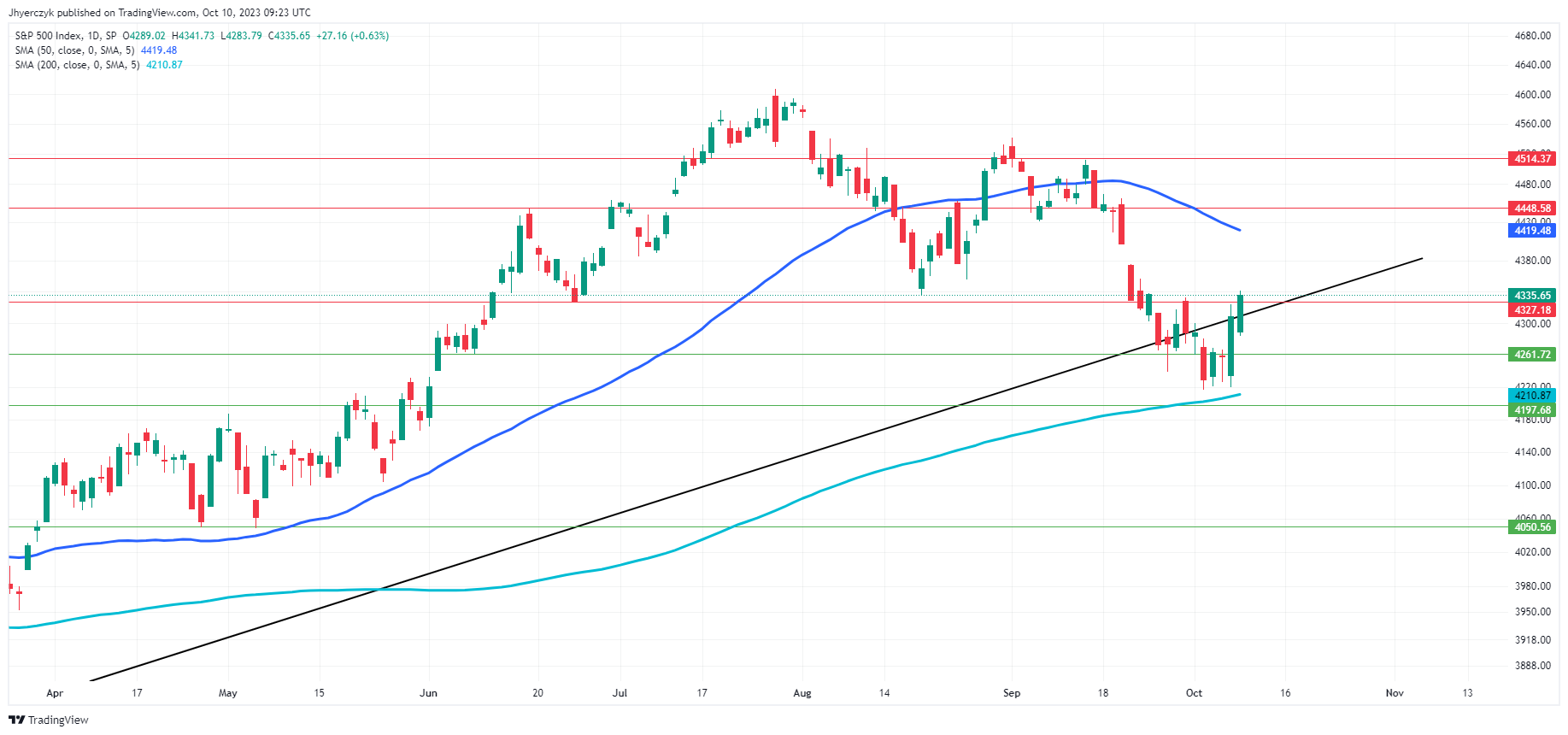
The index is also trading above its main and minor support levels and its trend line support, but hasn’t yet surpassed the minor and main resistance marks.
This suggests a mixed market sentiment: bullish for the long term due to its position over the 200-Day moving average, but short-term caution is advised as it’s below the 50-Day average.
 Chat now!
Add a Comment