

US Natural Gas Futures React to Mixed Signals
US natural gas futures are experiencing a setback on Tuesday, despite a strong upturn the previous day. Factors include varying weather projections, demand concerns, potential strikes in Australia, and fluctuations in US LNG consumption.
Weather and Demand Dynamics
The hot weather forecasted until early September, especially in Texas, fueled a 3% rise in U.S. natural gas futures on Monday. This heatwave sustains high air conditioning demand. Still, Refinitiv reports that even with temperatures remaining high, U.S. gas demand might drop in the coming weeks due to the seasonal shift. Meanwhile, NatGasWeather points out impressive heatwaves hitting the US interior, forecasting a cooler pattern for the last week of August.
Trading Derivatives carries a high level of risk to your capital and you should only trade with money you can afford to lose. Trading Derivatives may not be suitable for all investors, so please ensure that you fully understand the risks involved, and seek independent advice if necessary. A Product Disclosure Statement (PDS) can be obtained either from this website or on request from our offices and should be considered before entering into a transaction with us. Raw Spread accounts offer spreads from 0.0 pips with a commission charge of USD $3.50 per 100k traded. Standard account offer spreads from 1 pips with no additional commission charges. Spreads on CFD indices start at 0.4 points. The information on this site is not directed at residents in any country or jurisdiction where such distribution or use would be contrary to local law or regulation.
Supply Landscape
US gas output showed a slight dip in August from 101.8 billion cubic feet per day (bcfd) in July to 101.7 bcfd. Despite this, May saw a record monthly supply of 102.2 bcfd. However, gas flows to major U.S. LNG export plants decreased from 12.7 bcfd in July to 12.3 bcfd in August, largely due to reductions at Cheniere Energy’s facility in Louisiana.
Geopolitical Implications
Australia, the world’s leading LNG exporter, is amidst labor tensions. Workers at Woodside’s North West Shelf and Chevron’s projects threaten to strike over wage concerns. This possibility has spurred global LNG prices as any disruption in Australia’s supply would have a profound global impact. Woodside’s CEO, Meg O’Neill, underscores the company’s focus on understanding workers’ concerns while also emphasizing their responsibility to stakeholders.
Short-Term Forecast
The potential strike in Australia, alongside other bullish factors, could support an upward trend in natural gas futures. Mixed demand and varying weather forecasts introduce volatility, but supply disruptions, especially from a significant player like Australia, are likely to have a pronounced bullish effect on prices.
At this time, the focus seems to be on the mixed weather-demand outlook, but this could change quickly if a strike is announced.
Technical Analysis
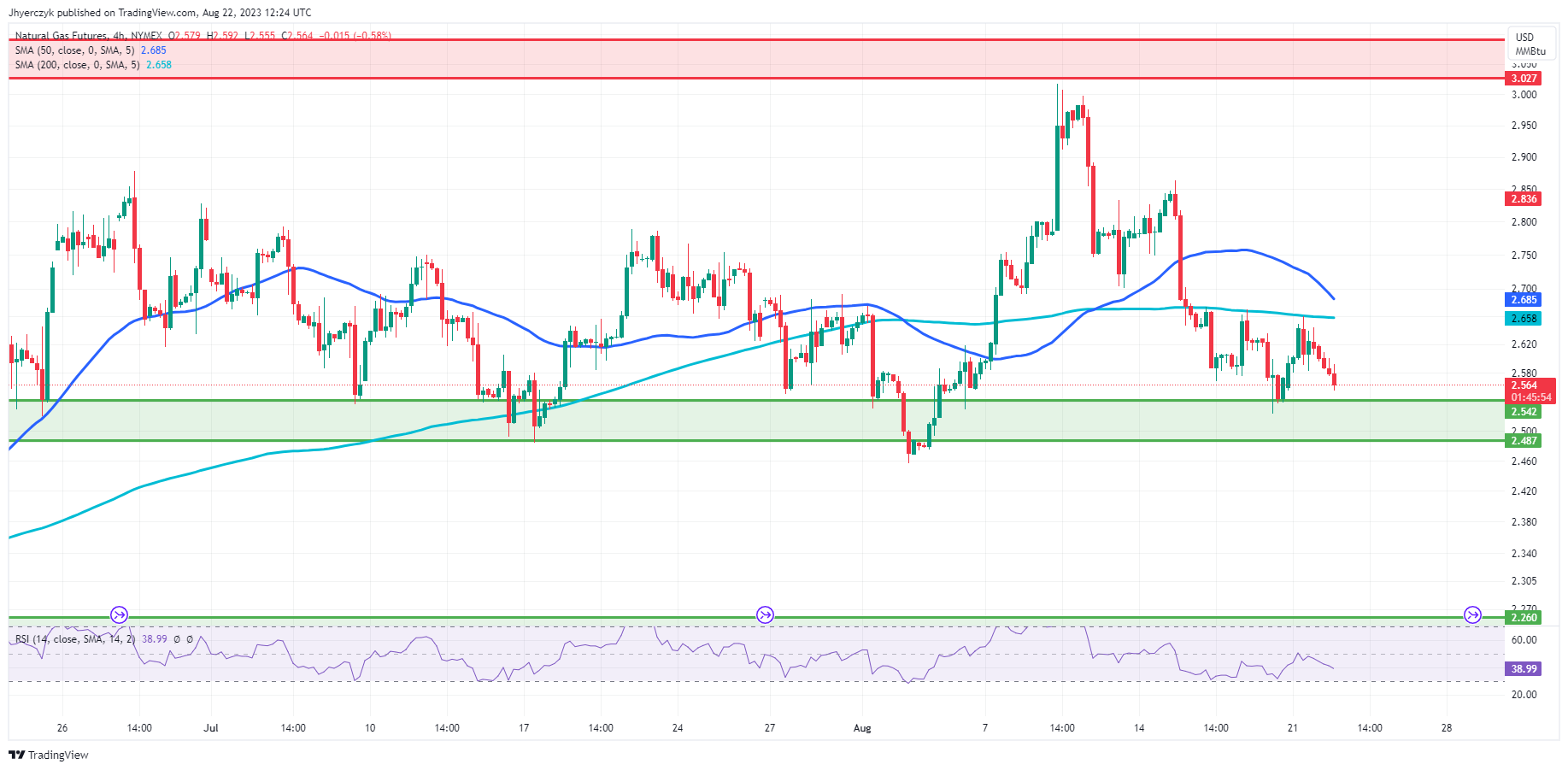
The current price is positioned closer to the main support area (2.542 to 2.487) rather than the main resistance zone (3.027 to 3.091), underlining the bearish sentiment in the market.
 Chat now!
Add a Comment