

Oil Prices Fluctuate Amid Geopolitical Tensions and Policy Shifts
Benchmarks WTI and Brent oil markets are in the midst of a rollercoaster week, with prices initially softening on Monday and Tuesday before surging on Wednesday. The mid-week rally was fueled by Iran’s call for an oil embargo against Israel and a greater-than-anticipated reduction in U.S. oil stockpiles. Nevertheless, prices retreated late Wednesday and into Thursday as OPEC dismissed Iran’s call for an embargo and the U.S. indicated plans to ease sanctions on Venezuela.
Supply Concerns
Last week’s heightened tensions between Iran and Israel sparked fears of supply disruption, buoying oil prices. Iran’s push for an embargo, however, didn’t find favor with OPEC, easing those concerns. On the other side of the globe, the U.S. reported a sharp draw in oil inventories, implying that supplies were tightening. The Energy Information Administration (EIA) showed that U.S. crude inventories fell by 4.5 million barrels, while distillate stockpiles dropped by 3.2 million barrels.
Trading Derivatives carries a high level of risk to your capital and you should only trade with money you can afford to lose. Trading Derivatives may not be suitable for all investors, so please ensure that you fully understand the risks involved, and seek independent advice if necessary. A Product Disclosure Statement (PDS) can be obtained either from this website or on request from our offices and should be considered before entering into a transaction with us. Raw Spread accounts offer spreads from 0.0 pips with a commission charge of USD $3.50 per 100k traded. Standard account offer spreads from 1 pips with no additional commission charges. Spreads on CFD indices start at 0.4 points. The information on this site is not directed at residents in any country or jurisdiction where such distribution or use would be contrary to local law or regulation.
Demand Outlook
While geopolitical tensions added upward pressure on prices, the market found little respite. The U.S.’s plan to ease sanctions on Venezuela, an OPEC member, could potentially increase global supply, balancing out some of the demand-pull. However, this depends on Venezuela attracting the investments it needs to ramp up production, which is far from certain given years of under-investment and deteriorated infrastructure.
U.S.-Venezuela Policy Shift
The U.S. issued a six-month license to authorize transactions in Venezuela’s energy sector, aiming to improve oil flows and counter high prices. The move is more expansive than expected, allowing global energy firms to work with state-run PDVSA without needing individual licenses. But experts caution that Venezuela’s exports won’t significantly offset global cuts without sustained investment.
Short-Term Forecast
Given the unresolved geopolitical tensions and the uncertain impact of U.S. policy changes on Venezuelan oil supply, the market remains volatile. Short-term, we’re looking at a neutral to bearish outlook as the various factors pulling the market in opposite directions seem likely to cancel each other out.
This high-stakes game of supply and demand leaves traders treading cautiously, making it all the more important to keep an eye on the evolving geopolitical landscape and policy shifts.
Technical Analysis
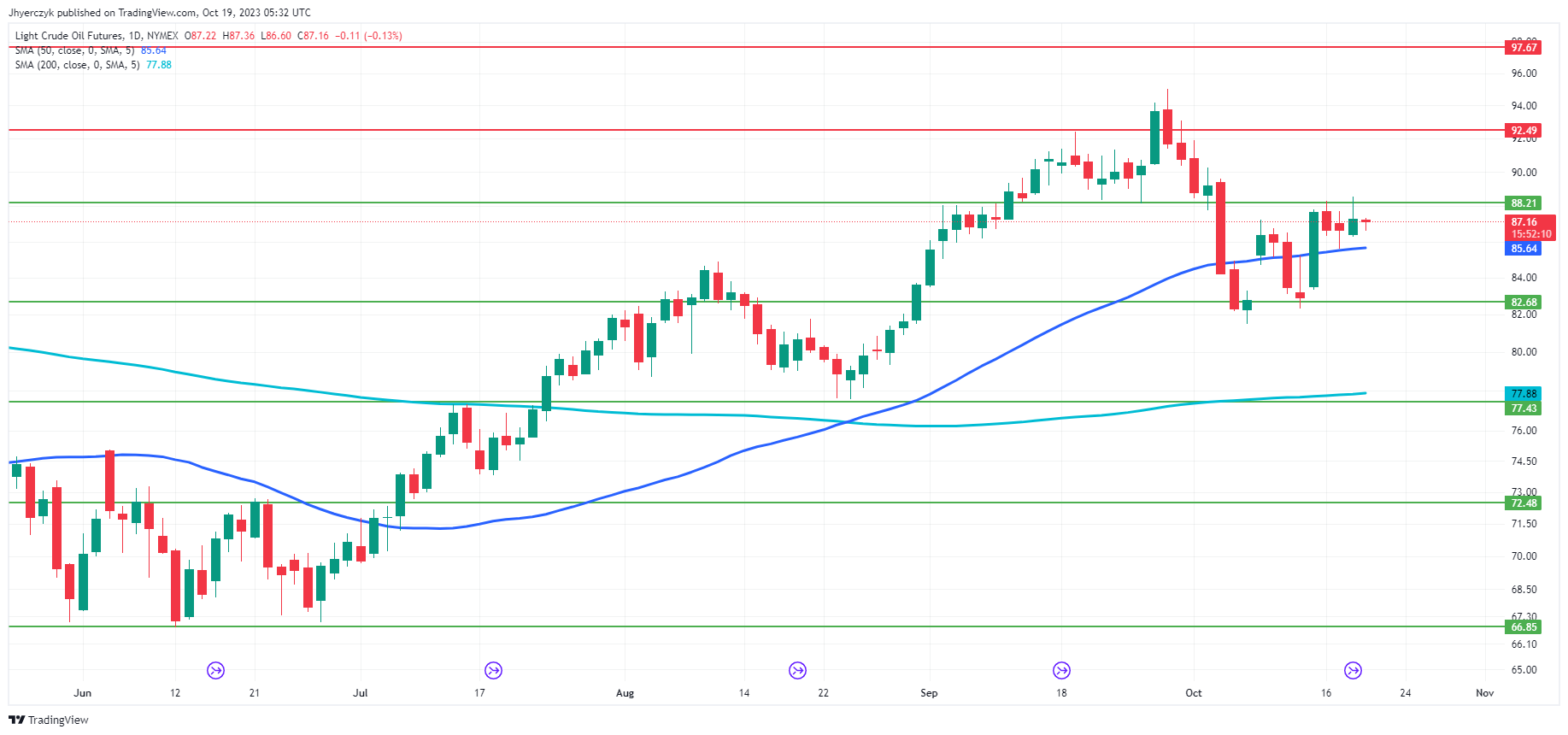
The current daily price of light crude oil futures at $87.14 is above both the 200-day and 50-day moving averages, at $77.88 and $85.64 respectively, signaling bullish momentum. However, the price is sandwiched between minor support at $82.68 and minor resistance at $92.49, suggesting a lack of decisive movement.
Main support and resistance levels stand at $77.43 and $97.67, which act as crucial barriers for significant trend reversals.
The market sentiment appears cautiously bullish, contingent on breaking the minor resistance to confirm the upward trend.
 Chat now!
Add a Comment