

Oil Prices Rebound Slightly Amid OPEC+ Decision to Hold Supply Cuts
Oil prices edged higher on Thursday, mitigating some of Wednesday’s steep declines. The rebound came after an OPEC+ ministerial panel decided to maintain existing output cuts, ensuring a tight supply. Brent crude was up 63 cents at $86.44 a barrel, while U.S. West Texas Intermediate (WTI) increased by 49 cents to $84.71.
Supply and Demand Tensions Keep Market on Edge
Wednesday saw oil prices plunge by over $5, rattled by an uncertain macroeconomic landscape and diminishing fuel demand. Despite the wobble, OPEC+—comprising OPEC countries and Russia-led allies—held its nerve, making no alterations to the group’s output policy. Saudi Arabia will continue its voluntary cut of 1 million barrels per day (bpd) through 2023, and Russia will maintain a 300,000 bpd export curb until year’s end.
Trading Derivatives carries a high level of risk to your capital and you should only trade with money you can afford to lose. Trading Derivatives may not be suitable for all investors, so please ensure that you fully understand the risks involved, and seek independent advice if necessary. A Product Disclosure Statement (PDS) can be obtained either from this website or on request from our offices and should be considered before entering into a transaction with us. Raw Spread accounts offer spreads from 0.0 pips with a commission charge of USD $3.50 per 100k traded. Standard account offer spreads from 1 pips with no additional commission charges. Spreads on CFD indices start at 0.4 points. The information on this site is not directed at residents in any country or jurisdiction where such distribution or use would be contrary to local law or regulation.
Demand Uncertainties Add to Market Jitters
Negative signals are coming from the demand side as well. A survey suggested that the euro zone economy likely contracted last quarter, with consumer demand in September falling at its fastest pace in nearly three years. In the U.S., the Energy Information Administration reported a sharp week-over-week decline in gasoline demand, plummeting to an 8-million bpd low for the year.
Mixed Signals for Oil Bulls
The recent three-month rally in oil prices had been fueled by tight supply and a resilient global economy. However, bulls are now facing some turbulence as previously favorable conditions appear less robust. This sentiment is exacerbated by Wednesday’s weaker U.S. economic data and a significant build in gasoline inventories.
Short-Term Forecast: Bearish
Given the increasing demand uncertainties and unaltered OPEC+ supply policies, the short-term outlook for oil prices leans bearish. While supply constraints are unlikely to ease, demand-side indicators point toward weaker consumption, putting downward pressure on prices.
Technical Analysis
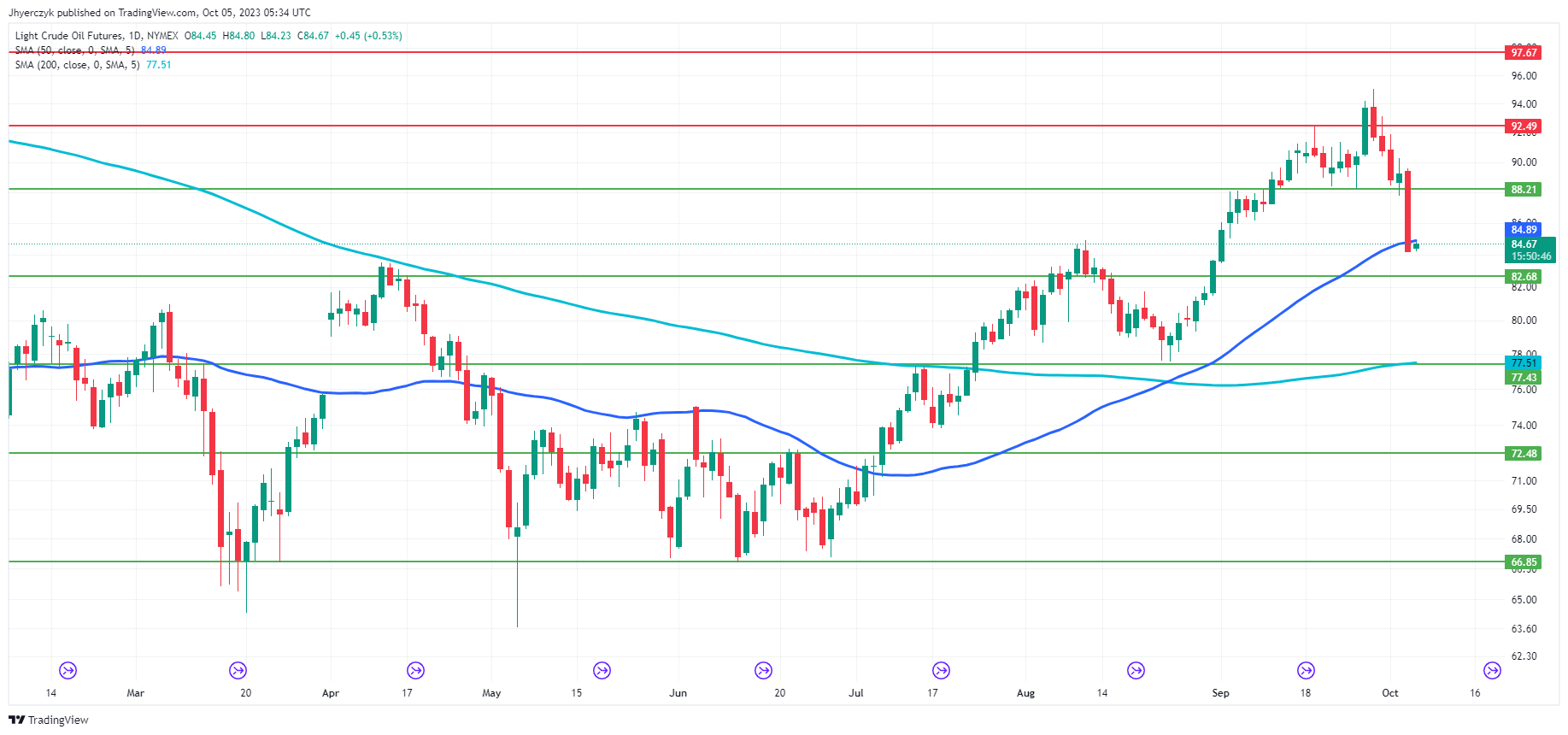
On the support and resistance spectrum, the commodity trades closer to the main support level of $82.68 than to the minor resistance of $92.49. Given that the current price is nestled between these crucial points, it portrays a market in a state of equilibrium, lacking strong directional bias.
Therefore, based on this data, the current market sentiment could be described as cautiously bullish with traders probing for support and value. However, looking at the situation from a momentum standpoint, trader reaction to the 50-Day moving average is likely to set the near-term tone. If it fails as support then look for the start of another acceleration to the downside with the 200-Day moving average the next crucial target.
 Chat now!
Add a Comment