

Overview
Oil prices remained relatively stable on Friday, but they are poised for a second consecutive week of losses. The key drivers behind these developments are concerns over supply disruptions in the Middle East, a significant oil-producing region, and uncertainties surrounding the demand outlook, particularly in China, the world’s largest crude importer.
Key Facts
Brent crude futures experienced a modest uptick of 29 cents, equivalent to 0.3%, reaching a price of $87.14 per barrel by 0658 GMT. At the same time, U.S. West Texas Intermediate crude futures saw gains of 36 cents, or 0.4%, settling at $82.82 per barrel.
Trading Derivatives carries a high level of risk to your capital and you should only trade with money you can afford to lose. Trading Derivatives may not be suitable for all investors, so please ensure that you fully understand the risks involved, and seek independent advice if necessary. A Product Disclosure Statement (PDS) can be obtained either from this website or on request from our offices and should be considered before entering into a transaction with us. Raw Spread accounts offer spreads from 0.0 pips with a commission charge of USD $3.50 per 100k traded. Standard account offer spreads from 1 pips with no additional commission charges. Spreads on CFD indices start at 0.4 points. The information on this site is not directed at residents in any country or jurisdiction where such distribution or use would be contrary to local law or regulation.
Despite significant gains exceeding $2 per barrel on Thursday, Brent crude is currently on track to post weekly losses of approximately 4%, while West Texas Intermediate (WTI) is expected to conclude the week with a 3% decline compared to the previous week.
Oil prices have been influenced by the prevailing risk environment, with market participants cautiously optimistic that the U.S. Federal Reserve is nearing the conclusion of its interest rate hiking cycle. However, lingering reservations persist regarding the demand for oil, specifically in light of recent developments in China.
China’s PMI and Economic Concerns
In October, China’s manufacturing activity exhibited unexpected contraction, as the official purchasing managers’ index (PMI) dropped from 50.2 to 49.5, falling below the critical 50-point threshold that separates expansion from contraction. This decline underscores uncertainties surrounding demand revival in the country.
A private sector survey conducted on Friday revealed that China’s services sector experienced slightly faster growth in October. However, sales registered the softest rate in ten months, and employment stagnated, reflecting a decline in business confidence.
Short-term Forecast
In the immediate future, the oil market is expected to maintain a cautious stance, leaning more towards a bearish sentiment. This outlook is influenced by the easing of supply concerns in the Middle East and lingering uncertainties in China’s demand dynamics. With Brent crude potentially posting weekly losses of around 4% and WTI facing a 3% decline compared to the previous week, market participants should remain vigilant for potential fluctuations in the coming days.
Technical Analysis
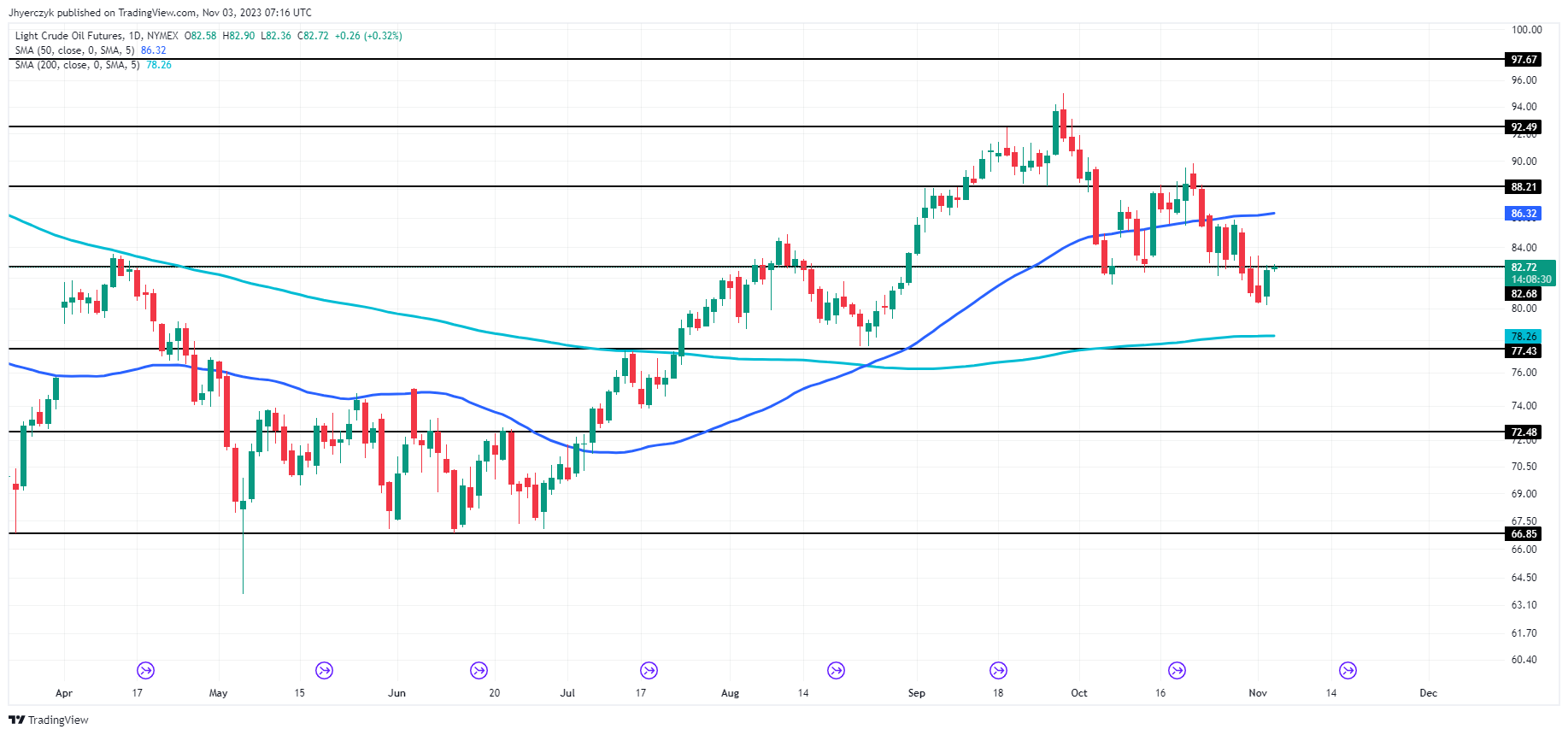
Currently, the price hovers above the minor resistance turned support at $82.68, suggesting a potential shift in sentiment.
The price remains nestled between the 200-day and 50-day moving averages, signaling a neutral zone but leans toward a bullish bias as it’s closer to the shorter-term 50-day MA at $86.32.
The proximity to minor resistance hints at a cautious optimism among traders.
 Chat now!
Add a Comment