

Overview
On Tuesday, oil prices exhibited a reserved response, despite an unexpected move by China to cut key policy rates for the second time in three months. This decision, aimed at boosting a waning economic recovery, saw the People’s Bank of China (PBOC) reduce the rate on 401 billion yuan ($55.25 billion) of one-year medium-term lending facility (MLF) loans to financial institutions.
The new rate stands at 2.50%, down 15 basis points from 2.65%. The PBOC stated this cash infusion aims to maintain “banking system liquidity reasonably ample,” especially in light of imminent tax payments. Market analysts had anticipated the PBOC would hold off on easing measures until September, suggesting growing concerns about China’s macroeconomic health.
Trading Derivatives carries a high level of risk to your capital and you should only trade with money you can afford to lose. Trading Derivatives may not be suitable for all investors, so please ensure that you fully understand the risks involved, and seek independent advice if necessary. A Product Disclosure Statement (PDS) can be obtained either from this website or on request from our offices and should be considered before entering into a transaction with us. Raw Spread accounts offer spreads from 0.0 pips with a commission charge of USD $3.50 per 100k traded. Standard account offer spreads from 1 pips with no additional commission charges. Spreads on CFD indices start at 0.4 points. The information on this site is not directed at residents in any country or jurisdiction where such distribution or use would be contrary to local law or regulation.
Despite the policy rate cut, recent economic data from China is not promising. Both industrial output and retail sales figures indicate a slowing economy. To counteract this, authorities made the aforementioned policy rate adjustments to invigorate economic activity. On a brighter note, China’s demand for oil remains robust. July saw the country’s refinery throughput increase by 17.4% year-on-year, driven by the domestic demand for summer travel and lucrative regional profit margins from fuel exports.
Internationally, other economies provide a mixed backdrop for oil prices. Japan’s economy outperformed expectations between April to June, with strong auto exports and increased tourist activity. In contrast, U.S. shale oil and natural gas outputs are predicted to drop in September, marking the second consecutive monthly decline. This decline could intensify the global oil supply squeeze, especially as the Organization of the Petroleum Exporting Countries (OPEC+) continues with production cuts.
In conclusion, while China’s aggressive rate cuts demonstrate proactive measures to stabilize its economy, the subsequent reaction in oil prices remains muted. Traders appear to be waiting, anticipating the time it will take for such stimuli to percolate through China’s vast economy and influence oil demand patterns.
Technical Analysis
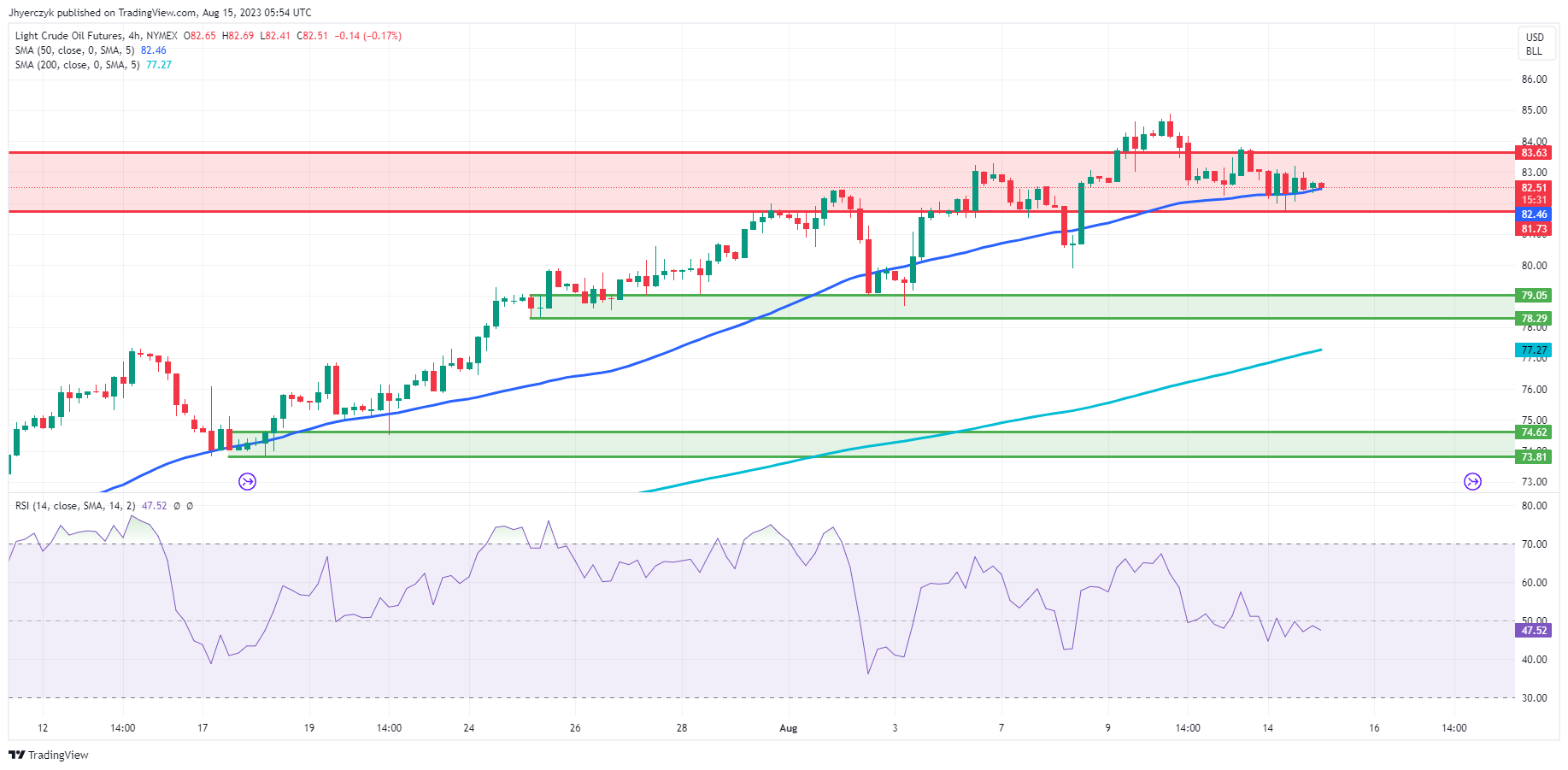
The price is hovering inside the main resistance area while sitting on the 50-H moving average. Considering the positioning relative to moving averages and the support and resistance zones, the Crude Oil market sentiment appears to be cautiously bullish in the short term.
 Chat now!
Add a Comment