

Oil Prices React to Mixed Market Signals
In recent Asian trading sessions, oil prices experienced a slight upswing. This movement stems from a balance between weak demand cues from China, the globe’s leading importer, and the potential impact of more U.S. rate hikes juxtaposed with possible constraints in oil supply.
China’s Economic Deceleration Impacts Oil Demand
China’s economic health plays a pivotal role in driving global oil demand. However, the world’s second-largest economy has been showing signs of deceleration. Market participants had placed high hopes on various stimulus measures, but the Chinese government’s efforts, such as a smaller-than-anticipated reduction in a key lending benchmark, haven’t met expectations. This lackluster performance casts a shadow over oil demand for the remaining months of this year.
Trading Derivatives carries a high level of risk to your capital and you should only trade with money you can afford to lose. Trading Derivatives may not be suitable for all investors, so please ensure that you fully understand the risks involved, and seek independent advice if necessary. A Product Disclosure Statement (PDS) can be obtained either from this website or on request from our offices and should be considered before entering into a transaction with us. Raw Spread accounts offer spreads from 0.0 pips with a commission charge of USD $3.50 per 100k traded. Standard account offer spreads from 1 pips with no additional commission charges. Spreads on CFD indices start at 0.4 points. The information on this site is not directed at residents in any country or jurisdiction where such distribution or use would be contrary to local law or regulation.
Central Banks’ Meeting Shadows OPEC+
Concurrently, all eyes are on Jackson Hole, Wyoming, as top officials from major global central banks, including the U.S. Federal Reserve, assemble for their annual meet. Investors are treading cautiously, looking for any hints on the future trajectory of interest rates. A higher rate environment, combined with China’s subdued demand, might temporarily eclipse the effects of tightening supply, primarily driven by OPEC+.
OPEC+ Efforts Tighten Oil Supply
On the brighter side for oil markets, supply has been constricting. Saudi Arabia’s initiative to reduce output by 1 million barrels per day from July to September and Russia’s pledge to cut exports by 500,000 bpd in August are prime examples. The collective effort from OPEC+ aims to rein in supply, offering support to prices. Additionally, in the U.S., despite a slight miss in expectations, crude stocks have been dwindling, suggesting a tauter supply landscape.
Short-Term Outlook
In the short-term, while rising interest rates and China’s waning demand present bearish cues, the tightening oil supply could provide a counterbalance. With pivotal events and data releases lined up, including the Energy Information Administration’s weekly report, market participants should brace for potential volatility.
Technical Analysis
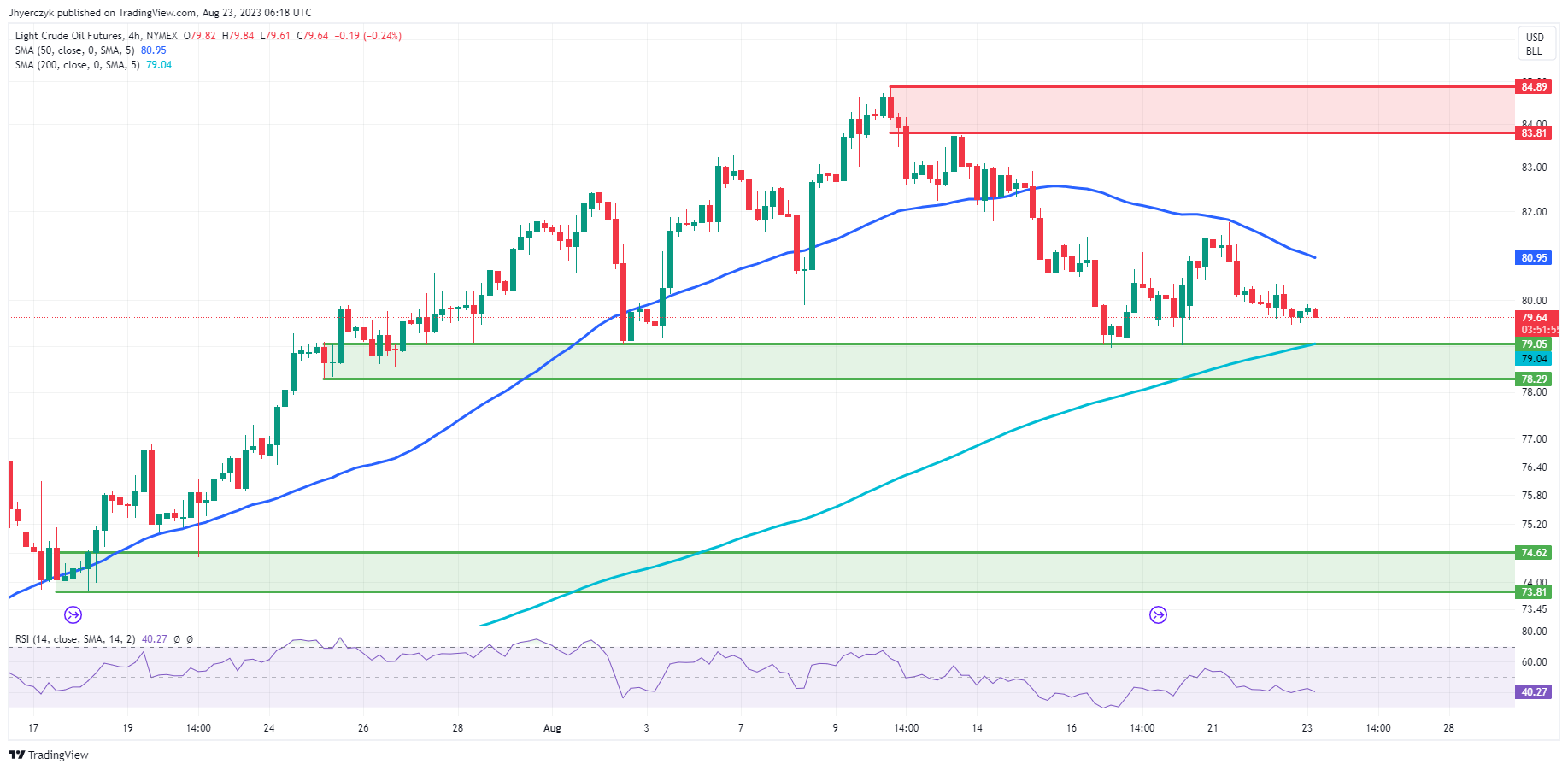
Notably, the current price is hovering just above the main support area, which ranges from 79.05 to 78.29, and remains significantly below the main resistance area, which stretches between 83.81 to 84.89. Considering the moving averages and proximity to the support region, the current market sentiment for crude oil appears to be cautiously bearish.
 Chat now!
Add a Comment