

The Pound Sterling (GBP) remains steady against its major peers on Tuesday after the United Kingdom (UK) Office for National Statistics (ONS) showed that Average Earnings accelerated in three months ending November. The agency reported that Average Earnings Excluding Bonus, a key measure of wage growth, rose at a robust pace of 5.6%, faster than estimates of 5.5% and the former 5.2%.
Average Earnings Including Bonus also rose by 5.6%, as expected, faster than the 5.2% growth in three months ending October.
Meanwhile, labor growth remained significantly weak, with a fresh addition of 35K workers against the former reading of 173K. The ILO Unemployment Rate rose to 4.4%, higher than estimates and the prior release of 4.3%. Weak labor growth clearly shows employers’ discontent with the government’s decision to increase their contribution to National Insurance (NI).
Bank of England (BoE) officials closely track wage growth data when deciding on interest rates, as wage growth is a major contributor to inflationary pressures in the UK service sector. Technically, stronger-than-expected UK wage growth should have jeopardized recent growing expectations that the BoE will reduce interest rates by 25 basis points (bps) to 4.5% in the policy meeting on February 6. However, soft labor demand would offset this.
Technical Analysis: Pound Sterling aims to recapture 20-day EMA
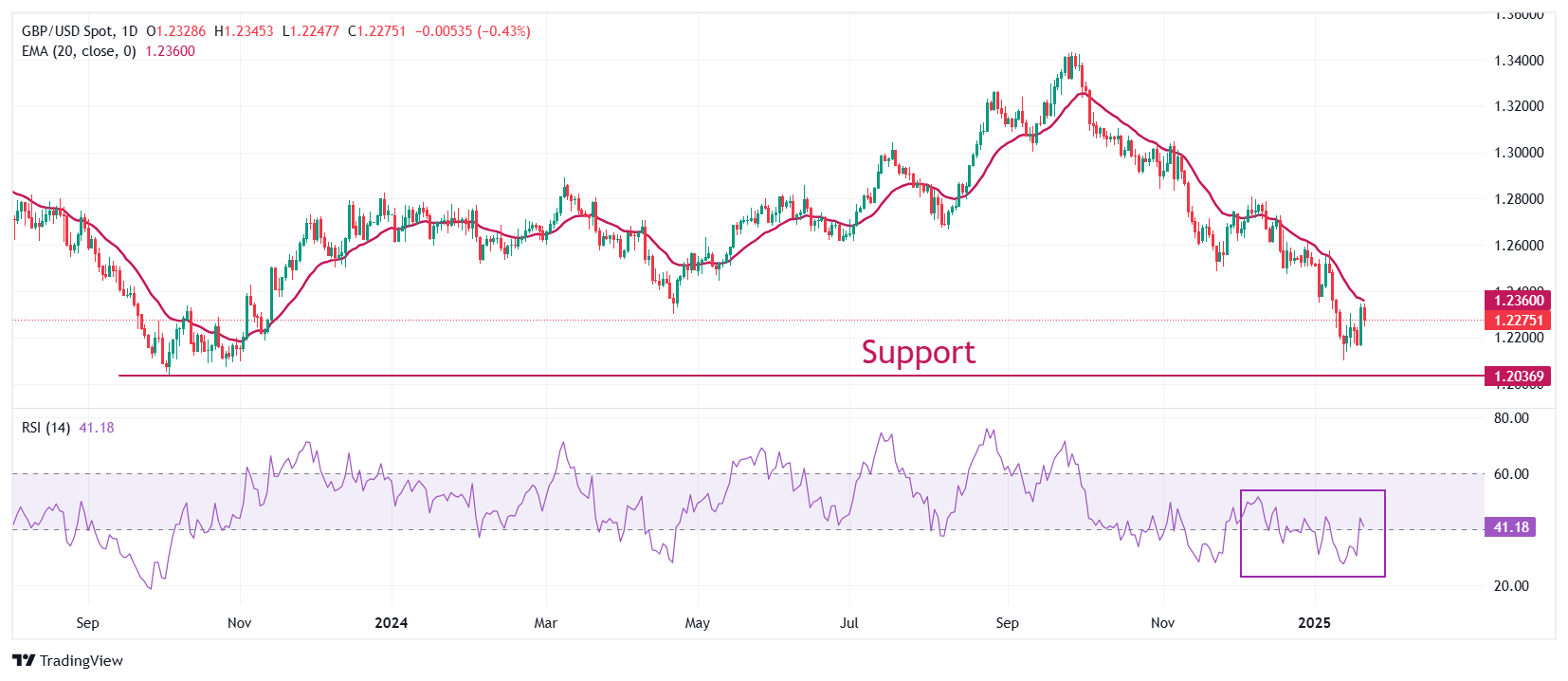
The Pound Sterling declines to near 1.2275 against the US Dollar on Tuesday after posting a fresh 10-day high near 1.2345 earlier in the day. The GBP/USD pair rebounded but failed to reclaim the 20-day Exponential Moving Average (EMA), which trades around 1.2360.
The 14-day Relative Strength Index (RSI) rebounds above 40.00. The bearish momentum would end if the RSI manages to sustain above that level.
Looking down, the pair is expected to find support near the October 2023 low of 1.2050. On the upside, the round-level resistance of 1.2400 will act as key resistance.
 Chat now!
Add a Comment