gold-bar-and-dollar-bills-42586628_XtraLarge

Gold price retreats further from two-week high; $3,300 mark holds the key for bulls

Gold price (XAU/USD) extends its steady intraday retracement slide from a nearly two-week high touched earlier this Thursday and slides to the lower end of its daily range during the first half of the European session. The pullback lacks any fundamental catalyst and is more likely to remain limited amid a combination of supporting factors. Investors now seem convinced that the Federal Reserve (Fed) will lower borrowing costs further in 2025, which might continue to act as a tailwind for the non-yielding yellow metal.

Apart from dovish Fed expectations, growing worries about rising US deficit amid US President Donald Trump’s tax bill and a sluggish US economic growth outlook on the back of renewed US-China trade tensions weigh on the US Dollar (USD). This could further offer support to the Gold price and support prospects for an extension of the weekly uptrend. Hence, any subsequent fall might still be seen as a buying opportunity and is more likely to be limited as traders now look forward to the US macro data for a fresh impetus.

Gold price corrective pullback could be seen as a buying opportunity amid a constructive technical setup

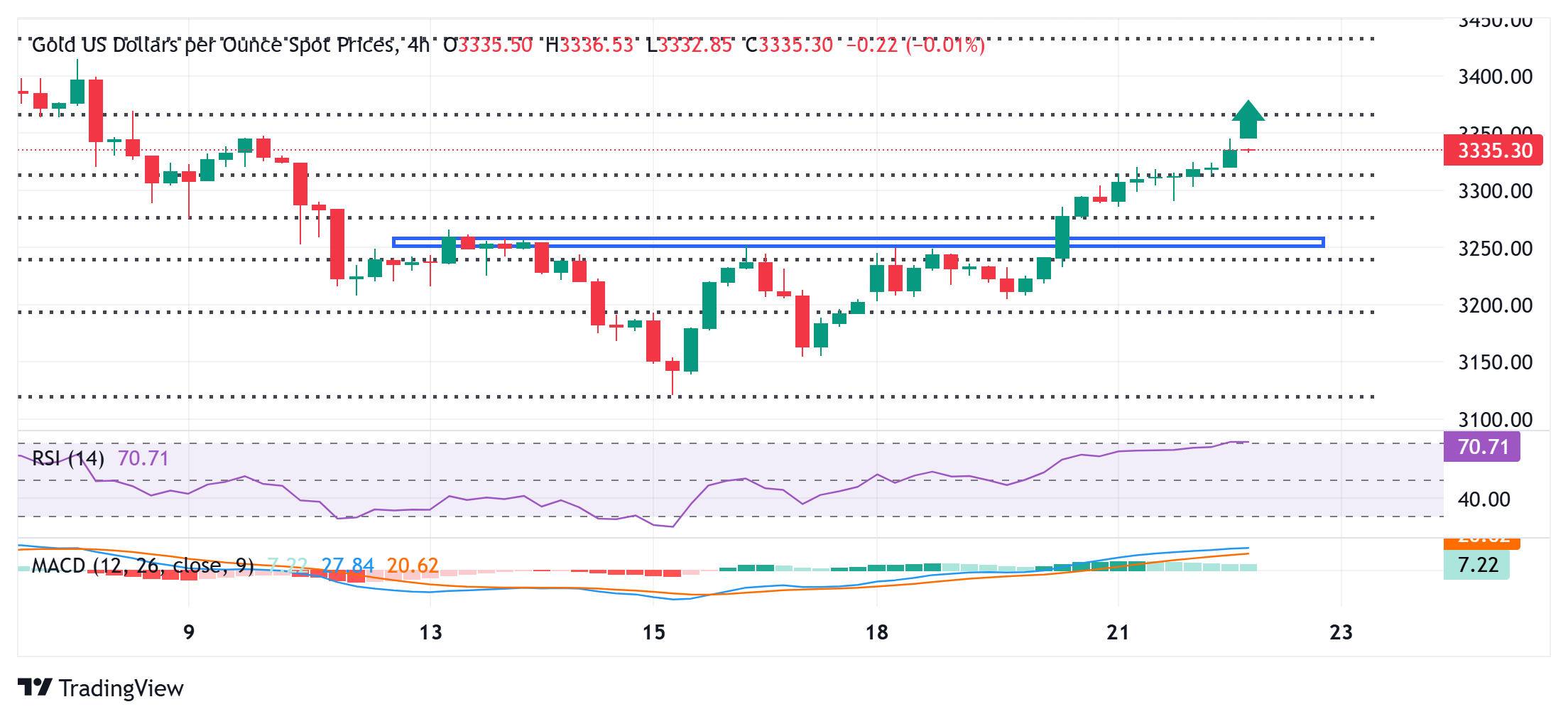
From a technical perspective, the XAU/USD pair now seems to have found acceptance above the 61.8% Fibonacci retracement level of the recent downfall from the monthly peak. This comes on the back of this week’s breakout through the $3,250-3,255 resistance zone and favors bullish traders. Moreover, oscillators on the daily chart have been gaining positive traction and suggest that the path of least resistance for the Gold price remains to the upside. Hence, a subsequent move towards the next relevant hurdle near the $3,363-3,365 region, en route to the $3,400 round figure, looks like a distinct possibility.

On the flip side, the $3,316-3,315 area, or the 61.8% Fibo. retracement level resistance breakpoint now seems to protect the immediate downside ahead of the $3,300 mark. Any further decline below the $3,285 area is more likely to attract fresh buyers and remain limited near the $3,255-3,250 hurdle-turned-support. A convincing break below the latter, however, might prompt some technical selling and drag the Gold price to the $3,200 mark.

images

XRP price gains alongside increase in volume

Ripple (XRP) price climbs and trades at $2.39 at the time of writing on Thursday, up from $2.36 and observing a 1.65% increase in the last 24 hours. The daily trade volume increased by 31.38%, as nearly $3,955,179,778.22 in XRP was traded. Volume remains high, meaning strong interest from a large number of investors likely anticipating a gain in the token in the short term.
XRP gained 2.99% in the last 7 days, and the total market capitalization currently hits $140,511,112,041.02.

In the last 24 hours, SPX6900, dogwifhat and Hyperliquid emerge as top gainers, while Aave, EOS and KuCoin Token are the top losers.

kl

German IFO Business Climate Index climbs to 87.5 in May vs. 87.4 expected

The headline German IFO Business Climate Index rose to 87.5 in May from 86.9 in April. The data came in slightly above the market forecast of 87.4.

Meanwhile, the Current Economic Assessment Index worsened to 86.1 during the same period from 86.4 in April, falling short of the estimated 86.8 reading.

The IFO Expectations Index, which indicates firms’ projections for the next six months, rose to 88.9 in May vs. 87.4 in April and 88 expected.

Market reaction to the German IFO Survey

EUR/USD keeps its range above 1.1300 following the mixed German IFO survey. When writing, the pair is trading 0.12% lower on the day.

mmm

EUR/USD holds above 1.1300 despite weak EU PMI data

EUR/USD stays in a tight daily range above 1.1300 in the European session on Thursday. The PMI data from Germany and the Eurozone showed that the business activity in the private sector contracted in May, limiting the Euro’s gains. Market focus shifts to US PMI data.

Bullish momentum continues to push EUR/USD higher following a technical bounce from the 50-day Exponential Moving Average (EMA) near 1.1100. The pair has closed higher for all but two of the last seven consecutive trading sessions, and price action is tilted firmly to the bullish side as intraday price action looks for a foothold from 1.1300.

Technical oscillators are nearly out of room to run, implying a technical reversal could be on the cards in the near-term. However, Fiber is still trading well north of its 200-day EMA near 1.0840.

US 20-year Treasury yields rose above 5% on Wednesday, sparking a flight out of US capital assets. Even with the rise in yields, investors still turned apprehensive on Treasuries, with bid-to-cover ratios falling below their six-month averages. The US government is on pace to pass President Donald Trump’s “big, beautiful bill” for the federal government’s tax and budget plans, which includes steep declines in critical services spending, and even steeper declines in federal tax receipts. The budget bill is broadly expected to add up to $4T to the US deficit over the next ten years. President Trump campaigned on reducing the deficit and eliminating US government debt.

Purchasing Managers Index (PMI) figures are due on Thursday. Pan-European PMIs are expected to rise slightly across the board, while US PMIs are forecast to come mixed. European Services PMI aggregate survey results are expected to rise to 50.3 from 50.1, while the manufacturing segment is expected to improve to 49.3 from 49.0. On the US side, Manufacturing PMIs are expected to tick down to 50.1 from 50.2, while the Services

eur6

Pound Sterling rises on hot UK inflation, US Dollar extends slide

Pound Sterling (GBP) gathers strength against its rivals early Wednesday following the release of April inflation data from the UK, while the US Dollar (USD) continues to weaken on trade uncertainty and political woes. The economic calendar will not feature high-tier data releases midweek, allowing investors to remain focused on geopolitics and comments from central bankers.

The UK’s Office for National Statistics (ONS) reported in the European morning that annual inflation in the UK, as measured by the change in the Consumer Price Index, climbed to 3.5% in April from 2.6% in March. This reading came in above the market expectation of 3.3%. On a monthly basis, the CPI rose by 1.2% after increasing by 0.3% previously. Finally, the core CPI, which excludes volatile food and energy prices, increased by 3.8% on a yearly basis, surpassing analysts’ estimate of 3.6%. GBP/USD gathered bullish momentum after hot UK inflation data and advanced to its highest level since February 2022 above 1.3450.

China’s Commerce Ministry said early Wednesday that the US’ measures on China’s advanced chips are “typical of unilateral bullying and protectionism,” adding that the US violates international law by abusing export controls to contain and suppress China. Meanwhile, House Republicans are struggling to pass President Donald Trump’s tax bill, which could add roughly $3.8 trillion to the national debt, according to an analysis released Tuesday by the Congressional Budget Office (CBO). The USD Index stays under bearish pressure on Wednesday and trades near 99.50, losing about 0.5% on the day, while US stock index futures fall between 0.4% and 0.6% after Wall Street’s main indexes closed in negative territory on Tuesday.

EUR/USD builds on its weekly gains and rises toward 1.1350 in the early European session. The European Central Bank (ECB) will publish its Financial Stability Review later in the day.

The data from Japan showed in the early Asian session that Exports rose by 2% on a yearly basis in April, as expected. In the same period, Imports declined by 2.2%. USD/JPY stays on the back foot on Wednesday and declines toward 143.50.

Gold benefited from the risk-averse market atmosphere and gained nearly 2% on Tuesday. XAU/USD preserves its bullish momentum and trades comfortably above $3,300, rising about 1% on the day.

USD/CAD continues to stretch lower and trades below 1.3900 after closing the first two days of the week in the red. Statistics Canada reported on Tuesday that the annual CPI inflation softened to 1.7% in April from 2.3% in March.

mmty

GBP/JPY jumps back above 193.00 on hotter UK CPI print, lacks follow-through amid stronger JPY

The GBP/JPY cross trims a part of its modest intraday losses following the release of hotter-than-expected UK consumer inflation figures, though it lacks follow-through buying. Spot prices currently trade around the 193.20 region, down over 0.15% for the day amid a broadly stronger Japanese Yen (JPY).

Data released by the UK Office for National Statistics (ONS) earlier this Wednesday showed that the headline annual Consumer Price Index (CPI) jumped from the 2.6% seen in the prior month to 3.5% in April, the highest level in over a year. Adding to this, the annual core CPI, which excludes volatile energy and food prices, rose 3.8% compared to 3.4% in March. The readings were well above consensus estimates and the Bank of England’s (BoE) 2.0% medium-term target, forcing investors to scale back their expectations for more rate cuts in 2025 and boosting the British Pound (GBP).

Traders, however, are still pricing in the possibility that the UK central bank will lower borrowing costs at least once by the year-end. This marks a sharp divergence in comparison to the growing acceptance that the Bank of Japan (BoJ) will hike interest rates again amid fears of broader and more entrenched price increases in Japan. Furthermore, reviving safe-haven demand, bolstered by renewed US-China trade tensions and persistent geopolitical risks, benefits the JPY. This, in turn, keeps a lid on the GBP/JPY pair’s intraday recovery of around 40 pips from the 192.85-192.80 region.

Nevertheless, the mixed fundamental backdrop makes it prudent to wait for strong follow-through selling below the 200-day Simple Moving Average (SMA) before positioning for an extension of the recent pullback from over a four-month high touched last week.

Untitled

Australian Dollar rises despite rising odds of further RBA rate cuts, focus on Fedspeak

The Australian Dollar (AUD) depreciated against the US Dollar (USD) on Wednesday, recovering after registering more than 0.50% losses in the previous session. The AUD/USD pair appreciates as the US Dollar extends its decline, pressured by cautious remarks from Federal Reserve (Fed) officials regarding the economic outlook and business sentiment.

Cleveland Fed President Beth Hammack and San Francisco Fed President Mary C. Daly both voiced rising concerns about the US economy during a panel event organized by the Federal Reserve Bank of Atlanta. Despite the fact that important economic indicators are still strong, both officials noted a decline in consumer and corporate confidence and partially blamed the change in opinion on US trade policies.

On Wednesday, China’s Commerce Ministry stated that US measures on China’s advanced chips are ‘typical of unilateral bullying and protectionism.’ Chinese authorities are looking further into whether the United States is serious about correcting its erroneous practices.

On Tuesday, the Reserve Bank of Australia (RBA) reduced its Official Cash Rate (OCR) by 25 basis points, from 4.1% to 3.85%. Moreover, RBA Governor Michele Bullock expressed confidence in the central bank’s rate cut decision. She emphasized the significance of curbing inflation and expressed that a rate cut was a proactive, confidence-boosting move that was suitable given the state of the economy. She also mentioned that the Board is prepared to take additional action if necessary, raising the prospect of future changes.

The AUD was also affected by Australia’s political unrest. Following the National Party’s withdrawal from its collaboration with the Liberal Party, the opposition coalition disbanded. The ruling Labor Party, meanwhile, took advantage of the unrest and retook power with a more robust and expansive agenda.

Australian Dollar remains below 0.6450, support appears at nine-day EMA

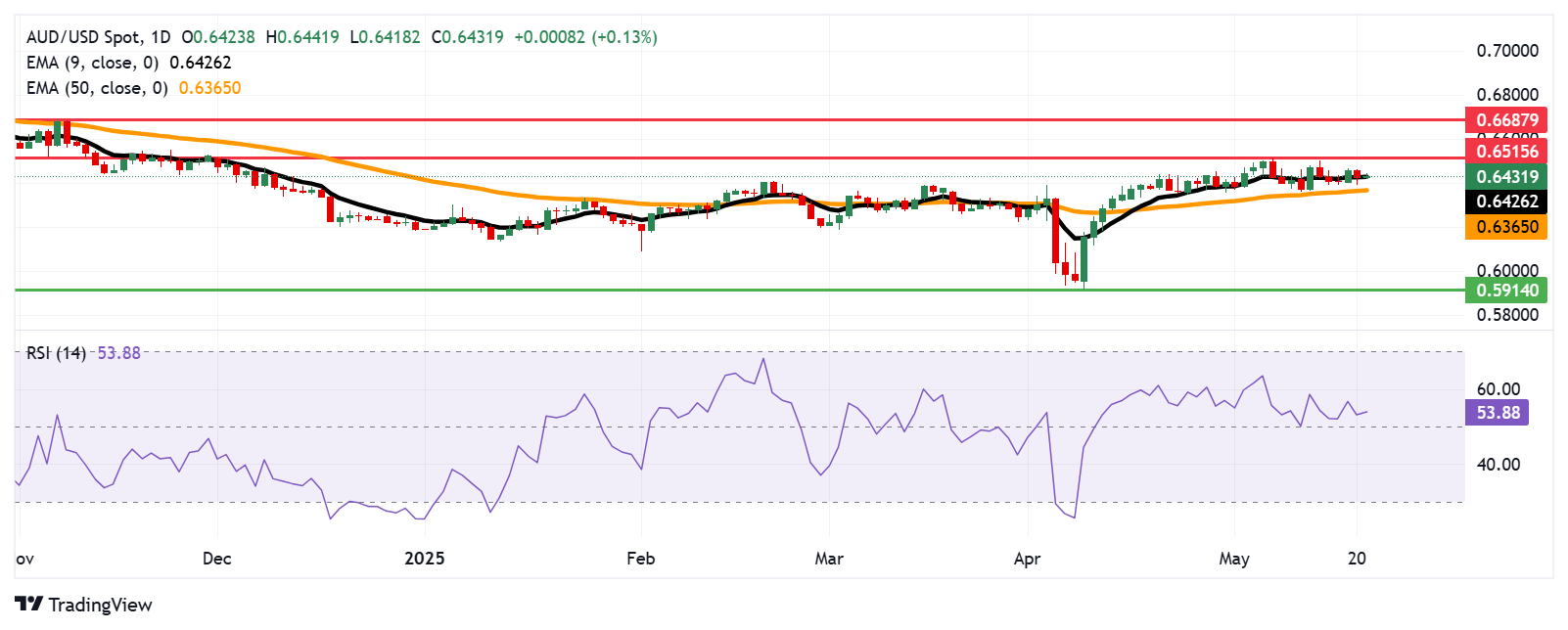
The AUD/USD pair is trading around 0.6450 on Wednesday, with daily technical indicators reflecting a bullish tone. The pair continues to trade above the nine-day Exponential Moving Average (EMA), while the 14-day Relative Strength Index (RSI) remains above the neutral 50 level—both signals supporting sustained upward momentum.

On the upside, immediate resistance is seen at the six-month high of 0.6515, recorded on December 2, 2024. A decisive break above this barrier could pave the way for a test of the seven-month high at 0.6687, which was reached in November 2024.

Initial support lies at the nine-day EMA of 0.6426, followed by the 50-day EMA near 0.6365. A firm move below these levels would undermine the short- to medium-term bullish outlook, possibly opening the path toward the March 2020 low of 0.5914.

AUD/USD: Daily Chart

Crude-Oil

Crude Oil price today: WTI price bullish at European opening

West Texas Intermediate (WTI) Oil price advances on Wednesday, early in the European session. WTI trades at $62.87 per barrel, up from Tuesday’s close at $62.16.

Brent Oil Exchange Rate (Brent crude) is also up, advancing from the $65.11 price posted on Tuesday, and trading at $65.76.

WTI Oil is a type of Crude Oil sold on international markets. The WTI stands for West Texas Intermediate, one of three major types including Brent and Dubai Crude. WTI is also referred to as “light” and “sweet” because of its relatively low gravity and sulfur content respectively. It is considered a high quality Oil that is easily refined. It is sourced in the United States and distributed via the Cushing hub, which is considered “The Pipeline Crossroads of the World”. It is a benchmark for the Oil market and WTI price is frequently quoted in the media.

images

UK CPI inflation leaps to 3.5% YoY in April vs. 3.3% forecast

The United Kingdom (UK) annual headline Consumer Price Index (CPI) jumped by 3.5% in April after recording a 2.6% growth in March, the data released by the Office for National Statistics (ONS) showed on Wednesday.

The market forecast was for a 3.3% acceleration in the reported period. The reading moves further away from the Bank of England’s (BoE) 2% target.

The core CPI (excluding volatile food and energy items) rose 3.8% year-over-year (YoY) in the same period, as against a 3.4% increase in March, beating the expected print of 3.6%.

Services inflation firmed up to 5.4% YoY in April from March’s 4.7%.

Meanwhile, the monthly UK CPI inflation jumped to 1.2% in April from 0.3% in March. Markets predicted a 1.1% reading.

GBP/USD reaction to the UK CPI inflation data

The UK CPI data provides a fresh boost to the Pound Sterling, driving GBP/USD briefly above 1.3450 before reversing to near 1.3432, where it now wavers. The pair is still up 0.32% on the day.

British Pound PRICE Today

The table below shows the percentage change of British Pound (GBP) against listed major currencies today. British Pound was the strongest against the US Dollar.

USD EUR GBP JPY CAD AUD NZD CHF
USD -0.36% -0.26% -0.55% -0.18% -0.35% -0.32% -0.63%
EUR 0.36% 0.10% -0.21% 0.16% 0.03% 0.04% -0.28%
GBP 0.26% -0.10% -0.27% 0.09% -0.05% -0.05% -0.39%
JPY 0.55% 0.21% 0.27% 0.34% 0.19% 0.21% -0.10%
CAD 0.18% -0.16% -0.09% -0.34% -0.17% -0.13% -0.47%
AUD 0.35% -0.03% 0.05% -0.19% 0.17% 0.02% -0.30%
NZD 0.32% -0.04% 0.05% -0.21% 0.13% -0.02% -0.33%
CHF 0.63% 0.28% 0.39% 0.10% 0.47% 0.30% 0.33%

The heat map shows percentage changes of major currencies against each other. The base currency is picked from the left column, while the quote currency is picked from the top row. For example, if you pick the British Pound from the left column and move along the horizontal line to the US Dollar, the percentage change displayed in the box will represent GBP (base)/USD (quote).

This section below was published at 02:15 GMT as a preview of the UK Consumer Price Index (CPI) inflation data.

  • The United Kingdom’s Office for National Statistics will publish the April CPI data on Wednesday.
  • Inflation, as measured by the CPI, is forecast to be much higher than in March.
  • The GBP/USD pair trades near its 2025 high and aims to advance beyond it.

The United Kingdom (UK) will release the Consumer Price Index (CPI) data for April on Wednesday at 06:00 GMT. The report, released by the Office for National Statistics (ONS), has a relevant impact on the Sterling Pound (GBP) amid its potential effect on future Bank of England (BoE) monetary policy decisions.

Inflation, as measured by the CPI, is foreseen to have risen by 1.1% on a monthly basis, much higher than the 0.3% posted in March. The annual figure is expected to be 3.3%, also higher than the previous 2.6%. Finally, the annual core CPI is forecast to hit 3.7% after posting 3.4% in the previous month.

What to expect from the next UK inflation report?

The UK CPI is then seen almost doubling the BoE’s goal of 2%. The news, while discouraging, would come as no surprise.

The BoE’s last decision on monetary policy was to cut the benchmark interest rate to 4.25% from 4.5%, with five out of the nine Monetary Policy Committee (MPC) members backing such a decision. Two other voting members aimed for a larger cut, while the other two preferred to keep rates on hold.

In the accompanying statement, policymakers noted, “There is also a lot of uncertainty from global developments, partly because of changes in global trade policies. We are assessing what this could mean for UK inflation closely.” Officials also added: “We expect an increase in inflation this year. It is likely to rise temporarily, to 3.7%, partly because of higher energy prices. Inflation is expected to fall back to the 2% target after that.”

Uncertainty has dominated central banks’ messages since United States (US) President Donald Trump arrived in the White House with his protectionist policies. Massive tariffs pose a risk to global growth and inflation. While the UK is among the economies less affected by Trump’s decision, it is indeed not exempt from suffering an economic setback due to levies.

Markets are cautiously optimistic amid a 90-day pause in levies and a reduction of retaliatory tariffs between Washington and Beijing. Still, it is worth noting tensions remain in the background, with trade negotiations underway without progress being reported.

Deutsche Bank senior economist Sanjay Raja adds: “April inflation will present the biggest test for the Monetary Policy Committee so far this year”.

How will the UK Consumer Price Index report affect GBP/USD?

The inflation uptick falls within the BoE’s predictions, but that does not make it less worrisome. Generally speaking, higher than anticipated CPI figures would suggest the BoE will adopt a more hawkish stance and refrain from trimming interest rates, resulting in a firmer GBP. The opposite scenario is also valid, with softer-than-anticipated inflationary pressures leaving the door open for additional rate reductions.

Ahead of the announcement, the GBP/USD pair comfortably trades above the 1.3300 mark, roughly 100 pips away from the 2025 peak at 1.3445 amid broad US Dollar weakness. The Greenback came under selling pressure after Moody’s Investors Service, a rating agency, downgraded the United States sovereign credit rating from Aaa to Aa1 on Friday, expressing concerns about piling up debt.

Valeria Bednarik, Chief Analyst at FXStreet, expects GBP/USD to reach higher highs for the year in the upcoming days. “Given the broad USD weakness and increasing price pressures in the UK, the GBP/USD pair is likely to resume its advance and challenge the yearly peak.”

Bednarik adds: “From a technical point of view, GBP/USD is in a consolidative stage since mid-April. The daily chart shows that moving averages have turned flat, reflecting the lack of directional strength, yet the pair holds above them all, with the 20 Simple Moving Average (SMA) providing support at around the 1.3300 mark. Below such level, buyers have been defending the downside at around the 1.3250 region, while the base of the monthly range comes at 1.3140.”

Finally, Bednarik states: “A steady advance beyond the 1.3400 mark should favor a run past the year high and towards the 1.3500 area, while additional gains expose the 1.3560 price zone, where GBP/USD peaked in September 2022.”


dollar

GBP/USD rises toward 1.3450 after strong UK inflation data

GBP/USD gains traction and climbs toward 1.3450 in the European morning on Wednesday. The data from the UK showed that the annual CPI inflation jumped to 3.5% in April from 2.6% in March, surpassing the market expectation of 3.3% and boosting Pound Sterling.

The Relative Strength Index (RSI) indicator on the 4-hour chart edges lower to below-60 but GBP/USD holds comfortably above the 20-period, 50-period, 100-period and the 200-period Simple Moving Averages (SMA), suggesting that the bullish stance remains intact, while losing some momentum.

On the upside, 1.3390-1.3400 (static level, round level) aligns as immediate resistance for GBP/USD before 1.3440 (upper limit of the latest uptrend) and 1.3500 (static level, round level). Looking south, supports could be spotted at 1.3300 (100-period SMA), 1.3270 (50-period SMA, Fibonacci 23.6% retracement of the latest uptrend) and 1.3225 (200-period SMA).

The US Dollar (USD) came under bearish pressure to start the week and fuelled GBP/USD’s rally on Monday, as markets reacted to Moody’s decision to downgrade the United States’ sovereign credit rating, citing an unsustainable deficit.

Early Tuesday, the cautious market stance caps GBP/USD’s upside. Additionally, the USD holds its ground, supported by the latest comments from Federal Reserve (Fed) officials. Atlanta Fed President Raphael Bostic repeated that he sees the Fed cutting the policy rate once this year. Additionally, Minneapolis Fed President Neel Kashkari and Fed Vice Chairman Philip Jefferson noted that they need to wait for more information before taking another policy step.

Meanwhile, Bank of England (BoE) Chief Economist Huw Pill argued early Tuesday that the quarterly pace of rate reductions would be “too rapid,” adding that he is concerned about indicators pointing to inflation pressure. These comments seem to be helping Pound Sterling stay resilient against its peers.

The economic calendar will not offer any high-tier macroeconomic data releases on Tuesday that could drive the USD’s valuation. Hence, investors will continue to scrutinize comments from central bank officials.

The CME Group FedWatch Tool shows that markets are pricing in a more than 70% probability that the Fed will cut the policy rate at least twice in 2025. In case Fed officials push back against this market expectation, the USD could gather strength and cause GBP/USD to lose its traction.