USD: Sticky inflation to keep market guessing over Fed rate cuts

USD: Sticky inflation to keep market guessing over Fed rate cuts

The US Dollar (USD  ) remained reasonably bid on Tuesday as markets digested the US tariff news, while news of a peace deal between Israel and Hezbollah has not affected the market much. Apart from the understandable pressure on the Mexican peso and US car producers with facilities south of the border, there was little impact on the US rates markets. In other words, the inflationary side of potential tariffs has yet to play out in US asset markets, ING’s FX analyst Chris Turner notes.

The environment looks dollar-bullish

“On the subject of inflation, today sees the release of the core PCE deflator for October. The 0.3% month-on-month reading may still be a little too high for the Fed’s liking, although such a number is fully discounted today. That means the market probably retains its pricing of 15bp worth of Fed cuts in December and also keeps US rate differentials versus the Rest of the World at reasonably wide levels.”

“We are bullish on the dollar and note that today’s US data set, including confirmation of US third-quarter GDP at 2.8% quarter-on-quarter annualized, will be the last in this holiday-shortened week. In its entirety, the environment looks dollar-bullish to us. The main downside risk to the dollar this week probably comes from month-end rebalancing flows.”

“Here the huge divergence for dollar-based equity investors of S&P 500 +5.3% month-to-date versus -1.36% for the Eurostoxx 50 or -1.6% for the Nikkei 225 warns of rebalancing dollar sales to raise European and Japanese equity weightings back to benchmarks. These flows could be going through poor liquidity conditions later this week, but any DXY dip to the 106.25/50 area this week should meet good demand.”

EUR/USD gains as US Dollar declines, US PCE inflation in focus

EUR/USD gains as US Dollar declines, US PCE inflation in focus

EUR/USD jumps higher to near 1.0530 in Wednesday’s European session. The major currency pair strengthens as the US Dollar (USD) tumbles ahead of a string of United States (US) economic data such as the Personal Consumption Expenditure Price Index (PCE), Durable Goods Orders, and Personal Spending data for October, revised Q3 Gross Domestic Product (GDP) growth estimates, and Initial Jobless Claims data for the week ending November 22, which will be published in the North American session.

The US Dollar Index (DXY), which gauges the Greenback’s value against six major currencies, posts a fresh weekly low near 106.35. The Greenback has corrected lately after posting a fresh two-year high at around 108.00 on Friday. The correction was triggered after Scott Bessent, a veteran hedge fund manager, said that the objective of enacting tariffs will be “layered in gradually and the budget deficit will be reduced to 3% of Gross Domestic Product (GDP) by slashing spending,” a move that won’t result in high inflation than feared. The comments from Bessent came after US President-elect Donald Trump nominated him for Treasury Secretary.

Within the array of US data, investors will pay close attention to the PCE inflation, the Federal Reserve’s (Fed) preferred inflation measure for decision-making on policy rates. The PCE report is expected to show that the headline inflation accelerated to 2.3% year-over-year in October from 2.1% a month earlier.

In the same period, the core PCE – which excludes volatile food and energy prices – is estimated to have risen by 2.8%, stronger than the former release of 2.7%. The month-on-month headline and core PCE are expected to have grown steadily by 0.2% and 0.3%, respectively.

The US PCE inflation data will influence Fed interest rate cut prospects for the December meeting. On Monday, Minneapolis Fed Bank President Neel Kashkari said it is reasonable to consider another interest rate reduction in the December meeting. His viewpoint of an interest rate cut next month was backed by expectations that inflation is gently trending down and the labor market remains strong right now.

Technical Analysis: EUR/USD rises above 1.0500

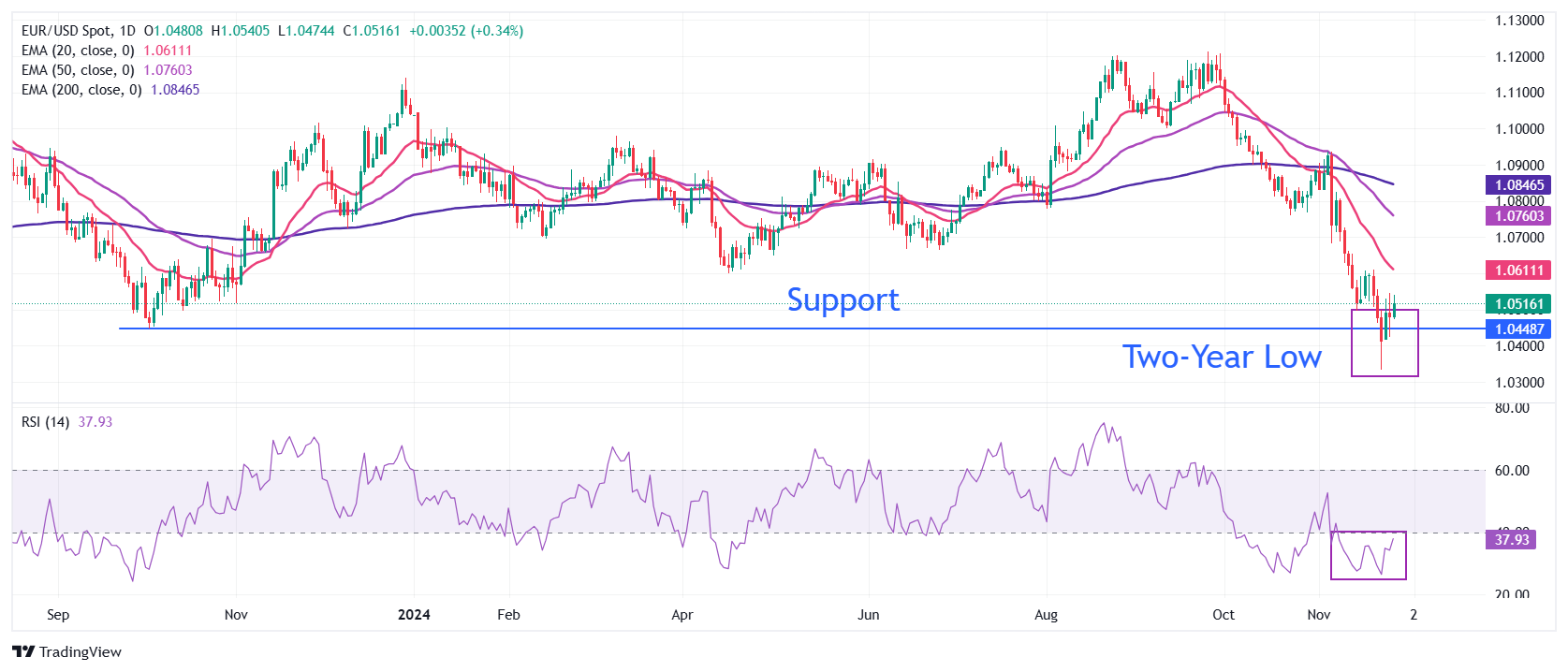
EUR/USD jumps above the psychological figure of 1.0500 in European trading hours on Wednesday. The major currency pair continues to hold the near-term low of 1.0330. However, the outlook remains bearish as all short-to-long-term day Exponential Moving Averages (EMAs) in the daily chart are declining, pointing to a downside trend.

The 14-day Relative Strength Index (RSI) rebounded after conditions turned oversold. However, the oscillator has cooled down, which could allow bears to take charge again.

Looking down, the November 22 low of 1.0330 will be a key support for Euro bulls. On the flip side, the November 20 high round 1.0600 will be the key barrier.

EUR/USD: Consolidation on the cards

EUR/USD: Consolidation on the cards

EUR consolidated in absence of fresh catalyst. Pair was last at 1.0480 levels, OCBC’s FX analysts Frances Cheung and Christopher Wong note.

Focus this week is on Euro-area CPI

“Bearish momentum on daily chart intact but shows signs of fading while RSI shows signs of turning higher. Bullish divergence is also observed on daily MACD.”

“Not ruling out EUR short squeeze in the near term. Resistance at 1.0510, 1.0650 (21 DMA). Key support at 1.0450 levels before 1.03 levels. Focus this week on Euro-area CPI. Upside surprise may aid the squeeze in EUR shorts.”

Pound Sterling gains against US Dollar ahead of US PCE inflation data

Pound Sterling gains against US Dollar ahead of US PCE inflation data

The Pound Sterling (GBP) moves higher against the US Dollar (USD) but struggles to extend its upside above the three-day resistance of 1.2600 in Wednesday’s London session. The GBP/USD pair rises as the US Dollar declines. The US Dollar Index (DXY), which gauges the Greenback’s value against six major currencies, has remained under pressure this week after US President-elect Donald Trump nominated Scott Bessent, a seasoned hedge fund manager, to fill the position of Treasury Secretary. Market participants expect Bessent to execute Trump-stated trade policies strategically and gradually with the intention of avoiding a lethal trade war.

In Wednesday’s session, investors will focus on the United States (US) Personal Consumption Expenditure Price Index (PCE) data for October, which will be published at 13:30 GMT. Economists expect the core PCE inflation data – which excludes volatile food and energy prices – to have accelerated to 2.8% year-over-year from 2.7% in September, with monthly figures growing steadily by 0.3%.

Investors will pay close attention to the core PCE inflation data as it is the Federal Reserve’s (Fed) preferred inflation measure for decision-making on interest rates. The inflation data will influence market expectations for the Fed’s likely interest rate action in the December meeting. According to the CME FedWatch tool, the probability that the Fed will cut interest rates by 25 basis points (bps) to the 4.25%-4.50% range in the December meeting has increased to 65% from 56% a week ago.

Dovish Fed bets have escalated after the release on Tuesday of the Federal Open Market Committee (FOMC) minutes for the policy meeting held on November 7, even though it didn’t offer any meaningful guidance about the interest rate path. Some officials reportedly suggested that the Fed could consider pausing its rate-cutting cycle if inflation remains “elevated”, while others argued that the policy-easing cycle would be needed to accelerate if economic conditions or the labor market deteriorate.

In today’s session, investors will also focus on the revised Q3 Gross Domestic Product (GDP) growth estimates, Durable Goods Orders and Personal Spending data for October, and Initial Jobless Claims data for the week ending November 22.

AUD/JPY Price Analysis: Drops to near 98.50 due to weakening short-term price momentum

AUD/JPY Price Analysis: Drops to near 98.50 due to weakening short-term price momentum

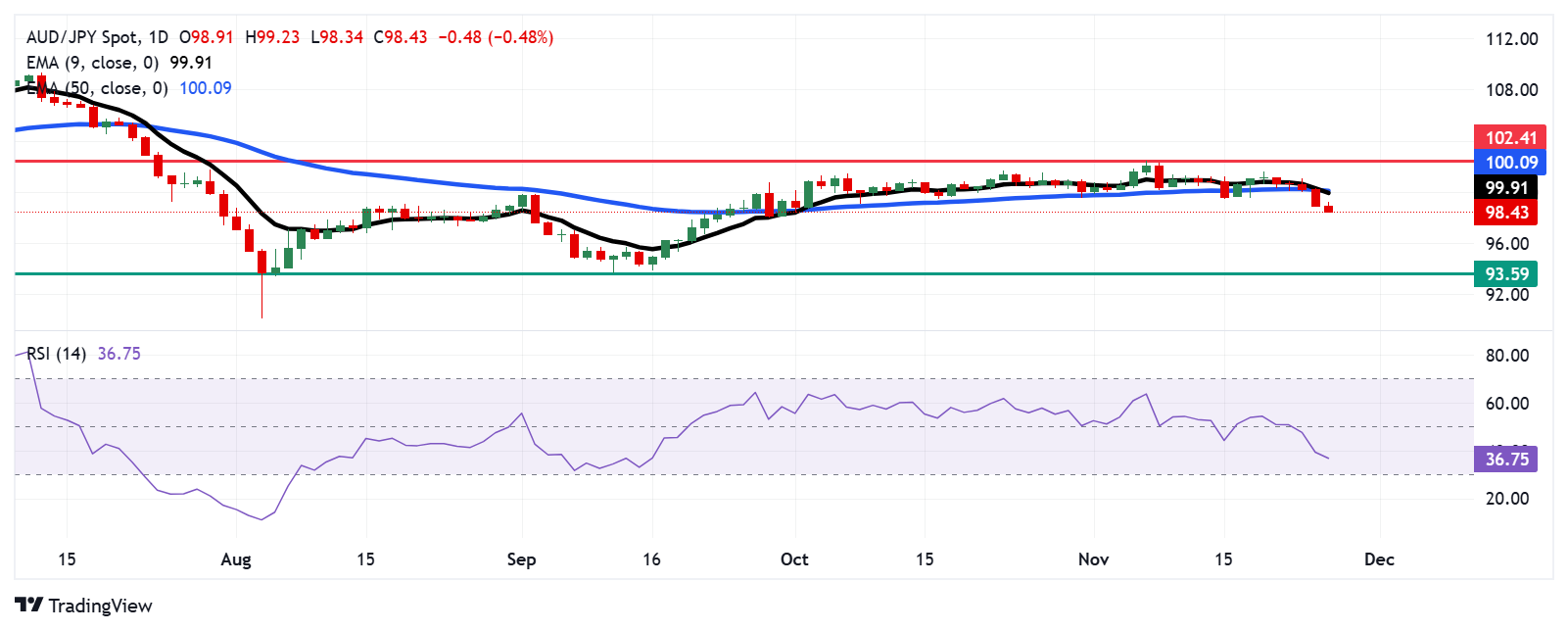
The AUD/JPY cross extends its losing streak for the fifth consecutive day, trading around 98.40 during the European hours on Wednesday. The 14-day Relative Strength Index (RSI) is currently above 30, indicating a bearish market trend. If the RSI drops below 30, it would signal an oversold condition, potentially leading to a corrective rebound.

Additionally, an analysis of the daily chart suggests that the nine-day Exponential Moving Average (EMA) crosses below the 50-day EMA, suggesting a bearish signal. This crossover indicates that the short-term momentum is weakening relative to the longer-term trend, which could signify the continued price weakness.

On the downside, the primary support for the AUD/JPY cross is located around the psychological level of 97.00, followed by the next support at 96.00 level. A decisive break below the latter could open the gates for the currency cross to navigate the region around its four-month low of 93.59, which was recorded on September 11.

To the upside, the AUD/JPY cross may test the primary resistance around the nine-day EMA at 99.92 level, followed by the 50-day EMA at 100.09 level. A break above these levels could weaken the bearish bias, potentially pushing the currency cross toward the four-month high of 102.41, reached on November 7.

AUD/JPY: Daily Chart

EUR/USD regains 1.0500 and beyond as US Dollar wilts ahead of data

EUR/USD regains 1.0500 and beyond as US Dollar wilts ahead of data

EUR/USD is extending the rebound above 1.0500 in the European session on Wednesday. Traders cash in on the US Dollar long positions ahead of a series if top-tier US data, lifting the pair. The USD/JPY sell-off also adds to the US Dollar downside.

EUR/USD faces first resistance at 1.0520, where the upper limit of the descending regression channel meets the 50-period Simple Moving Average (SMA). In case the pair rises above this level and starts using it as support, 1.0570 (static level) could be seen as next hurdle before 1.0600 (100-period SMA).

On the downside, immediate support is located at 1.0480 (20-period SMA) ahead of 1.0430 (mid-point of the descending channel) and 1.0400 (static level).

EUR/USD failed to make a decisive move in either direction on Tuesday and closed the day virtually unchanged slightly below 1.0500. The pair moves sideways in a narrow channel early Wednesday as investors await macroeconomic data releases from the US.

After dipping below 1.0450 on Tuesday, EUR/USD recovered its losses in the American session as the mixed data from the US and the modest improvement seen in risk mood made it difficult for the US Dollar (USD) to find demand.

Later in the day, the US Bureau of Economic Analysis will publish its second estimate of the annualized Gross Domestic Product (GDP) growth for the third quarter and release the Personal Consumption Expenditures (PCE) Price Index data, the Federal Reserve’s (Fed) preferred gauge of inflation, for October.

Investors expect the core PCE Price Index to rise 0.3% on a monthly basis to match September’s increase. A reading at or above the market expectation could support the USD with the immediate reaction. On the other hand, a print below analysts’ estimate could weigh on the USD and help EUR/USD push higher.

Ahead of the Thanksgiving holiday, the US economic calendar will feature other important data releases as well, making it difficult for market participants to assess the impact of these data on the USD’s valuation. The US Department of Labor will publish the weekly Initial Jobless Claims alongside the US Census Bureau’s Durable Goods Orders figures for October.

USD: Transactional Trump fires up tariff threat

USD: Transactional Trump fires up tariff threat

European FX markets are on the move today as they digest the first of President-elect Trump’s late-night social media posts on economic policy. His post threatened to enact 25% across-the-board tariffs on imports from Canada and Mexico unless they tightened border security to address the flows of illegal immigrants and drugs, particularly Fentanyl. China was threatened with an additional 10% on any current tariffs for not doing enough to address Fentanyl flows as well. His post on Truth Social said he’d use executive orders to make this happen – which he could potentially do under the US International Emergency Economic Powers Act (IEEPA), ING’s FX analyst Chris Turner notes.

DXY to stay bid in the 107-108 range

“Whilst most in the market assume that Trump will be using tariffs as a large bargaining stick – in this case to tighten US border controls – we would be careful of dismissing their market impact as some grandstanding. If 25% tariffs came close to seeing the light of day in Mexico, USD/MXN would be a 24/25 story, not just 21. We already think the currencies of Mexico and Canada will have a tougher Trump 2.0 than they did during his first term.”

“The above can help set the tone in FX markets into year-end – namely that Trump stands to deliver on his pre-election promises. These policies are generally positive for the dollar. Although the final outcome of the tariff threat may be less severe once negotiations are concluded, we recommend adopting a defensive stance in FX markets for the time being.”

“Two further inputs today should be USD positive too. The first should be a decent bounce in November US consumer confidence after Trump’s win earlier this month. The second should be a mildly less dovish set of FOMC minutes, where the Fed might have acknowledged that some of the downside risks to the economy had receded ahead of that policy meeting on 7 November. DXY is to stay bid in the 107-108 range.”

Crude Oil tries to claim $70 as geopolitics supports price

Crude Oil tries to claim $70 as geopolitics supports price

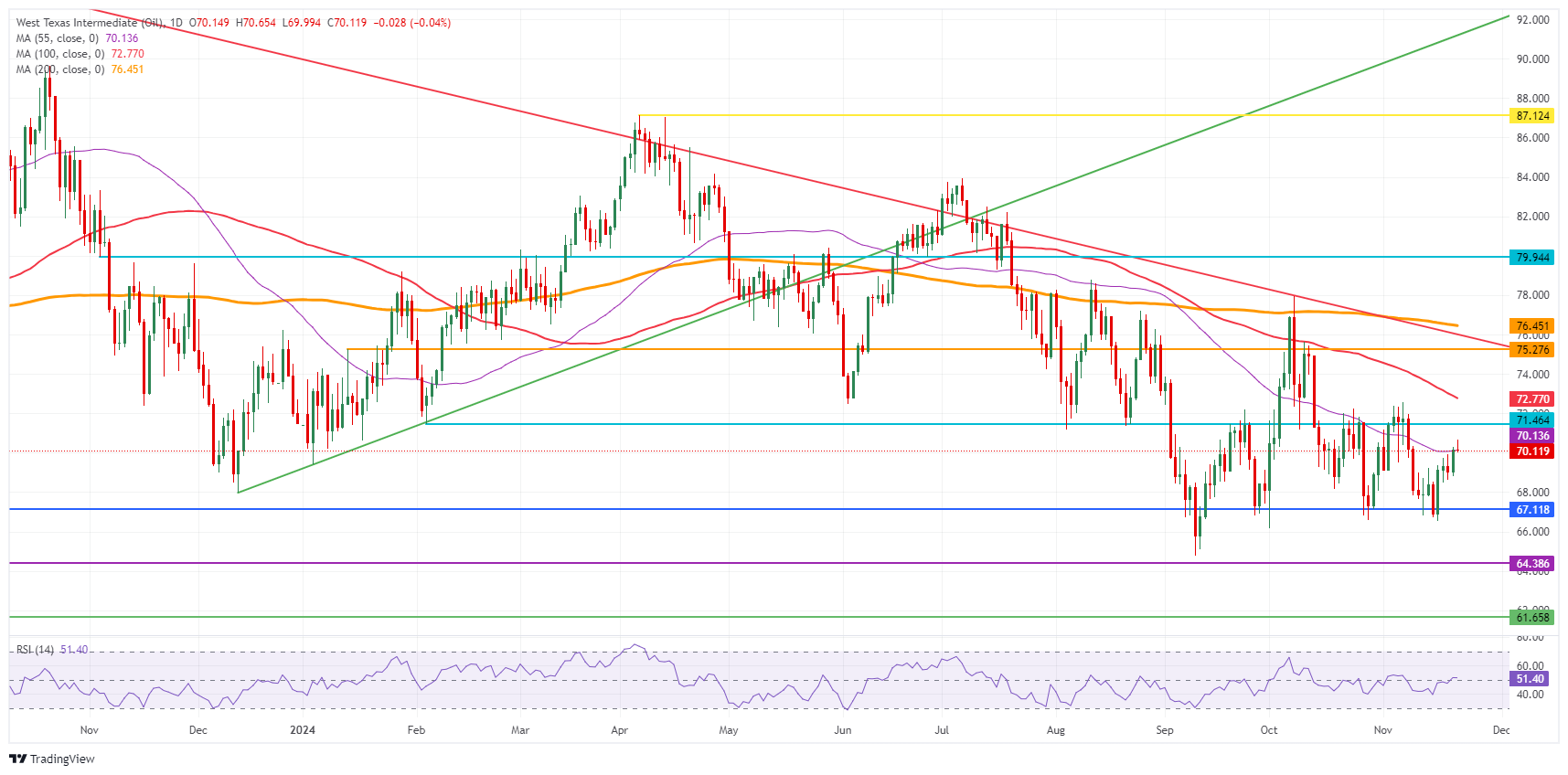
Crude Oil price steadies on Friday and tries to claim the $70 level after surging over 4.5% so far this week, fueled by fresh escalation between Russia and Ukraine. Both countries are rushing to get the tactical upper hand ahead of possible resolution talks once President-elect Donald Trump takes office in January 2025. One of the new elements in the escalation is that Russia apparently has put a Polish (Poland is a NATO member) military base at the top of its target list for any subsequent retaliation if Ukraine attacks again, Yahoo News reports.

Meanwhile, the US Dollar Index (DXY) is firmly up after European preliminary Purchasing Managers Index (PMI) numbers came in substantially below estimates in November. The data suggests that business activity in the Eurozone Manufacturing and Services sectors contracted, fueling the US exceptionalism with an inflow in the US Dollar. Later on Friday, the US PMI numbers are going to be released and might fuel a second round of inflow in case of an upbeat surprise.

Oil Technical Analysis: Is it possible to scale up further?

Crude Oil price is set to close this week on a high note, booking nearly 5% of gains. However, traders have been asking themselves if there is more upside to this tension-fueled trade. Several analysts have pointed out that these recent moves might have been the last few steps towards any deal, with both countries just trying to pick up the best possible cards to be used during any negotiations.

On the upside, the 55-day Simple Moving Average (SMA) at $70.13 was tested earlier on Friday, and we must see a daily close above it if Crude Oil prices want to head higher. Next up is the 100-day SMA at $72.77. The 200-day SMA at $76.45 is still far off, although it could be tested if tensions intensify further.

On the other side, traders need to look towards $67.12 – a level that held the price in May and June 2023 – to find the first support. In case that breaks, the 2024 year-to-date low emerges at $64.75, followed by $64.38, the low from 2023.

US WTI Crude Oil: Daily Chart

US WTI Crude Oil: Daily Chart

WTI Oil FAQs

GBP/USD: the next significant support at 1.2490 is out of reach

GBP/USD: the next significant support at 1.2490 is out of reach

A break of 1.2565 will not be surprising; the next significant support at 1.2490 is not expected to come into view for now. In the longer run, momentum received a boost; GBP is likely to break below 1.2565. The next level to monitor is 1.2490, UOB Group’s FX strategists Quek Ser Leang and Lee Sue Ann note.

The next level to monitor is 1.2490

24-HOUR VIEW: “We highlighted yesterday that ‘further range trading appears likely, even though the softened underlying tone suggests a lower range of 1.2615/1.2685.’ The sudden plunge that sent GBP to a low of 1.2577 was surprising. Given the rapid increase in momentum, a break of 1.2565 will not be surprising. However, deeply oversold conditions could indicate that the next significant support at 1.2490 is not expected to come into view for now. To sustain the momentum, USD must remain below 1.2640 (minor resistance is at 1.2615).”

1-3 WEEKS VIEW: “We have held a negative view in GBP since early last week. On Wednesday (20 Nov), when GBP was at 1.2685, we pointed out that ‘downward momentum is beginning to slow.’ We added, ‘a break above 1.2725 would mean that the major support at 1.2565 is out of reach.’ GBP subsequently rose briefly to 1.2713, and then pulled back. Yesterday, in a sudden move, GBP plunged to a low of 1.2577. Not surprisingly, downward momentum received a boost. From here, GBP is likely to break below 1.2565. The next level to monitor is 1.2490. On the upside, the ‘strong resistance’ level has moved lower to 1.2665 from 1.2725.”

EUR/USD drops to two-year lows below 1.0400 after weak PMI data

EUR/USD drops to two-year lows below 1.0400 after weak PMI data

EUR/USD stays under bearish pressure and trades at its weakest level in nearly two years below 1.0400. The data from Germany and the Eurozone showed that the business activity in the private sector contracted in early November, weighing on the Euro.

EUR/USD trades near the mid-point of the descending regression channel and the Relative Strength Index (RSI) indicator on the 4-hour chart stays close to 30, suggesting that the pair could stage a technical correction before falling further.

On the upside, 1.0500 (former support, static level) aligns as first resistance before 1.0540 (20-period Simple Moving Average (SMA)) and 1.0570 (50-period SMA, upper limit of the descending channel). Looking south, supports could be spotted at 1.0400 (lower limit of the descending channel) and 1.0360 (static level from May 2023).

EUR/USD came under renewed bearish pressure in the American session on Thursday and touched its lowest level since October 2023 below 1.0500. The pair struggles to find a foothold early Friday as investors await key macroeconomic data releases.

The US Dollar (USD) benefited from upbeat US data and hawkish comments from Federal Reserve (Fed) officials on Thursday, forcing EUR/USD to turn south in the second half of the day.

“Over the next year, it feels like rates will end up a fair bit lower than they are today,” Chicago Fed President Austan Goolsbee said and argued that it may make sense to slow the pace of interest rate cuts as the Fed gets close to where rates will settle.

Preliminary November HCOB Manufacturing and Services Purchasing Managers Index (PMI) data from Germany and the Eurozone will be featured in the European economic calendar. In case Services PMI unexpectedly falls into the contraction territory below 50 either in Germany or the Eurozone, the immediate reaction could cause the Euro to weaken further against its major rivals.

Later in the day, S&P Global Manufacturing and Services PMI data for the US will be watched closely by market participants. If the Manufacturing PMI recovers above 50 and the Services PMI comes in near October’s final print of 55, the USD could preserve its strength heading into the weekend and force EUR/USD to stretch lower.