EUR/CAD remains subdued near 1.5000 following softer German Retail Sales

EUR/CAD remains subdued near 1.5000 following softer German Retail Sales

EUR/CAD retraces its recent gains from the previous two sessions, hovering around 1.5020 during early European trading hours. The currency cross remains under pressure following weaker-than-expected German Retail Sales data released on Friday. Market participants now turn their attention to upcoming Unemployment Rate and Consumer Price Index (CPI) figures from Germany due later today.

Germany’s Retail Sales fell by 1.6% month-over-month in December, as reported by Destatis on Friday. This decline followed an upwardly revised of no growth in November and missed market expectations of a 0.2% increase. On a yearly basis, Retail Sales grew by 1.8%, falling short of analysts’ forecasts of 2.5%.

On Thursday, preliminary data from Eurostat reported that the Eurozone economy stagnated in Q4 2024 after expanding by 0.4% in Q3. This flat growth was weaker than the anticipated 0.1% increase, adding to concerns about economic momentum in the region.

The Euro remains under pressure amid growing expectations of further interest rate cuts by the European Central Bank (ECB). On Thursday, the ECB lowered its Deposit Facility Rate by 25 basis points (bps) to 2.75%, while the Main Refinancing Operations Rate dropped to 2.9%, in line with forecasts. Markets had already priced in the rate cut, expecting inflation in the Eurozone to remain on a trajectory toward the central bank’s 2% target.

However, EUR/CAD’s downside may be limited as the Canadian Dollar (CAD) faces headwinds due to a dovish shift in the Bank of Canada’s (BoC) policy stance. On Wednesday, the BoC reduced its key interest rate by 25 bps to 3.0% and ended its quantitative tightening program, signaling plans to resume asset purchases in early March.

Adding to CAD’s challenges, US President Donald Trump reiterated his intention to impose 25% tariffs on Mexico and Canada—United States’ (US) top two trading partners. The BoC’s policy outlook was further dampened by concerns over potential US trade restrictions, with Governor Tiff Macklem emphasizing that tariff threats remain a significant risk to the Canadian economy.


Untitled

Gold sets new record-high, majors stay quiet ahead of inflation data

Major currency pairs trade in narrow ranges early Friday, following some volatility seen on Thursday. Regional and nation-wide inflation data from Germany and December Personal Consumption Expenditures (PCE) Price Index data from the US will be watched closely by market participants on Friday. Fourth-quarter Employment Cost Index data will also be featured in the US economic calendar ahead of the weekend.

The European Central Bank (ECB) announced on Thursday that it lowered key rates by 25 basis points (bps) as expected. The ECB didn’t make any significant changes to its policy statement and ECB Christine Lagarde refrained from committing to the next rate move, reiterating that their next decision will be driven by data and analysis. After rising above 1.0450 in the second half of the day, EUR/USD lost its traction and retreated below to close in negative territory on Thursday. Early Friday, the data from Germany showed that Retail Sales declined by 1.6% on a monthly basis in December, missing the market expectation for an increase of 0.2%. EUR/USD showed no immediate reaction to this data and was last seen trading in a narrow channel at around 1.0400.

The US Bureau of Economic Analysis (BEA) reported on Thursday that the US’ Gross Domestic Product expanded at an annual rate of 2.3% in the fourth quarter. This reading followed the 3.1% expansion recorded in the third quarter and came in below the market estimate for a growth of 2.6%. On a positive note, weekly Initial Jobless Claims in the US declined to 207,000 in the week ending January 25 from 223,000 in the previous week. The US Dollar (USD) Index held its ground after mixed data and posted modestly gains on Thursday. Early Friday, the index stays in a consolidation phase near 108.00.

Meanwhile, US President Donald Trump took to social media late Thursday to make a fresh tariff threat against Canada and Mexico. According to President Trump’s social media post, the US is set to impose a flat 25% import tax “because of fentanyl” on all goods crossing the border into the US from Canada or Mexico. Trump also warned that they could impose 100% tariffs on BRICS nations if they were to try to replace the USD with a new currency in international trade.

Bank of Japan (BoJ) Governor Kazuo Ueda said on Friday that underlying inflation is still somewhat below 2%. Ueda added that the Japanese central bank would maintain an accommodative policy to support price trends. After losing more than 0.5% on Thursday, USD/JPY stages a rebound and trades in positive territory above 154.50.

GBP/USD closed modestly lower on Thursday after meeting resistance above 1.2450. The pair clings to small daily gains on Friday but remains below 1.2450.

Gold gathered bullish momentum and rose more than 1% on Thursday. Gold continued to stretch higher and trades at an all-time peak near $2,800

images

Pound Sterling consolidates against USD ahead of US core PCE inflation

The Pound Sterling (GBP) trades in a tight range slightly above the key support of 1.2400 against the US Dollar (USD) in Friday’s European session. The GBP/USD pair steadies despite an increase in the US Dollar’s safe-haven demand on Thursday after United States (US) President Donald Trump reiterated his intentions to impose 25% tariffs on Canada and Mexico from Saturday and 100% on BRICS if they try to replace the US Dollar with a new currency in international trade.

The US Dollar Index (DXY), which tracks the Greenback’s value against six major currencies, trades close to its weekly high of 108.20.

On his social media platform, TruthSocial, Trump said, “We are going to require a commitment from these seemingly hostile countries that they will neither create a new BRICS currency nor back any other currency to replace the mighty US Dollar, or they will face 100% tariffs.” He added that there is no chance that “BRICS will replace the US Dollar in International trade” or anywhere else, and any country that tries should say, “Hello to Tariffs, and goodbye to America!”

Market participants believe that President Trump’s higher tariffs would be inflationary for the US economy, which could force the Federal Reserve (Fed) to keep interest rates at their current levels for longer. On Wednesday, the Fed announced a pause in the easing policy cycle and kept borrowing rates unchanged in the range of 4.25%-4.50%.

Fed Chair Jerome Powell said that monetary policy adjustments will become appropriate when central bank officials see “real progress on inflation or at least some weakness in the labor market.”

In Friday’s session, investors will pay close attention to the US Personal Consumption Expenditures Price Index (PCE) data for December, which will be published at 13:30 GMT. The core PCE inflation, the Fed’s preferred inflation gauge, is estimated to have grown at a faster pace of 0.2% month-on-month from 0.1% in November, with annual figures growing steadily by 2.8%.

Technical Analysis: Pound Sterling holds above 1.2400

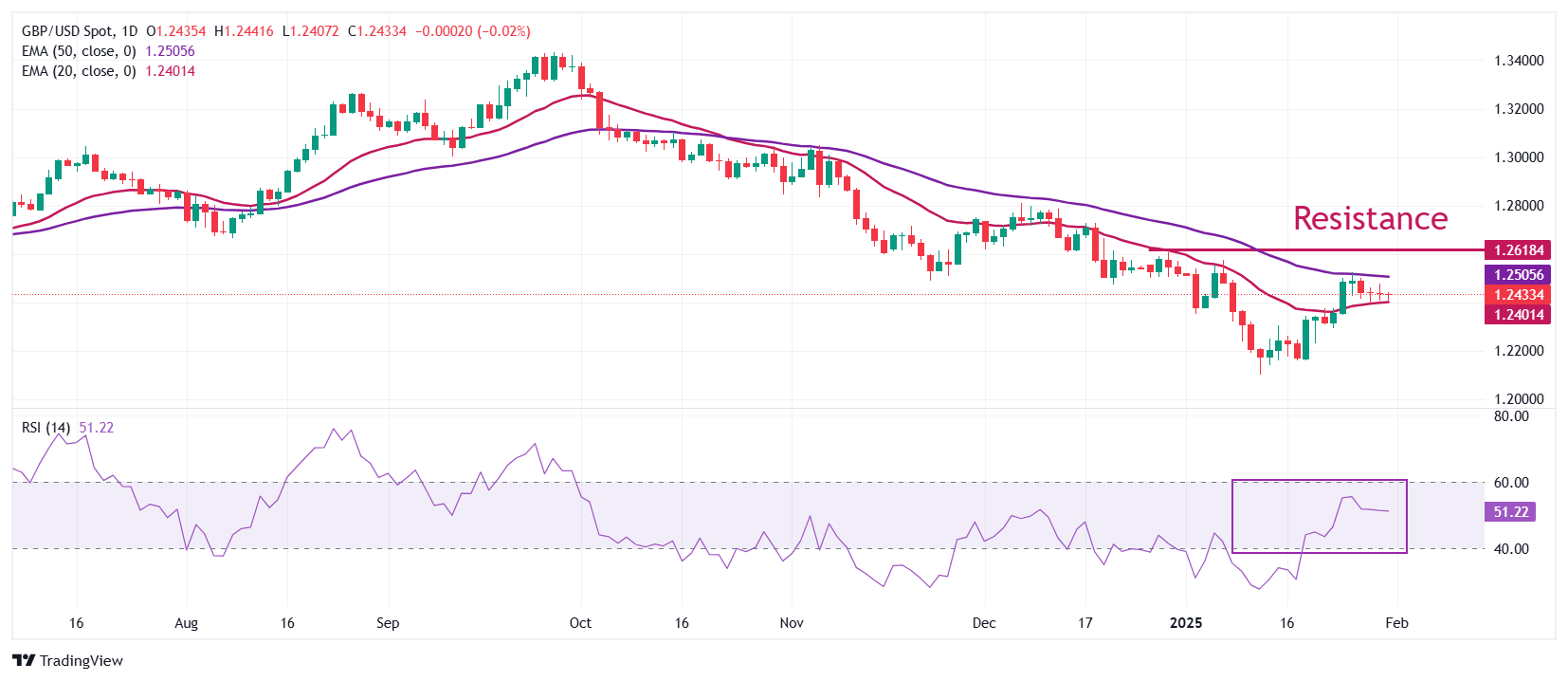
The Pound Sterling has held the key support of 1.2400 against the US Dollar since Monday. The near-term outlook for the GBP/USD pair remains firm as it holds the 20-day Exponential Moving Average (EMA), which trades around 1.2400. However, the 50-day EMA near 1.2510 remains a major barrier for the Sterling bulls.

The 14-day Relative Strength Index (RSI) oscillates in the 20.00-40.00 range, suggesting a sideways trend.

Looking down, the January 13 low of 1.2100 and the October 2023 low of 1.2050 will act as key support zones for the pair. On the upside, the December 30 high of 1.2607 will act as key resistance.

gold-bar-and-dollar-bills-42586628_XtraLarge

Gold price sits near record high; around $2,800 as traders await US PCE Price Index

Gold price (XAU/USD) touches the $2,800 mark, or a fresh all-time peak during the early part of the European session, and seems poised to prolong its well-established uptrend witnessed over the past month or so. US President Donald Trump’s threatened trade tariffs, along with geopolitical tensions, continue to underpin demand for the safe-haven bullion. Moreover, expectations that Trump’s protectionist policies would reignite inflation turn out to be another factor that benefits the commodity’s status as a hedge against rising price pressures.

This, along with a softer US Dollar (USD), supports prospects for a further near-term appreciating move for the Gold price. That said, the Federal Reserve’s (Fed) hawkish pause on Wednesday and a modest recovery in the US Treasury bond yields hold back traders from placing fresh bets around the non-yielding yellow metal. Traders also seem reluctant and opt to move to the sidelines ahead of the release of the US Personal Consumption Expenditure (PCE) Price Index, due for release later during the North American session.

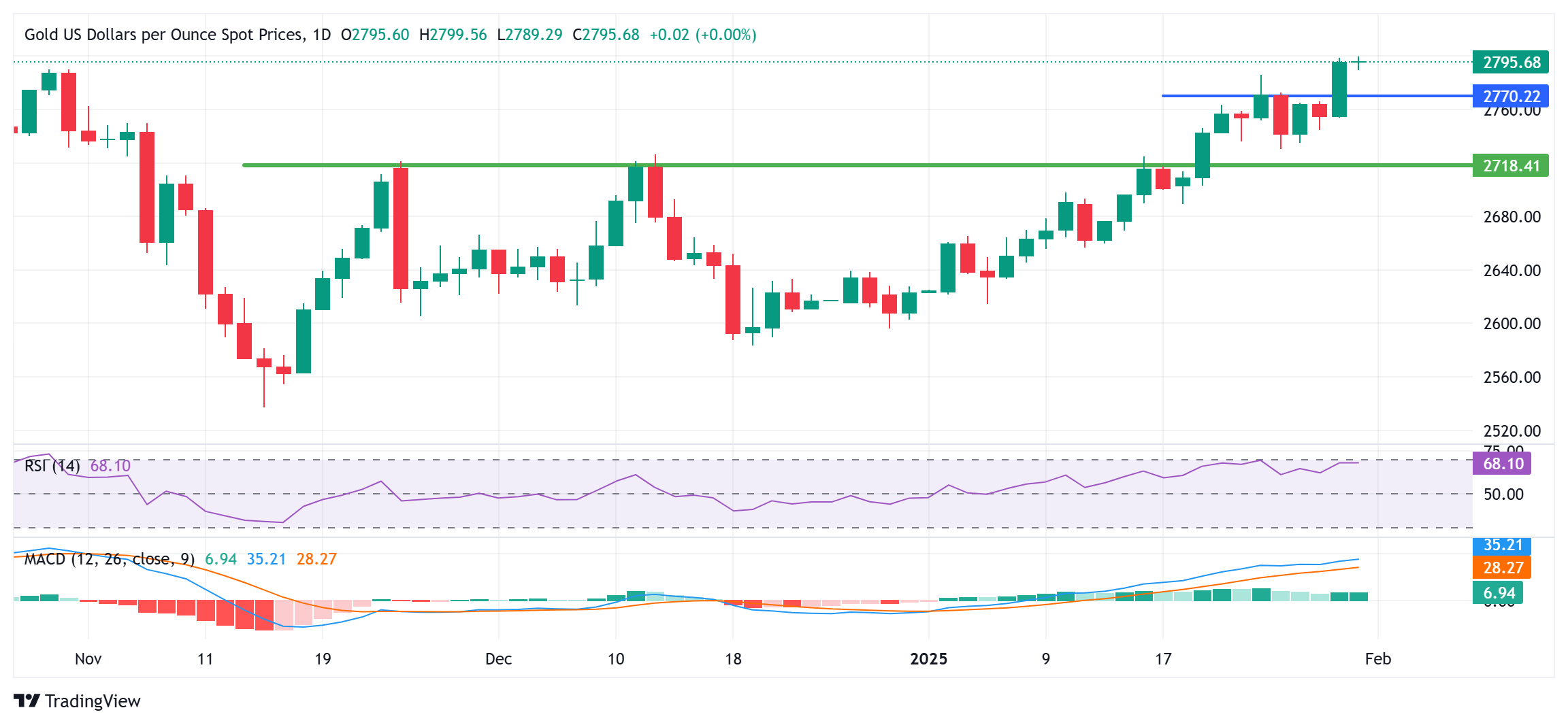
Gold price bulls have the upper hand while above the $2,773-2,772 resistance breakpoint

fxsoriginal

From a technical perspective, sustained strength and acceptance above the $2,800 mark will be seen as a fresh trigger for bulls. That said, the daily Relative Strength Index (RSI) is on the verge of breaking into the overbought zone. This makes it prudent to wait for some near-term consolidation or a modest pullback before placing fresh bullish bets around the Gold price and positioning for an extension of the strong move-up witnessed over the past month or so.

Meanwhile, any corrective slide is more likely to find decent support and remain limited near the $2,773-2,772 horizontal zone. This is followed by the $2,758-2,756 region, which if broken might prompt some long-unwinding and drag the Gold price further towards the $2,740 area en route to the $2,725-2,720 pivotal support. A convincing break below the latter could set the stage for some meaningful downside in the near term.

trading-plan_body_Actionplantradingplan-Copy

EUR/USD holds steady near 1.0400 after weak German data

EUR/USD continues to trade in a narrow channel at around 1.0400 in the European session on Friday. The data from Germany showed that Retail Sales unexpectedly declined in December, making it difficult for the Euro to gain traction.

From a technical standpoint, EUR/USD is navigating through mixed signals:

– Support levels: The pair finds initial support at 1.0176, the lowest point this year. A break below could open the door to the psychological 1.0000 mark.

– Resistance levels: On the upside, resistance is seen at 1.0532 (the YTD peak from January 27), seconded by 1.0629 and the 100-day Simple Moving Average (SMA) at 1.0666.

– Momentum Indicators: The Relative Strength Index (RSI) has dipped below 52, indicating weakening bullish momentum, while the Average Directional Index (ADX) below 24 suggests the trend is losing steam.

The European currency managed to regain some balance vs. its US counterpart on Thursday, prompting EUR/USD to set aside three daily pullbacks in a row while sparking a corrective decline in the US Dollar Index (DXY), which saw part of its weekly gains trimmed.

Dollar lost some of its shine

The US Dollar Index (DXY) faced a mild selling pressure and maintained its business in the vicinity of the 108.00 zone, coming back from Wednesday’s fresh four-day highs in the wake of the hawkish hold by the Federal Reserve (Fed) at its meeting. Thursday’s small downtick comes along a lacklustre rebound in US yields across the curve, while investors are keeping a close eye on President Trump’s trade policies, which have kept markets jittery since his Inauguration Day on January 20. Although a delay in imposing tariffs on the eurozone is expected to provide temporary relief for the Euro, the uncertainty remains, casting a shadow over the currency’s future.

Central Banks in the Spotlight

The Federal Reserve decided to keep interest rates steady on Wednesday, offering little guidance on when they might lower borrowing costs. Despite strong economic growth, persistent inflation above the target and low unemployment rates leave the Fed hesitant to make changes. In a notable shift, the Fed replaced its previous statement that inflation “has made progress” with one stating that price pressures remain “elevated.” This change signals a more cautious approach as they await further evidence of cooling inflation. The unanimous decision to maintain the federal funds rate at 4.25%–4.50% underscores the Fed’s wait-and-see strategy, especially as they consider the economic impacts of Trump’s trade and fiscal policies.

Meanwhile, the European Central Bank (ECB) met expectations by cutting interest rates by 25 basis points and hinted at more easing ahead. The ECB remains optimistic that inflation in the eurozone is gradually coming under control, despite ongoing global trade concerns. Although the eurozone economy is still sluggish, recent surveys show some signs of improvement, and inflation remains just above the ECB’s 2% target, justifying the rate cut.

Later, at her press conference, President Christine Lagarde stated that the ECB is not planning to reduce interest rates below the neutral level to stimulate the economy. She emphasised that rate decisions are made based on current data without committing to a specific pace. When it came to tariffs, Lagarde highlighted the complexity of economic factors, including global interest rates, trade shifts, and potential retaliatory measures. She reassured that a significant 50 basis points rate cut was never considered, with unanimous support for a 25 basis points reduction instead. She also affirmed confidence that inflation in the bloc will reach the 2% target by 2025 but warned that economic growth risks remain, particularly due to increased global trade tensions, which could keep the eurozone economy weak in the near term.

Tariff tensions could worsen the situation

The looming threat of US trade tariffs continues to cast a long shadow over the Euro. Should these tariffs be implemented, they could drive US inflation higher, potentially prompting the Fed to adopt a more hawkish stance. This would strengthen the Dollar even further and put additional pressure on the Euro, possibly dragging EUR/USD back to the critical parity level of 1.0000.

Looking Ahead: Challenges for the Euro

The Euro faces significant headwinds, including the Dollar’s resilience, differing policies between the ECB and the Fed, and structural issues within the eurozone, such as Germany’s economic slowdown. While short-term rallies are possible, sustained gains for the single currency seem unlikely in the current climate.

pop

USD/INR edges lower as traders await US GDP data

The Indian Rupee (INR) recovers some lost ground on Thursday after facing some selling pressure in the previous session. US Dollar sales by public sector banks, likely on behalf of the Reserve Bank of India (RBI) helped contain excess volatility in the local currency.

However, the month-end USD demand, maturity of positions in the non-deliverable forwards (NDF) market and cautious mood could weigh on the INR. Meanwhile, persistent foreign outflows and uncertainty about US President Donald Trump’s approach to trade tariffs might contribute to the INR’s downside.

Investors brace for the advance US Gross Domestic Product (GDP) data for the fourth quarter (Q4), including the weekly Initial Jobless Claims, and Pending Home Sales. On Friday, India’s Federal Fiscal Deficit will take center stage.

USD/INR’s outlook remains positive in the longer term

The Indian Rupee trades on a positive note on the day. The USD/INR pair remains capped within a narrow trading range on the daily timeframe. The positive bias of the USD/INR pair prevails as the price is well-supported above the key 100-day Exponential Moving Average (EMA). The upward momentum is reinforced by the 14-day Relative Strength Index (RSI), which is located above the midline near 64.05, suggesting the path of least resistance is to the upside.

On the bright side, the immediate resistance level for USD/INR is seen at an all-time high of 86.69. Extended gains above this level could pave the way to the 87.00 psychological mark.

On the flip side, the first downside target to watch is 86.31, the low of January 28. Any follow-through selling will expose 86.14, the low of January 24, followed by 85.85, the low of January 10.

nm

US GDP expected to confirm solid economic growth in Q4 despite easing from previous quarter

The United States (US) Bureau of Economic Analysis (BEA) is scheduled to release the preliminary estimate of the US Gross Domestic Product (GDP) for the October-December quarter on Thursday. Analysts anticipate that the report will indicate an annualised economic growth rate of 2.6%, slightly below the 3.1% posted in the third quarter of the year.

What to expect from GDP figures this time

The BEA’s preliminary GDP release is the most important for financial markets, as the figure is the ultimate indicator of US economic health. Alongside growth data, the report includes fresh Personal Consumption Expenditures (PCE) – Price Index figures, the Federal Reserve’s (Fed) favourite inflation gauge.

The current release is a bit tricky, as the Fed announced its monetary policy decision to keep interest rates on hold ahead of GDP and PCE updates, and financial markets are still digesting the latest on that front.

Back in December, the Fed published its latest Summary of Economic Projections (SEP) or dot plot, which showed upward revisions in 2025 year-end growth to 2.1% from 2% and to core inflation to 2.5% from 2.1%. Generally speaking, the latest SEP suggested policymakers expected continued economic expansion and inflation to remain above their 2% goal for some more time.

Beyond the headline GDP reading, market participants anticipate the Q4 core PCE Price Index will print at 2.5%, higher than the 2.2% posted in Q3.

Other than that, the report includes the GDP Price Index, which tracks changes in the prices of goods and services produced domestically, including exports but excluding imports. This index provides a clear view of how inflation is affecting GDP. For the fourth quarter, the GDP Price Index is expected to increase by 2.5%, up from the 1.9% rise seen in the third quarter.

It is worth adding that the GDPNow model from the Federal Reserve Bank of Atlanta estimates real GDP growth in the fourth quarter of 2024 is 3.2% on Tuesday, up from 3.0% on January 17.

When will the GDP print be released and how can it affect the USD?

The US GDP report will be published at 13:30 GMT on Wednesday. In addition to the headline real GDP figure, changes in private domestic purchases, the GDP Price Index and the Q4 PCE Price Index figures could impact the US Dollar’s (USD) valuation.

A better-than-anticipated GDP headline could support the Fed’s dovish case and pressure the USD while discouraging figures could have the opposite effect on the American currency.

Valeria Bednarik, FXStreet Chief Analyst, says: “The US Dollar Index (DXY) recovered amid a risk-averse environment at the beginning of the week but stands far below the monthly high posted in mid-January at 110.18. At the same time, the ongoing advance lacks momentum, according to technical readings in the daily chart. The January 23 intraday high at 108.50 comes as an immediate barrier ahead of the 109.00 figure. Should the index surpass the latter, market players will be looking at the 109.40-109.50 region as a potential bullish target.”

Bednarik adds: “A decline below 107.75, the January 29 intraday low, exposes the monthly bottom at 106.97. Still, and given the risk-averse environment, US Dollar dips could be seen as buying opportunities, with additional falls unlikely in the near term.”

lll

EUR/GBP recovers some lost ground above 0.8350, eyes on ECB rate decision

The EUR/GBP cross rebounds to near 0.8370, snapping the five-day losing streak during the early European trading hours on Thursday. However, the upside of the cross might be limited amid the dovish stance of the European Central Bank (ECB). The ECB interest rate decision and the preliminary reading of the Eurozone Gross Domestic Product (GDP) for the fourth quarter will be the highlights later on Thursday.

The ECB is expected to cut its key interest rate by another 25 basis points (bps) to 2.75% at its January meeting on Thursday and is likely to keep open the door to further policy easing amid an uncertain economic outlook and worries about persistent inflation. This, in turn, might weigh on the Euro (EUR) against the Pound Sterling (GBP). The ECB lowered borrowing costs four times in 2024, and up to four moves are anticipated this year.

On the GBP’s front, financial markets on Wednesday have priced in almost three quarter-point rate cuts by the Bank of England (BoE) this year, compared with fewer than two reductions in early January. The UK economy has stagnated and inflation eased last month, boosting the bets on BoE rate cuts. Economists polled by Reuters expect the BoE to cut its benchmark rate to 4.50% from 4.75% next week. “Although a dovish statement from the BoE can be expected to keep the pound on the back foot in the near term, it would also provide comfort for investors and the business community,” said Jane Foley, senior FX strategist at Rabobank.

mun

Token unlock worth $330 million could impact these four cryptos

Crypto protocols Optimism (OP), Sui (SUI), ZetaChain (ZETA) and DYDX (DYDX) are set to unlock $330 million in scheduled events this week. These four cryptos unlock between 1% and 7% of their circulating supply. Traders should be cautious as token unlocks frequently generate negative sentiment among investors as they represent an increase in circulating supply, weighing down prices.

Token unlocks could bring volatility in OP, SUI, ZETA and DYDX 

According to Tokenomist data, which provides solutions for supply-side tokenomics data for cryptocurrencies, key token unlocks worth $330 million are scheduled for this week.

The charts below show that Optimism, Sui, ZetaChain and DYDX plan to unlock tokens worth $46.70 million, $258.06 million, $19.13 million and $8.76 million, respectively, on Friday and Saturday.

OP, SUI, ZETA, and DYDX tokens unlock 2.32%, 2.13%, 6.98% and 1.15%, respectively, of their circulating supply. These tokens will fund initiatives such as a user growth pool, an ecosystem growth fund, core contributor rewards, advisory roles, and liquidity incentives.

Traders should remain cautious as the increased supply from token unlocks frequently generates negative sentiment among investors, which can weigh down prices.

Optimism tokenomics chart. Source: Tokenomist

Optimism tokenomics chart. Source: Tokenomist

Sui tokenomics chart. Source: Tokenomist

Sui tokenomics chart. Source: Tokenomist

ZetaChain tokenomics chart. Source: Tokenomist

ZetaChain tokenomics chart. Source: Tokenomist

DYDX tokenomics chart. Source: Tokenomist

DYDX tokenomics chart. Source: Tokenomis

gold_246-768x419

Gold price steadily climbs back closer to weekly top; seems poised to appreciate further

Gold price (XAU/USD) regains positive traction following the previous day’s two-way price move and trades near the top end of its weekly range, above the $2,765 level during the early part of the European session on Thursday. The uptick is sponsored by a fresh leg down in the US Treasury bond yields, which tends to underpin demand for the non-yielding yellow metal. Apart from this, concerns about the potential economic fallout from US President Donald Trump’s tariff plans further benefit the safe-haven commodity.

Furthermore, Trump’s demand for lower interest rates and signs of abating inflation in the US support the prospect for further policy easing by the Federal Reserve (Fed) and a further appreciating move for the Gold price. That said, the hawkish pause on Wednesday continues to underpin the US Dollar (USD), which, along with a positive risk tone, keeps a lid on the XAU/USD. Traders now look to the European Central Bank (ECB) decision for some impetus ahead of the release of the Advance US Q4 GDP print.

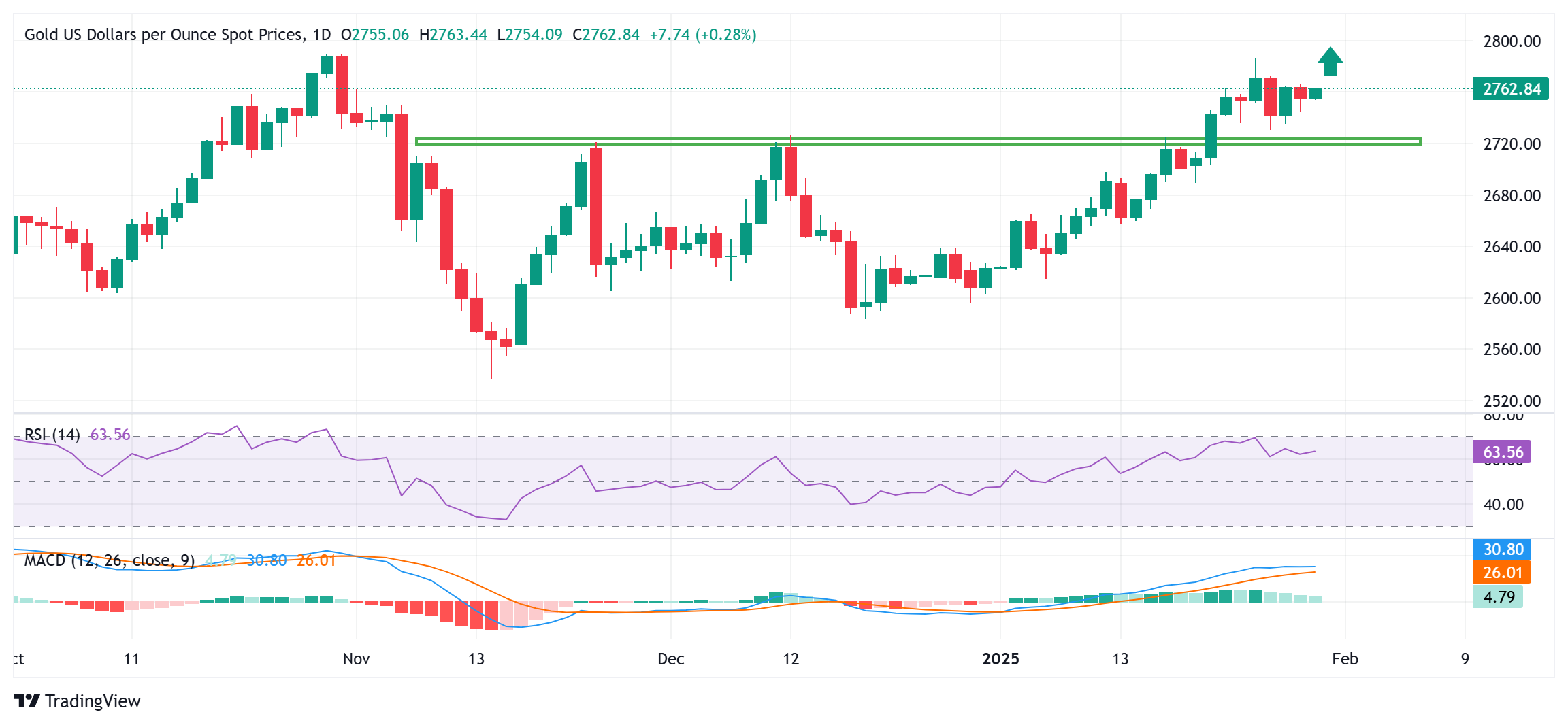
Gold price could accelerate the positive move once the $2,772-2,773 hurdle is cleared

fxsoriginal

From a technical perspective, the recent breakout through the $2,720-2,725 horizontal barrier and positive oscillators on the daily chart validate the near-term positive outlook for the Gold price. That said, it will still be prudent to wait for a subsequent strength beyond the $2,772-2,773 immediate hurdle before positioning for a move towards the $2,786 area, or the highest level since October 2024 touched last Friday. The momentum could extend further towards the all-time peak, near the $2,790 zone. Some follow-through buying, leading to a move beyond the $2,800 mark, will be seen as a fresh trigger for bulls and pave the way for an extension of a well-established uptrend witnessed over the past month or so.

On the flip side, weakness below the overnight swing low, around the $2,745-2,744 area could be seen as a buying opportunity but limited near the $2,730 region, or the weekly trough touched on Monday. This is followed by the $2,725-2,750 resistance-turned-support, below which the Gold price could accelerate the fall towards the $2,707-2,705 area en route to the $2,684 support zone.