eur_456

EUR/USD eases toward 1.0400 ahead of a busy EU docket

EUR/USD is falling back toward 1.0400 in European trading on Thursday. Unexpected French Q4 GDP contraction, ECB rate cut expectations and a renewed US Dollar uptick weigh on the pair. German and EU GDP data eyed ahead of ECB verdict.

From a technical perspective, EUR/USD is navigating choppy waters:

– Support lies at 1.0176, the YTD low from January 13, with the critical 1.0000 parity level below that.

– Resistance sits at the 2025 high of 1.0532 (January 27), followed by the December 2024 top of 1.0629 and the 100-day SMA at 1.0672.

– The broader bearish trend remains intact as long as the pair trades below the 200-day SMA at 1.0768.

Short-term indicators offer a mixed outlook. The RSI has dropped below 53, signalling waning bullish momentum, while the ADX near 24 suggests fading trend strength.

The Euro (EUR) remained on the defensive for yet another day on Wednesday, this time retreating to four-day lows around 1.0380. This decline came as the US Dollar (USD) maintained its recovery well in place, driven by renewed concerns over potential US trade tariffs and following the neutral tone from the FOMC event.

In addition, the US Dollar Index (DXY) climbed above 108.00 once again, hitting fresh four-day peaks alongside the continuation of the rebound in US yields across the curve.

Trade tariff jitters weigh on sentiment

Speculation about President Trump’s trade tariff policies has been keeping markets on edge since Inauguration Day on January 20. While the delay in imposing eurozone tariffs provided some short-term relief for the Euro, the lingering uncertainty continues to cloud the currency’s outlook.

Central banks in focus

The Federal Reserve kept interest rates unchanged on Wednesday, leaving markets with few hints about when borrowing costs might come down. Despite solid economic growth, inflation remains above target, and unemployment is still low, giving the central bank little urgency to act.

In a notable shift, the Fed dropped its previous statement that inflation “has made progress” toward its 2% goal. Instead, officials now describe price pressures as “elevated,” signalling caution as they wait for more evidence of cooling inflation. While policymakers still expect inflation to ease over time, they have put rate cuts on hold until data confirms the trend.

The decision to keep the federal funds rate at 4.25%–4.50% was unanimous, reinforcing the Fed’s wait-and-see approach. With inflation and job market data still in focus, officials are also assessing the potential economic impact of President Trump’s trade and fiscal policies before making their next move.

Across the Atlantic, the ECB faces its own challenges. Led by President Christine Lagarde, the bank is expected to cut rates further on Thursday but is treading carefully to avoid overshooting its 2% inflation target or exacerbating economic slowdowns in the eurozone. Germany’s economic struggles and broader political uncertainties remain significant hurdles.

Tariff tensions could tip the scales

The ongoing threat of US trade tariffs looms large over the Euro’s prospects. If implemented, such tariffs could drive US inflation higher, potentially prompting a more hawkish stance from the Fed, which would strengthen the Dollar and pressure the Euro further. In such a scenario, the psychologically critical parity level (1.0000) for EUR/USD could re-enter the picture.

The road ahead for the Euro

The Euro faces stiff headwinds, including the Dollar’s resilience, divergent ECB-Fed policies, and structural challenges within the eurozone, such as Germany’s slowdown. While short-term rallies remain possible, sustained gains for the Euro may prove elusive in the current environment.

What’s next for EUR/USD?

With the first major rate decisions of the year from both the Fed and the ECB, this week could set the tone for EUR/USD. Investors will also closely monitor key economic data, particularly inflation updates and any new developments in trade policies. For now, the battle between a resilient Dollar and the Euro’s internal struggles is likely to dominate the narrative in the weeks ahead.


dt

US Dollar consolidates gains as focus shifts to Fed policy announcements

The US Dollar (USD) struggles to build on Tuesday’s gains as investors move to the sidelines ahead of the Federal Reserve’s (Fed) highly-anticipated monetary policy announcements. The US economic docket will also feature Goods Trade Balance data for December. Additionally, the Bank of Canada (BoC) will release its interest rate decision in the early trading hours of the American session on Wednesday.

US Dollar PRICE This week

The table below shows the percentage change of US Dollar (USD) against listed major currencies this week. US Dollar was the strongest against the Australian Dollar.

USD EUR GBP JPY CAD AUD NZD CHF
USD 0.60% 0.17% -0.29% 0.27% 1.16% 0.75% -0.11%
EUR -0.60% -0.36% -0.74% -0.19% 0.56% 0.27% -0.60%
GBP -0.17% 0.36% -0.70% 0.18% 0.93% 0.65% -0.24%
JPY 0.29% 0.74% 0.70% 0.61% 1.64% 1.29% 0.33%
CAD -0.27% 0.19% -0.18% -0.61% 0.69% 0.48% -0.41%
AUD -1.16% -0.56% -0.93% -1.64% -0.69% -0.25% -1.11%
NZD -0.75% -0.27% -0.65% -1.29% -0.48% 0.25% -1.10%
CHF 0.11% 0.60% 0.24% -0.33% 0.41% 1.11% 1.10%

The heat map shows percentage changes of major currencies against each other. The base currency is picked from the left column, while the quote currency is picked from the top row. For example, if you pick the US Dollar from the left column and move along the horizontal line to the Japanese Yen, the percentage change displayed in the box will represent USD (base)/JPY (quote).

The USD Index gained traction and rose nearly 0.5% on Tuesday as the uncertainty surrounding US President Donald Trump’s tariff policy forced markets to adopt a cautious stance. Early Wednesday, the USD Index stays in a consolidation phase slightly below 108.00. The Fed is widely anticipated to keep its monetary policy settings unchanged following the first meeting of the year. After the Fed releases its policy statement, Chairman Jerome Powell will respond to questions in a press conference starting at 19:30 GMT.

USD/CAD holds steady at around 1.4400 after posting small gains on Tuesday. The BoC is expected to lower the policy rate by 25 basis points (bps) to 3%.

During the Asian trading hours on Wednesday, the data from Australia showed that the Consumer Price Index (CPI) rose 2.4% on a yearly basis in the fourth quarter. This reading followed the 2.8% increase recorded in the third quarter and came in below the market expectation of 2.5%. Assessing the inflation report, Australian Treasurer Jim Chalmers said the worst of the inflation challenge is well and truly behind them and added that the soft landing they have been planning for is looking more and more likely. AUD/USD stays under modest bearish pressure in the European morning and trades below 0.6250.

According to the Bank of Japan’s (BoJ) Monetary Policy Meeting Minutes, some policymakers preferred to raise the interest rate to 0.5%, while the majority voted to keep rates unchanged at 0.25%, citing uncertainties in wage growth and global economic conditions. USD/JPY showed no immediate reaction to this publication and was last seen trading near 155.20.

EUR/USD turned south and lost more than 0.5% on Tuesday. The pair holds steady at around 1.0430 to begin the European session on Wednesday. The European Central Bank will release Private Loans data for December later in the session.

GBP/USD closed in negative territory on Tuesday and snapped a three-day winning streak. The pair trades marginally higher on the day above 1.2450 early Wednesday.

Following the bearish opening to the week, Gold regained its traction and rose more than 0.8% on Tuesday. XAU/USD struggles to preserve its bullish momentum but holds comfortably above $2,750.

mmty

EUR/GBP falls below 0.8400 as continuing losing streak due to a potential ECB rate cut

EUR/GBP extends its losing streak for the fifth successive session, trading around 0.8380 during the early European hours on Wednesday. Further downside risks for the EUR/GBP cross seem possible as the Euro (EUR) could weaken due to the increased likelihood that the European Central Bank (ECB) will lower its Deposit Facility rate by 25 basis points (bps) to 2.75% on Thursday. This expectation stems from the sluggish economic outlook in the Eurozone and confidence that inflation will sustainably return to the ECB’s 2% target.

With a 25 bps rate cut already priced in, investors will closely monitor President Christine Lagarde’s press conference for insights on how potential tariffs from Trump might influence economic and monetary policy.

However, this downside of the EUR/GBP cross could be limited as the Pound Sterling (GBP) remains under pressure amid rising concerns over the risk of stagflation in the UK economy, driven by weakening labor demand and persistent inflation.

Traders are currently pricing in a 25 basis point (bps) rate cut in the Bank of England’s (BoE) first monetary policy decision of 2025 on February 6, which would bring borrowing rates down to 4.5% amid the sluggish economic outlook.

On Tuesday, UK Prime Minister Keir Starmer gave optimistic remarks on the economy in a Bloomberg interview. Starmer emphasized that the Labour government’s top priority is “growth” and noted that the economy is beginning to “turn around.” He also highlighted the strong trade ties between the United States (US) and the UK, stating that “we’ve got a huge amount of trade with the United States already, and the base is there for even better trading relations. We need to build on that.”

usd

The Japanese Yen (JPY) remains on the front foot against its American counterpart heading into the European

The Japanese Yen (JPY) remains on the front foot against its American counterpart heading into the European session on Wednesday amid bets for more interest rate hikes by the Bank of Japan (BoJ). Furthermore, the recent decline in the US Treasury bond yields, led by the prospects for further easing by the Federal Reserve (Fed), resulted in the narrowing of the US-Japan yield differential and further benefits the lower-yielding JPY. Apart from this, the emergence of some US Dollar (USD) selling drags the USD/JPY pair to the 155.00 psychological mark.

That said, growing market concerns about US President Donald Trump’s trade policies and a positive risk tone might hold back traders from placing aggressive bullish bets around the safe-haven JPY. Investors might also opt to move to the sidelines ahead of the key central bank event risk – the outcome of a two-day FOMC policy meeting. The Fed is scheduled to announce its decision later during the US session, which will play a key role in influencing the near-term USD price dynamics and provide some meaningful impetus to the USD/JPY pair.

USD/JPY could accelerate the slide once the 155.00 psychological mark is broken decisively

fxsoriginal

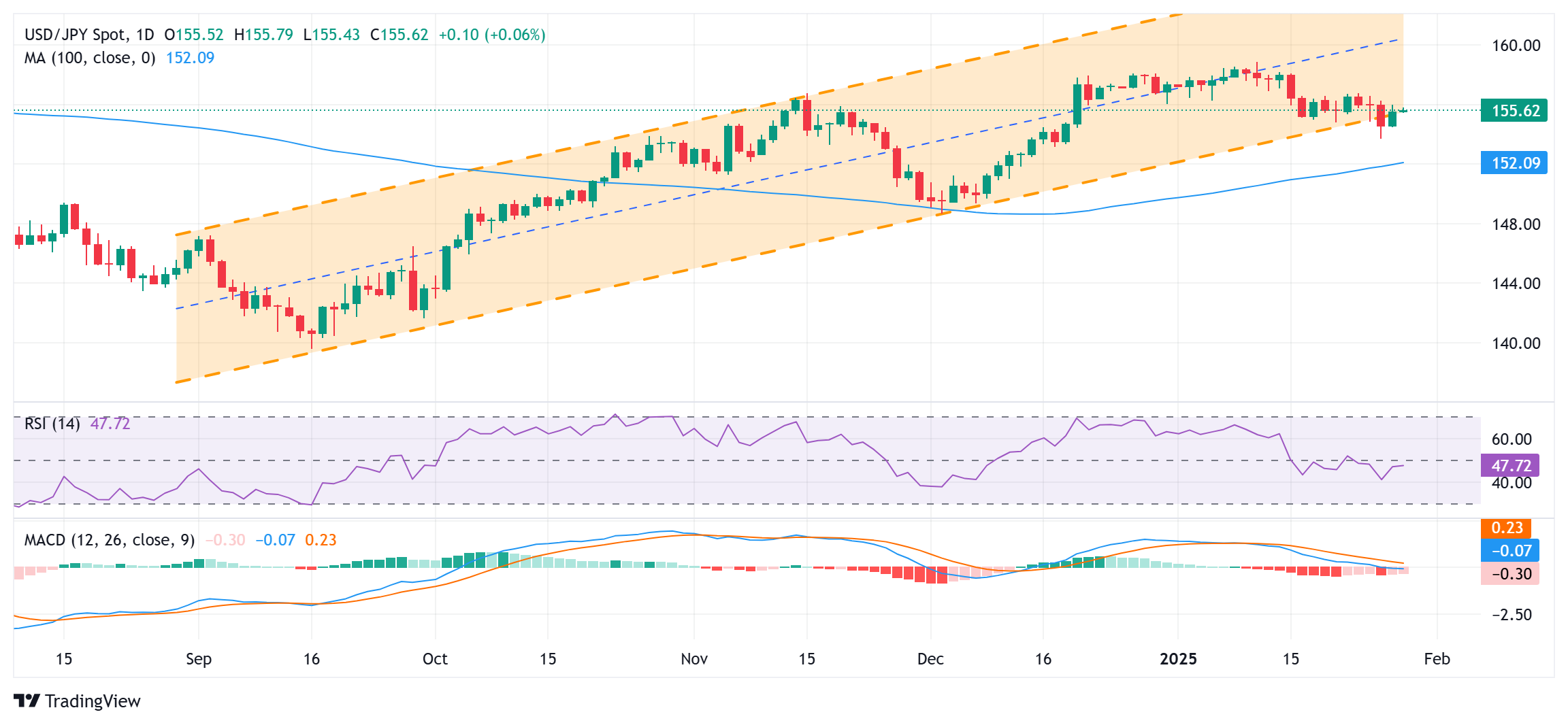
This week’s breakdown below a multi-month-old ascending channel favors bearish traders amid slightly negative oscillators on the daily chart. Hence, any subsequent move up beyond the 156.00 mark could be seen as a selling opportunity and remain capped near the 156.60-156.70 supply zone. Some follow-through buying, however, could trigger a short-covering rally and lift the USD/JPY pair beyond the 157.00 mark, towards the 157.45 hurdle. The momentum could extend further towards the 158.00 mark en route to the 158.85-158.90 region, or a multi-month top touched on January 10.

On the flip side, the 155.00 psychological mark now seems to protect the immediate downside ahead of the 154.55-154.50 horizontal zone and the 154.00 round figure. This is closely followed by the weekly swing low, around the 153.70 area touched Monday, below which the USD/JPY pair could accelerate the fall further towards the 153.30 support before eventually dropping to the 153.00 mark.


dollar

Japanese Yen builds on steady intraday ascent; USD/JPY eyes 155.00 ahead of Fed

The Japanese Yen (JPY) attracts fresh buyers during the Asian session on Wednesday and recovers a part of the previous day’s losses against its American counterpart part amid bets for more interest rate hikes by the Bank of Japan (BoJ). Apart from this, the recent narrowing of the US-Japan yield differential, led by rising the divergent BoJ-Federal Reserve (Fed) policy expectations, turns out to be another factor that benefits the lower-yielding JPY.

Meanwhile, the US Dollar (USD) struggles to capitalize on Tuesday’s goodish recovery from over a one-month low amid bets that the Fed will lower borrowing costs twice this year and contribute to the USD/JPY pair’s modest downtick. That said, concerns about US President Donald Trump’s threatened tariffs and a generally positive risk tone might cap gains for the safe-haven JPY as traders await the FOMC policy decision later this Wednesday.

USD/JPY bears await acceptance below ascending channel support before plaing fresh bets

fxsoriginal

This week’s breakdown below a multi-month-old ascending channel favors bearish traders amid slightly negative oscillators on the daily chart. Hence, any subsequent move up beyond the 156.00 mark could be seen as a selling opportunity and remain capped near the 156.60-156.70 supply zone. Some follow-through buying, however, could trigger a short-covering rally and lift the USD/JPY pair beyond the 157.00 mark, towards the 157.45 hurdle. The momentum could extend further towards the 158.00 mark en route to the 158.85-158.90 region, or a multi-month top touched on January 10.

On the flip side, the 155.00 psychological mark now seems to protect the immediate downside ahead of the 154.55-154.50 horizontal zone and the 154.00 round figure. This is closely followed by the weekly swing low, around the 153.70 area touched Monday, below which the USD/JPY pair could accelerate the fall further towards the 153.30 support before eventually dropping to the 153.00 mark.

Japanese Yen PRICE Today

The table below shows the percentage change of Japanese Yen (JPY) against listed major currencies today. Japanese Yen was the strongest against the Australian Dollar.

USD EUR GBP JPY CAD AUD NZD CHF
USD -0.07% -0.09% -0.19% -0.01% 0.22% 0.09% -0.08%
EUR 0.07% -0.02% -0.08% 0.06% 0.29% 0.18% 0.02%
GBP 0.09% 0.02% -0.08% 0.08% 0.31% 0.18% 0.01%
JPY 0.19% 0.08% 0.08% 0.17% 0.41% 0.26% 0.11%
CAD 0.01% -0.06% -0.08% -0.17% 0.23% 0.10% -0.07%
AUD -0.22% -0.29% -0.31% -0.41% -0.23% -0.12% -0.30%
NZD -0.09% -0.18% -0.18% -0.26% -0.10% 0.12% -0.17%
CHF 0.08% -0.02% -0.01% -0.11% 0.07% 0.30% 0.17%

The heat map shows percentage changes of major currencies against each other. The base currency is picked from the left column, while the quote currency is picked from the top row. For example, if you pick the Japanese Yen from the left column and move along the horizontal line to the US Dollar, the percentage change displayed in the box will represent JPY (base)/USD (quote).


arr

EUR/USD inches higher to near 1.0450 amid risk reset

EUR/USD has found buyers and tests 1.0450 in the early European session on Wednesday. The pair capitalizes on a modest recovery in risk sentiment and reduced haven demand for the US Dollar. Traders reposition ahead of the key Fed policy announcements.

The EUR/USD has immediate support around 1.0176, the year-to-date low reached on January 13, with a critical level at 1.0000 below that. On the upside, resistance is at the 2025 high of 1.0532 (January 27), followed by the December 2024 peak of 1.0629 and the provisional 100-day SMA of 1.0678.

For the time being, the larger negative trend will continue as long as the pair trades below the 200-day SMA at 1.0769.

Short-term indicators present a mixed picture. The RSI drops to around 53, indicating some loss of momentum, however the ADX, which is below 26, indicates fading trend strength.

The Euro (EUR) added to the pessimistic kickstart to the week and slipped back to the proximity of the key contention zone at 1.0400, or two-day lows, on the back of the resurgence of the marked bid bias in the US Dollar (USD).

Indeed, on the latter, the Greenback regained composure in response to another bout of US threats to implement tariffs, while cautiousness prevailed surrounding DeepSeek news. Against that backdrop, the US Dollar Index (DXY) reclaimed the 108.00 mark and slightly above, reaching fresh weekly tops along with an acceptable recovery in US yields across the spectrum.

Meanwhile, speculation about President Trump’s trade tariff policies continues to swirl, keeping investors on edge during a week dominated by key interest rate decisions from both the Federal Reserve (Fed) and the European Central Bank (ECB).

Central banks in the spotlight

The Fed has started its two-day meeting on Tuesday, with the CME Group’s FedWatch Tool showing a near-consensus expectation that the Fed will hold rates steady on Wednesday.

In addition, speculation that the bank might trim its interest rates by 50 basis points this year appearing quite firm for the time being.

Monetary policy remains a major driver of the EUR/USD pair’s direction.

In the US, a stronger-than-expected December jobs report (+256K) briefly reassured markets. However, concerns linger as the Fed lowered rates to 4.25%–4.50% during its December meeting and signalled a cautious approach for 2025. Fed Chair Jerome Powell emphasised the need to tackle stubbornly high inflation while acknowledging signs of cooling in the labour market.

On the other side of the Atlantic, the European Central Bank (ECB) is also navigating its path forward. While the ECB is expected to cut rates further, its policymakers—led by President Christine Lagarde—are taking a measured approach to avoid overshooting the 2% inflation target or risking further economic slowdown.

The market is also closely watching Trump’s decision to delay imposing trade tariffs on the eurozone. While this has provided some short-term relief for the Euro (EUR), the spectre of future tariffs still looms large, potentially dragging on the bloc’s economy and currency.

Trade tariff tensions cloud the outlook

Ongoing uncertainty around potential US trade tariffs is a wild card for EUR/USD. Should tariffs drive up US inflation, the Fed might adopt a more hawkish stance, which could strengthen the Dollar and pressure the European currency. In such a scenario, the psychologically critical parity level for EUR/USD could come back into focus.

Challenges ahead for the Euro

Despite recent gains, the Euro faces significant challenges. The Greenback’s resilience, divergent central bank policies, and structural issues within the eurozone—such as Germany’s economic slowdown and broader political uncertainties—pose serious headwinds. While short-term rallies are possible, sustained gains for the pair may remain elusive in this environment.

images

EUR/CAD Price Forecast: The first upside barrier emerges near 1.5100, BoC rate decision in focus

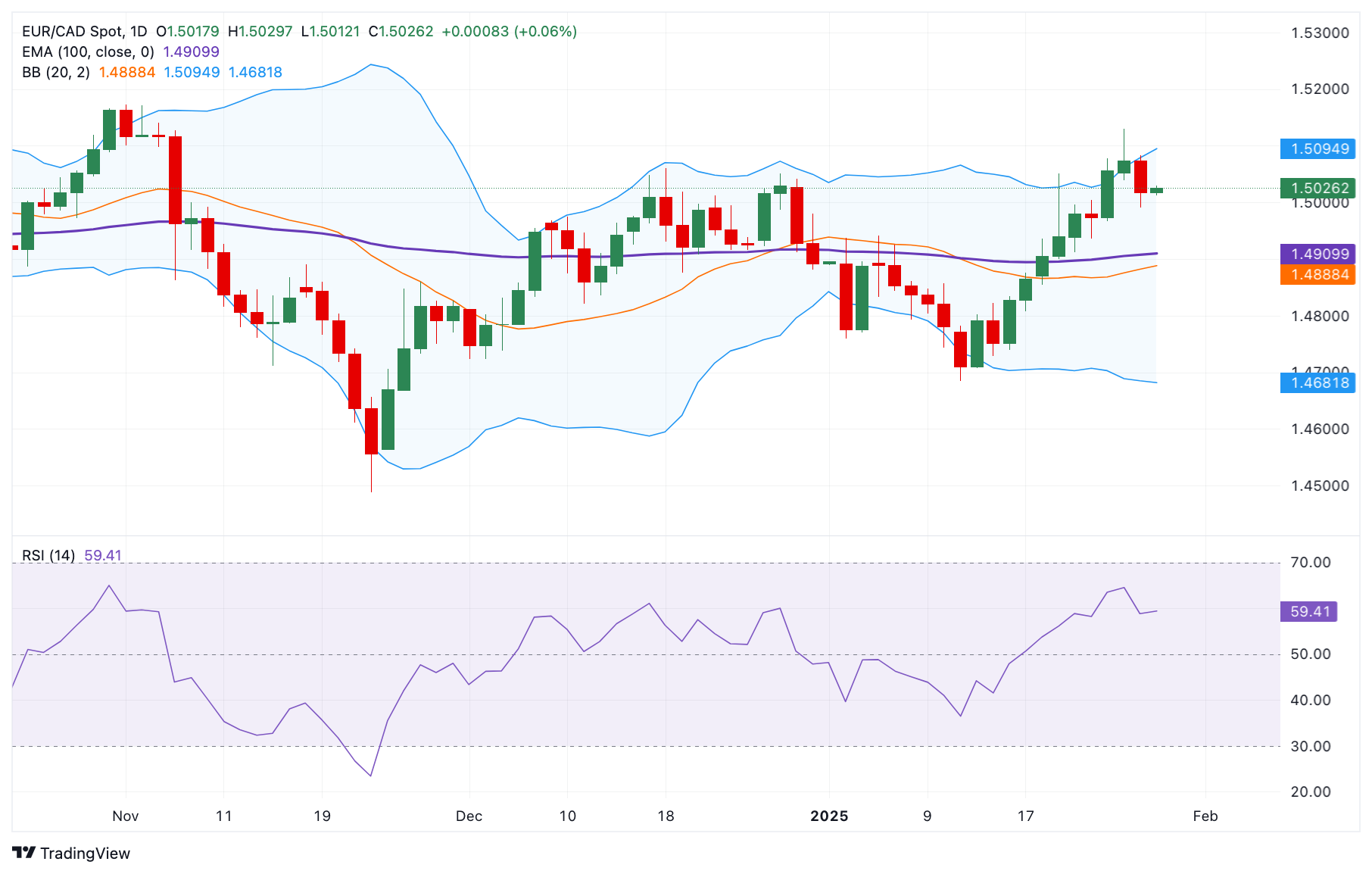
The EUR/CAD cross trades in positive territory around 1.5025 during the early European session on Wednesday. The Bank of Canada (BoC) will likely cut its key benchmark rate by 25 basis points (bps) at its January meeting on Wednesday.

The rising bets of BoC rate cut bets and the concerns about tariff policies from US President Donald Trump could weigh on the Canadian Dollar (CAD) against the Euro (EUR) in the near term. Trump said last week that he will impose a 25% tariff on Canada and Mexico from February 1.

Technically, the bullish outlook of EUR/CAD remains intact as the cross holds above the key 100-day Exponential Moving Averages (EMA) on the daily chart. The upward momentum is supported by the 14-day Relative Strength Index (RSI), which is located above the midline near 59.50. This indicates that further upside looks favorable.

The first upside barrier for the cross is in the 1.5095-1.5100 zone, representing the upper boundary of the Bollinger Band and psychological level. Further north, the next hurdle is seen at 1.5130, the high of January 27. A decisive break above this level will see a rally to 1.5172, the high of November 1, 2024.

On the other hand, the low of January 23 at 1.4936 acts as an initial support level for EUR/CAD. The crucial contention level to watch is 1.4905, the 100-day EMA. The additional downside filter is located at 1.4760, the low of January 2.

EUR/CAD daily chart

gold-bar-and-dollar-bills-42586628_XtraLarge

Gold price ticks lower on positive risk tone; bears lack conviction amid trade war fears

Gold price (XAU/USD) struggles to capitalize on the previous day’s positive move and trades with a mild negative bias, just above the $2,760 level during the Asian session on Wednesday. A generally positive tone around the equity markets is seen as a key factor acting as a headwind for the safe-haven precious metal. The downside, however, seems limited amid a fresh leg down in the US Treasury bond yields, which cap the US Dollar (USD) recovery from over a one-month low and lends support to the non-yielding yellow metal.

Apart from this, concerns about US President Donald Trump’s tariff plans might contribute to limiting losses for the Gold price amid subdued US Dollar (USD) price action. Traders might also refrain from placing aggressive bets and opt to wait on the sidelines ahead of the key central bank event risk – the outcome of a two-day FOMC monetary policy meeting. The Fed’s rate outlook will play a key role in influencing the near-term USD price dynamics and determining the next leg of a directional move for the precious metal.

Gold price bulls have the upper hand while above the $2,720-2,725 resistance breakpoint

fxsoriginal

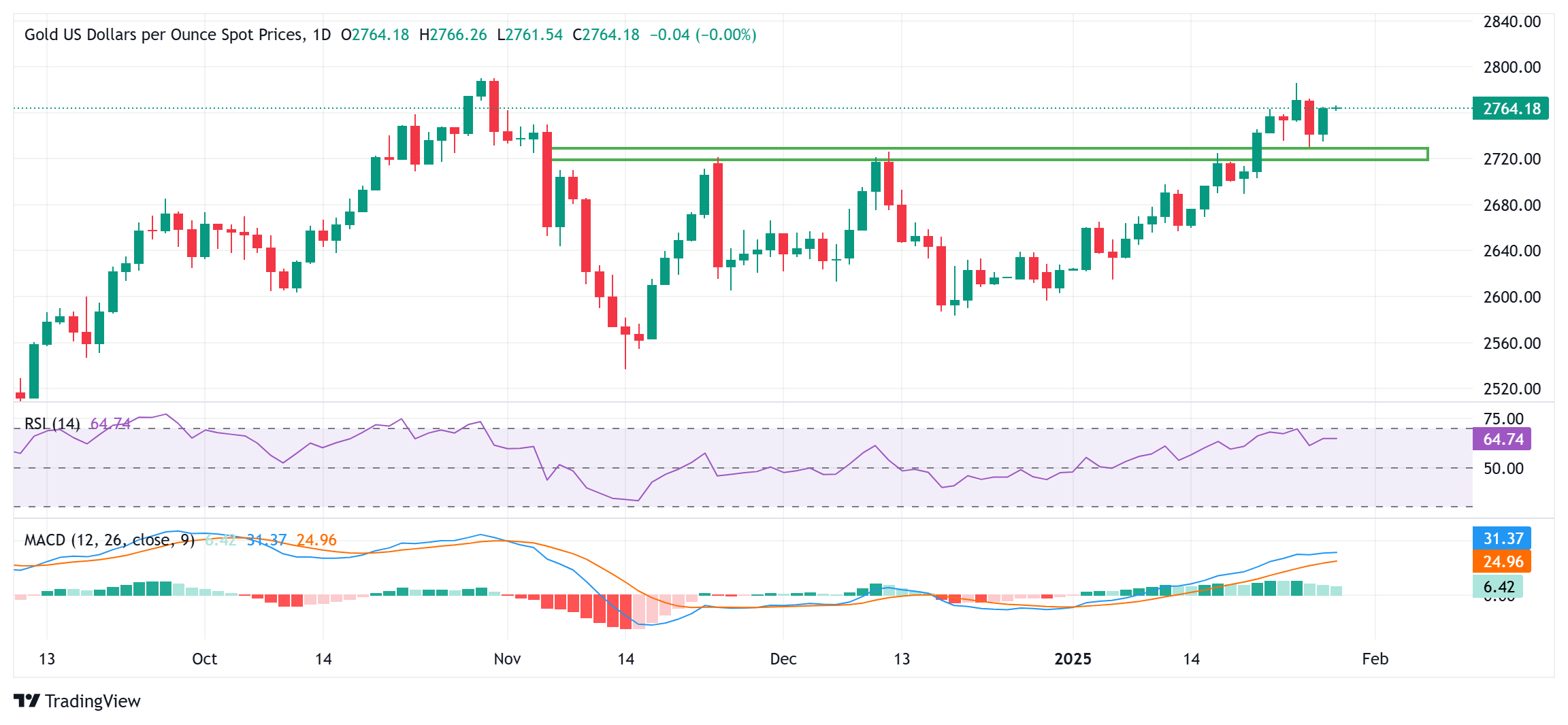
From a technical perspective, the recent breakout through the $2,720-2,725 horizontal barrier and positive oscillators on the daily chart suggest that the path of least resistance for the Gold price remains to the upside. A subsequent move above the $2,772-2,773 area will reaffirm the constructive outlook and lift the XAU/USD beyond the $2,786 area, or the highest level since October 2024 touched last Friday, towards the all-time peak, near the $2,790 zone. Some follow-through buying, leading to a strength beyond the $2,800 mark, will be seen as a fresh trigger for bullish traders and pave the way for an extension of a well-established uptrend witnessed over the past month or so.

On the flip side, weakness below the $2,755-2,753 immediate support might continue to attract some buyers and remain limited near the weekly swing low, around the $2,730 area touched on Monday. Some follow-through selling below the $2,725-2,720 resistance-turned-support could pave the way for deeper losses and drag the Gold price to the $2,707-2,705 area en route to the $2,684 region.

blog-eurusd-14-01-25

USD/INR gathers strength on month-end US Dollar demand, eyes on Fed rate decision

The Indian Rupee (INR) edges lower on Wednesday, pressured by strong US Dollar (USD) bids related to importers’ month-end payments. The local currency remains on the defensive amid renewed concerns about trade tariffs from US President Donald Trump, along with the sustained foreign fund outflows. Nonetheless, the routine foreign exchange intervention from the Reserve Bank of India (RBI) might help limit the INR’s losses.

The US Federal Reserve (Fed) interest rate decision will be in the spotlight later on Wednesday, with no change in rate expected. Investors will closely monitor Fed Chair Jerome Powell’s press conference as it might offer additional insights into the monetary policy outlook. The cautious stance from the Fed officials could provide some support to the Greenback and act as a headwind for the pair. On the Indian docket, the Federal Fiscal Deficit will take center stage on Friday.

images

EUR/USD inches higher to near 1.0450, upside seems limited amid a risk-off mood

EUR/USD halts its two-day losing streak, trading around 1.0440 during the Asian hours on Wednesday. However, the pair could continue facing challenges amid risk-off sentiment ahead of the Federal Reserve’s interest rate decision scheduled later in the North American session.

The EUR/USD has immediate support around 1.0176, the year-to-date low reached on January 13, with a critical level at 1.0000 below that. On the upside, resistance is at the 2025 high of 1.0532 (January 27), followed by the December 2024 peak of 1.0629 and the provisional 100-day SMA of 1.0678.

For the time being, the larger negative trend will continue as long as the pair trades below the 200-day SMA at 1.0769.

Short-term indicators present a mixed picture. The RSI drops to around 53, indicating some loss of momentum, however the ADX, which is below 26, indicates fading trend strength.

The Euro (EUR) added to the pessimistic kickstart to the week and slipped back to the proximity of the key contention zone at 1.0400, or two-day lows, on the back of the resurgence of the marked bid bias in the US Dollar (USD).

Indeed, on the latter, the Greenback regained composure in response to another bout of US threats to implement tariffs, while cautiousness prevailed surrounding DeepSeek news. Against that backdrop, the US Dollar Index (DXY) reclaimed the 108.00 mark and slightly above, reaching fresh weekly tops along with an acceptable recovery in US yields across the spectrum.

Meanwhile, speculation about President Trump’s trade tariff policies continues to swirl, keeping investors on edge during a week dominated by key interest rate decisions from both the Federal Reserve (Fed) and the European Central Bank (ECB).

Central banks in the spotlight

The Fed has started its two-day meeting on Tuesday, with the CME Group’s FedWatch Tool showing a near-consensus expectation that the Fed will hold rates steady on Wednesday.

In addition, speculation that the bank might trim its interest rates by 50 basis points this year appearing quite firm for the time being.

Monetary policy remains a major driver of the EUR/USD pair’s direction.

In the US, a stronger-than-expected December jobs report (+256K) briefly reassured markets. However, concerns linger as the Fed lowered rates to 4.25%–4.50% during its December meeting and signalled a cautious approach for 2025. Fed Chair Jerome Powell emphasised the need to tackle stubbornly high inflation while acknowledging signs of cooling in the labour market.

On the other side of the Atlantic, the European Central Bank (ECB) is also navigating its path forward. While the ECB is expected to cut rates further, its policymakers—led by President Christine Lagarde—are taking a measured approach to avoid overshooting the 2% inflation target or risking further economic slowdown.

The market is also closely watching Trump’s decision to delay imposing trade tariffs on the eurozone. While this has provided some short-term relief for the Euro (EUR), the spectre of future tariffs still looms large, potentially dragging on the bloc’s economy and currency.

Trade tariff tensions cloud the outlook

Ongoing uncertainty around potential US trade tariffs is a wild card for EUR/USD. Should tariffs drive up US inflation, the Fed might adopt a more hawkish stance, which could strengthen the Dollar and pressure the European currency. In such a scenario, the psychologically critical parity level for EUR/USD could come back into focus.

Challenges ahead for the Euro

Despite recent gains, the Euro faces significant challenges. The Greenback’s resilience, divergent central bank policies, and structural issues within the eurozone—such as Germany’s economic slowdown and broader political uncertainties—pose serious headwinds. While short-term rallies are possible, sustained gains for the pair may remain elusive in this environment.

What’s Next?

All eyes are now on the Federal Reserve and the European Central Bank as they make their first major rate decisions of the year. Traders should also keep an eye on economic data, especially inflation updates and any fresh developments in trade policies. For EUR/USD, the battle between a weakening Greenback and the Euro’s internal challenges will likely dominate the narrative in the weeks to come.