US Dollar rallies, Argentina to pay for Chinese imports in Yuan

US Dollar rallies, Argentina to pay for Chinese imports in Yuan

The US Dollar (USD) has gathered strength in the second half of the week and the US Dollar Index climbed above 102.00 for the first time in a week on Friday. The risk-averse market atmosphere helps the USD find demand as a safe haven while hawkish Federal Reserve (Fed) bets provide an additional boost to the currency.

Ahead of the weekend, the US Bureau of Economic Analysis (BEA) will release the Personal Consumption Expenditures (PCE) Price Index, the Fed’s preferred gauge of inflation, for March. Employment Cost Index data for the first quarter will also be watched closely by market participants.

Technical analysis: US Dollar Index techs point to a bullish tilt

The US Dollar Index (DXY) climbed above the 20-day Simple Moving Average (SMA), which is currently located near 101.80, for the first time in 10 days on Friday. Additionally, the Relative Strength Index (RSI) indicator on the daily chart rose to 50, reflecting the lack of seller interest.

In case the DXY manages to end the week above 101.80, it could stage an extended recovery toward 102.60 (static level) and 103.00 (50-day SMA, 100-day SMA).

If sellers defend 101.80 and don’t allow the index to hold above that level, additional losses toward 101.00/100.80 (psychological level, static level, multi-month low set on April 14) and 100.00 (psychological level) could be witnessed.

How does Fed’s policy impact US Dollar?

The US Federal Reserve (Fed) has two mandates: maximum employment and price stability. The Fed uses interest rates as the primary tool to reach its goals but has to find the right balance. If the Fed is concerned about inflation, it tightens its policy by raising the interest rate to increase the cost of borrowing and encourage saving. In that scenario, the US Dollar (USD) is likely to gain value due to decreasing money supply. On the other hand, the Fed could decide to loosen its policy via rate cuts if it’s concerned about a rising unemployment rate due to a slowdown in economic activity. Lower interest rates are likely to lead to a growth in investment and allow companies to hire more people. In that case, the USD is expected to lose value.

The Fed also uses quantitative tightening (QT) or quantitative easing (QE) to adjust the size of its balance sheet and steer the economy in the desired direction. QE refers to the Fed buying assets, such as government bonds, in the open market to spur growth and QT is exactly the opposite. QE is widely seen as a USD-negative central bank policy action and vice versa.

EU Breaking News: German Economy Stagnates, EU GDP Grows Marginally

EU Breaking News: German Economy Stagnates, EU GDP Grows Marginally

German GDP Stagnates, EU GDP Reveals Growth Slow Down

Q1 GDP data for Germany narrowly avoided a contraction as the first three months of the year registered a 0% improvement on Q4 of 2022, according to the flash estimate on Friday morning. The print comes in significantly lower than consensus estimates of a minor 0.3% growth, leading EU related assets decisively lower.

The wider Euro Area economy fared slightly better but also missed estimates on both the quarter on quarter (QoQ) and year on year (YoY) benchmarks. YoY growth of 1.3% represents a 0.5% decline from the Q4 statistic, continuing the growth slowdown.

image1.png

Customize and filter live economic data via our DailyFX economic calendar

The disappointing data has resulted in rate expectations shifting further in favor of a 25 basis point (bp) hike when the ECB’s governing council meets next week Thursday, with an outside chance of a 50 bps looking less likely. Markets currently anticipate an 80% chance of a 25 basis point hike next week.

ECB Interest Rate Probabilities (Implied)

image2.png

EU Assets Head Lower After Disappointing Growth Data

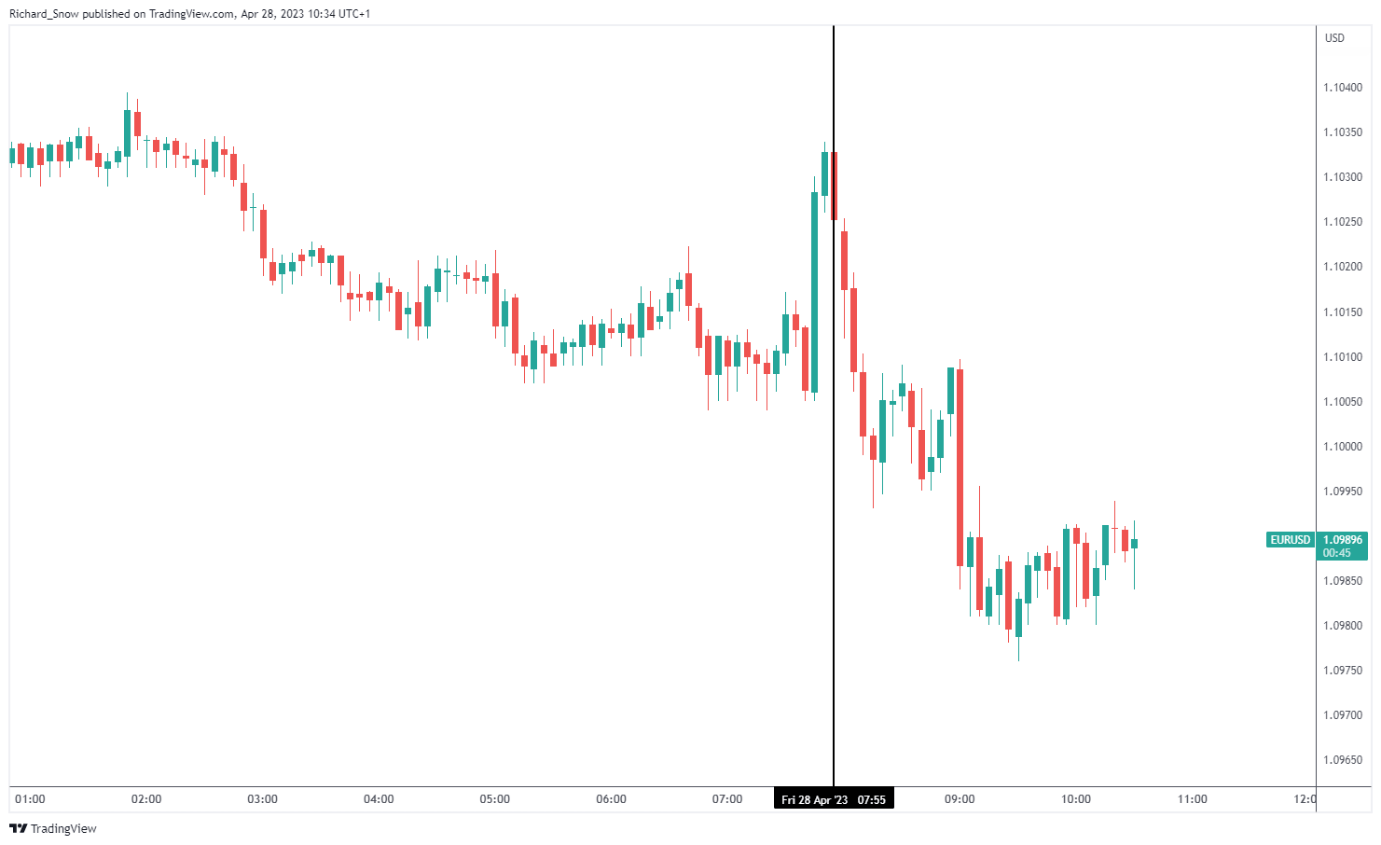
EUR/USD immediately headed lower after the German data but consolidated in the moments after the EU data made its way across computer screens.

EUR/USD 5-Min Chart

image3.png

Source: TradingView, prepared by Richard Snow

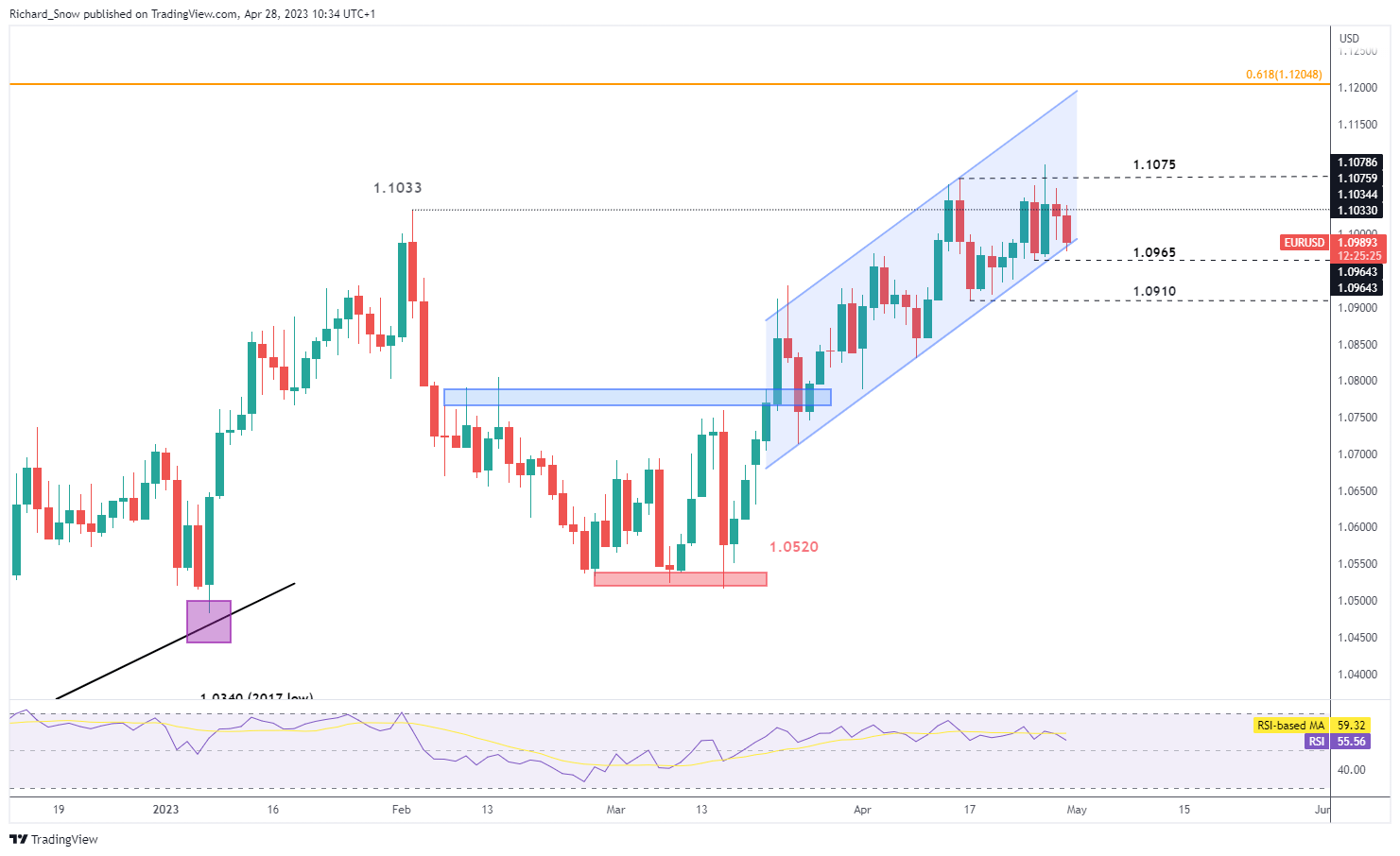
The recent move lower has been spurred on by the weaker than expected growth data in Germany along with a rare boost for the dollar as yesterday’s inflation component of the US Q1 GDP print came in hotter than expected – adding more weight behind the general consensus we’ll see a 25 basis point hike next week from the FOMC.

The longer-term uptrend remains bullish as prices remain within the ascending channel for now. In fact, such a pullback will be welcomed by EUR/USD bulls anticipating a pullback before considering a bullish continuation.

EUR/USD Daily Chart

image4.png

Source: TradingView, prepared by Richard Snow

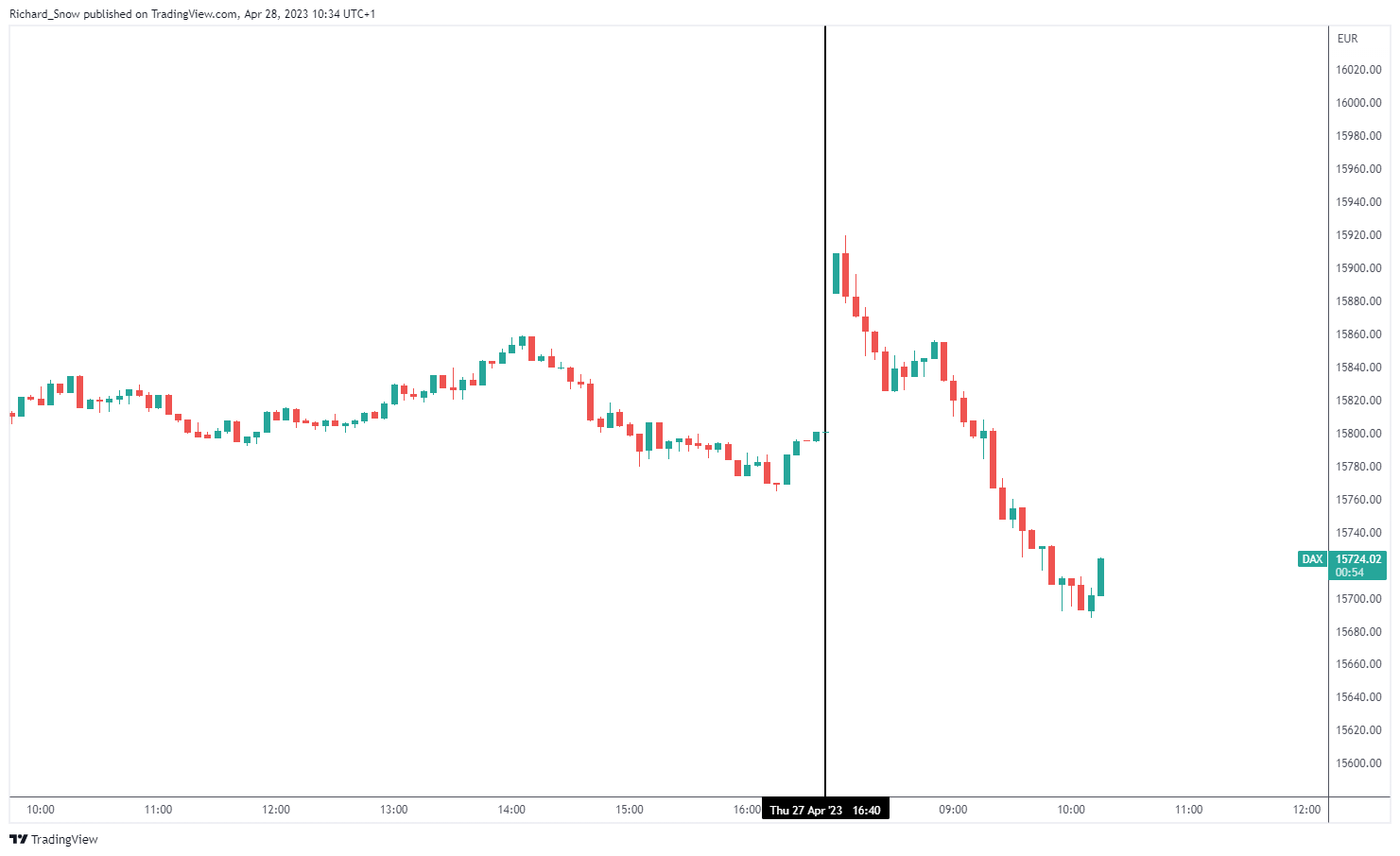
The DAX index also declined after the German growth data according to the 5-minute chart below despite a gap higher at the open. The index had already shown signs of bullish fatigue on the daily chart with as it struggled to push on from the yearly high.

image5.png

AUD/USD drops to its lowest level since March 10, further below 0.6600 ahead of US PCE

AUD/USD drops to its lowest level since March 10, further below 0.6600 ahead of US PCE

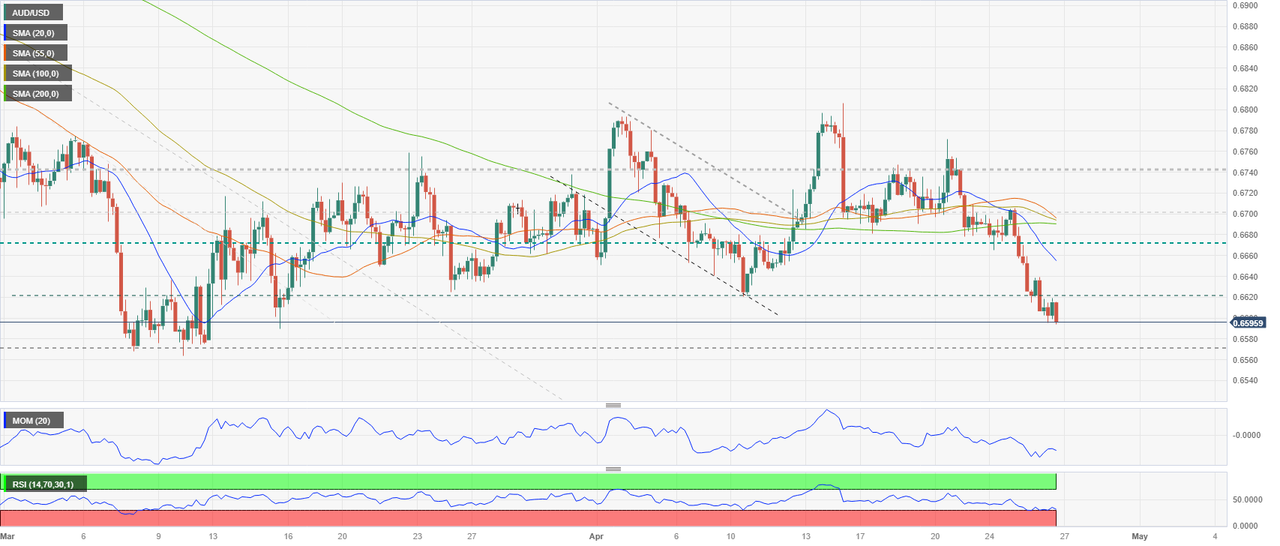
The AUD/USD pair attracts fresh selling near the 0.6640-0.6645 area on Friday and extends its intraday descent through the first half of the European session. The downward trajectory drags spot prices to the 0.6580-0.6575 region, or the lowest level since March 10, and is sponsored by resurgent US Dollar (USD) demand.

In fact, the USD Index (DXY), which tracks the Greenback against a basket of currencies, climbs to a fresh weekly top and draws support from firming expectations for another 25 bps lift-off at the next FOMC meeting in May. The bets for additional rate hikes by the US central bank were reaffirmed by the US macro data released on Thursday, which indicated persistent inflationary pressures and that the US job market remains healthy despite an economic slowdown.

Moreover, the Bank of Japan (BoJ)-inspired sell-off in the Japanese Yen (JPY), along with a generally weaker tone surrounding the equity markets, further benefit the safe-haven buck and drive flows away from the risk-sensitive Aussie. Apart from this,
technical selling below the 0.6600 round-figure mark aggravates the bearish pressure and contributes to the AUD/USD pair’s steep intraday decline. Spot prices now move back closer to the YTD low touched in March.

Investors now look forward to the release of the US Core PCE Price Index – the Fed’s preferred inflation gauge – due later during the early North American session. Given that the markets have been pricing in a pause in the Fed’s rate-hiking cycle after May, a stronger reading might prompt aggressive short-covering around the USD and pave the way for a further depreciating move for the AUD/USD pair. Nevertheless, spot prices remain on track to register heavy weekly losses.

AUD/USD Price Forecast: New 2023 Low for Aussie dollar?

AUD/USD Price Forecast: New 2023 Low for Aussie dollar?

AUSTRALIAN DOLLAR FUNDAMENTAL BACKDROP

The Australian dollar is trading in the red against the U.S. dollar this Friday morning as risk appetite dwindles. The greenback’s safe-haven appeal has come into play via renewed attacks from Russia in Ukraine US banking concerns. Emergency borrowings from the Federal Reserve increased for the second consecutive week underlining the tension in the financial sector. Earlier this morning, Australian housing credit data (see economic calendar below) for March printed in line with forecasts at 0.3% and maintains its downward trajectory as high interest rates make borrowing less attractive from a private sector point of view.

Later today, the Fed’s preferred measure of inflation (Core PCE) is due and anything suggestive of elevated levels may interfere with money market expectations on the Fed’s rate hike cycle that currently predicts only one more 25bps rate hike next week. Michigan consumer sentiment will close off the trading week with preliminary signs of a higher release than the March print (a USD positive).

ECONOMIC CALENDAR

image1.png

Source: DailyFX economic calendar

The RBA’s interest rate expectations (refer to table below) have been muted over the last few weeks, now anticipating no further rate hikes despite the strong inflation print on Wednesday. Should the Fed increase rates next week, the interest rate differential between the two nations will increase in favor of the US, making the USD more attractive moving forward. Although mostly priced in already, any indication as to more potential US rate hikes would likely hurt the Aussie dollar.

RBA INTEREST RATE PROBABILITIES

image2.png

Source: Refinitiv

Australian perspective, inflation for

TECHNICAL ANALYSIS

AUD/USD DAILY CHART

image3.png

Chart prepared by Warren Venketas, IG

Daily AUD/USD price action extends it’s bearish move after the bear flag (black) breakout on Tuesday and death cross (red). The next level under consideration for bears will be the 0.6565 swing low, with a break below signaling a fresh yearly low for the pair.

EUR/USD drops below 1.1000 after German Q1 GDP miss

EUR/USD drops below 1.1000 after German Q1 GDP miss

EUR/USD lost its traction in the European morning and extended the decline below the 1.1000 area after Germany’s Q1 GDP data missed estimates with 0% QoQ. Renewed US Dollar strength is also adding to the weight on the pair. EU GDP, German and US inflation data are

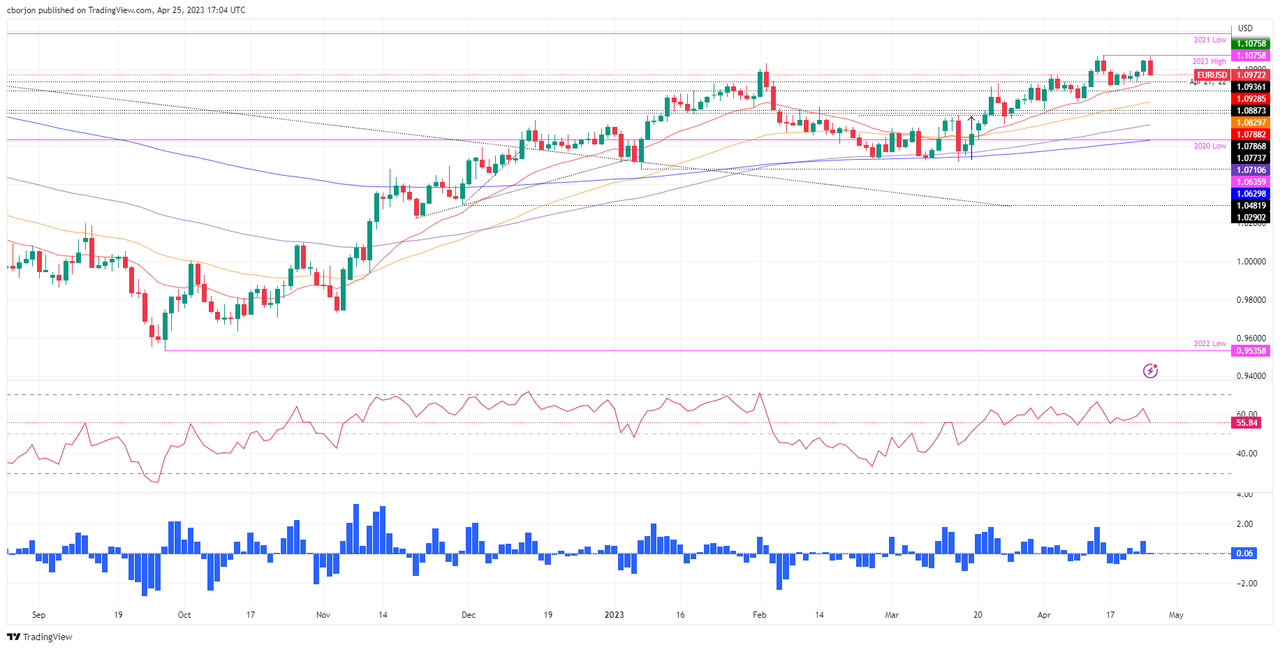
From a technical perspective, any subsequent fall is more likely to find decent support near the lower end of over a one-month-old upward sloping trend-channel, currently pegged just below the 1.1000 psychological mark. This coincides with the 100-period Simple Moving Average (SMA) on the 4-hour chart and should act as a pivotal point, which if broken decisively should set the stage for some meaningful corrective pullback from a 13-month high touched on Wednesday. The EUR/USD pair might then accelerate the fall towards the 1.0900 mark before eventually dropping to the 200-period SMA on the 4-hour chart, currently around the 1.0880 area. Some follow-through selling will negate any positive bias and shift the near-term bias in favour of bearish traders, paving the way for deeper losses.

On the flip side, the 1.1040 horizontal zone now seems to act as an immediate hurdle, above which bulls might aim to conquer the 1.1100 mark. Some follow-through buying should allow the EUR/USD pair to accelerate the momentum towards challenging the ascending channel resistance, currently around the 1.1160 region. A sustained strength beyond the latter will be seen as a fresh trigger for bullish traders and set the stage for an extension of the recent upward trajectory witnessed since mid-March.

The risk-on impulse caps gains for the safe-haven Greenback and lends support to the EUR/USD pair.

The shared currency is further underpinned by expectations for additional interest rate hikes by the European Central Bank (ECB) in the coming months.  In fact, the ECB’s Philip Lane told in a recent interview on Tuesday that leaving interest rates at the current level would be inappropriate despite falling inflation. This, in turn, suggests that the immediate market reaction to Friday’s release of the prelim German consumer inflation figures is more likely to be muted, albeit a stronger CPI print could provide a modest lift to the EUR/USD pair.

The focus will then shift to the release of the US Core PCE Price Index – the Fed’s preferred inflation gauge – later during the early North American session. This, along with the US bond yields and the broader risk sentiment, might influence the USD price dynamics and produce short-term trading opportunities around the EUR/USD pair on the last day of the week. The aforementioned fundamental backdrop, meanwhile, seems tilted in favour of bulls and suggests that the path of least resistance for spot prices is to the upside.

How to Manage the Emotions of Trading

How to Manage the Emotions of Trading

The Importance of Controlling Emotions While Trading

The importance of day trading emotional control cannot be overstated.

Imagine you’ve just taken a trade ahead of Non-Farm Payrolls (NFP) with the expectation that if the reported number is higher than forecasts, you will see the price of EUR/USD increase quickly, enabling you to make a hefty short-term profit.

NFP comes, and just as you had hoped, the number beats forecasts. But for some reason, price goes down!

You think back to all the analysis you had done, all the reasons that EUR/USD should be going up – and the more you think, the further price falls.

As you see the red stacking up on your losing position, emotions begin to take over – this is the ‘Fight or Flight’ instinct.This impulse can often prevent us from accomplishing our goals and, for traders, this issue can be very problematic, leading to knee-jerk reactions.

Professional traders don’t want to take the chance that a rash decision will damage their account – they want to make sure that one knee-jerk reaction doesn’t ruin their entire career. It can take a lot of practice, and many trades, to learn how to minimize emotional trading.

The 3 Most Common Emotions Traders Experience

Some of the most common emotions traders experience include fear, nervousness, conviction, excitement, greed and overconfidence.

Fear/Nervousness

A common cause of fear is trading too big. Trading with improper size magnifies volatility unnecessarily and causes you to makemistakes you normally wouldn’t make if you weren’t under the stress of risking larger losses than normal.

Another culprit for fear (or nervousness) is you are in the ‘wrong’ trade, meaning one that doesn’t fit your trading plan.

Conviction/Excitement

Conviction and excitement are key emotions you’ll want to feed off, and you should feel these in every trade you enter. Conviction is the final piece of any good trade, and if you don’t have a level of excitement or conviction then there is a good chance you are not in the ‘right’ trade for you.

By ‘right’ we mean the correct trade according to your trading plan. Good trades can be losers just as bad trades can be winners. The idea is to keep yourself winning and losing on only good trades. Making sure you have conviction on a trade will help ensure this.

Greed/Overconfidence

If you find yourself only wanting to take trades that you deem as possible big winners, you could be getting greedy. Your greed may have been the result of doing well, but if you aren’t careful you may slip and end up in a drawdown.

Always check that you are using proper trade mechanics (i.e. sticking to stops, targets, good risk/management, good trade set-ups). Sloppy trading as a result of overconfidence can end a strong run.

International trade: what you need to know this month

International trade: what you need to know this month

Global trade growth to slow this year, WTO says, but trade is getting greener

World merchandise trade volumes will rise by a “subpar” 1.7% in 2023, with transactions “weighed down by the ongoing war in Ukraine, stubbornly high inflation, tighter monetary policy and financial uncertainty”, according to the World Trade Organization (WTO).

The forecast is higher than the WTO’s October estimate for 2023 growth of 1.0% because of an improvement in the outlook for the global economy. But it is still below the 2.6% average for the 12 years since trade volumes collapsed after the global financial crisis.

World merchandise trade volume and GDP growth 2015-2024
World merchandise trade volumes will rise by 1.7% in 2023, the WTO predicts.
Image: WTO

The new prediction follows a downturn in trade volumes in the final quarter of 2022 because of elevated global commodity prices, a tightening of monetary policy in response to inflation, and COVID‑19 outbreaks that disrupted production and trade in China, the WTO says.

However, goods trade was “remarkably resilient for most of 2022 despite a challenging macro environment”, it adds, noting that year-on-year trade volume growth averaged 4.3% for the first three quarters. Full-year trade growth for 2022 stood at 2.7%, putting it below the WTO’s forecast of 3.5%.

Green goods are bucking the trend, however, with 4% trade growth in the second half of last year, according to UNCTAD’s latest Global Trade Update. Trade in “environmentally friendly goods” – any products designed to use fewer resources or emit less pollution than their traditional counterparts – hit a record $1.9 trillion in 2022, up more than $100 billion from 2021. The top performers were electric and hybrid vehicles (up 25%), non-plastic packaging (up 20%) and wind turbines (up 10%).

“Trade continues to be a force for resilience in the global economy, but it will remain under pressure from external factors in 2023,” says WTO Director-General Ngozi Okonjo-Iweala. “This makes it even more important for governments to avoid trade fragmentation and refrain from introducing obstacles to trade. Investing in multilateral cooperation on trade … would bolster economic growth and people’s living standards over the long term.”

2. UK strikes its biggest trade deal since Brexit by joining trans-Pacific pact

The UK has joined a trans-Pacific trade pact as it looks to deepen ties in the region and build its global trade links after leaving the European Union in 2020. Its entry into the Comprehensive and Progressive Agreement for Trans-Pacific Partnership (CPTPP) marks the country’s biggest trade deal since Brexit.

UK exports to the 11 other countries in the CPTPP – Australia, Brunei Darussalam, Canada, Chile, Japan, Malaysia, Mexico, Peru, New Zealand, Singapore and Vietnam – were worth £60.5 billion ($75 billion) in the 12 months to the end of September 2022. The agreement will cut tariffs on food, drink and cars, and will boost the UK economy by £1.8 billion ($2.25 billion) each year in the long term, the government says.

UK export markets for goods and services 4 quarters to the end of September 2022

Britain’s goods exports have recently fallen behind those of all other G7 economies.
Image: UK Government

Regulatory harmonization will not be required, as the countries in the CPTPP do not have a single market for goods or services, unlike the EU. Nevertheless, the deal has drawn some criticism over concerns that the UK will come under pressure to reduce standards on food and the environment to compete with CPTPP countries. The UK is liberalizing tariffs on palm oil from Malaysia, even though the product has been blamed for widespread deforestation. However, it has not agreed to remove a ban on hormone-treated beef.

The deal may not offset the impact of leaving the EU, with the UK’s Office for Budget Responsibility estimating the post-Brexit trading relationship between the UK and EU will reduce long-run productivity by 4% relative to remaining in the EU.

Britain’s goods exports have recently fallen behind those of all other G7 economies, with trade experts saying this is more evidence of the impact of Brexit, according to The Financial Times. UK exports in October-December 2022 – excluding precious metals – were more than 9% lower than their 2019 average.

3. News in brief: International trade stories from around the world

The EU has approved a landmark deforestation law that will ban imports of coffee, beef, soy and other commodities if they are linked to the destruction of the world’s forests. Companies that sell goods into the European Union will have to provide a due diligence statement and “verifiable” information proving their goods were not grown on land deforested after 2020. Deforestation is responsible for 10% of global greenhouse gas emissions.

Indonesia plans to propose a free trade agreement for some minerals shipped to the United States, so that companies in the electric vehicle battery supply chain that operate in the US can benefit from its tax credits. Indonesia’s nickel products have become increasingly important in the supply chain.

Flows of foreign direct investment (FDI) are increasingly moving between countries that are close geopolitically rather than geographically, the International Monetary Fund says. “These trends indicate that if geopolitical tensions continue to intensify and countries further diverge along geopolitical fault lines, FDI may become even more concentrated within blocs of aligned countries”, it says.

FDI is increasingly directed to geopolitically close countries
Flows of FDI appear to be changing for geopolitical reasons.
Image: IMF

US Treasury Secretary Janet Yellen has warned that any moves by Washington to decouple from China would be “disastrous”. It comes as China is reportedly targeting Western interests in the country after several years of trade and technology restrictions from the US, The Financial Times reports.

The EU has moved to prevent a spillover of geopolitical tensions into trade by allowing retaliatory measures against countries that put economic pressure on EU members to change their policies. The “anti-coercion instrument”, which is expected to take effect in the second half of 2023, will allow the bloc to impose higher import tariffs or limit access to EU public tenders.

The African Continental Free Trade Area (AfCFTA) Secretariat has held its first Business Forum, as it looks to boost trade and investment across the continent. The event took place in Cape Town and featured a private-sector engagement platform drawing attention to areas such as agro-processing, the automotive sector, pharmaceuticals, transportation and logistics, as well as digital trade.

United Nations Global Compact

China Goes Concentration to Supporting Position as Youth Joblessness Takes off

China Goes Concentration to Supporting Position as Youth Joblessness Takes off

China is encouraging companies to boost hiring as the economic recovery gathers pace, underscoring persistent worries over the labor market and soaring unemployment among young people.

The State Council, China’s cabinet, published a detailed plan Wednesday to promote employment. Measures include expanding recruitment within state-owned enterprises, as well as providing subsidies to employers that recruit new graduates and young people who are struggling to find work.

The emphasis on jobs comes as the urban unemployment rate for people aged 16 to 24 hit 19.6% last month, nearly as high as the record set last July. Fears about further pressure on that rate will likely continue in the coming months, given that some 11.58 million students are expected to graduate from universities and colleges this year.

The State Council’s plan included a vow from authorities to ensure the size of public institutions — including Communist Party and government organizations — will remain stable. They urged those groups to use their existing headcount to hire graduates.

The government also aims to have at least 1 million internship positions for young people, which the plan said can be achieved by providing subsidies to employers.

Rising unemployment pressure in recent years — the result of a perfect storm of Covid Zero-fueled layoffs, along with the government’s regulatory crackdown that hit the private sector — led an increasing number of young people to lose faith in private companies and instead accept lower pay in the state sector.

At the time time, the government has called on state firms to shoulder the responsibility of absorbing more workers. The number of college graduates hired by state-owned enterprises jumped 23.4% to over 760,000 in 2022 from a year earlier, officials said at a briefing Thursday.

The central government has also sought to streamline its bureaucracy, and is planning to cut the number of positions in its departments by 5%. It wants to redistribute those jobs into strategically important areas.