EUR/USD struggles as ECB officials shift focus to revive economic growth

EUR/USD struggles as ECB officials shift focus to revive economic growth

EUR/USD continues to face pressure near 1.0600 in Wednesday’s European session, struggling to extend recovery since Friday. The major currency pair lacks adequate strength for further upside as the US Dollar (USD) remains broadly firm on expectations of fewer interest rate cuts from the Federal Reserve (Fed) in its currency policy-easing cycle.

Fed’s data-dependent approach is expected to refrain from cutting interest rates aggressively as market experts project a rebound in the United States (US) inflation and see economic growth accelerating, given that President-elected Donald Trump’s victory in both houses will allow him to implement his economic agenda smoothly.

Trump vowed to raise import tariffs universally by 10% and lower taxes, a move that would not allow the Fed to go for deeper rate cuts. For the December meeting, the Fed will likely cut its borrowing rates by 25 basis points (bps) to the 4.25%-4.50% range, but the decision remains a “close call,” according to analysts at Deutsche Bank.

At the time of writing, the US Dollar Index (DXY), which gauges the Greenback’s value against six major currencies, bounces to near 106.30 from the immediate support of 106.10. The USD Index exhibited sheer volatility on Tuesday due to fresh escalation in the Russia-Ukraine war.

The Greenback gained in the European session on Tuesday as Russian President Vladimir Putin’s clearance to nuclear doctrine revision against Ukraine’s launch of long-range missiles, permitted and provided by the US on President Joe Biden’s approval, strengthened its safe-haven appeal. However, the safe-haven demand lost steam after Russian Foreign Minister Sergei Lavrov said the country would “do everything possible” to avoid the onset of nuclear war, Reuters reported.

Technical Analysis: EUR/USD sees more downside below 1.0500
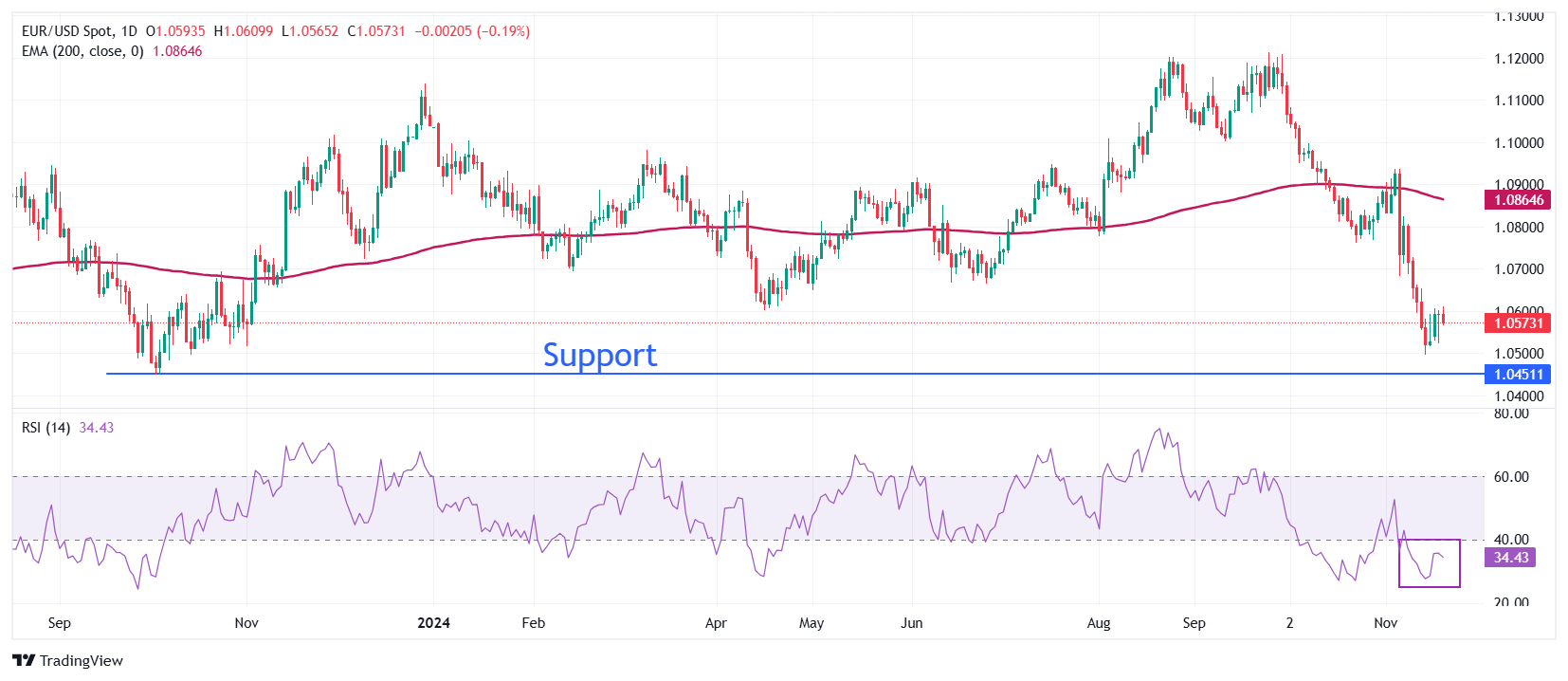
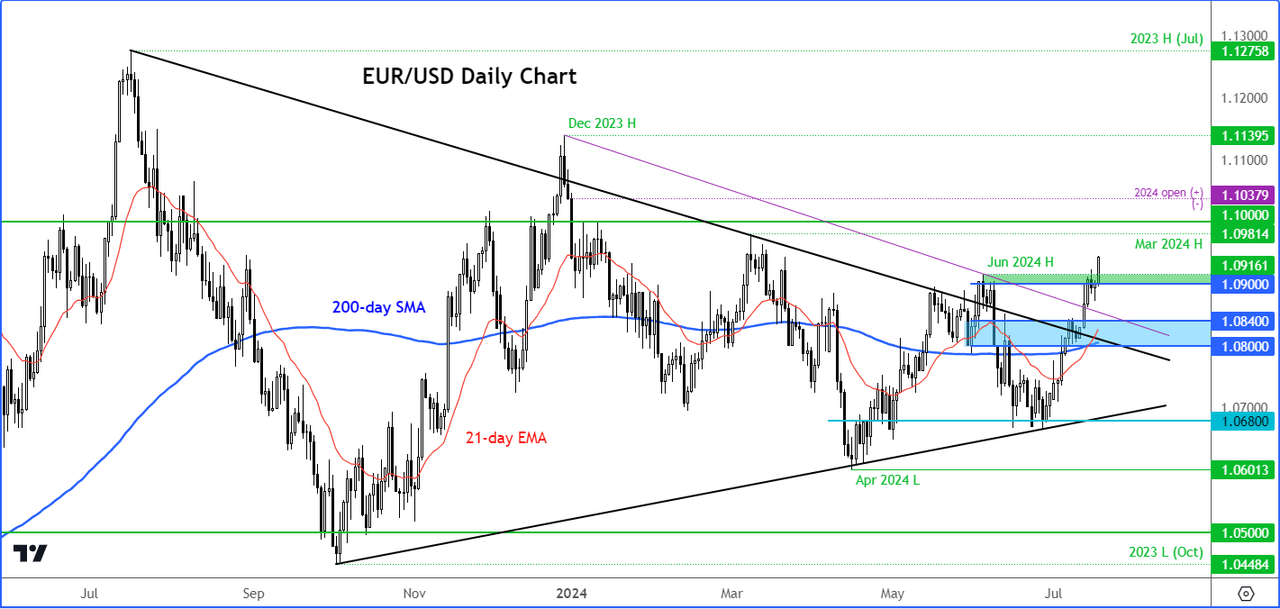
EUR/USD holds the key support of 1.0500 but struggles to extend recovery above 1.0600. The outlook of the major currency pair remains bearish as all short- to long-term daily Exponential Moving Averages (EMAs) are declining.

The 14-day Relative Strength Index (RSI) oscillates in the bearish range of 20.00-40.00, adding to evidence of more weakness in the near term.

Looking down, the pair is expected to find a cushion near the October 2023 low at around 1.0450. On the flip side, the round-level resistance of 1.0600 will be the key barrier for the Euro bulls.

AUD/USD: Expected to rise further to 0.6560

AUD/USD: Expected to rise further to 0.6560

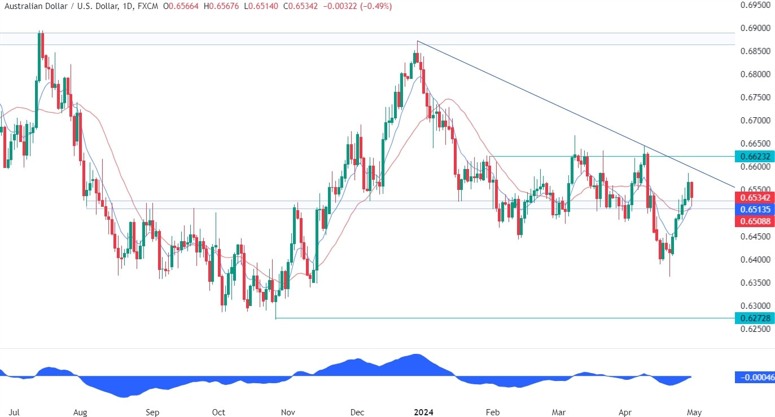
There has been a slight increase in momentum; the Australian Dollar (AUD) is expected to rise further to 0.6560. In the longer run, current price action is part of a rebound that could reach 0.6560, possibly 0.6600, UOB Group’s FX analysts Quek Ser Leang and Lee Sue Ann note.

Current rebound can reach 0.6560

24-HOUR VIEW: “We expected AUD to trade in a range between 0.6470 and 0.6520 yesterday. Our view was incorrect as AUD rose to 0.6534. There has been a slight increase in momentum. Today, AUD is expected to rise further to 0.6560. The major resistance at 0.6600 is unlikely to come into view. To maintain the buildup in momentum, AUD must not break below 0.6500, with minor support at 0.6515.”

1-3 WEEKS VIEW: “Yesterday (19 Nov, spot at 0.6505), we noted that ‘downward momentum is slowing.’ We pointed out, ‘a break above 0.6520 would mean that instead of continuing to weaken, AUD is more likely to consolidate.’ AUD then broke above 0.6520, reaching a high of 0.6534. Not only has downward momentum faded, but upward momentum has also increased to an extent. We view the current price action as part of a rebound that could reach 0.6560, possibly 0.6600. We will maintain the same view as long as AUD remains above 0.6460.”

Pound Sterling jumps as UK inflation accelerates more than expected

Pound Sterling jumps as UK inflation accelerates more than expected

The Pound Sterling (GBP) gains sharply against its all major peers on Wednesday as data from the United Kingdom (UK) Office for National Statistics (ONS) showed inflation accelerated more than expected in October. The Consumer Price Index (CPI) report showed that the annual headline inflation quickened to 2.3% YoY, higher than estimates of 2.2% and the September reading of 1.7%.

Compared with the previous month, headline inflation rose sharply by 0.6%, higher than expectations of 0.5% and after remaining flat in September.

The core CPI – which excludes volatile items such as food, energy, oil, and tobacco – grew by 3.3%, higher than the former reading of 3.2%. Economists had expected core inflation to fall to 3.1%.

Services inflation, a closely watched indicator by Bank of England (BoE) officials, accelerated to 5% from the prior release of 4.9%. Signs of further acceleration in price pressures could force traders to pare bets supporting interest rate cuts in the BoE December policy meeting.

On Tuesday, traders priced a roughly 80% chance that the BoE will cut interest rates by 25 basis points (bps) in the December meeting, according to Reuters.

Several Bank of England (BoE) policymakers – including Governor Andrew Bailey – also warned about price pressures remaining persistent in the monetary policy hearings before the Treasury Select Committee (TSC) on Tuesday. “Services inflation is still above a level that’s compatible with on-target inflation,” Andrew Bailey said. BoE external member Catherine Mann, an outspoken hawk, said: “Financial markets’ inflation expectations suggest the BoE will not get to sustainable 2% inflation in the forecast horizon.”

EUR/GBP breaks below 0.8350 following stronger UK inflation data

EUR/GBP breaks below 0.8350 following stronger UK inflation data

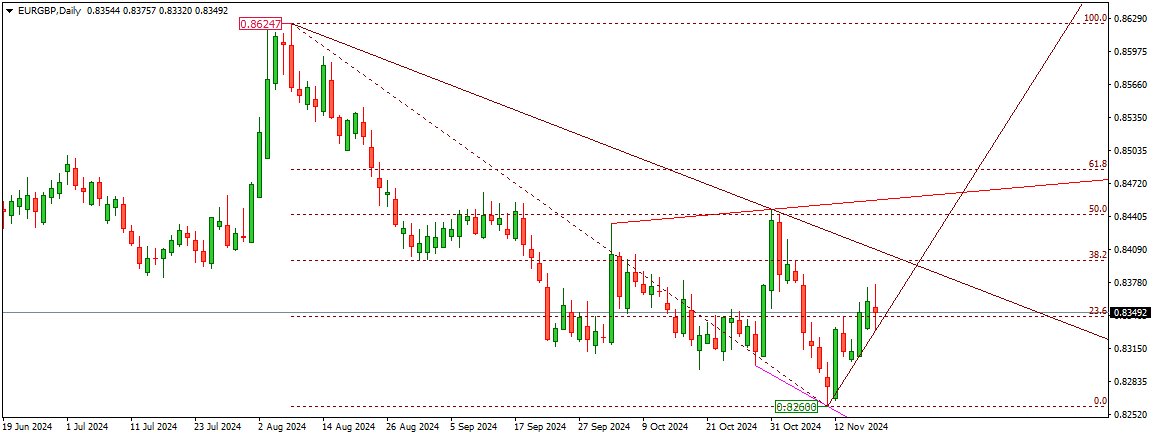
EUR/GBP loses ground to near 0.8330 during the early European hours. The Pound Sterling (GBP) appreciates following the stronger Consumer Price Index (CPI) data from the United Kingdom (UK) released on Wednesday.

The UK CPI inflation climbed to 2.3% year-over-year in October, the highest in six months, up from 1.7% in September and surpassing forecasts of 2.2%. On a monthly basis, the CPI increased by 0.6% after remaining unchanged in September. Meanwhile, the annual Core CPI, which excludes volatile food and energy prices, rose to 3.3% during the same period, exceeding market expectations of 3.1%. Additionally, the Retail Price Index increased by 3.4% year-over-year, compared to 2.7% in September.

In Germany, the Producer Price Index (PPI) fell by 1.1% year-on-year in October, following a 1.4% decline the previous month, in line with market expectations. This marks the 16th consecutive period of producer deflation. On a monthly basis, producer prices rose by 0.2%, rebounding from a 0.5% drop in September, also matching market estimates.

Since June, the ECB has reduced rates three times as inflation approaches its 2% target, although growth forecasts have been downgraded twice. Markets largely anticipate a 25-basis-point rate cut next month, with a smaller chance of a more significant reduction.

On Wednesday, ECB President Christine Lagarde is set to deliver the opening remarks at the ECB’s Conference on Financial Stability and Macroprudential Policy in Frankfurt. Investors will also be closely watching the preliminary Purchasing Managers’ Index (PMI) figures from the Eurozone and Germany, which are scheduled for release on Friday.

Gold price continues losing ground as rising US bond yields offset geopolitical tensions

Gold price continues losing ground as rising US bond yields offset geopolitical tensions

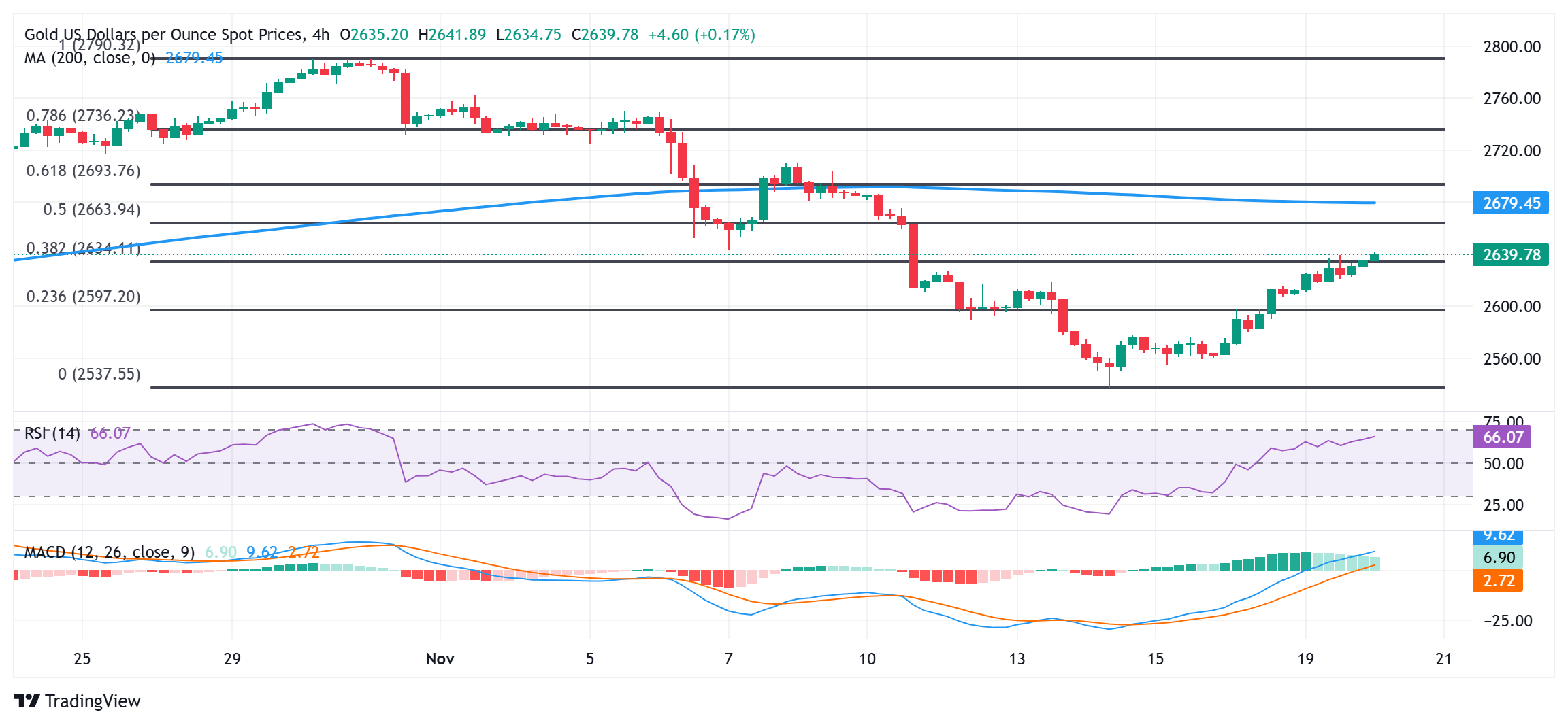
Gold price (XAU/USD) extends its intraday pullback from the $2,642 area, or a one-and-half-week high touched earlier this Wednesday and drops to a fresh daily low during the first half of the European session. The US Dollar (USD) attracts some dip-buyers on the back of a goodish pickup in the US Treasury bond yields, bolstered by expectations of a less aggressive policy easing by the Federal Reserve (Fed). This, in turn, is seen as a key factor driving flows away from the non-yielding yellow metal.

Adding to this, a positive risk tone further undermines demand for the safe-haven Gold price, which, for now, seems to have snapped a two-day winning streak and stalled its recovery from a two-month low touched last week. That said, the worsening Russia-Ukraine conflict might continue to offer some support to the safe-haven precious metal and limit deeper losses. Traders might also opt to wait for speeches from influential FOMC members for cues about the future rate-cut path and before placing fresh directional bets.

Gold price might attract some dip-buyers near the $2,600 pivotal support

fxsoriginal

The recovery momentum from a two-month low touched last week lifts the Gold price beyond the 38.2% Fibonacci retracement level of the recent sharp retracement slide from the all-time peak. Adding to this, bullish oscillators on hourly charts support prospects for a further intraday appreciating move towards the $2,658-2,660 region en route to the $2,670-2,672 congestion zone. Some follow-through buying could allow the XAU/USD to aim back towards reclaiming the $2,700 round figure. That said, the lack of follow-through buying warrants caution for bullish traders.

On the flip side, the $2,622-2,620 area now seems to protect the immediate downside ahead of the $2,600 mark. A convincing break below the latter could make the Gold price vulnerable to accelerate the fall to the 100-day Simple Moving Average (SMA), around the $2,555 region, with some intermediate support near the $2,570 zone. This is followed by last week’s swing low, around the $2,537-2,536 area, which if broken decisively will be seen as a fresh trigger for bearish traders and set the stage for deeper losses.

EUR/USD: Weakness in EUR has stabilised

EUR/USD: Weakness in EUR has stabilised

Brief decline did not result in any increase in momentum; the Euro (EUR) is expected to trade in a range between 1.0550 and 1.0620. In the longer run, weakness in EUR has stabilised; it is expected to consolidate between 1.0520 and 1.0685, UOB Group’s FX analysts Quek Ser Leang and Lee Sue Ann note.

EUR to consolidate between 1.0520 and 1.0685

24-HOUR VIEW: “Following EUR rise to 1.0607 on Monday, we indicated yesterday that ‘instead of continuing to rise, EUR is likely to trade in a 1.0560/1.0610 range today.’ Although EUR subsequently plummeted to 1.0523, it rebounded quickly to close largely unchanged at 1.0595 (-0.04%). The brief decline did not result in any increase in momentum. We continue to expect EUR to trade in a range, likely between 1.0550 and 1.0620.”

1-3 WEEKS VIEW: “We have held a negative view in EUR for about two weeks. Yesterday (19 Nov, spot at 1.0590), we noted that ‘downward momentum is beginning to fade.’ We stated, ‘A clear break of 1.0610 (‘strong resistance’ level) would mean that EUR has entered a consolidation phase.’ EUR then dropped to 1.0523, rebounded quickly to 1.0600, closing at 1.0595. While our ‘strong resistance’ level at 1.0610 has not been breached yet, downward momentum has eased considerably. To put it another way, the EUR weakness has stabilised. From here, EUR is likely to consolidate, expected to be between 1.0520 and 1.0685.”

NZD/USD Price Forecast: Remains below 0.5900, nine-day EMA due to growing bearish bias

NZD/USD Price Forecast: Remains below 0.5900, nine-day EMA due to growing bearish bias

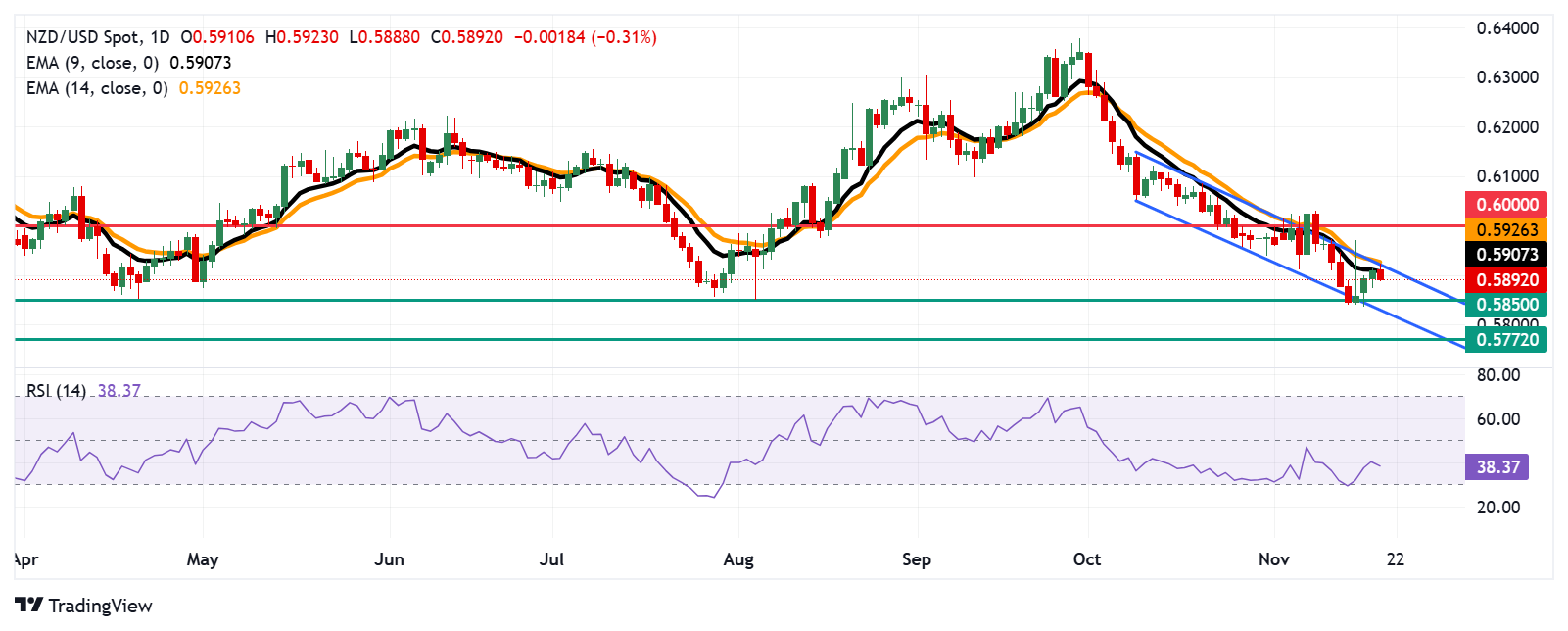
The NZD/USD pair breaks its three-day winning streak, trading around 0.5890 during the European session on Wednesday. A review of the daily chart highlights a growing bearish bias, as the pair moves downwards within the descending channel pattern.

The nine-day Exponential Moving Average (EMA) remains below the 14-day EMA, signaling persistent weakness in short-term price momentum. Meanwhile, the 14-day Relative Strength Index (RSI) consolidates below 50 level, confirming the ongoing bearish sentiment.

Regarding the support, the NZD/USD pair could navigate the region around the “throwback support” at the psychological level of 0.5850, followed by the lower boundary of the descending channel at 0.5930 level.

A decisive break below this channel would reinforce the bearish outlook, increasing downward pressure and potentially driving the Kiwi pair toward its two-year low of 0.5772, last seen in November 2023.

On the upside, immediate resistance lies at the nine-day EMA at 0.5907, followed by the 14-day EMA at 0.5926, which coincides with the upper boundary of the descending channel. A breakout above this channel would weaken the bearish momentum, paving the way for the NZD/USD pair to target the psychological level of 0.6000.

NZD/USD: Daily Chart

GBP/USD: Likely to trade between 1.2630 and 1.2710

GBP/USD: Likely to trade between 1.2630 and 1.2710

Price action still appears to be part of a range trading phase; the Pound Sterling (GBP) is likely to trade between 1.2630 and 1.2710. In the longer run, downward momentum is beginning to slow; a break above 1.2725 would mean that the major support at 1.2565 is out of reach, UOB Group’s FX analysts Quek Ser Leang and Lee Sue Ann note.

Downward momentum is beginning to slow

24-HOUR VIEW: “GBP traded between 1.2615 and 1.2689 yesterday, closing little changed at 1.2682 (+0.02%). We were expecting it to trade in a 1.2625/1.2705 range. The price action still appears to be part of a range trading phase. Today, we expect GBP to trade between 1.2630 and 1.2710.”

1-3 WEEKS VIEW: “We turned negative in GBP about a week ago (12 Nov), when it was at 1.2875. As we tracked the decline, in our latest narrative from two days ago (18 Nov, spot at 1.2620), we highlighted that GBP ‘is likely to continue to weaken to 1.2565.’ After dropping to a low of 1.2598, GBP has not been able to make further headway on the downside. Downward momentum is beginning to slow, and should GBP break above 1.2725 (‘strong resistance’ level previously at 1.2745), it would mean that the major support at 1.2565 is out of reach this time around.”

GBP/USD holds gains near 1.2700 after UK inflation data

GBP/USD holds gains near 1.2700 after UK inflation data

GBP/USD holds the latest uptick near 1.2700 in the European session on Wednesday. The data from the UK showed that the annual inflation, as measured by the change in the CPI, rose to 2.3% in October from 1.7% in September, supporting Pound Sterling.

On Wednesday, traders await key UK data, including the Consumer Price Index (CPI) inflation and Retail Price Index (RPI) figures for October. These numbers could influence the Bank of England’s (BoE) decision on whether to pursue additional rate cuts this year.

The UK’s CPI inflation is projected to rise to 2.2% year-on-year in October, up from 1.7% the previous month. The monthly CPI for October is expected to increase by 0.5%, compared to a flat 0.0% in September. Additionally, the Retail Price Index (RPI) is likely to have grown by 3.4%, up from 2.7% previously.

The US Dollar (USD) remained steady on Wednesday after three days of losses, weighed down by weaker-than-expected economic data released on Tuesday. However, the downside for the Greenback may be limited as investors expect pro-inflationary policies from the incoming Trump administration, such as tax cuts and higher tariffs. These measures could drive up inflation, potentially prompting the Federal Reserve to slow the pace of rate cuts.

Kansas City Fed President Jeffrey Schmid stated on Tuesday that he anticipates both inflation and employment will move closer to the Fed’s targets. Schmid explained that rate cuts reflect the central bank’s confidence in inflation heading toward its 2% goal. He also noted that while large fiscal deficits might not directly cause inflation, the Fed may need to respond to any emerging inflationary pressures by raising interest rates.

NZD/USD: To trade in a range between 0.5845 and 0.5885

NZD/USD: To trade in a range between 0.5845 and 0.5885

The New Zealand Dollar (NZD) is expected to trade in a range between 0.5845 and 0.5885. In the longer run, outlook for NZD remains negative; the technical target now is at last year’s low of 0.5775, UOB Group’s FX analysts Quek Ser Leang and Lee Sue Ann note.

Outlook for NZD remains negative

24-HOUR VIEW: “We expected NZD ‘to continue to weaken’ last Friday. However, it traded in a 0.5841/0.5880 range. The price movements are likely part of a range trading phase. Today, NZD is expected to trade between 0.5845 and 0.5885.”

1-3 WEEKS VIEW: “We turned negative in NZD last Wednesday (13 Nov, spot at 0.5925), but we indicated that ‘it is too early to tell if the major support at 0.5850 is within reach.’ After NZD fell below 0.5850, we indicated last Friday (15 Nov, spot at 0.5845) that ‘the outlook for NZD remains negative, and the technical target now is at last year’s low of 0.5775.’ We will continue to hold the same view, provided that 0.5915 (‘strong resistance’ previously at 0.5925) is not breached.”