NZD/USD: Likelihood of NZD dropping to 0.5850 has increased

NZD/USD: Likelihood of NZD dropping to 0.5850 has increased

Further New Zealand Dollar (NZD) weakness appears likely; any decline may not reach the major support at 0.5850. In the longer run, likelihood of NZD dropping to 0.5850 has increased, UOB Group’s FX analysts Quek Ser Leang and Lee Sue Ann note.

NZD weakness appears likely

24-HOUR VIEW: “Yesterday, when NZD was at 0.5925, we held the view that NZD ‘is likely to trade with a downward bias towards 0.5900.’ We were also of the view that ‘a sustained break below 0.5900 is unlikely.’ The anticipated weakness exceeded our expectations, as NZD dropped to a low of 0.5876, closing at 0.5882 (-0.76%). Further weakness appears likely today, but oversold conditions suggest any decline may not reach the major support at 0.5850 (there is another support at 0.5865). On the upside, a breach of 0.5920 (minor resistance is at 0.5905) would mean that NZD is not weakening further.”

1-3 WEEKS VIEW: “We revised our view from neutral to negative yesterday (13 Nov, spot at 0.5925), indicating that ‘Despite the slight increase in momentum, the risk for NZD appears to have shifted to the downside.’ However, we noted that ‘it is too early to tell if the major support at 0.5850 is within reach.’ NZD subsequently dropped to 0.5876. The increase in momentum indicates that the likelihood of NZD dropping to 0.5850 has also increased. To maintain the buildup in momentum, NZD must remain below the ‘strong resistance’ at 0.5955 (level was at 0.5975 yesterday).”

GBP/JPY remains tepid around 197.50, awaits BoE Bailey speech

GBP/JPY remains tepid around 197.50, awaits BoE Bailey speech

GBP/JPY edges lower after posting gains in the previous session, hovering around 197.50 during European trading hours on Thursday. Traders await a speech from Bank of England (BoE) Governor Andrew Bailey at the annual financial and professional services dinner later in the day.

However, the downside of the Pound Sterling (GBP) could be restrained due to rising concerns among BoE officials about persistent price pressures. On Wednesday, BoE Monetary Policy Committee external member Catherine Mann participated in a panel at the BNP Paribas Global Market Conference, where she noted that monetary policy is affecting inflation more quickly than economic theory suggests. This allows the central bank to hold off on significant interest rate cuts for now.

The Japanese Yen (JPY) continues to face pressure as political uncertainty in Japan raises concerns about the Bank of Japan’s (BoJ) rate-hike plans. Additionally, worries over the potential impact of US President-elect Donald Trump’s proposed trade tariffs on the Japanese economy are further undermining the JPY.

On Thursday, BoJ Deputy Governor Shinichi Uchida highlighted the need for financial institutions and authorities to be prepared for sudden deposit outflows due to digitalization and technological advances.

BoJ’s Uchida also noted the growing presence of non-bank financial institutions, which now account for nearly half of global financial intermediation. As the relationship between non-bank financial institutions and the banking sector strengthens, any deterioration in the non-bank sector could ripple through the entire financial system via market channels.

EUR/USD refreshes annual lows as Trump trade momentum advances

EUR/USD refreshes annual lows as Trump trade momentum advances

EUR/USD posts a fresh annual low near 1.0530 in European trading hours and extends its losing streak for the fifth trading day on Thursday. The major currency pair has faced an intense sell-off as the US Dollar (USD) continues to enjoy upside momentum, being one of the major beneficiaries of President-elected Donald Trump’s win in the United States (US) presidential election. The US Dollar Index (DXY), which gauges the Greenback’s value against six major currencies, climbs to near 106.80, the highest level seen since November 1, 2023.

It will be easy for Trump to implement the agenda of lower taxes on businesses and workers, as well as high import tariffs, as Republicans have ensured control of the Senate and the House of Representatives, according to the Associated Press.

An increase in import tariffs would increase the demand for domestically produced goods and services, which would boost inflationary pressures that limit the potential of the Federal Reserve (Fed) to cut interest rates faster and deeper.

The Greenback rose sharply on Wednesday after the release of the US Consumer Price Index (CPI) data for October. The inflation report showed that price pressures grew expectedly on a monthly as well as annual basis, boosting expectations of interest rate cuts in the December meeting. According to the CME FedWatch tool, the probability of the Fed cutting interest rates by 25 basis points (bps) to 4.25%-4.50% next month increased to 83% from 59% a day before.

In Thursday’s session, investors will pay close attention to Fed Chair Jerome Powell’s commentary in a panel discussion hosted by the Federal Reserve Bank of Dallas at 20:00 GMT. Market participants would like to know his stance on December’s monetary policy decision and the impact of Trump’s policies in the medium and longer term.

On the economic front, investors will focus on the US Initial Jobless Claims for the week ending November 8 and the Producer Price Index (PPI) data for October, which will be published at 13:30 GMT.

Technical Analysis: EUR/USD sees more downside as all short-to-long-term EMAs turn downwards

EUR/USD slides to its lowest since November 1, 2023, near 1.0530. The major currency pair weakened after breaking below the April 16 low of 1.0600. The outlook of the shared currency pair has become bearish as all short to long-term Exponential Moving Averages (EMAs) are declining.

The 14-day Relative Strength Index (RSI) drops to nearly 30.00, adding to evidence of more weakness in the near term.

Looking down, the pair is expected to find a cushion near the psychological support of 1.0500. On the flip side, the round-level resistance of 1.0700 will be the key barrier for the Euro bulls.

Mexican Peso resumes downside after Republicans take Congress

Mexican Peso resumes downside after Republicans take Congress

The Mexican Peso (MXN) resumes the slide in its key pairs on Thursday after briefly pausing on Wednesday following the release of US inflation data. Republicans winning a majority in the US Congress is weighing on the Peso as it gives the party a “clean sweep” of the Presidency, the US Senate, and the House of Representatives. This will augment its power to push through policies, many of which the market is assessing as directly negative to the Peso (or positive for the US Dollar (USD)).

A more immediate bearish factor for the Peso comes in the form of market expectations that the Bank of Mexico (Banxico) will cut its main interest rate by 25 basis points (bps) (0.25%) to 10.25% at its meeting on Thursday. In a Reuters survey, 19 out of 20 economists said they expected Banxico to cut by 0.25% at the meeting, according to Christian Borjon Valencia,.

Mexican Peso faces headwinds from US protectionism

The Mexican Peso continues to face broader headwinds from the prospect of increased US protectionism under the leadership of President-elect Donald Trump. The imposition of tariffs on Mexican imports and the threat to deport millions of illegal workers who regularly send remittances home are both likely to reduce demand for the Peso.

The Peso steadied on Wednesday amid US Dollar weakness after the US Consumer Price Index (CPI) in October aligned with economists’ expectations. This solidified expectations that the US Federal Reserve (Fed) will cut interest rates by a quarter of a percent (25 bps) at its meeting in December. This, in turn, restrained the strength of the US Dollar since lower interest rates reduce foreign capital inflows – and gave the Peso some breathing space.

Comments from Mexican Finance Minister Marcelo Ebrard further supported the MXN after he said on Wednesday that the level of Foreign Direct Investment (FDI) in Mexico likely hit a new record high of $35.732 billion in 2024, according to El Financiero. Ebrard also hit back at suggestions from Canada’s Prime Minister of Ontario, Doug Ford, that the US and Canada should sign their own private free trade deal, saying that it was better for the Canadian economy to include Mexico, thereby maintaining the current USMCA tripartite agreement.

Technical Analysis: USD/MXN closes in on November high

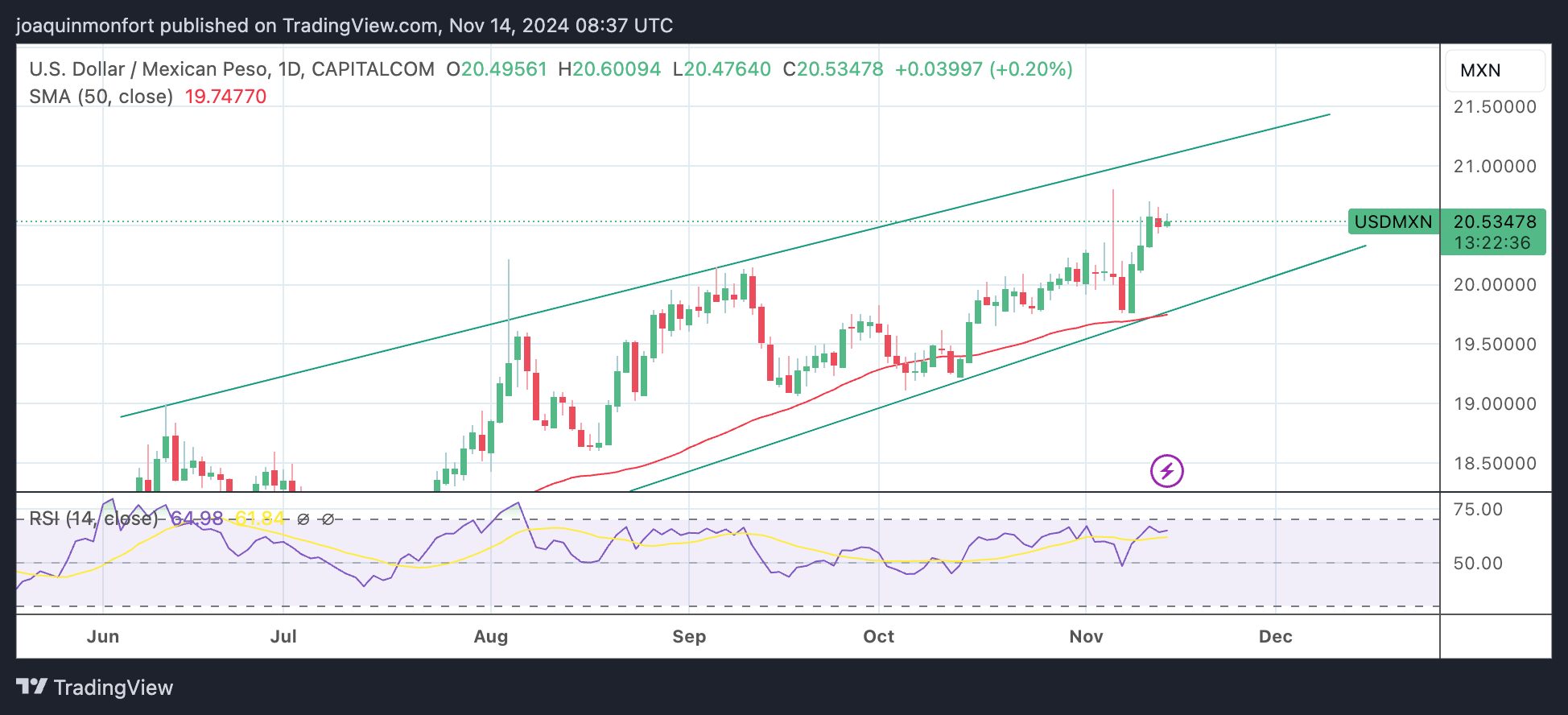
USD/MXN resumes its rally within a rising channel after a brief pause. The short-term trend is bullish, and given the technical analysis saying that “the trend is your friend,” the odds favor a continuation higher.

USD/MXN Daily Chart

USD/MXN is also in an uptrend on a medium and long-term basis, adding weight to the move higher. A break above 20.80 (November 6 high) would confirm a higher high and an extension of the bullish trend. The next upside target lies at 21.00 (round number, upper boundary of channel), where buyers could start to meet resistance.

EUR/USD sits at yearly lows near 1.0550 ahead of EU GDP, US PPI data

EUR/USD sits at yearly lows near 1.0550 ahead of EU GDP, US PPI data

EUR/USD is trading near 1.0550 in the European session on Thursday, sitting at the lowest level in a year. The Trump trades-driven relentless US Dollar buying and German political instability weigh on the pair. Traders await EU GDP data and US PPI report ahead of Fed Chair Powell’s speech.

The selling bias around the EUR/USD pair remains unabated for the fifth consecutive day in the wake of the continuation of the so-called Trump trade, which has been a key factor behind the post-election US Dollar (USD) rally. In fact, the USD Index (DXY), which tracks the Greenback against a basket of currencies, has advanced to its highest level since November 2023 amid hopes that US President-elect Donald Trump’s policies will boost economic growth.

Meanwhile, Trump’s plans to hike tariffs on imports could accelerate inflation and force the Federal Reserve (Fed) to pause its easing cycle. Moreover, the US Consumer Price Index (CPI) released on Wednesday pointed to a slower progress toward bringing inflation down and could result in fewer rate cuts next year. This remains supportive of elevated US Treasury bond yields and continues to push the USD higher across the board.

The US Bureau of Labor Statistics reported that the headline CPI rose 0.2% in October and by 2.6% over the last twelve months. Additional details of the report revealed that the core gauge – which excludes the more volatile food and energy categories—increased by 0.3% last month and by 3.3% as compared to the same time period last year. The data reaffirmed bets that the Fed would deliver a third rate cut in December against the backdrop of a softening labor market.

Commenting on the report, St. Louis Fed President Alberto Musalem noted that the risk of inflation moving higher has risen and that sticky inflation makes it difficult for the central bank to continue to ease rates. Moreover, Dallas Fed President Lorie Logan struck a similar tone and said that the central bank should proceed cautiously, adding that if we cut too far, past neutral, inflation could reaccelerate and the FOMC could need to reverse direction.

Separately, Kansas Fed President Jeffrey Schmid made a rare appearance and said it remains to be seen how much more the US central bank will cut rates, and where they may settle. Hence, investors will closely scrutinize Fed Chair Jerome Powell’s comments on Thursday for cues about the rate-cut path. This, in turn, will play a key role in influencing the near-term USD price dynamics and provide some meaningful impetus to the EUR/USD pair.

In the meantime, the shared currency might continue to feel pressure from the political uncertainty in Germany, following the collapse of the governing coalition in the Eurozone’s largest economy. Adding to this, the highly probable tariffs on Europe’s exports to the US, under the second Trump presidency, could significantly impact the region’s economy. This further seems to weigh on the Euro and drags the EUR/USD pair to a fresh year-to-date (YTD) low.

Heading into the key event risk, the US economic docket – featuring the release of the usual Weekly Initial Jobless Claims and the Producer Price Index (PPI) – could drive the USD demand and produce short-term opportunities around the EUR/USD pair. Nevertheless, the aforementioned fundamental backdrop seems tilted firmly in favor of the USD bulls and suggests that the path of least resistance for spot prices remains to the downside.

Dogecoin extends gains as traders assess Elon Musk’s role in upcoming Trump administration

Dogecoin extends gains as traders assess Elon Musk’s role in upcoming Trump administration

Dogecoin (DOGE) extends its gains on Monday and trades around $0.28 after rallying over 83% in the previous week, buoyed by the victory of crypto-friendly candidate Donald Trump in the US presidential election and its promotion by Trump supporter Elon Musk.

Elon Musk’s continued support for Dogecoin has reignited interest in the dog-themed meme coin. DOGE’s open interest reached a new all-time high of $2.26 billion on Monday, signaling a surge of new capital, while its daily trading volume also hit a yearly high of $13.96 billion.

Elon Musk’s support for DOGE

Elon Musk’s involvement has reignited interest in Dogecoin, particularly following his co-founding of the “Department of Government Efficiency” (DOGE), a concept aimed at streamlining US government operations and reducing waste.

Last week, Donald Trump’s victory in the US presidential election sparked renewed attention on Musk’s proposed initiative. During a campaign rally in New York on October 27, Musk claimed the formation of the “Department of Government Efficiency” could save the United States $2 trillion in tax spending. Elon Musk’s continued support for Trump’s campaign and Trump’s victory has increased the likelihood of forming such a department.

The initiative’s initials, DOGE, align with the Dogecoin ticker, fueling discussions and speculation on social media about the token’s future and enhancing bullish sentiment for the meme coin.

Dogecoin bulls eye for October 2021 highs 

Dogecoin’s weekly chart has broken and closed above the ascending trendline, which had previously acted as resistance. The breakout from this trendline, which was drawn by connecting multiple highs since October 2022, favors bulls. As of Monday DOGE trades slightly higher around $0.278.

If DOGE’s upward momentum continues or the ascending trendline holds as support, it could extend the rally by another 21% to retest its October 2021 high of $0.34.

The Relative Strength Index (RSI) on the weekly chart is currently at 78, above the overbought threshold of 70, signaling caution as the likelihood of a pullback increases. However, the RSI may also dip slightly but maintain its bullish momentum by staying above the overbought level and continuing its ongoing rally. An exit from overbought territory would give a sell signal.
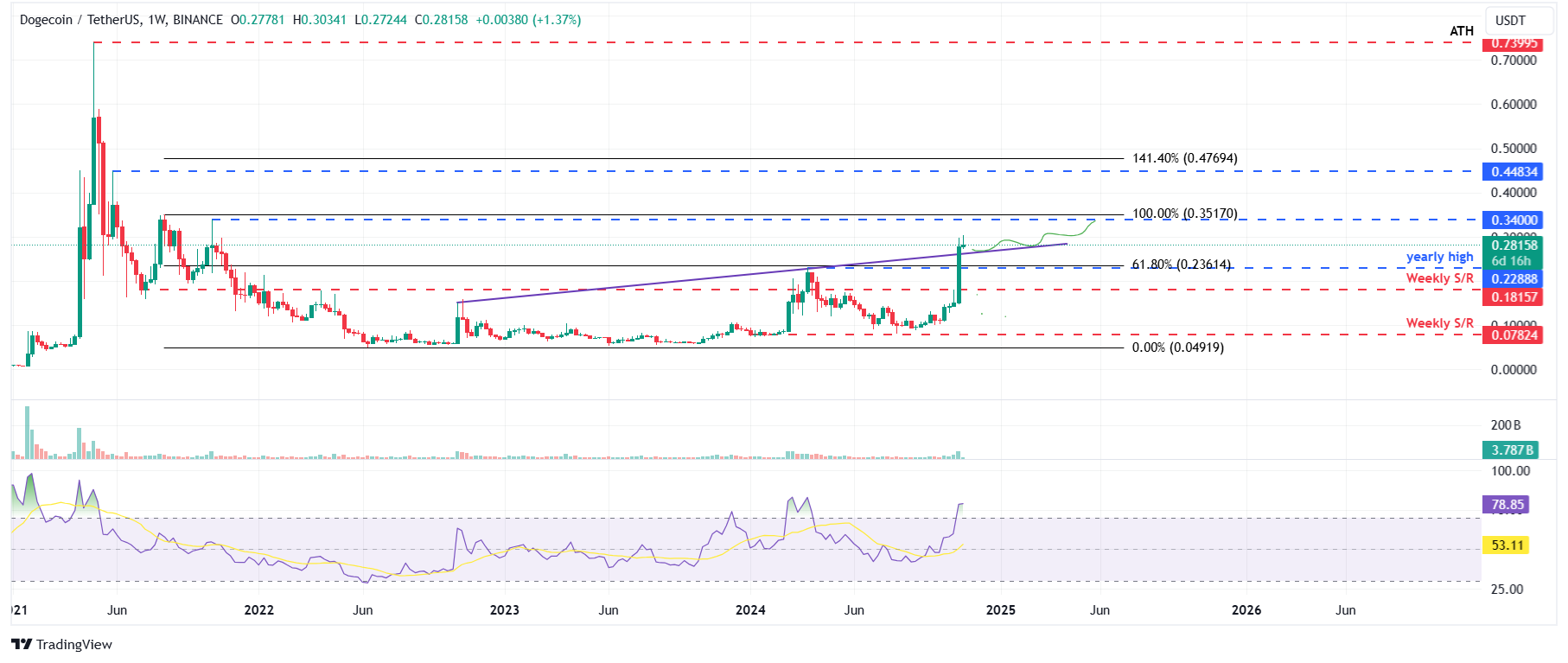
DOGE/USDT weekly chart

DOGE/USDT

Dogecoin’s on-chain data further supports the bullish thesis. Coinglass’s data shows that the futures’ Open Interest (OI) in Dogecoin at exchanges is increasing. Increasing OI represents new or additional money entering the market and new buying, which suggests a bullish trend.

The graph below shows that DOGE’s OI roughly doubled from $1.16 billion on November 5 to a new all-time high of $2.26 billion on Monday.

Dogecoin Open Interest chart. Source: Coinglass

Another aspect bolstering the platform’s bullish outlook is a recent surge in traders’ interest and liquidity in Doge’s ecosystem. Token terminal data shows that DOGE’s daily trading volume rose from $1.49 billion on November 3 to $13.96 billion on Thursday, the highest daily trading volume this year.


Dogecoin daily trading volume chart. Source: Token Terminal


USD/INR drifts higher as Donald Trump win pressures Asian FX Market

USD/INR drifts higher as Donald Trump win pressures Asian FX Market

The Indian Rupee (INR) edges lower to an all-time low on Monday. The local currency remains vulnerable amid the sustained outflows from local stocks and expectations of a stronger Greenback and higher US bond yields after Donald Trump won the US election.

On the other hand, the decline in crude oil prices might help limit the INR’s losses as India is the world’s third-largest oil consumer. Additionally, the routine intervention by the Reserve Bank of India (RBI) to sell USD might prevent the INR from significant depreciation in the near term. Traders will keep an eye on India’s October Consumer Price Index (CPI), which is due on Tuesday. On the US docket, the CPI inflation report will be released on Wednesday.

Technical Analysis: USD/INR’s constructive outlook remains in place, eyes on overbought RSI

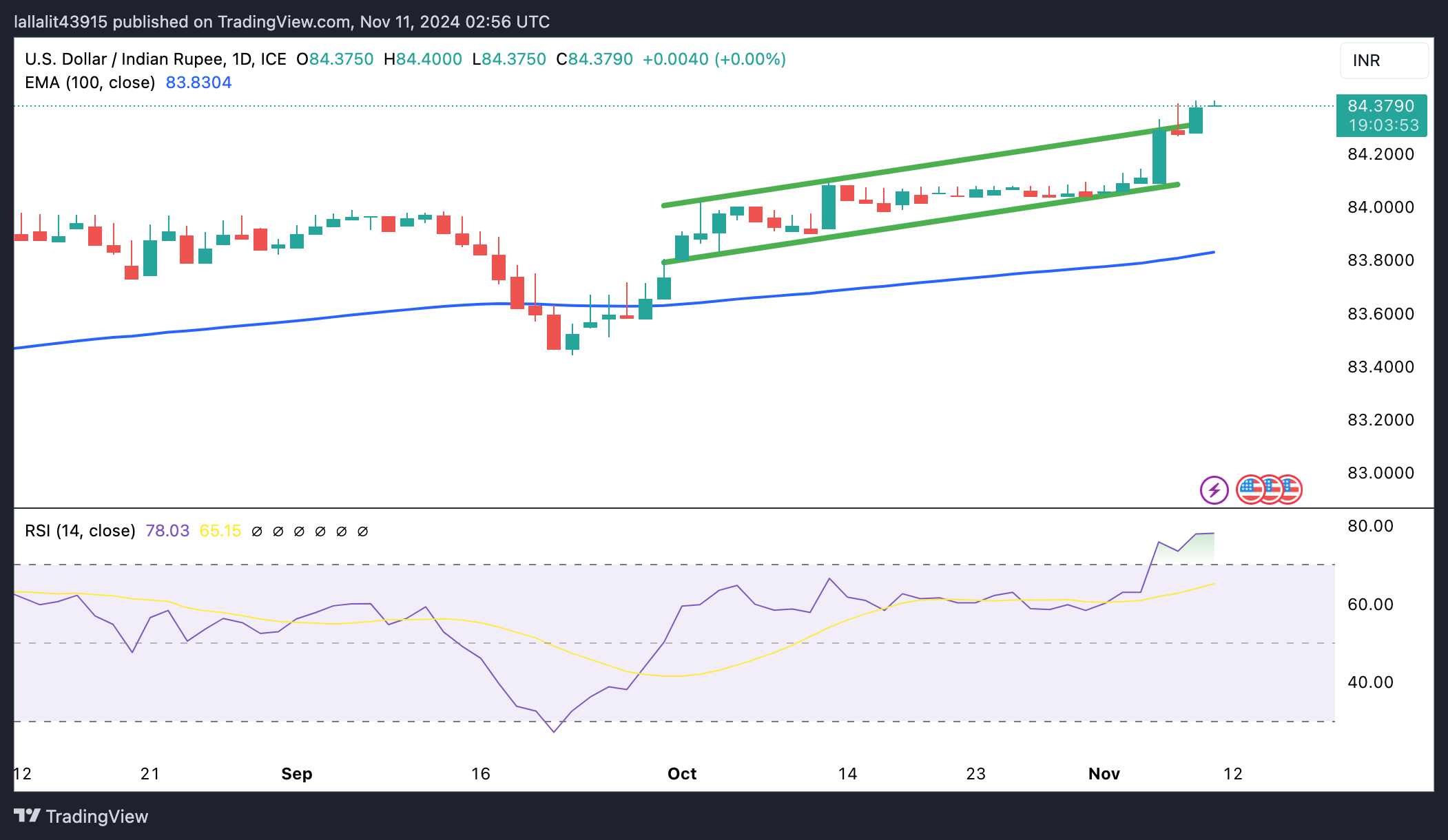
The Indian Rupee trades on a  soft note on the day. The bullish outlook of the USD/INR pair remains in play, with the pair holding above the key 100-day Exponential Moving Average (EMA) on the daily timeframe. However, additional consolidation should not be ruled out before positioning for any short-term USD/INR appreciation as the 14-day Relative Strength Index (RSI) is over the midline near 77.75, indicating an overbought condition.

A sustained buying momentum could take USD/INR to the next upside barrier at 84.50. Further north, the next hurdle emerges at the 85.00 psychological level.

On the downside, a move below the lower limit of the trend channel and the high of October 11 in the 84.05-84.10 zone could pave the way for a selloff to 83.83, the 100-day EMA. The additional downside level to watch is 83.46, the low of September 24.


USD/CHF gathers strength above 0.8750 amid the rally in US Dollar

USD/CHF gathers strength above 0.8750 amid the rally in US Dollar

The USD/CHF pair extends its upside to around 0.8770, the highest since August 1 during the early European trading hours on Monday. The upward movement of the pair is bolstered by the strength of the US Dollar (USD) as traders await the US inflation data and Federal Reserve (Fed) speakers this week.

Analysts expect that Trump’s policies would put upward pressure on US inflation and bond yields while slowing the Fed’s path to ease policy. This, in turn, lifts the Greenback against the Swiss Franc (CHF). “Given this, we still expect that the Fed will cut another 25bp at the December meeting, but thereafter will only cut once per quarter, in contrast to our previous forecast for a 25bp cut every meeting,” said JPMorgan economist Michael Feroli.

Traders will take more cues from the US Consumer Price Index (CPI), which is due on Wednesday. The headline CPI is expected to show an increase of 2.6% YoY in October, while the core CPI is estimated to show a rise of 3.3% YoY during the same period. In case of the hotter-than-expected outcome, this could further reduce the possibility of a December rate reduction, supporting the USD.

The Swiss National Bank (SNB) Vice Chairman Antoine Martin said on Monday that the central bank is not locked into more interest rate cuts in December, adding that everything will depend on conditions when we assess the situation in December. The markets anticipate the SNB to cut at least 25 basis points (bps) from the current 1% level at its next meeting on December 12.

Japanese Yen hangs near daily low, around mid-153.00s against USD

Japanese Yen hangs near daily low, around mid-153.00s against USD

The Japanese Yen (JPY) attracts some sellers on the first day of a new week after the Bank of Japan (BoJ) Summary of Opinions from the October meeting showed that policymakers were divided on rate hike timing. This, along with the political uncertainty in Japan, raises doubts over the BoJ’s ability to tighten its monetary policy further, which keeps the JPY depressed against its American counterpart heading into the European session. Apart from this, fears that US President-elect Donald Trump might again hit Japan with protectionist trade measures further dent demand for the JPY.

That said, the recent verbal intervention by Japanese authorities, along with the cautious market mood, could help limit further losses for the safe-haven JPY. Investors might also opt to move to the sidelines ahead of this week’s important macro releases – the US consumer inflation figures and the prelim Q3 GDP report from Japan. This, along with Federal Reserve (Fed) Chair Jerome Powell’s speech, will provide a fresh impetus to the USD/JPY pair. In the meantime, expectations that Trump’s policies would boost inflation and restrict the Fed’s ability to ease policy act as a tailwind for the US Dollar (USD).

Technical Outlook: USD/JPY could aim to surpass the 154.00 mark and test multi-month top

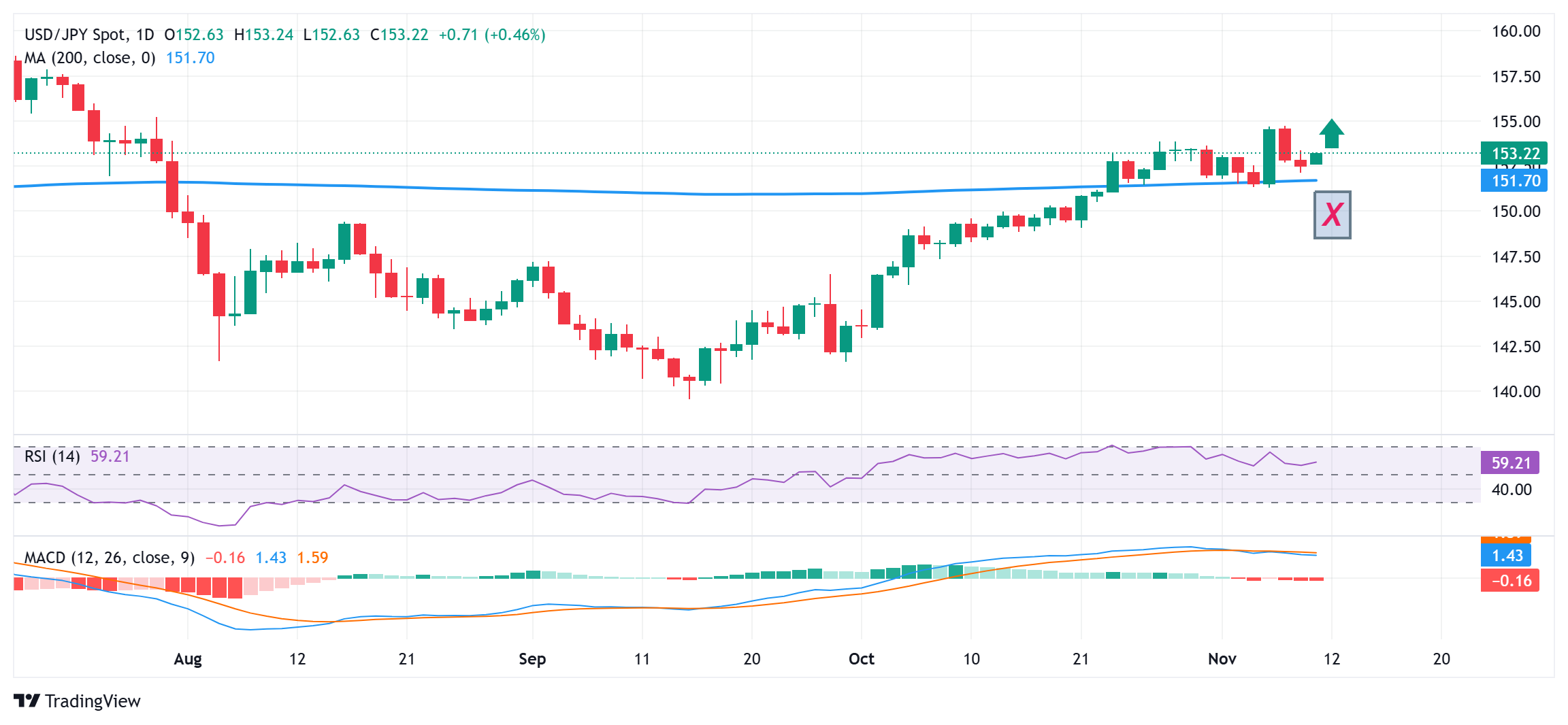
fxsoriginal

The USD/JPY pair, so far, has managed to hold above the very important 200-day Simple Moving Average (SMA) resistance breakpoint, which should act as a key pivotal point. This, along with positive oscillators on the daily chart, suggests that the path of least resistance for spot prices is to the upside. Any further move-up, however, is likely to confront some resistance ahead of the mid-153.00s. A sustained strength beyond could be seen as a fresh trigger for bulls and pave the way for a move towards reclaiming the 154.00 mark en route to the 154.70 area, or the multi-month top touched last week.

On the flip side, the Asian session low, around the 152.60 area, now seems to protect the immediate downside. Some follow-through selling could drag the USD/JPY pair below the 152.00 round figure, towards the 151.70 region (200-day SMA). A convincing break below the latter will suggest that the recent strong move up from the September low has run out of steam and shift the near-term bias in favor of bearish traders.

AUD/JPY moves above 101.00 due to BoJ uncertainty regarding interest rate hikes

AUD/JPY moves above 101.00 due to BoJ uncertainty regarding interest rate hikes

AUD/JPY retraces its recent losses from the previous session, trading around 101.20 during early European hours on Monday. The upside of the AUD/JPY cross is attributed to lower Japanese Yen (JPY) following the release of the Bank of Japan’s (BoJ) Summary of Opinions. The BoJ’s October report highlighted divisions among policymakers regarding the timing of future interest rate hikes.

Some members of the Bank of Japan expressed concerns about global economic uncertainties and rising market volatility, particularly around the Yen’s depreciation. Still, the central bank has suggested it might increase its benchmark policy rate to 1% by the latter half of the 2025 fiscal year.

In Japan, Prime Minister Shigeru Ishiba’s Cabinet resigned en masse before the Diet (parliament) during an extraordinary Cabinet meeting on Monday morning. With the ruling coalition of the Liberal Democratic Party (LDP) and Komeito now holding less than a majority in the House of Representatives, Monday’s vote is expected to lead to a runoff between Ishiba and Yoshihiko Noda, the leader of the major opposition party, the Constitutional Democratic Party.

The Australian Dollar (AUD) edged higher despite a generally cautious outlook due to concerns over Donald Trump’s proposed tariff increases on Chinese goods, which could impact Australian markets as China is one of its largest trading partners.

Further weighing on the Australian Dollar were China’s latest stimulus measures, which fell short of investor expectations and dampened demand prospects for Australia’s top trading partner. On Friday, China announced a 10 trillion Yuan debt package aimed at easing local government financing pressures and supporting sluggish economic growth; however, the package stopped short of including direct economic stimulus initiatives.