EUR/USD comes under pressure ahead of Fed speakers, US inflation

EUR/USD comes under pressure ahead of Fed speakers, US inflation

EUR/USD trades cautiously near more than four-month low around 1.0700 in Monday’s European session. The major currency pair remains on tenterhooks as the election of Republican Donald Trump as US President has strengthened the US Dollar’s (USD) outlook in the long run. The US Dollar Index (DXY), which gauges Greenback’s value against six major currencies, edges higher to near 105.00.

Trump vowed to raise import tariffs and lower taxes in his election campaign, which would add to United States (US) inflationary pressures and boost debt levels. According to a November 6-7 Reuters poll, 62% of respondents – including 94% of Democrats and 34% of Republicans – said that Trump’s policies likely “will push the US national debt higher.”

Trump’s tax cut proposals could add $7.5 trillion to the nation’s debt over the next decade, according to the nonpartisan Committee for a Responsible Federal Budget.

This week, investors will pay close attention to speeches from a slew of Federal Reserve (Fed) officials to get fresh cues about the likely monetary policy action in December. According to the CME FedWatch tool, there is a 65% chance that the central bank will cut interest rates again by 25 basis points (bps) to 4.25%-4.50% in December. This would be the second quarter-to-a-percent interest rate cut by the Fed in a row, as it also reduced its key borrowing rates last week.

On the economic front, investors will focus on the US Consumer Price Index (CPI) data for October, which will be published on Thursday. The impact of the inflation data is expected to be nominal on the interest rate outlook as Fed officials are confident about the disinflation trend towards the bank’s target of 2%. However, a significant deviation from the consensus could impact the same.

Technical Analysis: EUR/USD remains lower near 1.0700

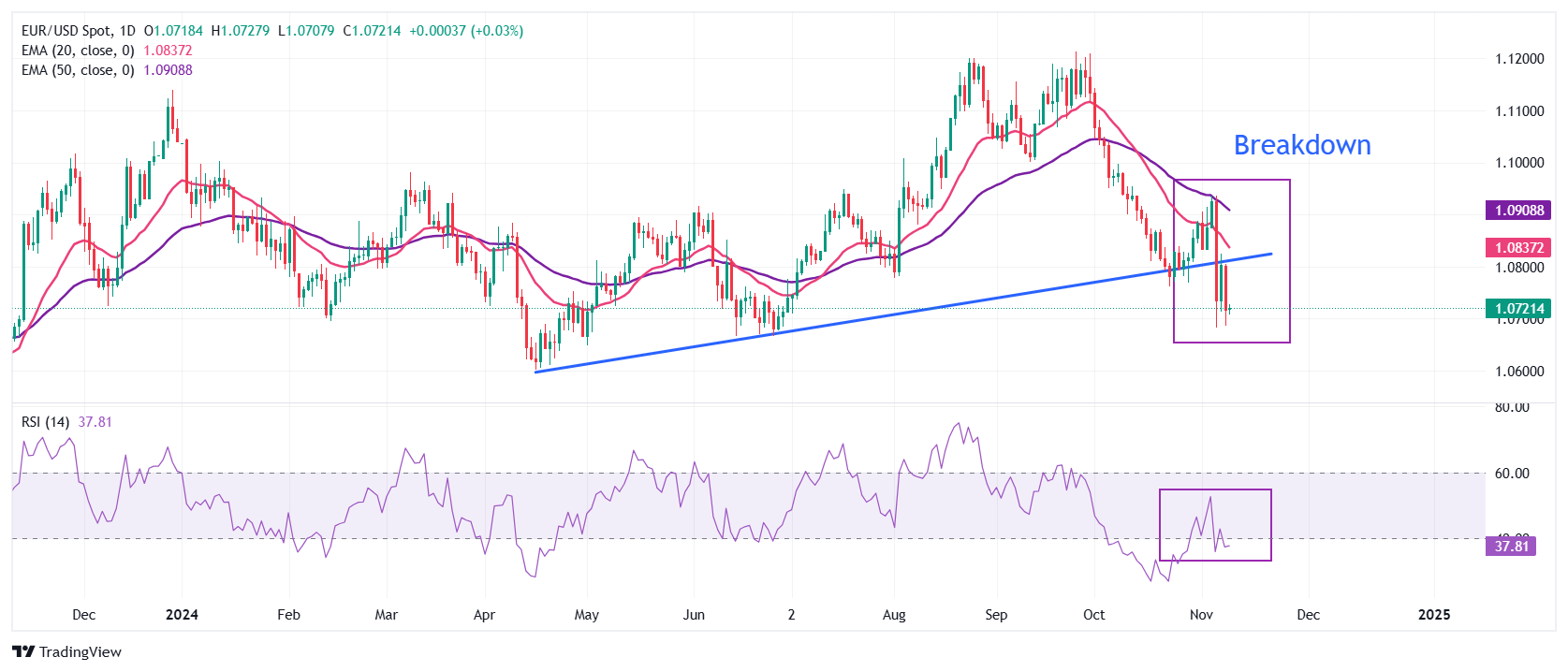
EUR/USD trades in a tight range near the more than four-month low around 1.0700. The near-term trend of the major currency pair remains bearish as the 20-day and 50-day Exponential Moving Averages (EMAs) near 1.0840 and 1.0910, respectively, continue to decline.

The 14-day Relative Strength Index (RSI) wobbles near 40.00. A bearish momentum would resume if the RSI (14) slides below that level.

The upward-sloping trendline around 1.0800, plotted from the April 16 low at around 1.0600, will act as a key resistance zone for Euro (EUR) bulls. Looking down, the shared currency pair could decline to the year-to-date (YTD) low of 1.0600.

GBP/JPY maintains position above 198.00 after LDP Ishiba re-elects as Japan Prime Minister

GBP/JPY maintains position above 198.00 after LDP Ishiba re-elects as Japan Prime Minister

GBP/JPY breaks its two days of losses, trading around 197.90 during the European session on Monday. The Japanese Yen (JPY) faces challenges due to uncertainty surrounding the Bank of Japan’s (BoJ) interest rate hikes in the future. The BoJ Summary of Opinions for the October meeting highlighted divisions among policymakers regarding the timing of future interest rate hikes.

Some members of the Bank of Japan expressed concerns about global economic uncertainties and rising market volatility, particularly around the Yen’s depreciation. Still, the central bank has suggested it might increase its benchmark policy rate to 1% by the latter half of the 2025 fiscal year.

Liberal Democratic Party’s (LDP) Shigeru Ishiba has been re-elected as Japan’s Prime Minister, receiving 221 out of 465 votes in the lower house of parliament. This follows last month’s election, in which Ishiba’s LDP, along with its coalition partner Komeito, lost their parliamentary majority.

The Bank of England (BoE) lowered interest rates by 25 basis points on Thursday. BoE Governor Andrew Bailey noted that, if the economy develops as anticipated, interest rates will continue to decrease gradually. However, Bailey stressed that monetary policy will remain tight until the risks of persistent inflationary pressures are reduced.

The Office for Budget Responsibility recently revised its inflation forecast for 2025, raising it to an average of 2.6%, up from the 1.5% estimate in March. This adjustment is closely aligned with the BoE’s August projections, which forecast inflation at 2.4% in one year, 1.7% in two years, and 1.5% in three years.

Gold price languishes near daily low amid Trump optimism-inspired USD buying

Gold price languishes near daily low amid Trump optimism-inspired USD buying

Gold price (XAU/USD) adds to last week’s heavy losses and remains under some selling pressure for the second straight day on Monday amid the underlying bullish sentiment surrounding the US Dollar (USD). The optimism over Donald Trump’s anticipated expansionary policies keeps the USD close to a four-month top touched last week, which, in turn, is seen as a key factor undermining the commodity.

Meanwhile, US President-elect Donald Trump’s pledged 10% tariff on all US imports is expected to trigger a resurgence in inflation and restrict the Federal Reserve’s (Fed) ability to ease aggressively. This, in turn, remains supportive of elevated US Treasury bond yields and contributes to driving flows away from the non-yielding yellow metal. That said, the cautious market mood could limit losses for the safe-haven XAU/USD.

Traders might also opt to move to the sidelines ahead of the release of the latest US consumer inflation figures and speeches by influential FOMC members, including Fed Chair Jerome Powell later this week. This, in turn, might help limit any further losses and warrants some caution before positioning for an extension of the recent sharp retracement slide from the vicinity of the $2,800 mark, or the all-time high touched on October 31.

Technical Outlook: Gold price remains close to multi-week low and 50-day SMA pivotal support

fxsoriginal

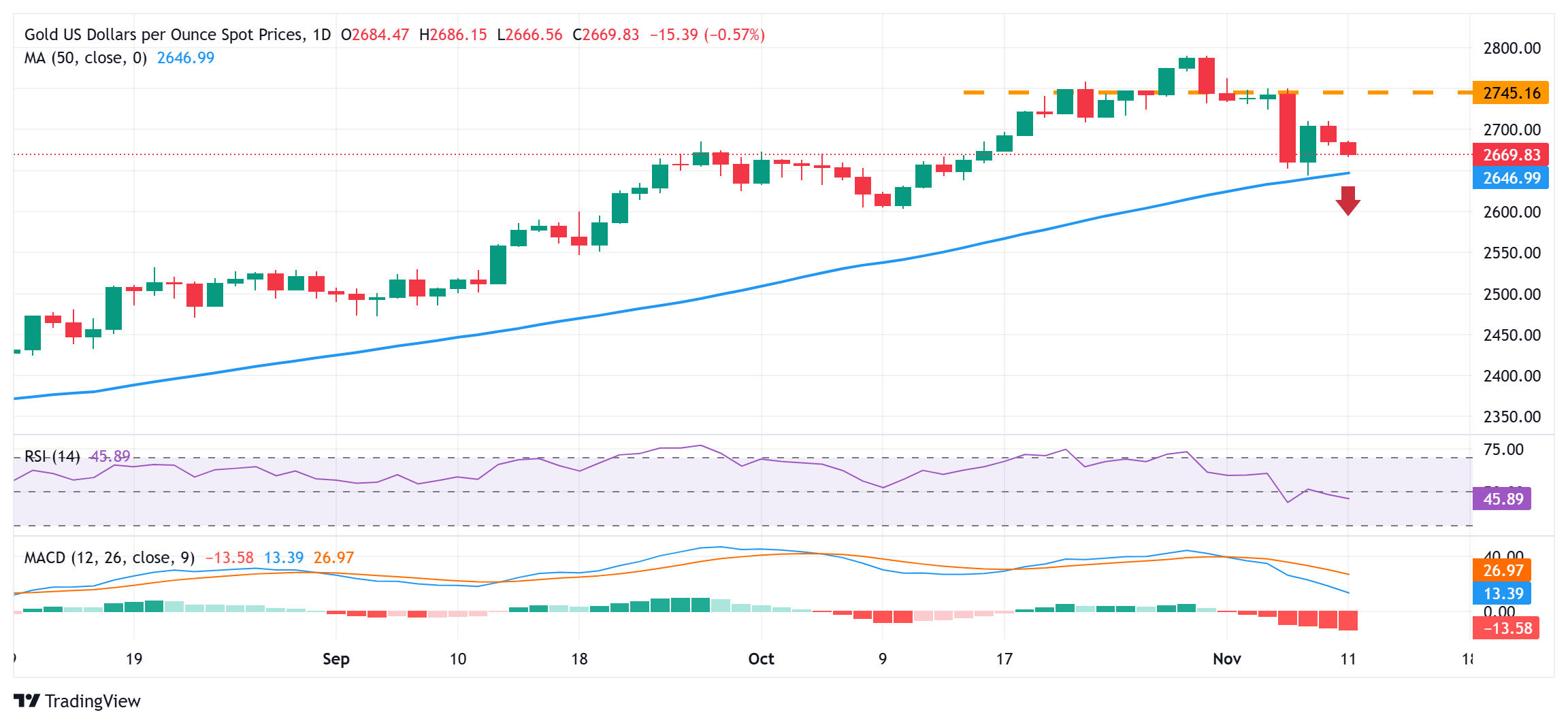
From a technical perspective, any further decline is likely to find some support near the $2,660 zone ahead of the 50-day Simple Moving Average (SMA), currently pegged near the $2,647-2,746 region. Some follow-through selling below last week’s swing low, around the $2,643 area, will be seen as a fresh trigger for bearish traders. Given that oscillators on the daily chart have been losing positive traction, the Gold price might then accelerate the fall toward the October monthly swing low, around the $2,605-2,602 region.

On the flip side, momentum back above the $2,700 mark now seems to confront stiff resistance near the $2,718 region ahead of the $2,740-2,745 supply zone. A sustained strength beyond the latter will suggest that the corrective pullback has run its course and lift the Gold price beyond the $2,750 static resistance, towards the $2,758-2,790 zone, or the record high touched on October 31.

EUR/USD stays defensive around 1.0700 amid light trading

EUR/USD stays defensive around 1.0700 amid light trading

EUR/USD stays defensive at around 1.0700 in European trading on Monday. The pair reamins undermined by the German political risks and a sustained US Dollar strength, as traders brace for the key US inflation data later this week. US holiday-led thin trading is likely to extend.

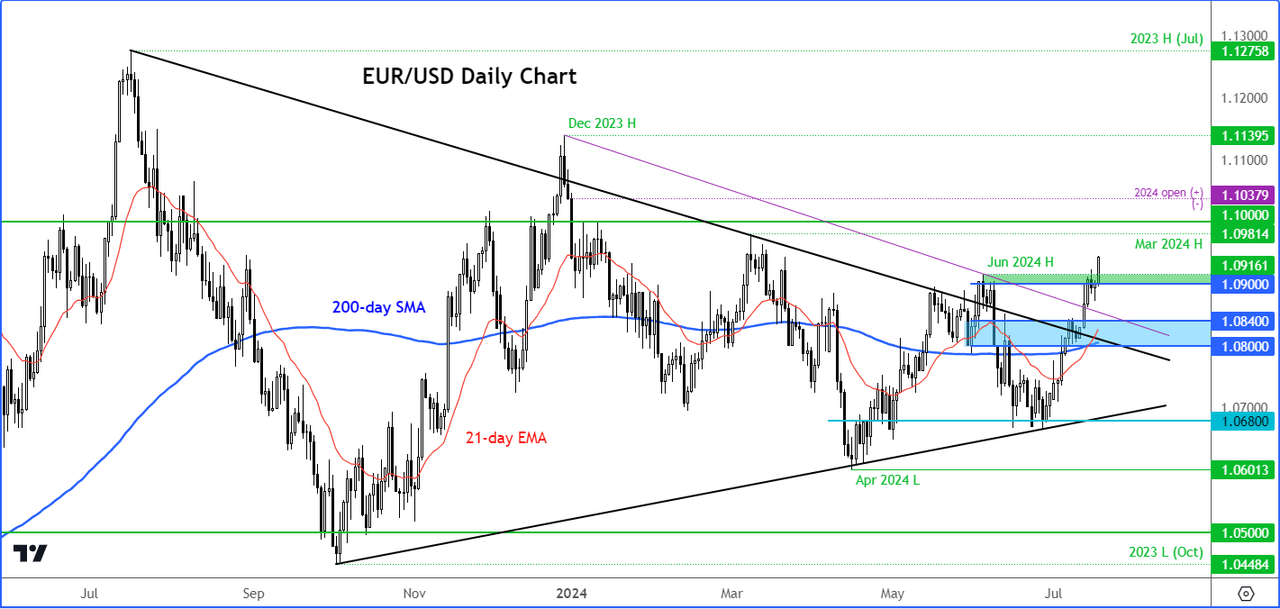
The Relative Strength Index (RSI) indicator on the 4-hour chart stays below 50, suggesting that the bearish bias remains intact following Thursday’s correction.

On the downside, static support is located at 1.0750 ahead of 1.0700 (static level, round level) and 1.0680 (static level). Looking north, initial resistance aligns at 1.0800 (static level, round level) before 1.0870 (200-day Simple Moving Average).

Following Wednesday’s sharp decline, EUR/USD gained traction and rose nearly 0.7% on Thursday. The pair, however, struggles to keep its footing and trades below 1.0800 in the European morning on Friday.

After outperforming its rivals with the initial reaction to the Donald Trump’s victory in the presidential election on Wednesday, the US Dollar (USD) lost its strength as investors booked profits ahead of the Federal Reserve’s (Fed) monetary policy announcements.

The Fed lowered the policy rate by 25 basis points to the range of 4.5%-4.75% following the November policy meeting, as anticipated. In its policy statement, the US central bank repeated that risks to the job market and inflation were “roughly in balance.” In the post-meeting press conference, Fed Chairman Jerome Powell refrained from hinting whether they will ease the policy further in December and explained that the results of the presidential election will have no effect on the monetary policy in the near term.

The market reaction to the Fed event remained largely muted. According to the CME FedWatch Tool, the probability of a 25 bps rate cut in December remains largely unchanged at about 70%. Early Friday, the cautious market mood helps the USD hold its ground and doesn’t allow EUR/USD to extend its rebound.

The University of Michigan’s (UoM) preliminary Consumer Sentiment Index for November will be featured in the US economic docket. In the meantime, US stock index futures were last seen trading virtually unchanged on the day. In case markets remain cautious following Wall Street’s opening bell, the USD could stay resilient against its peers and limit EUR/USD’s upside.

Mexican Peso recovers against USD on eve of “coin toss” US presidential election

Mexican Peso recovers against USD on eve of “coin toss” US presidential election

The Mexican Peso (MXN) trades mixed in its key pairs on Monday. The Peso is rising against the US Dollar (USD) as the “Trump trade” – which has proven positive for the Greenback – fades due to increased doubts about the outcome of the US presidential election.

The USD is further under pressure as concerns mount that post-election market volatility might encourage the Federal Reserve (Fed) to slash interest rates by another 50 basis points (bps) (0.50%) at its November meeting on Thursday to act as a “tranquilizer”.

Against the Euro (EUR), however, MXN is edging lower, as the shared currency gains mild support from recent solid Eurozone Unemployment and IFO survey data. Versus the Pound Sterling (GBP), the Peso seesaws between tepid gains and losses as Sterling attempts to reboot after the dust settles after the Autumn government’s budget sell-off.

USD/MXN is trading at 20.11, EUR/MXN at 21.92, and GBP/MXN at 26.07 at the time of publication.

Mexican Peso rises against USD as election remains a “coin toss”

The Mexican Peso trades higher against the US Dollar as the US presidential election proves too close to call, and traders unwind bets from a few days ago when the odds favored former President Donald Trump winning the race.

According to election guru Nate Silver, the election outcome is going to be “a pure coin toss-up,” and his website FiveThirtyEight gives Trump a 53% probability of winning, Vice President Kamala Harris a 46% chance, and a 1% probability of no outright winner.

Four US presidential election scenarios for the Peso

The number of Mexican Pesos that can be bought with one US Dollar could fluctuate between a low of 18.30 and a high of 22.26 depending on the outcome of the US presidential election, according to Mexican financial daily El Financiero.

The financial news site posits four possible US presidential election scenarios for the USD/MXN pair (graphic below).

In the case of Harris winning the presidency and the Democrats securing a majority in Congress, the Peso is likely to strengthen to between 18.30 and 19.00 against the USD.

In the worst-case scenario of a Trump victory and a Republican majority in Congress, the Peso is likely to fall to between 21.14 and 22.26 to the US Dollar.

If Kamala Harris wins the presidency without a Democrat majority in Congress, USD/MXN is likely to fluctuate between 19.40 and 18.80.

A win for Trump without a Republican majority in Congress, however, could see the pair in a range between 21.14 and 19.70.

Mexican data upbeat

The Mexican Peso is underpinned by relatively positive recent macroeconomic data.

Mexican Business Confidence improved to 52.3 in October, and the S&P Global Mexican Manufacturing PMI rose to 48.4 in October from 47.3 in the previous month, albeit remaining in contraction territory below 50. The survey showed orders remained low due to fierce competition from China, although it highlighted lower cost pressures, which might feed through into lower inflation.

The Mexican Unemployment rate stood at a relatively low 2.9% in September, unchanged from the corresponding period in the previous year.

As measured by the Gross Domestic Product (GDP) growth rate, the third-quarter economic growth for Mexico came out at 1.0% quarter-on-quarter, accelerating from 0.2% in Q2, and annualized GDP growth rose by 1.5%.

Banxico expected to cut by 0.25%

Expectations are generally still high for the Banco de Mexico (Banxico) to cut interest rates by 25 bps (0.25%) to 10.25% at their meeting on November 14. This is likely to put pressure on the Mexican Peso as lower interest rates attract less foreign capital inflows.

According to Kimberley Sperrfechter, Emerging Markets Economist at Capital Economics, Mexico’s surprise GDP growth in Q3 does not “preclude another rate cut in November” by Banxico.

A rate cut will depend on the path of inflation, and core inflation is likely to remain low, according to Klaus Baader, Global Chief Economist, Societe Generale.

“In Mexico, the sluggish core disinflation continues amid a weakening economy, and despite significant Peso depreciation,” says Baader in a recent note.

A further driver of the Peso is remittances from Mexican migrants working abroad, sending money home. These fell by 4.6% in September to $5.36 billion compared to $5.62 billion recorded in the same month last year, according to Banxico.

Technical Analysis: USD/MXN gaps down at open after peaking on Friday

USD/MXN gaps down (orange shaded rectangle on the chart below) to trade in the 20.11s at the open on Monday, after peaking at 20.29 on Friday.

The pair appears to have completed a bullish Measured Move, or “abc” pattern (see chart), which began at the October 14 swing low.

USD/MXN 4-hour Chart
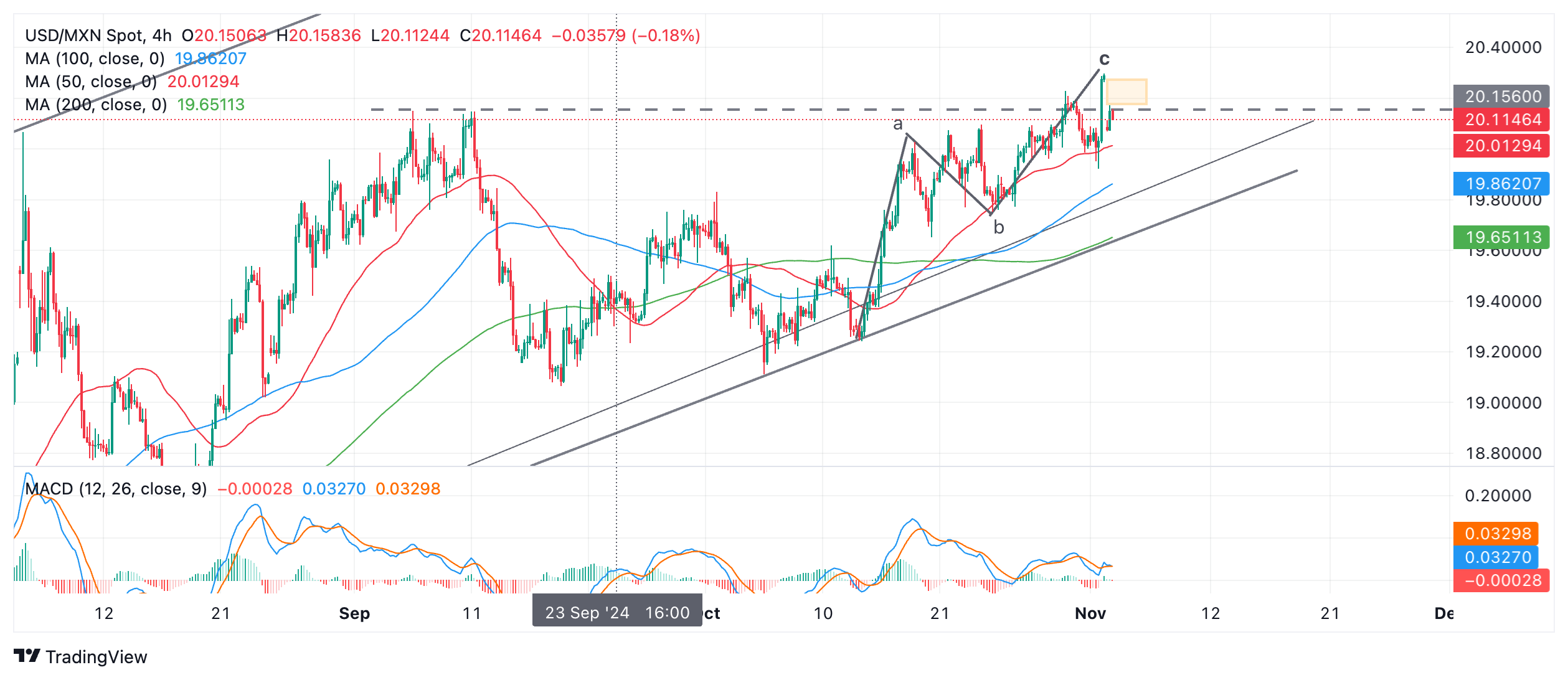
Despite the gap down, USD/MXN is still probably in an uptrend on a short, medium and long-term basis. Further, it is trading in a bullish rising channel. Given the technical dictum “the trend is your friend,” the odds favor a continuation higher.

In addition, according to technical analysis theory, gaps do not tend to remain open for long, suggesting the gap that opened on Monday could soon be filled by rising prices.

That said, momentum, as measured by the Moving Average Convergence Divergence (MACD), remains low by recent standards and indicates a lack of bullish enthusiasm underpinned Friday’s rally to new highs.


NZD/USD: Likely to trade in a 0.5940/0.6040 range for now

NZD/USD: Likely to trade in a 0.5940/0.6040 range for now

The New Zealand Dollar (NZD) could trade in a choppy manner between 0.5965 and 0.6015. In the longer run, weakness in NZD from early last month has ended; it is likely to trade in a 0.5940/0.6040 range for now, UOB Group’s FX analysts Quek Ser Leang and Lee Sue Ann note.

Weakness in NZD from early last month ends

24-HOUR VIEW: “Last Friday, we expected NZD to trade in a range between 0.5950 and 0.5990. NZD then traded in a 0.5960/0.5999 range. It closed at 0.5962 but rose above 0.6000 in early Sydney trade today. The volatile price action has resulted in a mixed outlook. Today, NZD could continue to trade in a choppy manner, probably between 0.5965 and 0.6015.”

1-3 WEEKS VIEW: “We turned negative in NZD early last month. As we tracked the decline, in our most recent narrative from last Wednesday (30 Oct, spot at 0.5970), we indicated that ‘There is still no clear increase in downward momentum and the chance of a sustained break below 0.5950 is not high.’ While NZD subsequently dropped below 0.5950, it rebounded quickly from 0.5940. In early Sydney trade today, it rose to 0.6010. Although our ‘strong resistance’ at 0.6010 has not been clearly breached, downward momentum appears to have faded. In other words, the weakness in NZD has ended. NZD has likely entered a range trading phase and is expected to trade between 0.5940 and 0.6040 for now.”

USD/CAD bounces back as Canadian Dollar weakens, US elections take center stage

USD/CAD bounces back as Canadian Dollar weakens, US elections take center stage

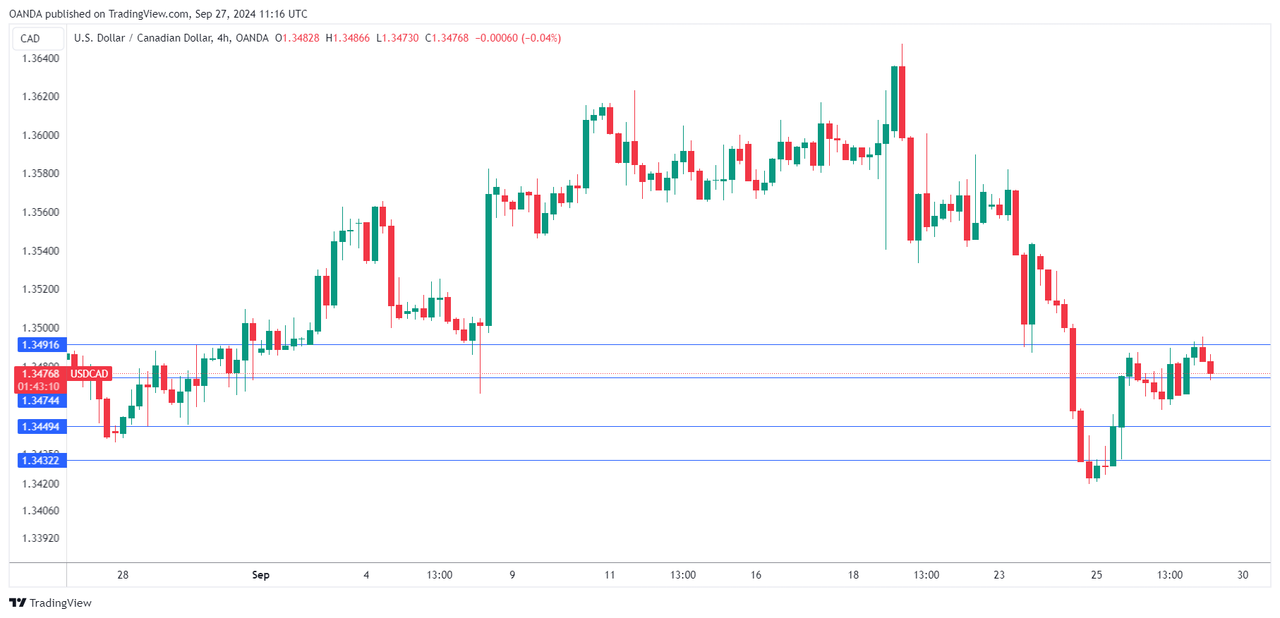
The USD/CAD pair recovers half of its intraday losses after discovering significant buying interest around the key support of 1.3900. The Loonie asset bounces back despite the US Dollar (USD) remaining vulnerable against its major peers, suggesting sheer weakness in the Canadian Dollar (CAD).

The CAD remains on the backfoot as the Bank of Canada (BoC) is expected to cut interest rates further in the last monetary policy meeting of the year in December. BoC Governor Tiff Macklem opened doors for another 50 basis points (bps) interest rate reduction in December.

“We’ve demonstrated we’re prepared to do a 50-basis-points cut if we think that’s appropriate. And if we think it’s appropriate to do it again, we’ll do it again,” Macklem told to Senate Committee on Wednesday. Macklem emphasized the need to lower interest rates unless he sees surprises from economic developments. The BoC also reduced its interest rates by 50 bps to 3.75% in its policy meeting in October.

For more interest rate guidance, investors will pay close attention to BoC’s Summary of Deliberations and the minutes of the policy meeting of October, which will be published on Tuesday.

Meanwhile, the US Dollar faces intense selling pressure as recent United States (US) national polls have shown that there would be fierce competition between Democratic candidate Kamala Harris and former President Donald Trump for presidential elections on Tuesday. The US Dollar Index (DXY), which gauges Greenback’s value against six major currencies, tumbles to near 103.70.

This week, investors will also focus on the Federal Reserve (Fed) policy meeting, which is scheduled on Thursday. The Fed is expected to reduce interest rates by 25 bps to 4.50%-4.75%.

USD: Trump trades being unwound after latest polls

USD: Trump trades being unwound after latest polls

US election week is starting with a weak dollar across the board. Markets are still digesting the very soft payrolls numbers on Friday, which were highly affected by extreme weather events. Meanwhile, the latest polls suggest that the Democrats have regained some momentum in some swing states may have prompted some unwinding of Trump trades. Incidentally, a recent poll suggests that Kamala Harris is leading in Iowa, previously considered a red-leaning state, ING’s FX analyst Francesco Pesole notes.

US elections and upcoming Fed meeting to shape the market

“Despite some unwinding of Trump trades, asset markets are still broadly pricing in a Trump win. As things stand now, we expect the dollar to sell off if Harris wins, while the impact of a Trump win may depend more on the Congress composition. A Republican clean sweep can send the dollar higher, but probably by less than how much a Harris win could hit USD. The USD might not rally at all if Trump wins but Democrats secure the house.”

“Another big event this week is the Federal Reserve’s rate announcement on Wednesday. By then, the election results may have not been called yet, meaning the FOMC market impact could prove rather short-lived. The Fed should cut by 25bp regardless of the US election result. Had it not been for the proximity of the vote, we would have argued a Fed cut would have been net-negative for the dollar, but the implications for FX of this Fed decision will only be assessed once the election volatility has dimmed down.”

“Expect volatility in USD crosses today and tomorrow as FX liquidity may tighten and large hedging positions may be re-assessed on the back of latest sentiment on the vote. Today’s momentum seems to be pointing to a weaker dollar, but things can turn rapidly in intraday trading. We retain a bias for a stronger USD today and tomorrow from this morning levels.”

GBP/USD: To decline GBP must break and remain below 1.2845

GBP/USD: To decline GBP must break and remain below 1.2845

The Pound Sterling (GBP) is likely to trade in a range, probably between 1.2890 and 1.2980. In the longer run, GBP must break and remain below 1.2845 before a sustained decline can be expected, UOB Group’s FX analysts Quek Ser Leang and Lee Sue Ann note.

Rangebound between 1.2890 and 1.2980 for the time being

24-HOUR VIEW: “After GBP dropped sharply last Thursday, we highlighted on Friday that ‘The sharp drop appears to be overdone, and GBP is unlikely to weaken further.’ We held the view that GBP ‘is more likely to trade in a range, probably between 1.2860 and 1.2950.’ GBP did not weaken further, but instead of trading in a range, it rose to 1.2980, then pulled back to close at 1.2921. It opened higher today. The price action provides no fresh clues, and we continue to expect GBP to trade in a range, probably between 1.2890 and 1.2980.”

1-3 WEEKS VIEW: “Last Thursday, GBP plummeted to a low of 1.2845. In our update from last Friday (01 Nov, spot at 1.2900), we indicated that ‘While there has been a buildup in momentum, GBP must break and remain below 1.2845 before further sustained decline can be expected.’ We added, ‘The likelihood of GBP breaking clearly below 1.2845 will remain intact, provided that 1.2985 is not breached.’ In NY trade, GBP rose to 1.2980, then pulled back. Downward momentum has slowed, and the chance of GBP breaking below 1.2845 has diminished. However, only a clear break above 1.2985 would indicate that the downside risk has faded.”

USD/CHF dips toward 0.8650 as the US Dollar weakens amid lower Treasury yields

USD/CHF dips toward 0.8650 as the US Dollar weakens amid lower Treasury yields

USD/CHF retraces its recent gains from the previous session, trading around 0.8650 during the European session on Monday. The US Dollar faces downward pressure as subdued Treasury yields follow Friday’s weaker-than-expected US Nonfarm Payrolls report.

The US Dollar Index (DXY), which measures the value of the US Dollar against its six major peers, trading around 103.80 with 2-year and 10-year yields on US Treasury bonds standing at 4.17% and 4.31%, respectively, at the time of writing.

On the data front, the US Bureau of Labor Statistics (BLS) indicated that October’s Nonfarm Payrolls increased by only 12,000, following a revised September gain of 223,000 (down from 254,000), which fell well short of market expectations of 113,000. Meanwhile, the Unemployment Rate remained steady at 4.1% in October, matching the consensus forecast.

Traders are closely watching the upcoming US presidential election on Tuesday, as the final New York Times/Siena College poll showed Democratic candidate Kamala Harris and Republican nominee Donald Trump are locked in a close contest across seven battleground states on Sunday. The focus will shift to the US Federal Reserve (Fed) policy decision, with expectations of a modest 25 basis point rate cut later this week.

The yield on the 10-year Swiss government bond dropped toward 0.38%, its lowest level since early October, as expectations grew for more substantial rate cuts by the Swiss National Bank (SNB). This shift follows a continued slowdown in Switzerland’s inflation, with the Consumer Price Index (CPI) falling 0.6% year-over-year in October, below the 0.8% forecast and marking the slowest rate of increase since July 2021.

Swiss inflation has not risen since April, and October’s figure came in well below the SNB’s fourth-quarter inflation forecast of 1%. This raises the likelihood that the SNB may consider a larger rate cut in December to keep inflation within its target range of 0-2%, signaling concerns over potential economic softening.