AUD/USD: Likely to trade in a sideways range of 0.6445/0.6485

AUD/USD: Likely to trade in a sideways range of 0.6445/0.6485

Momentum indicators are turning flat; Australian Dollar (AUD) is likely to trade in a sideways range of 0.6445/0.6485. In the longer run, further AUD weakness still appears likely; the next level to watch is 0.6400, UOB Group’s FX analysts Quek Ser Leang and Lee Sue Ann note.

The next level to watch is 0.6400

24-HOUR VIEW: “When AUD was at 0.6450 last Friday, we highlighted that ‘provided that 0.6490 remains intact, AUD could decline further.’ However, we pointed out that ‘the major support at 0.6400 is unlikely to come into view.’ Our expectations did not turn out, as AUD traded sideways between 0.6443 and 0.6482, closing at 0.6465 (+0.16%). As momentum indicators are turning flat, further sideways trading appears likely, probably in a range of 0.6445/0.6485.”

1-3 WEEKS VIEW: “We indicated last Friday (15 Nov, spot at 0.6450) that ‘further AUD weakness still appears likely.’ We also highlighted that ‘The next level to watch is 0.6400.’ Although downward momentum has slowed somewhat, we will continue to hold the same view for now. Overall, only a breach of 0.6520 (no change in ‘strong resistance’ level) would mean that the weakness in AUD has stabilised.”
USD/JPY: Consolidation on daily chart

USD/JPY: Consolidation on daily chart

USD/JPY rose sharply this morning, and was last seen at 154.84, OCBC FX analysts Frances Cheung and Christopher Wong notes.

Bullish momentum on daily chart fades

“Markets were earlier anticipating some hint on policy moves from Governor Ueda at an event in Nagoya but his remarks were interpreted as less hawkish. He said that actual timing of adjustments will continue depending on developments in economic activity and prices as well as financial conditions – akin to policy decision being data dependent.”

“Last Fri, Finance Minister Kato said authorities will respond appropriately to any excessive move and authorities see one sided, sudden move in FX markets. In the very near term, self-inflicted concerns of officials’ intervention may slow pace of USD/JPY rise.”

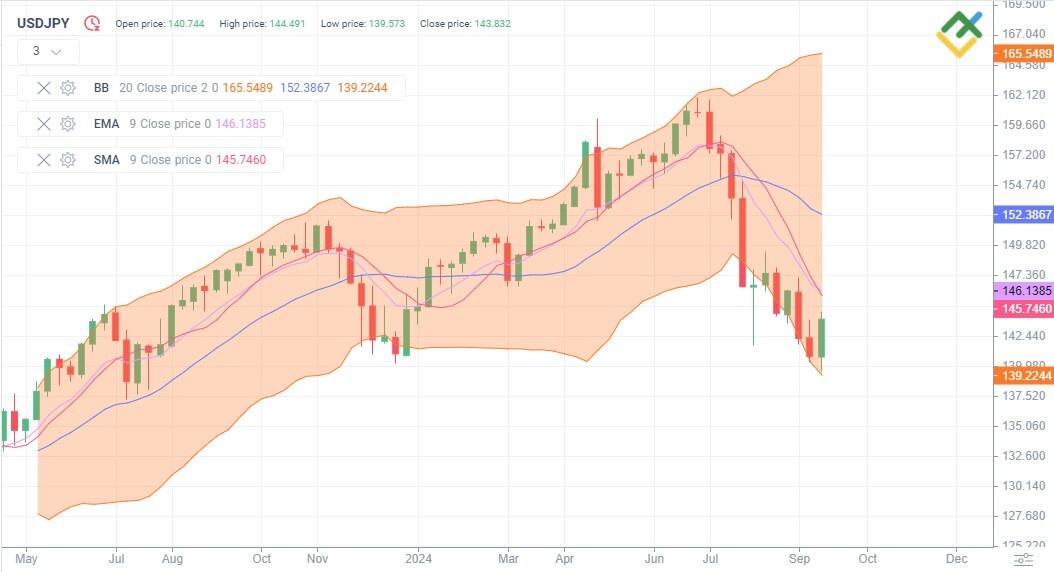
“Bullish momentum on daily chart faded while RSI was flat. Potential bearish divergence on RSI observed. Further downside play not ruled out. Support at 153.00/30 (21 DMA, 61.8% fibo retracement of Jul high to Sep low) needs to be broken for bears to gather further traction towards 150.70 (50% fibo). Resistance at 156.50 (76.4% fibo).”

EUR/USD: To trade in a range between 1.0505 and 1.0585

EUR/USD: To trade in a range between 1.0505 and 1.0585

The Euro (EUR) is likely to trade in a range between 1.0505 and 1.0585. In the longer run, price action continues to suggest EUR weakness; the next support level is at last year’s low, near 1.0450, UOB Group’s FX analysts Quek Ser Leang and Lee Sue Ann note.

The next support level is at last year’s low, near 1.0450

24-HOUR VIEW: “The following are excerpts from our update last Friday: ‘Conditions remain oversold, but the weakness still has not quite stabilised just yet. That said, as momentum has slowed somewhat, any further decline is likely part of a lower trading range of 1.0490/1.0580. In other words, EUR is unlikely to break clearly below 1.0490.’ Our view of range trading was not wrong, even though EUR traded in a higher range of 1.0516/1.0592, closing at 1.0541 (+0.10%). There has been no increase in either downward or upward momentum, and we continue to expect EUR to trade in a range, probably between 1.0505 and 1.0585.”

1-3 WEEKS VIEW: “We turned negative in EUR on 07 Nov, when EUR was at 1.0730. After EUR fell below our technical target of 1.0500, we indicated last Friday (15 Nov, spot at 1.0525) that ‘The price action continues to suggest EUR weakness, even though caution is warranted given the deeply oversold conditions.’ We added, ‘The next support is at last year’s low, near 1.0450.’ EUR then snapped its 5-day losing streak, closing higher by 0.10% at 1.0541. Although downward momentum has slowed somewhat, only a breach of 1.0610 (no change in ‘strong resistance’ level) would indicate that EUR is not weakening further. Meanwhile, oversold conditions could lead to a couple of days of range trading.”

GBP/USD: GBP to edge lower to 1.2590

GBP/USD: GBP to edge lower to 1.2590

Scope for the Pound Sterling (GBP) to edge lower to 1.2590; the major support at 1.2565 is likely out of reach. In the longer run, GBP is likely to continue to weaken to 1.2565, UOB Group’s FX analysts Quek Ser Leang and Lee Sue Ann note.

Below 1.2590 GBP to weaken towards 1.2565

24-HOUR VIEW: “Last Friday, we noted that ‘Downward momentum is showing tentative signs of slowing, but there is scope for GBP to retest the 1.2630 level.’ We added, ‘The major support at 1.2615 is unlikely to come under threat.’ The anticipated decline exceeded our expectations, as GBP fell to a low of 1.2598, closing at 1.2619 (-0.39%). Despite the relatively sharp decline, downward momentum has not increased much. That said, there is scope for GBP to edge lower to 1.2590. The major support at 1.2565 is likely out of reach. Resistance is at 1.2640, followed by 1.2670.”

1-3 WEEKS VIEW: “When GBP was at 1.2665 last Friday (15 Nov), we indicated that GBP “is expected to continue to weaken to 1.2615, possibly 1.2565.” We did not anticipate it to reach 1.2615 as quickly, as it dropped to a of low of 1.2598. While downward momentum has not increased much, GBP is likely to continue to weaken to 1.2565. On the upside, a breach of 1.2745 (‘strong resistance’ level was at 1.2770 last Friday) would indicate that the downward pressure that started early last week has faded.”


Pound Sterling stays under pressure against US Dollar as traders pare back Fed dovish bets

Pound Sterling stays under pressure against US Dollar as traders pare back Fed dovish bets

The Pound Sterling (GBP) remains under pressure near 1.2600 against the US Dollar (USD) in Monday’s London session. The GBP/USD pair struggles to gain ground as the US Dollar clings to gains near a more-than-a-year high, with the US Dollar Index (DXY) wobbling around 107.00.

The Greenback trades firmly as investors expect the Federal Reserve (Fed) to follow a more gradual rate-cut approach given the recent slight rebound in inflation and the growth outlook on strong expectations that President-elected Donald Trump will be able to implement his economic agenda smoothly.

In the December meeting, there is a 62% chance that the Fed will cut interest rates by 25 basis points (bps) to 4.25%-4.50%, according to the CME FedWatch tool. This is significantly down from the almost 77% seen a month ago.

Trump’s victory is also making analysts reassess the Fed’s interest-rate outlook for next year. “The Fed’s Monetary Policy Committee (MPC) will be acutely aware that Donald Trump’s policies could be significantly inflationary, primarily due to the impact of tariffs being passed on to consumers while lower taxes heat up the economy,” analysts at Quilter Investors said.

“Investors will no doubt be combing through their comments carefully for any perceived guidance on how that might impact the path of interest rates going forward,” they added.

Meanwhile, Fed officials have refused to comment on the likely impact of Trump’s policies on the monetary policy action and the economic outlook. On Thursday, Fed Chair Jerome Powell said that “it is too early to reach judgments on the effect of Trump policies.”

On the economic data front, investors await the preliminary S&P Global Purchasing Managers’ Index (PMI) data for November, which will be published on Friday.

Technical Analysis: Pound Sterling hovers near 1.2600

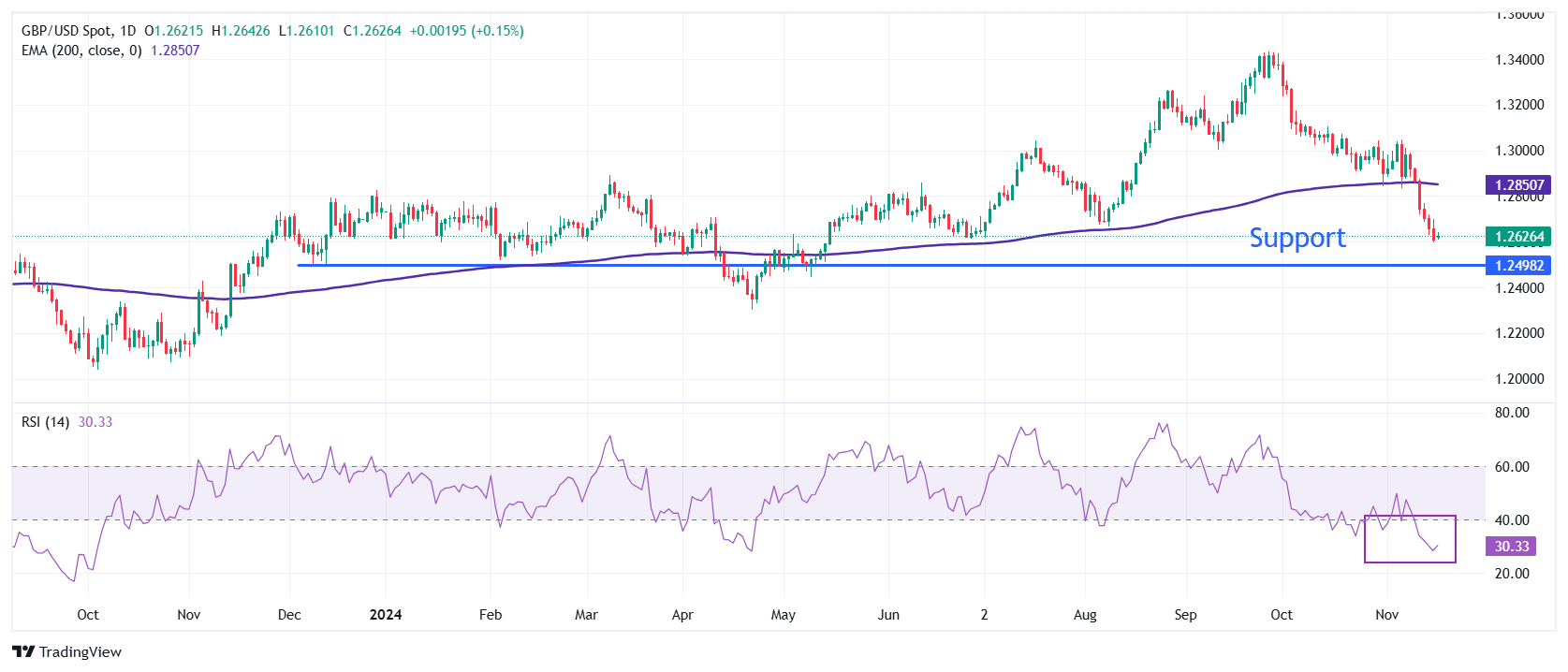
The Pound Sterling aims for a firm footing near 1.2600 against the US Dollar in London trading hours on Monday. The GBP/USD pair remains broadly under pressure as it remains well below the 200-day Exponential Moving Average (EMA) at 1.2850.

The 14-day Relative Strength Index (RSI) slides sharply to 30.00, suggesting a strong bearish momentum.

Looking down, the psychological support of 1.2500 will be a major cushion for Pound Sterling bulls. On the upside, the Cable will face resistance near the 200-day EMA.

EUR/USD grinds higher above 1.0550 amid a cautious start to the week

EUR/USD grinds higher above 1.0550 amid a cautious start to the week

EUR/USD grinds higher above 1.0550 in Monday’s European session. The pair shrugs off the re-emergence of the Russia-Ukraine geopolitical risks as the US Dollar stalls its uptrend. Divergent ECB-Fed policy outlooks could cap the upside ahead of central banks’ talks.

EUR/USD seems to have stabilized following the previous week’s decline but the technical outlook remains bearish. The pair trades within the descending regression channel and the Relative Strength Index (RSI) indicator stays below 50.

On the downside, 1.0500 (mid-point of the descending channel) aligns as first support before 1.0440 (lower limit of the descending channel). Looking north, first resistance could be spotted at 1.0570 (upper limit of the descending channel) ahead of 1.0600 (round level) and 1.0650 (50-period Simple Moving Average).

EUR/USD managed to find a foothold on Friday but still lost nearly 1.7% in the previous week. The pair stays in a consolidation phase to begin the new week and trades at around 1.0550.

Hawkish comments from Federal Reserve (Fed) officials caused investors to reassess the probability of one more 25 basis points rate cut in December last week, providing a boost to the US Dollar (USD) and weighing heavily on EUR/USD.

Monday’s economic calendar will not offer any high-impact data releases that could impact EUR/USD’s action. Hence, market participants will pay close attention to comments from central bank officials.

In the early American session, Chicago Fed President Austan Goolsbee will be delivering a speech. Speaking on the policy outlook on Friday, “I don’t like tying our hands,” Goolsbee said and added that they still have more data to come before deciding on the December policy decision. Later in the day, European Central Bank (ECB) President Christine Lagarde will deliver a speech titled “The Economic and Human Issues of a Changing Era” at an event organized by The Collège des Bernardins in Paris, France.

Meanwhile, investors will also keep an eye on geopolitical headlines. Over the weekend, CNN News reported that US President Joe Biden has authorized Ukraine to use powerful long-range American weapons to strike inside Russia. Reporting on the matter, “the change comes largely in response to Russia’s deployment of North Korean ground troops to supplement its own forces, a development that has caused alarm in Washington and Kyiv,” Reuters said.

US stock index futures trade marginally higher in the European morning but investors could seek refuge in case geopolitical tensions escalate further. A bearish opening in US stocks could help the USD regather its strength in the second half of the day.

AUD: Labor market only slightly weaker

AUD: Labor market only slightly weaker

Australia’s labor market cooled slightly last month, with only around 16,000 new jobs created in October, less than analysts had expected, according to the Bloomberg consensus. At the same time, the unemployment rate remained unchanged at 4.1%, but only because the participation rate fell slightly from 67.2 to 67.1%, Commerzbank’s FX analyst Volkmar Baur notes.

AUD to weaken in the coming months

“Despite the slowdown though, the level at which the labor market is operating remains very robust. The number of new jobs created has fallen below the pre-pandemic average of around 22,000 – but one should not read too much into a single figure. The three-month average is still above 40,000 new jobs.”

“And unemployment, at 4.1%, remains well below pre-pandemic levels, with the participation rate continuing to be very high. The unemployment rate for young people aged 15-19, who tend to be more sensitive to the business cycle, has even fallen to its lowest level in a year.”

“The Reserve Bank of Australia should feel vindicated in its hawkish stance earlier in the month when it left the cash rate unchanged at 4.35%. The market continues to take a similar view, pricing in the first rate cut only in the middle of next year. In my view, the risk is therefore more towards an earlier economic slowdown and a faster rate cut. The AUD should therefore tend to weaken in the coming months.”

EUR/USD: Trend is your friend

EUR/USD: Trend is your friend

The Euro (EUR) extended its move lower amid broad USD strength while political uncertainties in Germany is not helping. EUR was last seen at 1.0521 levels, OCBC’s FX analysts Frances Cheung and Christopher Wong note.

Risks remain skewed to the downside

“Elsewhere EU-UST yield differentials continued to widen, validating EUR’s ‘fair value’ relative to yield differentials. Daily momentum is bearish while RSI fell. Risks remain skewed to the downside. Next support at 1.0450/1.05 levels. Resistance at 1.06, 1.0740 (76.4% fibo fibo retracement of 2024 low to high), 1.0780 (21 DMA).”

“On German politics, the minority government faces economic and diplomatic challenges. PM Scholz is seeking confidence vote earlier on 16 Dec instead of 15 Jan – but is expected to lose. Snap elections likely planned for 23 Feb.”

“Overall, EUR should continue to bear the brunt of the US election outcome. Trump presidency will result in shifts in US foreign, trade policies. The potential 20% tariff (if implemented) can hurt Europe where growth is already slowing, and that US is EU’s top export destination.”

Pound Sterling falls further against USD on Trump’s clean sweep

Pound Sterling falls further against USD on Trump’s clean sweep

The Pound Sterling (GBP) refreshes over a four-month low below the round level of 1.2700 against the US Dollar (USD) in Thursday’s London session. The GBP/USD pair extends its downside for the fifth consecutive trading day as the US Dollar (USD) continues to gain on optimism over the United States (US) economic outlook, fuelled by headlines that President-elected Donald Trump and the Republican Party will control both the US Senate and the House of Representatives, according to the Associated Press.

This “clean sweep” will allow Donald Trump to execute his protectionist and expansionary policies without interruption. Trump vowed to raise import tariffs by 10% universally and lower taxes on corporations and workers in his election campaign.

Market participants believe that lower taxes and higher import tariffs will result in a high-inflation environment, a scenario that would limit the Federal Reserve’s (Fed) potential to cut interest rates aggressively. Markets currently highly anticipate a 25 basis points (bps) interest rate cut that will push borrowing rates lower to 4.25%-4.50% in December, according to the CME FedWatch tool. Market expectations for the Fed to cut interest rates again next month strengthened after the October Consumer Price Index (CPI) data released on Wednesday showed that inflationary pressures rose in line with estimates.

In Thursday’s US economic calendar, investors will focus on Fed Chair Jerome Powell’s speech, Initial Jobless Claims data for the week ending November 8, and the Producer Price Index (PPI) data for October for fresh guidance on interest rates.

Silver price today: Silver falls

Silver price today: Silver falls


Silver prices (XAG/USD) fell on Thursday, according to FXStreet data. Silver trades at $29.82 per troy ounce, down 1.58% from the $30.30 it cost on Wednesday.

Silver prices have increased by 25.32% since the beginning of the year.

Unit measure Silver Price Today in USD
Troy Ounce 29.82
1 Gram 0.96

The Gold/Silver ratio, which shows the number of ounces of Silver needed to equal the value of one ounce of Gold, stood at 85.61 on Thursday, up from 84.95 on Wednesday.