
lll

AUD/USD retraces to near 0.6450 on slowdown in China’s PMI

The AUD/USD pair corrects sharply to near 0.6450 in Tuesday’s European session from the five-month high of 0.6500 posted on Monday. The Aussie pair retraces as the Australian Dollar (AUD) underperforms across the board due to a slowdown in business activity in China.

Australian Dollar PRICE Today

The table below shows the percentage change of Australian Dollar (AUD) against listed major currencies today. Australian Dollar was the strongest against the Swiss Franc.

USD EUR GBP JPY CAD AUD NZD CHF
USD -0.01% -0.24% -0.36% -0.03% 0.27% -0.11% 0.42%
EUR 0.01% -0.24% -0.36% -0.02% 0.27% -0.10% 0.43%
GBP 0.24% 0.24% -0.13% 0.21% 0.53% 0.13% 0.69%
JPY 0.36% 0.36% 0.13% 0.32% 0.63% 0.33% 0.80%
CAD 0.03% 0.02% -0.21% -0.32% 0.29% -0.09% 0.47%
AUD -0.27% -0.27% -0.53% -0.63% -0.29% -0.38% 0.19%
NZD 0.11% 0.10% -0.13% -0.33% 0.09% 0.38% 0.56%
CHF -0.42% -0.43% -0.69% -0.80% -0.47% -0.19% -0.56%

The heat map shows percentage changes of major currencies against each other. The base currency is picked from the left column, while the quote currency is picked from the top row. For example, if you pick the Australian Dollar from the left column and move along the horizontal line to the US Dollar, the percentage change displayed in the box will represent AUD (base)/USD (quote).

Signs of moderate growth in economic activities in China weigh heavily on the Aussie Dollar, given Australia’s significant reliance on its exports to Beijing.

Caixin Manufacturing and Services Purchasing Managers’ Index (PMI) data for April have demonstrated that businesses are facing pressure due to the fallout of higher tariffs by United States (US) President Donald Trump. Activities in both the manufacturing and the services sector expanded at a moderate pace. The exports from China to the US are facing a 145% import duty, limiting US companies from buying from their Chinese trading partners.

Domestically, firming expectations that the Reserve Bank of Australia (RBA) will reduce its Official Cash Rate (OCR) in the policy meeting later this month have also pushed the AUD on the backfoot.

Meanwhile, the US Dollar (USD) has recovered a majority of its intraday losses and has turned almost flat, with investors focusing on the Federal Reserve’s (Fed) monetary policy decision, which will be announced on Wednesday. The US Dollar Index (DXY), which tracks the Greenback’s value against six major currencies, rebounds from the day’s low of 99.50 to near 99.75.

According to the CME FedWatch tool, traders have fully priced in that the Fed will leave interest rates steady in the range of 4.25%-4.50% for the third straight meeting in a row.

 

litefinance-blog-audusd-05-04-22-768x419

USD/JPY has likely entered a consolidation phase – UOB Group

US Dollar (USD) is expected to trade in a 143.40/144.85 range vs Japanese Yen (JPY). In the longer run, USD has likely entered a consolidation phase and is likely to trade between 142.20 and 146.70 for now, UOB Group’s FX analysts Quek Ser Leang and Peter Chia note.

USD/JPY likely to trade between 142.20 and 146.70

24-HOUR VIEW: “Yesterday, USD dropped to a low of 143.52, closing at 143.70, down by 0.85%. Despite the decline, there has been no clear increase in downward momentum. Furthermore, conditions are oversold. The price action is likely part of a range-trading phase. Today, we expect USD to trade in a 143.40/144.85 range.”

1-3 WEEKS VIEW: “The initial rebound from the late April low of 139.86 has been strong, but upward momentum has since slowed. USD has likely entered a consolidation phase, and it is likely to trade between 142.20 and 146.70 for now.”

_XAU_USD

Gold snaps two-week high after German Parliament fails to nominate upcoming Chancellor

Gold (XAU/USD) sprints higher on Tuesday for a second consecutive day, as geopolitical tensions around the globe continue to support investors’ demand for safe-haven assets. In the Middle East, Israel is further preparing its ground offensive in the Gaza Strip with the aim of fully controlling the area.

In the United States (US), pressure is building on US President Donald Trump and his administration to finally announce a first trade deal. Trump and his cabinet have been very vocal about deals being imminent, with US Commerce Secretary Howard Lutnick saying that the first trade deal will be with a top ten economy, Fox News reported.

Meanwhile, some very sharp moves in the Forex market are also keeping investors on edge. Traders are trying to assess how to position themselves after the fallout of the Taiwan Dollar (TWD) move seen on Monday after it appreciated sharply against the US Dollar (USD). The bigger risk is having a domino effect on the US Dollar – which could weaken against other major Asian currencies – making it no longer a steady and reliable safe haven currency and thus benefiting Gold.

An additional element that pushes the precious metal even higher this Tuesday, comes from the German Bundestag, the German Parliament. A rather ceremonial vote to secure the nomination of Chancellor Friedrich Merz fell short of a majority. This event has never taken place in German history and means that the Chancellor already lost trust of the coalition majority, which opens up the door to German political uncertainty with no clues on when a new vote could take place, or a new Chancellor needs to be elected, or even new snap elections need to be held.

Gold Price Technical Analysis: Uncertainty rules again

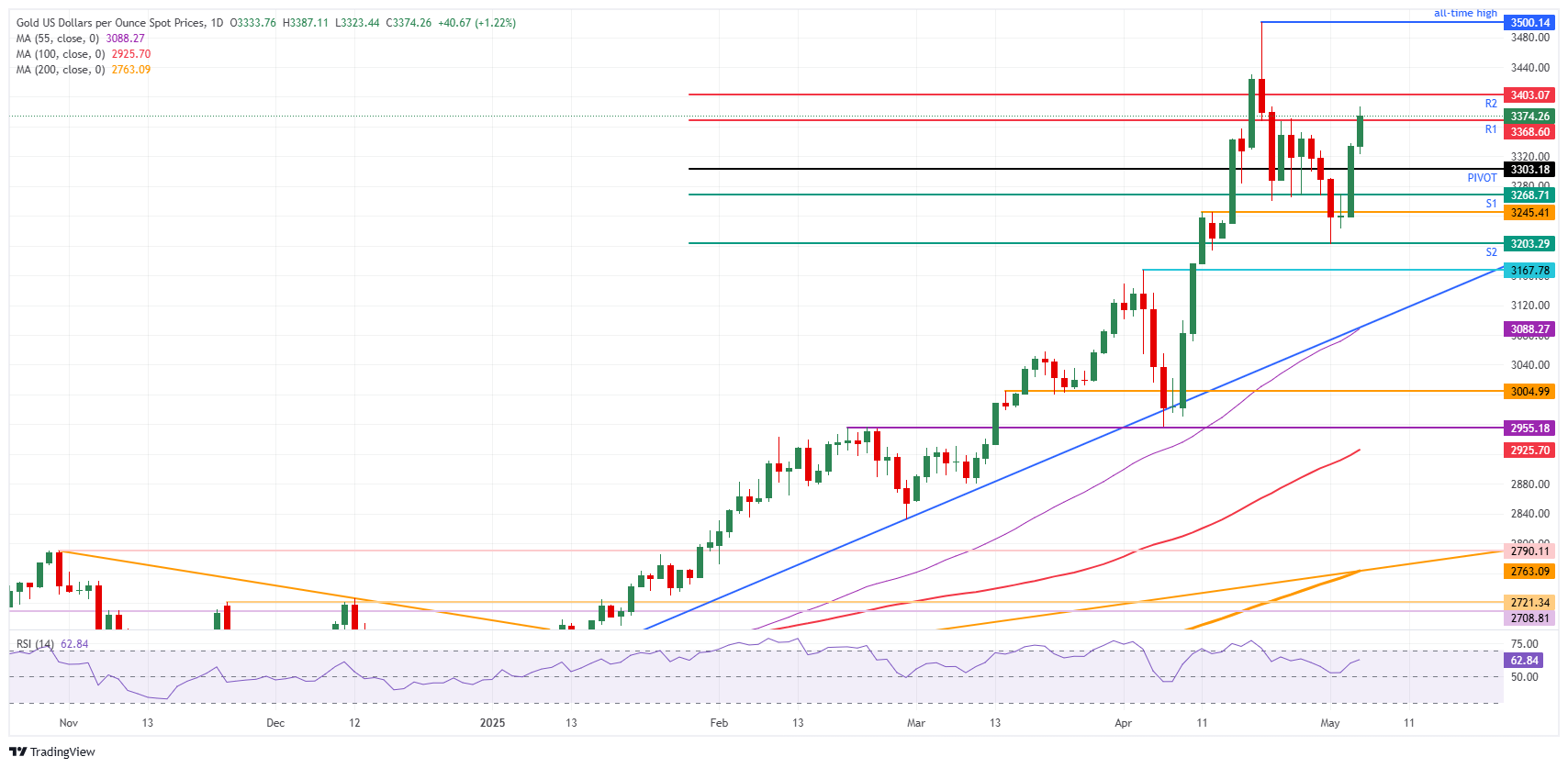
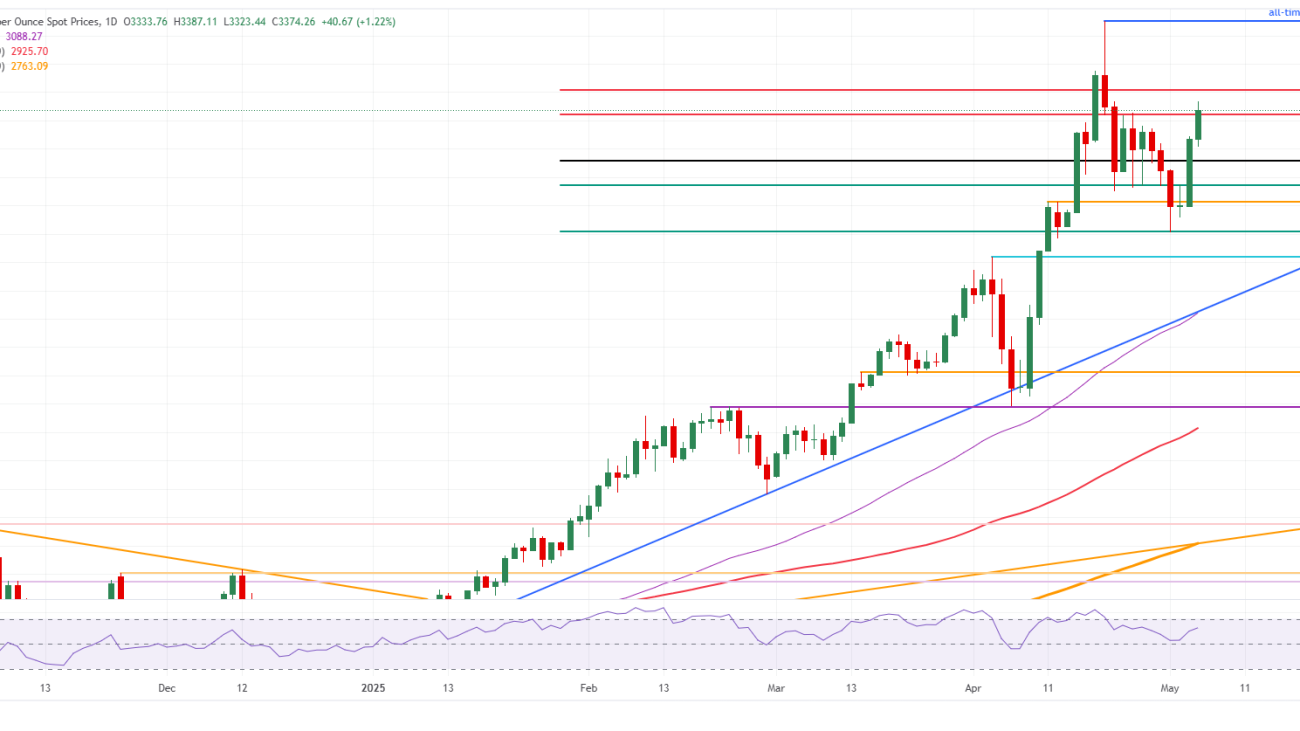
Gold price is rallying higher in what looks to be a second wave of safe haven inflow in the precious metal. Balances and powers in financial markets are shifting, and one of them seems to be the Greenback losing its status as a safe haven in benefit of Bullion. In this scenario, Gold is set to rocket higher should President Trump and his administration be unable to soon announce a trade deal with any country, preferably a G20 one.

On the upside, the R1 resistance at $3,368 has already been broken in a topside test in early trading this Tuesday. Should some follow-through come, the R2 resistance at $3,403 might see a test very swiftly. The all-time high at $3,500 might be a bit too far off for traders to test already on Tuesday.

On the downside, the Pivot Point at $3,303 is the first level to watch. Further down, the daily S1 support comes in at $3,268, coinciding with the lows of last week on April 30, 28, 25 and 23. The technical level at $3,245 should do the trick and hold in case of any sudden reversals.

dollar

EUR/CHF falls despite soft Swiss CPI print – Danske Bank

April’s downside surprise in Swiss inflation has reinforced expectations of a June rate cut by the SNB, with markets now entertaining the possibility of a return to negative interest rates as the strong franc and global uncertainties weigh on growth and price stability, Danske Bank’s FX analysts report.

Swiss inflation miss sparks talk of SNB rate cuts

“Despite a significant downside surprise to Swiss inflation for April, EUR/CHF ended the day lower. Headline came in at 0.0% y/y (cons: 0.2%, prior: 0.3%) and core at 0.6% y/y (prior: 0.9%, cons: 0.8%). This falls significantly below the SNBs expectation for Q2 of 0.3% y/y. The low inflation print reflects the recent decline in energy prices but can also largely be attributed to the recent strengthening of the CHF, which puts significant downward pressure on imported inflation. ”

“More broadly, price pressures remain very muted in Switzerland. The growth backdrop has likewise worsened for the Swiss economy the past month with trade war uncertainty and the strong CHF acting as a headwind for the manufacturing sector. Markets reacted by pricing just above 30bp worth of cuts for the next SNB meeting in June and 45bp for 2025 and hence a return to a negative interest rate policy.”

“We stick to our long-held call of the policy rate being cut to 0% in June. However, following yesterday’s print the risks of a return to NIRP has notably increased. We expect the SNB to resort to FX intervention before negative territory is reached.”

images

EUR/USD Price Forecast: Remains confined in a range around 1.1300 ahead of FOMC meeting

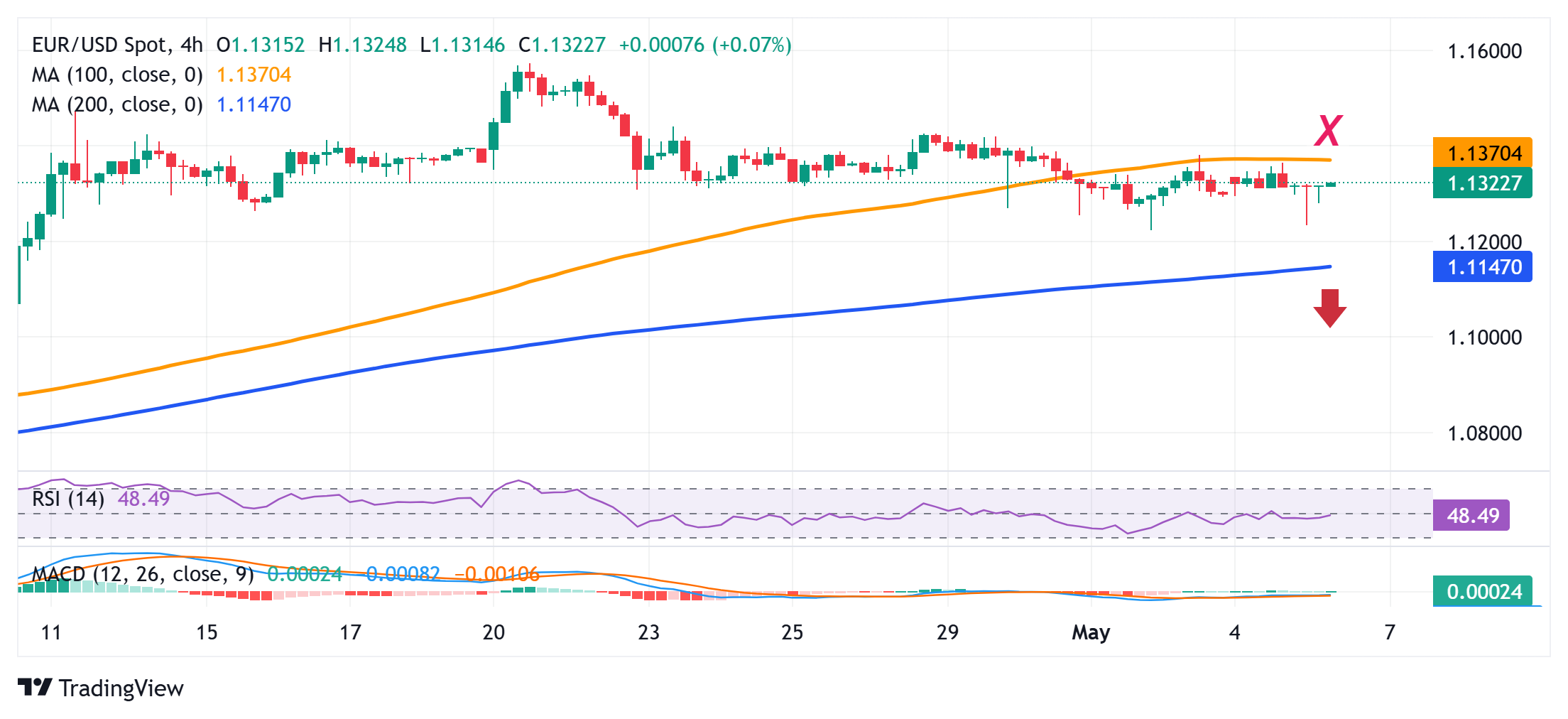
The EUR/USD pair reverses an Asian session tip to the 1.1280-1.1275 region on Tuesday and climbs a fresh daily high in the last hour, though it lacks strong follow-through buying. Spot prices remain confined in a multi-day-old trading range, close to the three-week low touched last Thursday, as traders opt to wait on the sidelines ahead of the crucial FOMC decision on Wednesday.

Heading into the key central bank event risk, Friday’s upbeat US jobs data and the US ISM Services PMI released on Monday eased market concerns about a recession. This, in turn, helps limit the downside for the US Dollar (USD) and acts as a headwind for the EUR/USD pair. However, the heightened economic uncertainty led by US President Donald Trump’s rapidly shifting stance on trade policies keeps the USD bulls on the defensive.

From a technical perspective, last week’s breakdown below the 100-period Simple Moving Average (SMA) on the 4-hour chart – for the first time since early April – was seen as a key trigger for bearish traders. However, oscillators on the said chart are yet to confirm a negative bias and are holding in bullish territory on the daily chart. This makes it prudent to wait for strong follow-through selling before positioning for any meaningful depreciating move.

In the meantime, the 100-period SMA on the 4-hour chart, currently pegged around the 1.1380 region, could act as an immediate hurdle ahead of the 1.1400 round figure.  A sustained strength beyond the latter should allow the EUR/USD pair to surpass the 1.1425-1.1430 intermediate barrier and aim toward reclaiming the 1.1500 psychological mark. The momentum could extend further towards the multi-year peak, around the 1.1575 region touched in April.

On the flip side, the 1.1265 region, or a three-week low touched last Thursday, might offer immediate support and should act as a key pivotal point. A convincing break below should pave the way for an extension of the EUR/USD pair’s corrective slide from the 1.1575 area, or the highest level since November 2021 touched last week. Spot prices might then weaken to the 1.1200 round figure before dropping to the 1.1140 area, or the 200-period SMA on the 4-hour chart.

EUR/USD 4-hour chart

arr

Japanese Yen sticks to intraday losses; downside seems limited ahead of BoJ decision on Thursday

The Japanese Yen (JPY) remains depressed against its American counterpart heading into the European session on Wednesday as signs of easing US-China trade tensions undermine demand for safe-haven status. Furthermore, US President Donald Trump’s decision to give flexibility on tariffs to US carmakers remains supportive of the upbeat market mood. This, along with disappointing domestic data, turn out to be key factors weighing on the safe-haven JPY. The US Dollar (USD), on the other hand, attracts some buyers for the second straight day and lifts the USD/JPY pair back above mid-142.00s.

Any meaningful JPY depreciation, however, seems elusive as traders might refrain from placing aggressive bets and opt to wait for the crucial Bank of Japan (BoJ) policy decision on Thursday. The central bank is widely expected to keep interest rates steady amid heightening risks to the fragile economy from US tariffs. However, signs of broadening inflation in Japan keep the door open for further BoJ policy normalization. This marks a big divergence in comparison to expectations for more aggressive easing by the Federal Reserve (Fed), which should cap the USD and benefit the lower-yielding JPY.

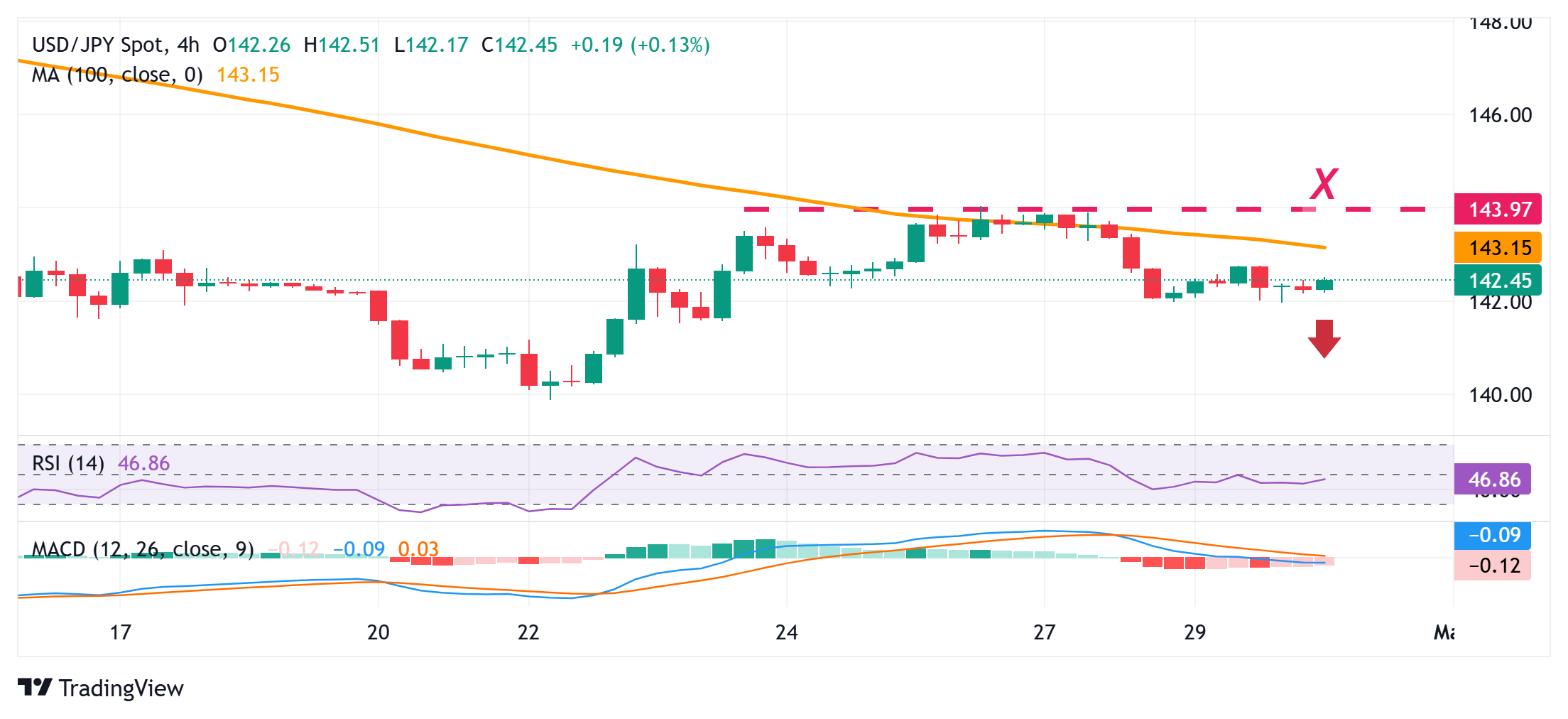
USD/JPY could accelerate the intraday positive move once the 142.60-142.65 immediate hurdle is cleared decisively

From a technical perspective, the USD/JPY pair earlier this week struggled to find acceptance above the 100-period Simple Moving Average (SMA) on the 4-hour chart and faced rejection near the 144.00 mark. The subsequent downfall and negative oscillators on hourly/daily charts validate the near-term negative outlook. That said, it will still be prudent to wait for some follow-through selling below the 142.00 mark before positioning for deeper losses. Spot prices might then accelerate the fall towards the mid-141.00s en route to the 141.10-141.00 region. The downward trajectory could extend further towards the 140.50 intermediate support before the pair eventually drops to the multi-month low – levels below the 140.00 psychological mark touched last week.

On the flip side, the 142.60-142.65 region is likely to act as an immediate hurdle, above which a bout of a short-covering could lift the USD/JPY pair beyond the 143.00 mark, towards the next relevant resistance near the 143.40-143.45 zone. A sustained strength beyond the latter should allow spot prices to conquer the 144.00 round figure. Acceptance above the latter would suggest that the currency pair has formed a near-term bottom and pave the way for some meaningful upside.

pop

EUR/USD flat lines below 1.1400 mark ahead of Eurozone/US macro data

EUR/USD holds the recovery below 1.1400 in early Europe on Wednesday, though it lacks any follow-through amid a modest US Dollar uptick. The pair remains confined in a familiar range held over the past week or so as traders aswait the top-tier German, EU and US GDP data for fresh impetus.

EUR/USD faces immediate resistance at the 2025 high of 1.1572, followed by the 1.1600 handle and the October 2021 top at 1.1692.

Interim support remains firm at the 55-day SMA at 1.0882, prior to the critical 200-day SMA at 1.0773, with a secondary floor at the weekly low at 1.0732.

Momentum remains skewed to the upside, with the Relative Strength Index (RSI) around 61 and the Average Directional Index (ADX) holding above 51—pointing to a strong underlying trend.

The European currency gave away part of Monday’s gains vs. the US Dollar (USD), motivating EUR/USD to retreat to the 1.1370 region following an early advance to the 1.1420-1.1425 band.

On the other side of the equation, the US Dollar Index (DXY) managed to regain some balance and approach the 99.40 zone, where that bullish attempt seems to have fizzled out.

Tariff hopes tempered by market scepticism
The firmer note around the US Dollar came in as investors continued to digest hints by the White House of a possible de-escalation of the trade conflict with China. However, investors remained cautious, with many expressing doubt over whether concrete progress is being made behind the scenes.

Central bank divergence remains well in place
The Federal Reserve (Fed) left its benchmark rate unchanged at 4.25%–4.50% in March, with Chair Jerome Powell emphasising the Fed’s continued commitment to fighting inflation. He reiterated that policy will remain data-driven, particularly as new tariffs raise concerns over potential stagflation.

Meanwhile, the European Central Bank (ECB) moved in the opposite direction, delivering a 25 basis-point rate cut to 2.25% and softening its language by removing references to “restrictive” policy. The dovish tone has raised expectations for another cut as early as June, further widening the policy divergence with the Fed.

Speculative bets continue to favour the Euro
CFTC data through April 22 revealed steady optimism toward the single currency, with net long positions easing a tad to around 65K contracts, or two-week lows. Commercial hedgers, meanwhile, maintained their short exposure around 118K contracts, while open interest increased to six-week peaks near 720K contracts.

eur_456

GBP/USD tests key resistance at 1.3430–1.3500

The Pound Sterling (GBP) is approaching a critical technical zone against the US dollar, challenging last year’s high and the top of a long-term ascending channel. While momentum indicators remain strong, the risk of a short-term pullback is rising if resistance near 1.3500 proves difficult to breach, Société Générale’s FX analysts note.

Support seen near 1.3230 if pullback occurs

“GBP/USD is challenging the peak of last year and the upper limit of an ascending channel drawn since 2023 at 1.3430/1.3500. Daily MACD is at a multiyear high denoting a stretched up-move. This is not a reversal signal, but a brief pullback can’t be ruled out in case the pair fails to establish beyond 1.3430/1.3500.”

“Recent pivot low of 1.3230 is likely to be an important support near term. Beyond 1.3500, next objectives could be located at projections of 1.3620 and 1.3740/1.3810.”

mmm

EUR/USD holds losses below 1.1400 amid US Dollar recovery

EUR/USD remains pressured below 1.1400 in the European trading hours on Tuesday. The Euro weakens amid rising expectations of further ECB interest rate cuts while the US Dollar draws support from some progress on US trade deals with its major global trading partners. US jobs data awaited.

The Relative Strength Index (RSI) indicator on the 4-hour chart stays slightly above 50, suggesting that sellers remain reluctant to bet on an extended slide despite the recent pullback.

In case EUR/USD drops below 1.1390-1.1400 (50-period Simple Moving Average (SMA), Fibonacci 23.6% retracement of the latest uptrend) and confirms this area as resistance, technical sellers could take action. In this scenario, 1.1300 (100-period SMA) could be seen as next support before 1.1270 (Fibonacci 38.2% retracement).

On the upside, interim resistance seems to have formed at 1.1430 (static level) before 1.1500 (static level, round level).

The data from the US showed on Monday that the Federal Reserve Bank of Dallas’ Texas Manufacturing Business Index slumped to its weakest level in nearly five years at -35.8 in April from -16.3 in March. This reading revived fears over an economic downturn in the US and caused the US Dollar (USD) to weaken against its major rivals.

In the second half of the day on Tuesday, JOLTS Job Openings for March and the Conference Board’s Consumer Confidence Index data for April will be featured in the US economic docket.

A significant decrease in the number of job openings could be seen as a sign of worsening conditions in the labor market and weigh on the USD with the immediate reaction. On the flip side, a positive surprise, with a reading above 8 million, could support the currency and cause EUR/USD to stretch lower.

The CME FedWatch Tool currently shows that markets see a nearly 60% probability of a rate cut in June after the Federal Reserve (Fed) keeps policy settings unchanged in May. In case disappointing data releases from the US allow investors to lean toward a rate reduction in June, the market positioning suggests that the USD has room on the downside.