
Gold price bulls not ready to give up yet; overbought conditions warrant some caution

Gold price bulls not ready to give up yet; overbought conditions warrant some caution

Gold price (XAU/USD) continues scaling higher through the Asian session on Wednesday and advances to a fresh all-time peak, around the $2,858 region in the last hour. Concerns about the economic fallout from US President Donald Trump’s trade tariffs continue to underpin demand for the safe-haven bullion. Furthermore, expectations that the Federal Reserve (Fed) would maintain its easing cycle, bolstered by signs of slowing momentum in the US labor market, contribute to driving flows towards the non-yielding yellow metal.

Meanwhile, the US Dollar (USD) languishes near the weekly low amid the prospects for further policy easing by the Fed and turns out to be another factor lending additional support to the Gold prices. That said, Trump’s decision to delay tariffs against Canada and Mexico remains supportive of the risk-on mood, which could cap gains for the XAU/USD amid slightly overbought conditions on the daily chart. This makes it prudent to wait for a near-term consolidation or a modest pullback before positioning for an extension of the recent upward trajectory. Traders now look to the US ADP report on private-sector employment and the US ISM Services PMI for some impetus.

Gold price needs to consolidate its recent gains amid overbought conditions on the daily chart
fxsoriginal

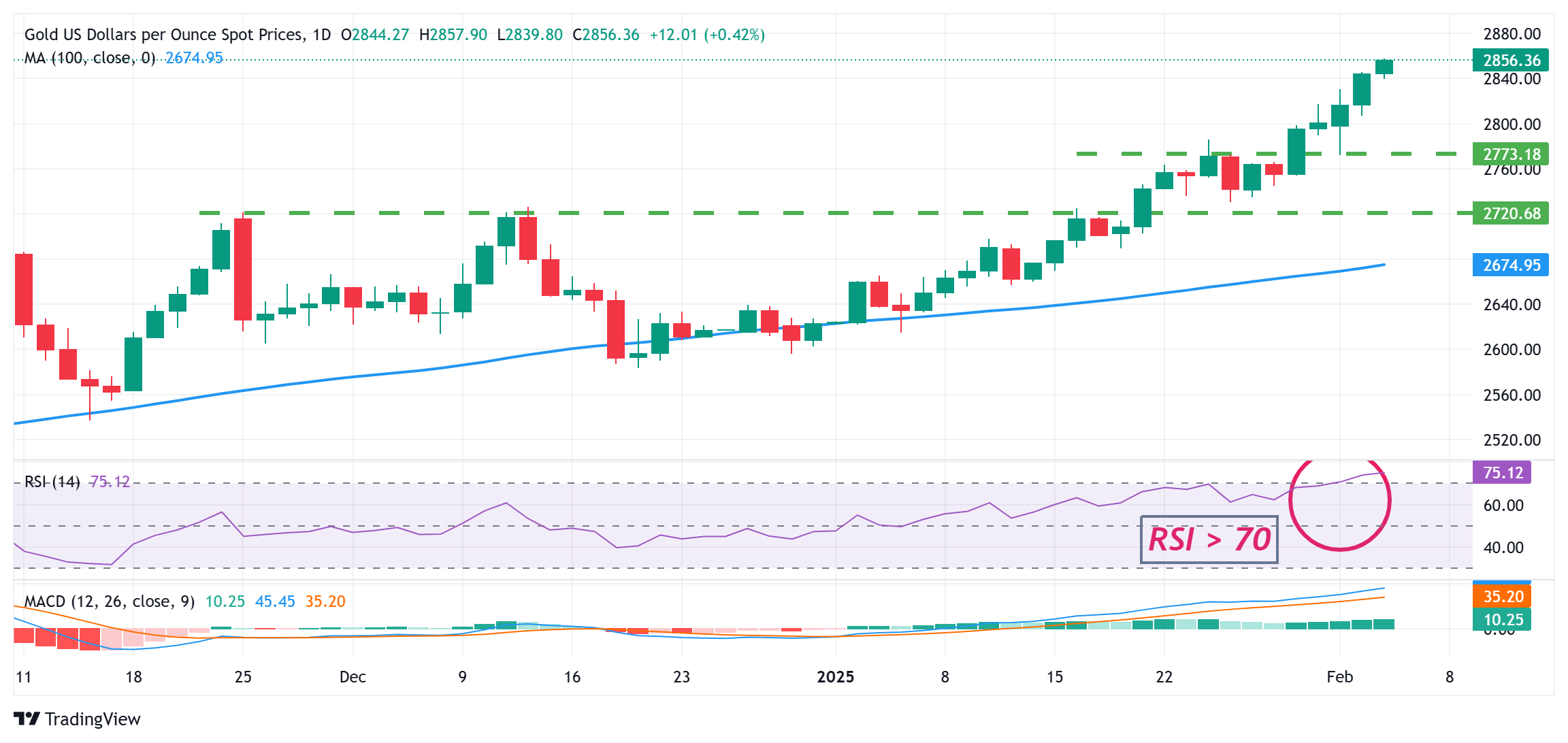
From a technical perspective, the Relative Strength Index (RSI) on hourly and daily charts is flashing slightly overbought conditions, warranting some caution for bullish traders. That said, the recent breakout momentum beyond the $2,800 mark suggests that the path of least resistance for the Gold price remains to the upside. This, in turn, supports prospects for an extension of the recent well-established uptrend from the December 2024 swing low.

In the meantime, any corrective slide now seems to find some support near the $2,830 area ahead of the $2,800 mark. A further decline could be seen as a buying opportunity and is more likely to remain limited near the $2,773-2,772 horizontal resistance breakpoint, now turned support. A convincing break below the latter, however, might prompt some technical selling and pave the way for deeper losses.

Australian Dollar moves little as traders put eyes on US-China tariff situation

Australian Dollar moves little as traders put eyes on US-China tariff situation

The Australian Dollar (AUD) edges lower against the US Dollar (USD) amid an increased risk aversion following rising fears over US-China trade tensions. The AUD/USD pair failed to draw support from the improved Judo Bank Purchasing Managers Index (PMI) released on Wednesday.

Australia’s Judo Bank Composite PMI climbed to 51.1 in January from 50.2 in December, reflecting modest growth in private sector activity. Meanwhile, the Judo Bank Services PMI rose to 51.2 from 50.8, marking the twelfth consecutive month of expansion in the services sector. Although growth was moderate, it was the strongest since August.

The AUD may further depreciate amid the increased likelihood that the Reserve Bank of Australia (RBA) could consider a rate cut in February. The RBA has maintained the Official Cash Rate (OCR) at 4.35% since November 2023, emphasizing that inflation must “sustainably” return to its 2%-3% target range before any policy easing.

The Aussie Dollar faces challenges as market volatility remains a concern as investors closely watch the ongoing trade war between the United States (US) and China, Australia’s key trading partner. China retaliated against the new 10% US tariff that took effect on Tuesday. However, Trump stated on Monday afternoon that he would likely speak with China within the next 24 hours. He also warned, “If we can’t reach a deal with China, the tariffs will be very, very substantial.”

Technical Analysis: Australian Dollar breaks above nine-day EMA and descending channel

The AUD/USD pair trades near 0.6250 on Wednesday. Sustained price action above the descending channel pattern on the daily chart indicates a potential bullish shift. The 14-day Relative Strength Index (RSI) sits at the 50 level, reflecting neutral momentum. A sustained break above 50 on the RSI could confirm a stronger bullish trend.

On the upside, the AUD/USD pair could explore the area around its seven-week high at 0.6330 level, which was recorded on January 24.

The AUD/USD pair may find immediate support at the nine-day Exponential Moving Average (EMA) near 0.6240, followed by the upper boundary of the descending channel. A pullback to the channel would reinforce the bearish bias, potentially driving the pair toward the lower boundary of the descending channel around 0.6140.

AUD/USD: Daily Chart

EU prepares to hit Big Tech in retaliation for Trump’s tariffs

EU prepares to hit Big Tech in retaliation for Trump’s tariffs

Citing two officials with knowledge of the plans, the Financial Times (FT) reported on Wednesday that the European Commission is preparing to deploy its “anti-coercion instrument” (ACI) in a potential retaliation to US President Donald Trump’s tariffs, which would enable the European Union (EU) to target US service sectors like Big Tech.

One of the officials said that “all options are on the table” and emphasized that the ACI was the most forceful response possible without violating international law.

Market reaction

EUR/USD appears unperturbed by these headlines, adding 0.14% on the day to retest 1.0400.

EUR/USD lacks firm intraday direction, stuck in a range around 1.0375-1.0380 zone

EUR/USD lacks firm intraday direction, stuck in a range around 1.0375-1.0380 zone

EUR/USD consolidates in a range near the weekly high touched earlier this Wednesday. The USD struggles to lure buyers amid Fed rate cut bets and lends support to the major. Concerns about Trump’s trade tariffs and dovish ECB weigh on the Euro and cap the pair.

The EUR/USD pair struggles to capitalize on this week’s solid recovery from the 1.0200 neighborhood, or the lowest level since January 13, and oscillates in a range near the weekly top touched earlier this Wednesday. Spot prices currently trade around the 1.0375-1.0380 region, nearly unchanged for the day amid mixed fundamental cues.

The Job Openings and Labor Turnover Survey (JOLTS) published on Tuesday pointed to a slowdown in the US labor market and supports prospects for further policy easing by the Federal Reserve (Fed). In fact, the markets are pricing in the possibility that the US central bank will lower borrowing costs twice this year. Apart from this, the risk-on mood keeps the safe-haven US Dollar (USD) depressed near the weekly low, which, in turn, is seen acting as a tailwind for the EUR/USD pair.

Traders, however, seem reluctant to place aggressive bullish bets in the wake of concerns that US President Donald Trump would slap tariffs on goods from the European Union. Adding to this, the European Central Bank’s (ECB) dovish stance, which overshadowed a rise in the Eurozone Harmonized Index of Consumer Prices (HICP) at an annual rate of 2.5% in January, is seen undermining the Euro and contributing to keeping a lid on any meaningful upside for the EUR/USD pair.

Traders now look forward to the release of the final Eurozone Services PMI. Meanwhile, the US economic docket features the release of the ADP report on private-sector employment and ISM Services PMI. Apart from this, speeches by influential FOMC members will drive the USD demand and provide a fresh impetus to the EUR/USD pair. The focus, however, remains glued to the US monthly employment details – popularly known as the Nonfarm Payrolls (NFP) report on Friday.

kl

EUR/USD: Continues to trade in a choppy manner

Euro (EUR) could continue to trade in a choppy manner, probably between 1.0255 and 1.0370. In the longer run, risk is for further EUR weakness; it remains to be seen if it can break and remain below 1.0100, UOB Group’s FX analysts Quek Ser Leang and Peter Chia note.

Risk is for further EUR weakness

24-HOUR VIEW: “EUR gapped lower and plummeted when it opened yesterday. We noted that ‘while it is already oversold, the weakness has not stabilized, and EUR could continue to decline.’ We pointed out ‘support levels are at 1.0175 and 1.0100, and the latter level is likely out of reach for now.’ The subsequent price movements did turn out as we expected. EUR fell to 1.0210 before soaring to close at 1.0344 (-0.17%). The volatile price action has resulted in a mixed outlook. Today, EUR could continue to trade in a choppy manner, probably between 1.0255 and 1.0370.”

1-3 WEEKS VIEW: “We continue to hold the same view as yesterday (03 Feb, spot at 1.0245). As indicated, ‘the risk is for further EUR weakness.’ However, we highlighted that ‘it remains to be seen if it can break and remain below 1.0100.’ Overall, only a breach of 1.0380 (no change in ‘strong resistance’ level) would indicate that the weakness in EUR has stabilized.”

Oil: No change to OPEC+ output policy – ING

Oil: No change to OPEC+ output policy – ING

The oil market gave back a lot of its gains yesterday after Mexico and Canada came to a deal with the US, which saw a delay in the implementation of tariffs. Both Mexico and Canada agreed to put more resources on their border to combat the flow of fentanyl to the US. The delay has seen crude oil prices coming under further pressure in early morning trading today with NYMEX WTI down more than 1%, while NYMEX RBOB and ULSD are under relatively more pressure, ING’s FX analysts Francesco Pesole notes.

OPEC+ recommends no change to its output policy

“Unsurprisingly fears over tariffs on Canadian oil saw the differential for West Canada Select (WCS) widening relative to WTI. The differential widened by US$1.55/bbl to a discount of US$17.84/bbl yesterday – the weakest the differential has been since July 2024. The differential has been weakening for much of this year, given concerns over tariffs. Clearly, with still plenty of uncertainty over trade it would be wise for Canada to start investing in further pipeline capacity from its producing regions to its east and west coasts.”

“OPEC+ held its Joint Ministerial Monitoring Committee (JMMC) meeting yesterday, and as widely expected the group recommended no change to its output policy. This suggests that the group is likely to go ahead with the unwinding of their additional voluntary supply cuts from April. The group is scheduled to bring back around 2.2m b/d of supply over an 18-month period starting in April. Obviously, the return of this supply will still be dependent on market conditions.”

“Preliminary production numbers show that OPEC production fell by 70k b/d MoM to 27.03m b/d in January according to a Bloomberg survey. Iraq led the declines, with its output falling by 110k b/d to 4.01m b/d. This reduction was largely due to a fire at the Rumaila oilfield.”

mmm

EUR/USD holds losses near 1.0300 amid mounting trade tensions

EUR/USD trades with sizeable losses near 1.0300 in early Europe on Tuesday. The pair loses ground on renewed haven demand for the US Dollar as China retaliates to US tariffs with counter-tariffs, hitting risk sentiment. Markets remain wary of potential US tariffs on the Euro area.

Technically, EUR/USD is navigating uncertain waters. The pair finds initial support at the weekly low of 1.0209 (February 3), prior to 1.0176, its lowest point this year. A drop below this level could pave the way for a move toward 1.0000.

On the upside, resistance is spotted at 1.0532 (the YTD peak from January 27), with further hurdles at the December peak of 1.0629 and the 100-day Simple Moving Average at 1.0651.

Momentum indicators add to the caution: the Relative Strength Index (RSI) has dipped below 40, hinting at weakening momentum, while the Average Directional Index (ADX) near 22 suggests the current trend is losing steam.

In quite a dreadful start to the new trading week, the Euro (EUR) gapped lower and plummeted to multi-week lows around the 1.0200 region on the back of the abrupt resumption of the demand for the US Dollar (USD).

The strong uptick in the Greenback came as market participants adjusted to news over the weekend that President Donald Trump unleashed a 25% tariff on Canadian and Mexican goods and a 10% charge on Chinese imports.

Against that backdrop, the US Dollar Index (DXY) surged to new three-week highs just below the key 110.00 hurdle. The pronounced advance in the US Dollar, however, lost some traction afterwards in response to some delay in the implementation of tariffs in Mexico. Despite the latter, the tariffs narrative remained a strong support for the Greenback and emerged as a strong driver behind the expected bullish outlook for the currency in the current year.

Fed-ECB divergence to weigh further on EUR

Central banks are now under the microscope. The Federal Reserve (Fed) chose to keep interest rates unchanged on Wednesday, offering little hint about when a cut might come. Despite robust economic growth, persistent inflation, and low unemployment, the Fed remains cautious. In a notable shift, it moved from saying inflation “has made progress” to describing price pressures as “elevated,” signaling a more watchful approach as it waits for clearer signs of cooling inflation. The decision to maintain the federal funds rate at 4.25%-4.50% highlights a wait-and-see strategy amid concerns over the impact of Trump’s trade and fiscal policies.

Across the Atlantic, the European Central Bank (ECB) met expectations by cutting rates by 25 basis points and hinted at more easing in the future. The ECB remains hopeful that eurozone inflation will gradually come under control, even as global trade worries persist. While the eurozone economy is still sluggish, recent surveys suggest some improvement, and with inflation just above the ECB’s 2% target, the rate cut was seen as justified.

In her press conference, President Christine Lagarde emphasized that the ECB isn’t planning to lower rates below neutral levels to stimulate the economy. She explained that decisions are data-driven, without any commitment to a rapid pace of easing. Lagarde made it clear that a drastic 50 basis point cut was never on the table—only a 25 basis point reduction had unanimous support. She expressed confidence that bloc inflation would reach the 2% target by 2025 but warned that rising global trade tensions could continue to slow economic growth in the near term.

Profit amid the turmoil: Who gains in a trade war?

Tariff tensions, especially those driven by US policy, could further complicate the path of the euro in the near-to-medium term. If tariffs persist, they might fuel US inflation and prompt the Fed to adopt an even more hawkish stance, thereby strengthening the dollar and pressuring its rivals—potentially paving the way for EUR/USD to return to the key parity level.

Negative outlook

Looking ahead, the euro faces a challenging road. The US Dollar’s resilience, divergent central bank policies between the ECB and the Fed, and structural issues within the eurozone—such as Germany’s slowing economy—could all hinder sustained gains for the single currency. While short-term rallies might occur, the overall outlook for the euro remains uncertain.

EUR/USD lacks firm intraday direction, stuck in a range around 1.0375-1.0380 zone

EUR/USD falls toward 1.0200 as Trump announces tariffs

EUR/USD stays under heavy bearish pressure and declines toward 1.0200 on Monday. Following US President Donald Trump’s tariff announcements on imports from Canada, Mexico and China, the US Dollar (USD) gathers strength and weighs on the pair.

The Relative Strength Index (RSI) indicator on the 4-hour chart edges slightly higher but stays below 30, reflecting oversold conditions.

On the downside, 1.0200 (static level, round level) aligns as immediate support before 1.0160 (static level from August 2022) and 1.0100 (static level, round level). Looking north, resistances could be spotted at 1.0290-1.0300 (Fibonacci 23.6% retracement of the latest downtrend, round level), 1.0350 (Fibonacci d38.2% retracement) and 1.0370 (200-period Simple Moving Average).

EUR/USD started the new week under strong bearish pressure and dropped to its weakest level since mid-January below 1.0250. Although the pair’s technical outlook points to oversold conditions in the near term, investors could refrain from betting on a steady recovery in the Euro following US President Donald Trump’s tariff threats.

Over the weekend, Trump announced that they will impose sweeping 25% tariffs on Mexican and Canadian imports and 10% on Chinese goods entering the US. While speaking to reporters on Sunday, Trump said that he would “definitely” impose tariffs on European imports but refrained from providing any details regarding the size or the timing.

Regarding this development, European Central Bank (ECB) policymaker Francois Villeroy de Galhau said on Monday that Trump’s tariffs would increase economic uncertainty and added there will likely be further rate cuts.

The European economic calendar will feature the Harmonized Index of Consumer Prices (HICP) inflation data for January. In the second half of the day, the January ISM Manufacturing PMI data from the US will be looked upon for fresh impetus. Nevertheless, investors are likely to pay little to no attention to these releases, while keeping a close eye on headlines surrounding the US. If safe-haven flows continue to dominate the action in financial markets, EUR/USD could continue to stretch lower.

EUR/CAD remains subdued near 1.5000 following softer German Retail Sales

EUR/CAD remains subdued near 1.5000 following softer German Retail Sales

EUR/CAD retraces its recent gains from the previous two sessions, hovering around 1.5020 during early European trading hours. The currency cross remains under pressure following weaker-than-expected German Retail Sales data released on Friday. Market participants now turn their attention to upcoming Unemployment Rate and Consumer Price Index (CPI) figures from Germany due later today.

Germany’s Retail Sales fell by 1.6% month-over-month in December, as reported by Destatis on Friday. This decline followed an upwardly revised of no growth in November and missed market expectations of a 0.2% increase. On a yearly basis, Retail Sales grew by 1.8%, falling short of analysts’ forecasts of 2.5%.

On Thursday, preliminary data from Eurostat reported that the Eurozone economy stagnated in Q4 2024 after expanding by 0.4% in Q3. This flat growth was weaker than the anticipated 0.1% increase, adding to concerns about economic momentum in the region.

The Euro remains under pressure amid growing expectations of further interest rate cuts by the European Central Bank (ECB). On Thursday, the ECB lowered its Deposit Facility Rate by 25 basis points (bps) to 2.75%, while the Main Refinancing Operations Rate dropped to 2.9%, in line with forecasts. Markets had already priced in the rate cut, expecting inflation in the Eurozone to remain on a trajectory toward the central bank’s 2% target.

However, EUR/CAD’s downside may be limited as the Canadian Dollar (CAD) faces headwinds due to a dovish shift in the Bank of Canada’s (BoC) policy stance. On Wednesday, the BoC reduced its key interest rate by 25 bps to 3.0% and ended its quantitative tightening program, signaling plans to resume asset purchases in early March.

Adding to CAD’s challenges, US President Donald Trump reiterated his intention to impose 25% tariffs on Mexico and Canada—United States’ (US) top two trading partners. The BoC’s policy outlook was further dampened by concerns over potential US trade restrictions, with Governor Tiff Macklem emphasizing that tariff threats remain a significant risk to the Canadian economy.

Untitled

Gold sets new record-high, majors stay quiet ahead of inflation data

Major currency pairs trade in narrow ranges early Friday, following some volatility seen on Thursday. Regional and nation-wide inflation data from Germany and December Personal Consumption Expenditures (PCE) Price Index data from the US will be watched closely by market participants on Friday. Fourth-quarter Employment Cost Index data will also be featured in the US economic calendar ahead of the weekend.

The European Central Bank (ECB) announced on Thursday that it lowered key rates by 25 basis points (bps) as expected. The ECB didn’t make any significant changes to its policy statement and ECB Christine Lagarde refrained from committing to the next rate move, reiterating that their next decision will be driven by data and analysis. After rising above 1.0450 in the second half of the day, EUR/USD lost its traction and retreated below to close in negative territory on Thursday. Early Friday, the data from Germany showed that Retail Sales declined by 1.6% on a monthly basis in December, missing the market expectation for an increase of 0.2%. EUR/USD showed no immediate reaction to this data and was last seen trading in a narrow channel at around 1.0400.

The US Bureau of Economic Analysis (BEA) reported on Thursday that the US’ Gross Domestic Product expanded at an annual rate of 2.3% in the fourth quarter. This reading followed the 3.1% expansion recorded in the third quarter and came in below the market estimate for a growth of 2.6%. On a positive note, weekly Initial Jobless Claims in the US declined to 207,000 in the week ending January 25 from 223,000 in the previous week. The US Dollar (USD) Index held its ground after mixed data and posted modestly gains on Thursday. Early Friday, the index stays in a consolidation phase near 108.00.

Meanwhile, US President Donald Trump took to social media late Thursday to make a fresh tariff threat against Canada and Mexico. According to President Trump’s social media post, the US is set to impose a flat 25% import tax “because of fentanyl” on all goods crossing the border into the US from Canada or Mexico. Trump also warned that they could impose 100% tariffs on BRICS nations if they were to try to replace the USD with a new currency in international trade.

Bank of Japan (BoJ) Governor Kazuo Ueda said on Friday that underlying inflation is still somewhat below 2%. Ueda added that the Japanese central bank would maintain an accommodative policy to support price trends. After losing more than 0.5% on Thursday, USD/JPY stages a rebound and trades in positive territory above 154.50.

GBP/USD closed modestly lower on Thursday after meeting resistance above 1.2450. The pair clings to small daily gains on Friday but remains below 1.2450.

Gold gathered bullish momentum and rose more than 1% on Thursday. Gold continued to stretch higher and trades at an all-time peak near $2,800