USD/CAD slides back closer to mid-1.4000s amid modest USD weakness

USD/CAD slides back closer to mid-1.4000s amid modest USD weakness

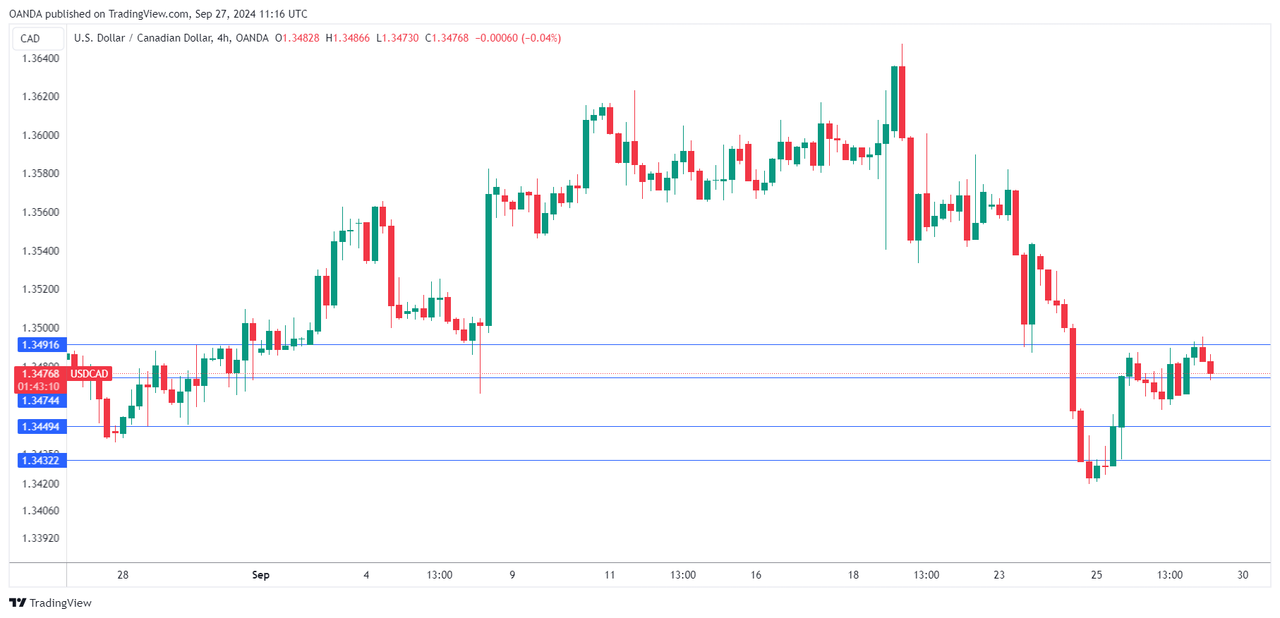
The USD/CAD pair struggles to capitalize on its weekly gains registered over the past three days and attracts some sellers during the first half of the European session on Thursday. Spot prices slide closer to mid-1.4000s in the last hour, though any meaningful downfall still seems elusive ahead of the crucial monthly employment details from the US and Canada on Friday.

Heading into the key data risk, a modest US Dollar (USD) downtick is seen as a key factor exerting some downward pressure on the USD/CAD pair. That said, rebounding US Treasury bond yields, bolstered by expectations for a less dovish Federal Reserve (Fed), acts as a tailwind for the Greenback. Apart from this, subdued Crude Oil prices ahead of the OPEC+ meeting could undermine the commodity-linked Loonie and contribute to limiting losses for the USD/CAD pair.

Meanwhile, hawkish remarks from several FOMC members, including Fed Chair Jerome Powell, suggested that the US central bank will adopt a cautious stance on cutting rates. Adding to this, speculations that US President-elect Donald Trump’s policies will reignite inflation might force the Fed to stop cutting rates or possibly raise them again. This assists the US Treasury bond yields to stage a modest bounce after their lowest closing levels in more than a month on Wednesday.

Crude Oil prices, on the other hand, struggle to gain any meaningful traction on the back of concerns over slowing oil demand, especially China – the world’s top importer. That said, the worsening Russia-Ukraine conflict and increasing tensions in the Middle East, along with expectations that the OPEC+ will further delay plans to increase production until at least the second quarter of 2025, act as a tailwind for the commodity, though fail to influence the Canadian Dollar (CAD).

Traders now look to the release of the US Weekly Initial Jobless Claims data, which, along with the US bond yields, will drive the USD demand and provide some impetus to the USD/CAD pair later during the North American session. Apart from this, Oil price dynamics should contribute to producing short-term opportunities. The mixed fundamental backdrop, meanwhile, warrants some caution for aggressive traders and before positioning for any firm near-term direction.


EUR/USD edges higher as investors digest French government fallout

EUR/USD edges higher as investors digest French government fallout

EUR/USD ticks higher and strives to stay above 1.0500 in European trading hours on Thursday. The major currency pair gains slightly as investors attempt to move forward from the already anticipated collapse of a mere three-month-long Michel Barnier’s government after losing a no-confidence vote proposed by the Far Right and Left-wing coalition.

The demolition of the French government has put the economy into a much deeper crisis by limiting its capacity to tame the burgeoning fiscal deficit. Far-right and left-wing lawmakers backed a no-confidence motion against Barnier after claiming the budget from his government was “flawed and harmful” to French people. The budget in question proposed €60 billion in tax increases and spending cuts aimed at addressing France’s ballooning deficit, according to Firstpost.

Before the no-confidence vote, Barnier appealed to lawmakers, “This reality will not disappear by the magic of a motion of censure.” He added the budget deficit would come back to haunt whichever government comes next.

French political turmoil has complicated the road ahead for the already-troubled Eurozone, which is facing severe downside risks to economic growth due to weak demand and potential tariffs once the new US administration of President-elect Donald Trump takes office. Meanwhile, monthly German Factory Orders declined in October but at a slower-than-expected pace. The economic data contracted by 1.5% after rising 7.2% in September. Economists expected the Factory Orders data to have declined by 2%.

European Central Bank (ECB) President Christine Lagarde also warned about growing risks to the trading bloc in her testimony before the Parliamentary Committee on Wednesday. “The medium-term economic outlook is uncertain, however, and dominated by downside risks,” Lagarde said. “Geopolitical risks are elevated, with growing threats to international trade,” she added.

On the interest rate outlook, Lagarde sticked to her data-dependent approach. However, traders expect that the ECB will cut its Deposit Facility Rate by 25 basis points (bps) to 3% at its December 12 meeting.

Euro PRICE Today

The table below shows the percentage change of Euro (EUR) against listed major currencies today. Euro was the strongest against the Swiss Franc.

USD EUR GBP JPY CAD AUD NZD CHF
USD -0.14% -0.14% -0.21% -0.04% -0.02% -0.15% 0.08%
EUR 0.14% -0.01% -0.08% 0.09% 0.11% -0.02% 0.21%
GBP 0.14% 0.01% -0.08% 0.10% 0.12% -0.01% 0.22%
JPY 0.21% 0.08% 0.08% 0.17% 0.19% 0.03% 0.29%
CAD 0.04% -0.09% -0.10% -0.17% 0.03% -0.12% 0.12%
AUD 0.02% -0.11% -0.12% -0.19% -0.03% -0.14% 0.10%
NZD 0.15% 0.02% 0.00% -0.03% 0.12% 0.14% 0.23%
CHF -0.08% -0.21% -0.22% -0.29% -0.12% -0.10% -0.23%

Bitcoin soars past $100K as Trump nominates pro-crypto Atkin as next SEC chair

Bitcoin soars past $100K as Trump nominates pro-crypto Atkin as next SEC chair

Bitcoin’s (BTC) price breaks its all-time high (ATH) of $99,588, surpassing its $100K milestone on Thursday after recovering from its recent pullback since last week. On Wednesday, announcing that Paul Atkins would replace Gary Gensler as Securities & Exchange Commission (SEC) Chair added fuel to BTC’s rally. BTC has entered price discovery mode, with analysts eyeing a target of $113,000.

Donald Trump nominates Paul Atkins as the next SEC Chairman

President-elect Donald Trump confirmed on Wednesday that he has nominated Patomak Global Partners CEO Paul Atkins as the next Chairman of the Securities & Exchange Commission (SEC). This announcement positively impacted the crypto market, as Atkins is considered pro-crypto. Bitcoin’s price increased 2.8% on Wednesday, and the rally continued, surpassing the $100K milestone on Thursday.

Bitcoin breaks above the six-figure mark 

Bitcoin price breaks above its ATH level of $99,588, surpassing its $100K milestone on Thursday after recovering from its recent pullback since last week. At the time of writing, it trades higher above $103,000.

If BTC continues its upward trend, it could extend the rally to test its 141.40% Fibonacci extension level drawn from the November 4 low of $66,835 to the November 22 high of $99,588 at $113,147. A successful close above this level could extend an additional rally toward the psychologically important $125K level.

The Relative Strength Index (RSI) on the daily chart reads 72, trading above its overbought level of 70. Traders should be cautious when adding to their long positions because the chances of a price pullback are increasing. Still, the RSI is still pointing upwards, so there is the possibility that the rally continues and the indicator remains above the overbought level.

BTC/USDT daily chart

EUR/USD trades cautiously ahead of French no-confidence vote

EUR/USD trades cautiously ahead of French no-confidence vote

EUR/USD ticks down but holds the key support of 1.0500 in European trading hours on Wednesday. The major currency pair is broadly sideways as investors await the no-confidence motion by French far-right and left-wing parties against Prime Minister Michel Barnier. The vote has bolstered political uncertainty in the Eurozone’s second-largest nation due to the increasing chances that the French government will collapse, hurting the Euro (EUR).

Looking at the economic calendar, investors will also focus on the United States (US) ADP Employment Change and the ISM Services Purchasing Managers’ Index (PMI) data for November, which will be published in the North American session.

Economists expect the US private sector to have added fresh 150K jobs in November, significantly lower than 233K in October. In the same period, the Services PMI – which gauges activity in the services sector – is estimated to decline to 55.5 from the prior release of 56.0, suggesting a slowdown in growth.

The economic data will influence market expectations for the Federal Reserve’s (Fed) likely interest rate action in its monetary policy meeting on December 18. There is a 74% chance that the Fed will reduce its key borrowing rates by 25 basis points (bps) to 4.25%-4.50% and a 26% probability of rates being unchanged at the current levels, according to the CME FedWatch tool.

In Wednesday’s session, investors will also focus on the Fed’s Beige Book and Chair Jerome Powell’s speech for fresh interest rate guidance.

Meanwhile, a string of Fed officials have recently said that they see more interest rate cuts as appropriate as inflation continues to cool down. “I expect it will be appropriate to continue to move to a more neutral policy setting over time,”  New York Fed President John Williams said on Monday. However, Williams didn’t provide any target for the Federal Funds Rate and said that the path would be data-dependent.

Ahead of the private sector employment and the service sector activity data, the US Dollar (USD) exhibits a muted trend. The US Dollar Index (DXY), which tracks the Greenback’s value against six major currencies, wobbles around 106.30.

The outlook of the US Dollar remains broadly positive as US President-elect Donald Trump threatened to impose 100% tariffs on BRICS. “The idea that the BRICS countries are trying to move away from the dollar while we stand by and watch is OVER,” Trump wrote in a social media post over the weekend.

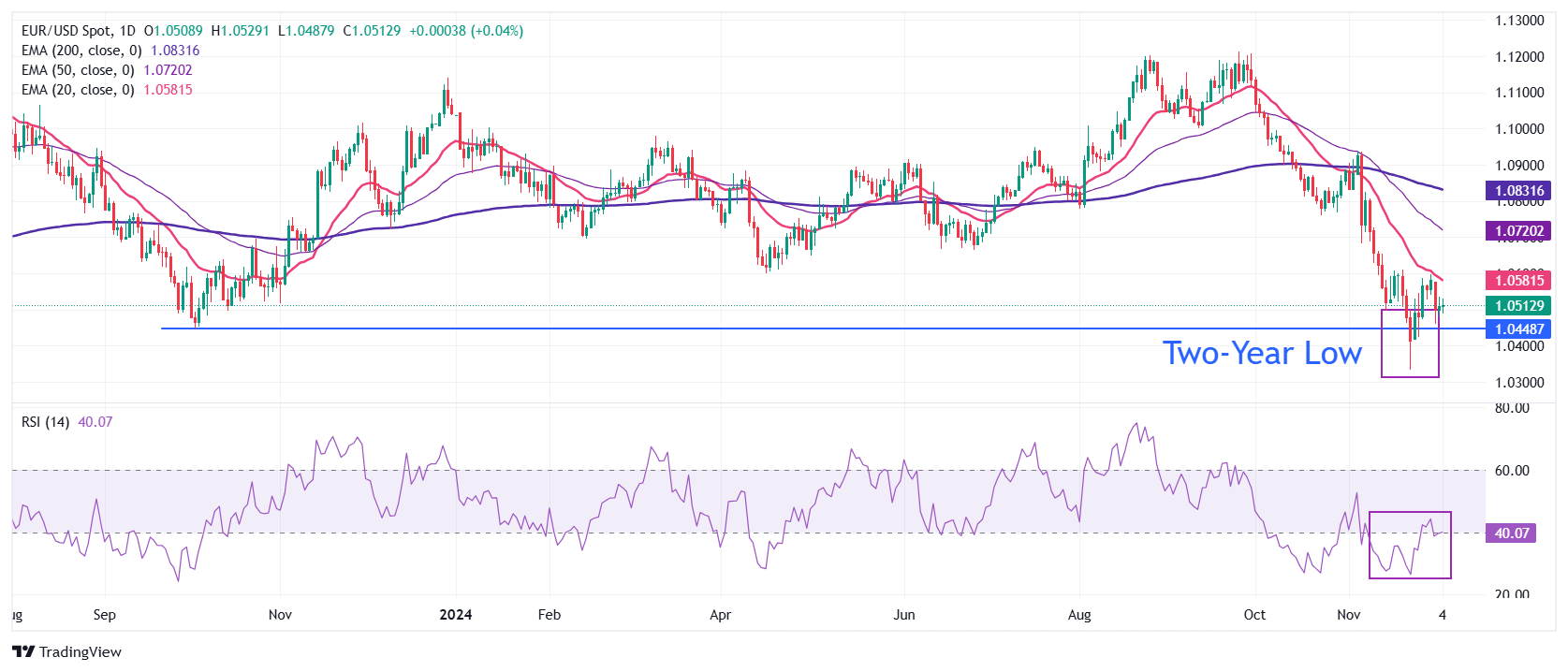
Technical Analysis: EUR/USD consolidates around 1.0500

EUR/USD trades in a tight range near 1.0500 in Wednesday’s European session. The outlook of the major currency pair remains bearish as all short-to-long-term day EMAs are declining, pointing to a downside trend.

The 14-day Relative Strength Index (RSI) remains close to 40.00, suggesting that the bearish momentum has faded. However, the bearish trend has not been extinguished.

Looking down, the November 22 low of 1.0330 will be a key support for Euro bulls. On the flip side, the 50-day EMA near 1.0750 will be the key barrier for the Euro bulls.

USD/JPY: Bearish momentum on daily chart intact

USD/JPY: Bearish momentum on daily chart intact

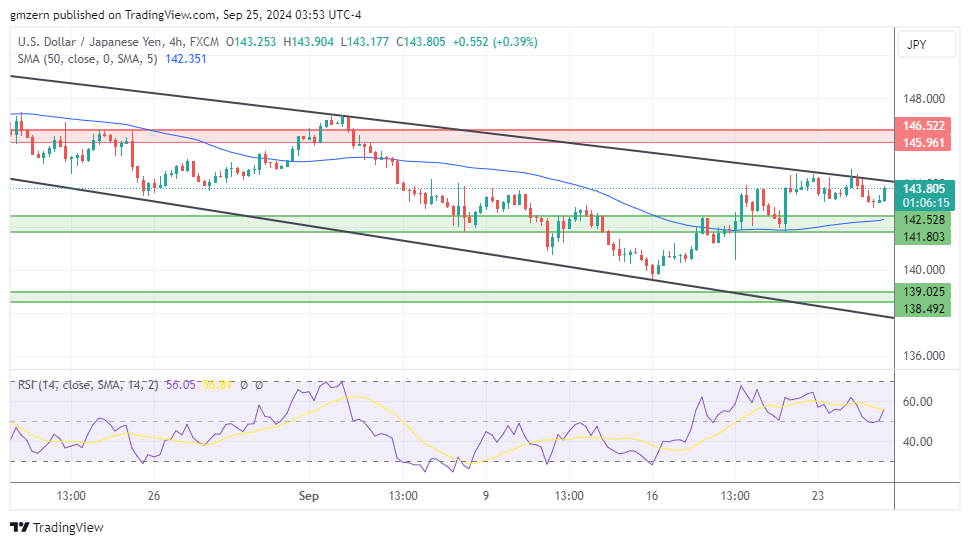
USD/JPY traded a low of 148.65 overnight on safe-haven demand, and was last seen at 150.73 levels, OCBC’s FX analysts Frances Cheung and Christopher Wong note.

Rebound risks not ruled out near term

“Bearish momentum on daily chart intact while RSI shows signs of turning higher from near oversold conditions. Rebound risks not ruled out in the near term. Resistance at 151.20, 152 (200 DMA), 153.30/70 levels (61.8% fibo retracement of 2024 high to low, 21DMA). Support at 149.50, 148.90 levels (100 DMA). Broader bias remains to lean against strength.”

“Price-related data (Tokyo CPI, PPI, etc.), labour market development (jobless rate easing, job-to-applicant ratio increasing, etc.), wage growth expectations (PM Ishiba and trade unions calling for another 5-6% wage increase at shunto wage negotiations for 2025) and Ueda’s recent comments on Nikkei over the weekend continue to reinforce the view that Bo J is likely to proceed with another hike, sooner rather than later.”

USD/CAD Price Analysis: Ascending Triangle breakout keep upside trend afloat

USD/CAD Price Analysis: Ascending Triangle breakout keep upside trend afloat

The USD/CAD pair extends its winning streak for the third trading day on Wednesday. The Loonie pair moves higher to near 1.4075 as the US Dollar (USD) gains ahead of United States (US) economic data for November, including ADP Employment Change and ISM Services PMI, and Federal Reserve (Fed) Chair Jerome Powell’s speech in the North American session.

The US Dollar Index (DXY), which tracks the Greenback’s value against six major currencies, climbs around 106.60.

Investors will pay close attention to the Jerome Powell’s speech at at the New York Times DealBook Summit to get fresh cues about whether the central bank will cut interest rates again in its policy meeting on December 18. According to the CME FedWatch tool, there is a 74% chance that the Fed will reduce its key borrowing rates by 25 basis points (bps) to 4.25%-4.50%, while the rest favors leaving them unchanged at their current levels.

This week, the Canadian Dollar (CAD) will be influenced by the labor market data for November, which will be released on Friday, along with US Nonfarm Payrolls (NFP).

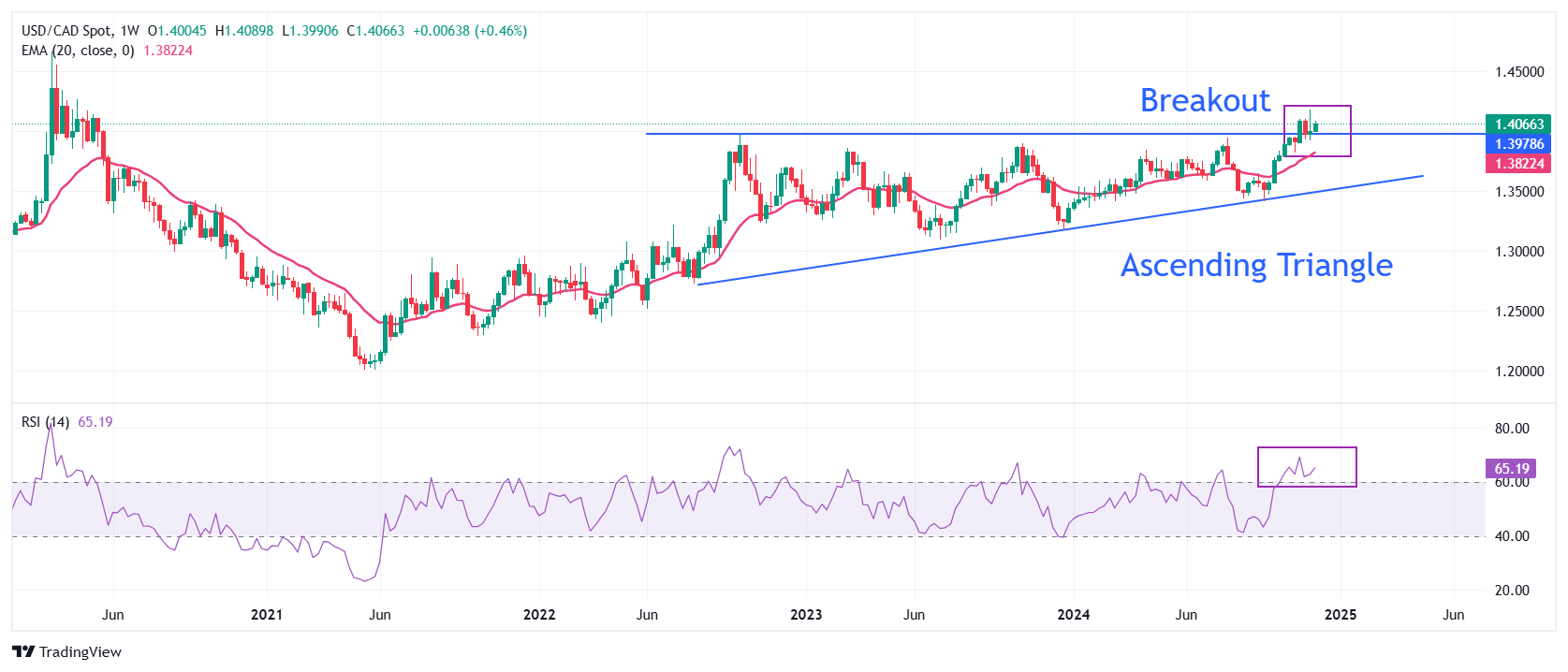
USD/CAD holds the breakout of the Ascending Triangle chart pattern formed on a weekly timeframe. The outlook of the Loonie pair remains firm as the 20-day Exponential Moving Average (EMA) near 1.3820 is sloping higher.

The 14-week Relative Strength Index (RSI) oscillates above 60.00, suggesting a strong bullish momentum.

A fresh upside would appear if the asset breaks above November’s high of 1.4178. The scenario will pave the way for the April 2020 high of 1.4265 and the round-level resistance of 1.4300.

On the contrary, a downside move below the October 29 low of 1.3875 will expose the asset to the October 15 high near 1.3840, followed by the round-level figure of 1.3800.

USD/CAD weekly chart

USD/JPY: Must break and close below 148.65 to continue to declining

USD/JPY: Must break and close below 148.65 to continue to declining

To continue to decline, the US Dollar (USD) must break and close below 148.65, which is acting as a significant support level now, UOB Group’s FX analysts Quek Ser Leang and Lee Sue Ann note.

The next significant support level below 148.65 is at 146.95

24-HOUR VIEW: “USD plummeted to 149.06 on Monday before rebounding. Yesterday, we pointed out that ‘despite the sharp decline, downward momentum has not increased much.’ We expected USD to ‘trade in a range between 149.00 and 150.50.’ Our view was incorrect, as USD plummeted briefly to 148.63, rebounding sharply to close unchanged at 149.59. The brief drop did not result in any increase in momentum, and we continue to expect USD to trade in a range, probably between 148.80 and 150.30.”

1-3 WEEKS VIEW: “We shifted our outlook to negative late last week. Tracking the subsequent decline, we indicated yesterday (03 Dec, spot at 149.85) that USD ‘may continue to decline, but given that downward momentum has not increased much further, it is unclear if there is enough momentum for it to reach 148.65.’ USD subsequently dropped briefly to 148.63, rebounding to close unchanged at 149.59. There is still no clear increase in momentum, and for USD to continue to decline, it must break and close below 148.65, which is acting as a significant support level now. On the upside, should USD break above 150.80 (‘strong resistance’ level previously at 151.30), it would indicate that the weakness in USD has stabilised. Looking ahead, the next significant support level below 148.65 is at 146.95.”

EUR/USD stays defensive near 1.0500 amid French political jitters

EUR/USD stays defensive near 1.0500 amid French political jitters

EUR/USD is battling 1.0500 in the European session on Wednesday. The pair trades with caution amid renewed US Dollar buying and French political uncertainty as the government faces a no-confidence vote in a busy day ahead. US data, Lagarde and Powell eyed.

The Relative Strength Index (RSI) indicator on the 4-hour chart stays slightly below 50, reflecting a lack of recovery momentum.

EUR/USD faces immediate resistance at 1.0520-1.0530, where the Fibonacci 23.6% retracement of the latest downtrend and the 100-period Simple Moving Average (SMA) are located. In case the pair rises above this area and starts using it as support, technical buyers could take action. In this scenario, 1.0600 (Fibonacci 38.2% retracement) could be seen as next resistance before 1.0660-1.0670 (Fibonacci 50% retracement, 200-period SMA).

Looking south, supports could be spotted at 1.0440 (static level) and 1.0400 (end-point of the downtrend, static level).

EUR/USD found its footing following Monday’s drop but struggled to gather recovery momentum on Tuesday. The pair trades in a tight channel above 1.0500 in the European morning on Wednesday as the market focus shifts to US data releases and speeches by European Central Bank (ECB) President Christine Lagarde and Federal Reserve (Fed) Chairman Jerome Powell.

The cautious market mood and the better-than-expected JOLTS Job Openings data for October from the US helped the US Dollar (USD) stabilize in the second half of the day on Tuesday and capped the EUR/USD’s upside.

ECB President Lagarde will testify before the Committee on Economic and Monetary Affairs of the European Parliament in Brussels, starting at 13:30 GMT. ECB policymakers have been voicing their supports for another rate cut in December, citing growing concerns over the economic outlook. In case Lagarde adopts a similar tone, EUR/USD could have a difficult time stretching higher.

In the American session, ADP Employment Change and ISM Services PMI data for November will be watched closely by market participants. Investors expect the private sector employment to increase by 150,000. A positive surprise in this data, with a reading at or above 200,000, could help the USD gather strength and drag EUR/USD lower.

Later in the day, Fed Chairman Powell will participate in a moderated discussion at the New York Times DealBook Summit, starting at 18:45 GMT. According to the CME FedWatch Tool, markets currently see a nearly 75% probability of a 25 basis points (bps) rate cut in December. In case Powell voices his willingness to ease policy further at the last meeting of the year, the market positioning suggests that there is room for further USD weakness.


Euro recovers above 1.0500 against US Dollar after plunging due to French political turmoil

Euro recovers above 1.0500 against US Dollar after plunging due to French political turmoil

The Euro recovers firmly above 1.0500 against the US Dollar on Tuesday after losing 0.78% on Monday due to doubts over the stability of the French government. French Prime Minister Michel Barnier used a special decree to pass his social budget reform by circumventing the French parliament, a move that set off bad blood with the opposition parties, which were very quick to support a vote of no confidence that could be held as early as Wednesday.

Meanwhile in the US, Federal Reserve Governor Christopher Waller said that he is keen for a December interest-rate cut. This has pushed up the odds for that rate cut to take place, narrowing the rate differential between European and US bond yields. Some further easing from the US Dollar should materialize on the back of this, giving further impulse to the EUR/USD pair ahead of the US JOLTS Job Openings report to be published in Tuesday’s American session.

Technical Analysis: EUR/USD to put up a fight 

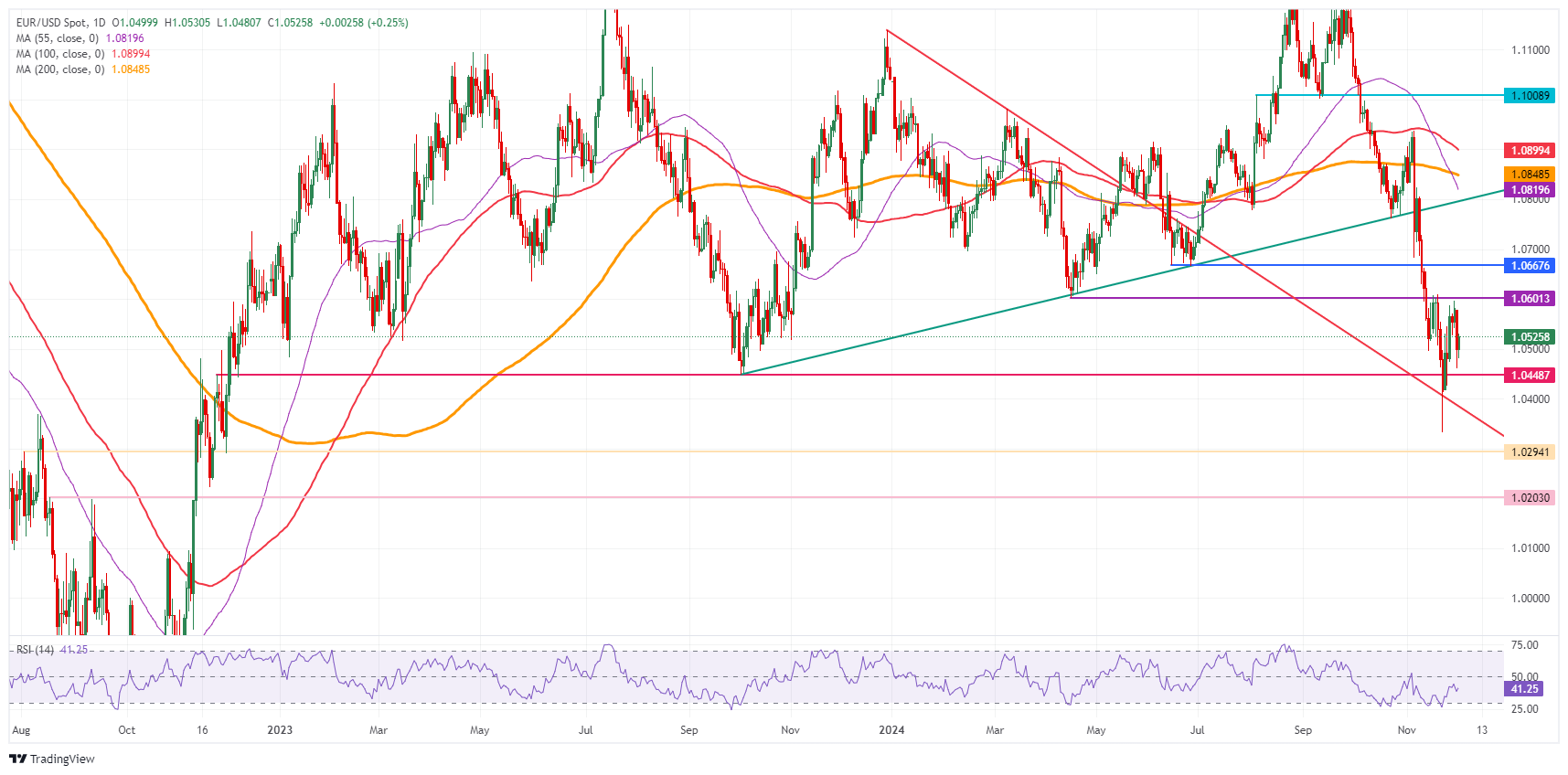
EUR/USD has a long road to recover after its stellar correction in November. With policies from US President-elect Donald Trump being priced in, a lot could be priced out once it turns out that bold statements were a bargaining chip to get some deal or consensus done.

Major banks are already calling for parity, but it would not come as a surprise that parity does not materialize. There is the possibility that the EUR/USD pair reverts back to 1.0600 and 1.0800 in the coming weeks as traders unwind positions ahead of the Christmas season and the end of the year.

On the upside, three firm lines of resistance can be seen. The first is the previous 2024 low at 1.0601 registered on April 16. If that level breaks, the triple bottom from June at 1.0667 will be the next cap upwards. Further up, the 1.0800 round level, which roughly coincides with the green ascending trend line from the low of October 3, 2023, could deliver a harsh rejection.

Looking for support, the 2023 low at 1.0448 is the next technical candidate. The current two-year low at 1.0332 is the second level to look out for. Further down, 1.0294 and 1.0203 are the next levels to consider.

EUR/USD: Daily Chart

EUR/USD: Daily Chart

China announces export ban of gallium, germanium, antimony to US

China announces export ban of gallium, germanium, antimony to US

China’s Commerce Ministry announced on Tuesday that they will ban exports of dual-use items related to gallium, germanium, antimony and superhard materials to the United States (US) with immediate effect.

This comes a day after the latest crackdown on China’s chip sector by US President Joe Biden’s administration.

Market reaction

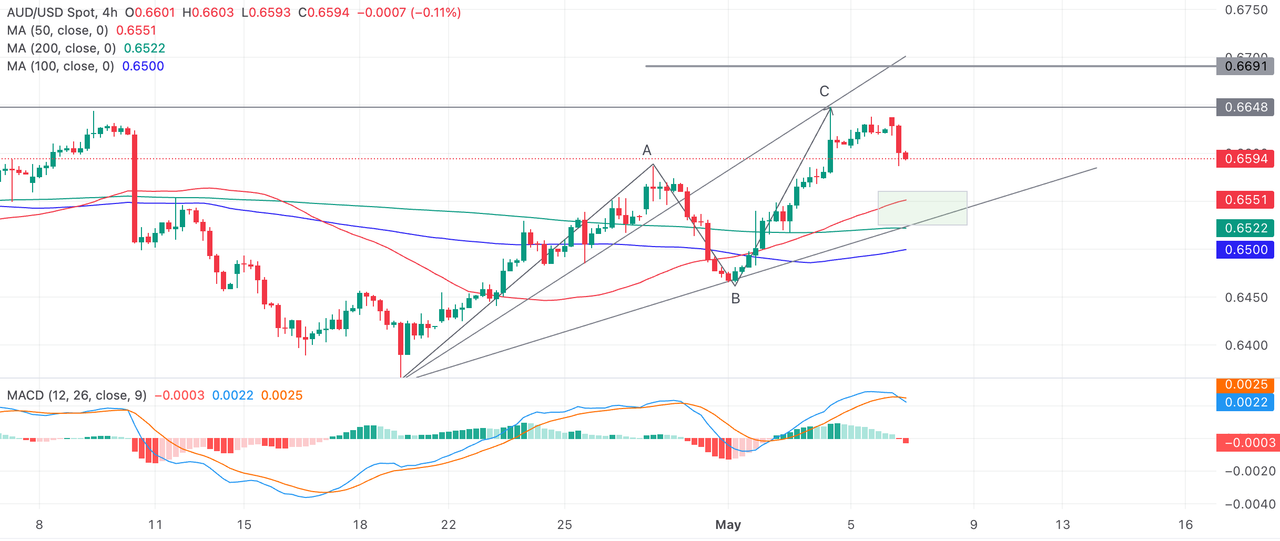
Mounting US-Sino trade tensions seem to have little to no impact on the Chinese proxy Australian Dollar, as of writing. AUD/USD is up 0.37% on the day, testing 0.6500 on renewed US Dollar weakness.