Gold Price Forecast – Gold Markets Recover Slightly on Thursday

Gold Price Forecast – Gold Markets Recover Slightly on Thursday

Gold Market Technical Analysis

Gold markets rallied a bit during the trading session on Thursday, as we continue to flirt with the $2000 level. The $2000 level is a large, round, psychologically significant figure, and an area where a lot of people will be paying close attention to. We have sliced through here a couple of times, so it may have lost some of its efficacy, but at the end of the day it certainly looks as though the market is trying to do everything you can to go higher.

Trading Derivatives carries a high level of risk to your capital and you should only trade with money you can afford to lose. Trading Derivatives may not be suitable for all investors, so please ensure that you fully understand the risks involved, and seek independent advice if necessary. A Product Disclosure Statement (PDS) can be obtained either from this website or on request from our offices and should be considered before entering into a transaction with us. Raw Spread accounts offer spreads from 0.0 pips with a commission charge of USD $3.50 per 100k traded. Standard account offer spreads from 1 pips with no additional commission charges. Spreads on CFD indices start at 0.4 points. The information on this site is not directed at residents in any country or jurisdiction where such distribution or use would be contrary to local law or regulation.

If we do break down below the support candlestick on Thursday, the market is likely to continue to go much lower, perhaps reaching down to the 50-Day EMA, and of course the $1950 level. All things being equal, this is a market that I think has plenty of buyers underneath, and therefore it’s likely that we will continue to see a lot of noisy behavior. With this being the case, and the fact that the interest rates in America continue to jump around, I anticipate that the gold market will continue to be very noisy.

All things being equal, I think you do continue to see a lot of noise, and then of course you have the jobs number that come out on Friday in America which will have a major influence. After all, a lot of traders will be looking to see whether or not the employment situation is slowing down, or if it’s going to continue to be aggressive and positive, perhaps driving inflation even further to the upside.

With that being said, gold markets will continue to be noisy but it’s obvious that they are very bullish in general, and therefore I think you’ve got a situation where you continue to buy dips. We certainly have seen that over the last 48 hours and I think it is probably only a matter of time before we do break to a fresh, new high. However, if we were to break down below the 50-Day EMA, it would be very negative, opening up the possibility of a move down to the 200-Day EMA. With this, I think you continue to see a lot of choppy and difficult trading.

Bank of England Pauses Rate Hikes Amid Economic, Inflation Concerns

Bank of England Pauses Rate Hikes Amid Economic, Inflation Concerns

Interest Rates Decision

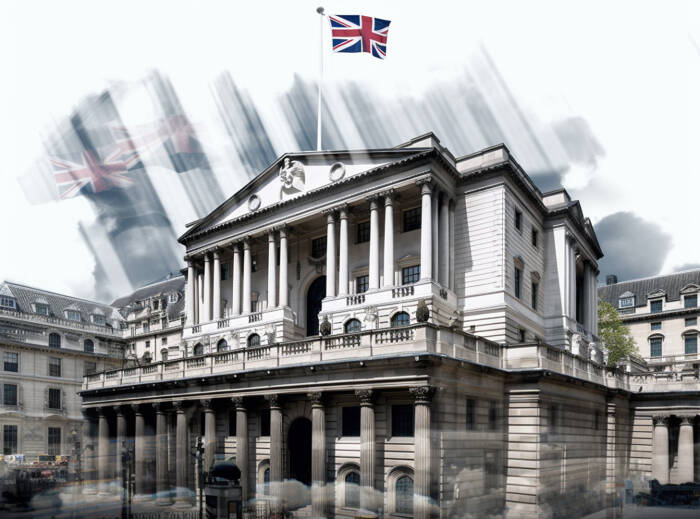
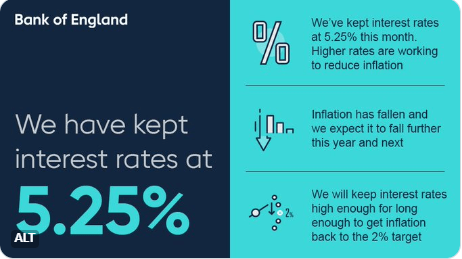
The Bank of England’s Monetary Policy Committee (MPC) made a significant move, halting its streak of 14 consecutive rate hikes. By a 6-3 vote, the committee chose to keep the interest rates unchanged at 5.25%, a decision influenced by their assessment of the economic landscape and its foreseeable effect on inflation.

Economic and Inflationary Landscape

Recent data paint a picture of a UK economy losing steam. GDP growth recorded a standstill in Q3 2023 and forecasts suggest a paltry 0.1% rise in Q4. Concurrently, the labor market appears to be loosening its grip. Employment growth is on a downward trend, with certain sectors still grappling with skills shortages. On the inflation front, the rate hovers at an elevated 6.7%, substantially overshooting the MPC’s 2% target. However, a silver lining appears as projections anticipate a drastic decline, aligning it closer to the target by 2025’s end.

Global Influences and Risks

Several external factors are casting shadows on the UK’s economic landscape. The tumultuous events in the Middle East have precipitated a surge in oil futures, stoking global inflationary fires. Additionally, a notable rise in long-term government bond yields across major economies signals a recalibration in global investor sentiment. The MPC is candid about the potential pitfalls in their projections, especially concerning inflation. Chief among the concerns are lingering second-round effects on domestic prices and wages, combined with potential energy price shocks on the world stage.

Outlook on Future Monetary Policy

In the midst of these challenges, the MPC reiterates its stance that the prevailing monetary policy is tight, especially in light of the Bank Rate’s significant elevation. With an unwavering commitment to steer inflation back to the 2% mark over the medium term, the committee hints that if persistent inflationary pressures arise, they might consider further tightening.

Conclusion and Market Implications

The MPC’s decision to hold the rate resonates with the broader narrative of a decelerating economy juxtaposed with stubborn inflationary pressures. While a cautious optimism surrounds the prospect of inflation rates nearing the target in coming years, the erratic dance of global events and domestic economic trends could sway future MPC decisions. For traders and investors, keeping a keen eye on unfolding economic data and Bank communications will be pivotal in anticipating upcoming policy shifts.

Unit Labour Costs Decline As Productivity Improves

Unit Labour Costs Decline As Productivity Improves

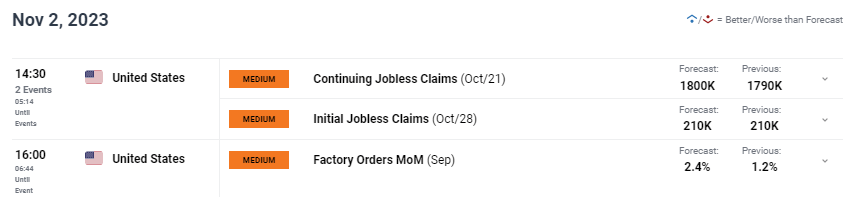
On November 2, U.S. released Initial Jobless Claims report, which indicated that 217,000 Americans filed for unemployment benefits in a week. Analysts expected Initial Jobless Claims of 210,000.

Continuing Jobless Claims increased from 1.78 million to 1.82 million, compared to analyst consensus of 1.8 million.

Importantly, Unit Labour Costs declined by 0.8% in the third quarter, while analysts expected that they would grow by 0.7%. Non Farm Productivity increased by 4.7%, compared to analyst consensus of 4.1%.

U.S. Dollar Index tested session lows after the release of the reports. Traders continue to digest Powell’s words and bet that Fed will not raise rates again. Treasury yields are moving lower, and the yield of 10-year Treasuries has already declined towards the 4.65% level. Falling yields put additional pressure on the American currency.

Gold moved towards the $1990 level, supported by weaker dollar and lower Treasury yields. Demand for safe-haven assets also provides support to gold markets as traders stay focused on the developments in the Middle East.

SP500 futures moved towards the 4280 level in premarket trading. The market sentiment is bullish as traders bet on a less hawkish Fed.

For a look at all of today’s economic events, check out our economic calendar.

Crypto News: Fed Chair Powell Delivers a Crypto Boost as SBF Defense Rests

Crypto News: Fed Chair Powell Delivers a Crypto Boost as SBF Defense Rests

US Federal Reserve Chair Jerome Powell Suggests End to Rate Hike Cycle

On Wednesday, Fed Chair Powell eased bets on a December Fed rate hike, fueling demand for BTC and the broader market.

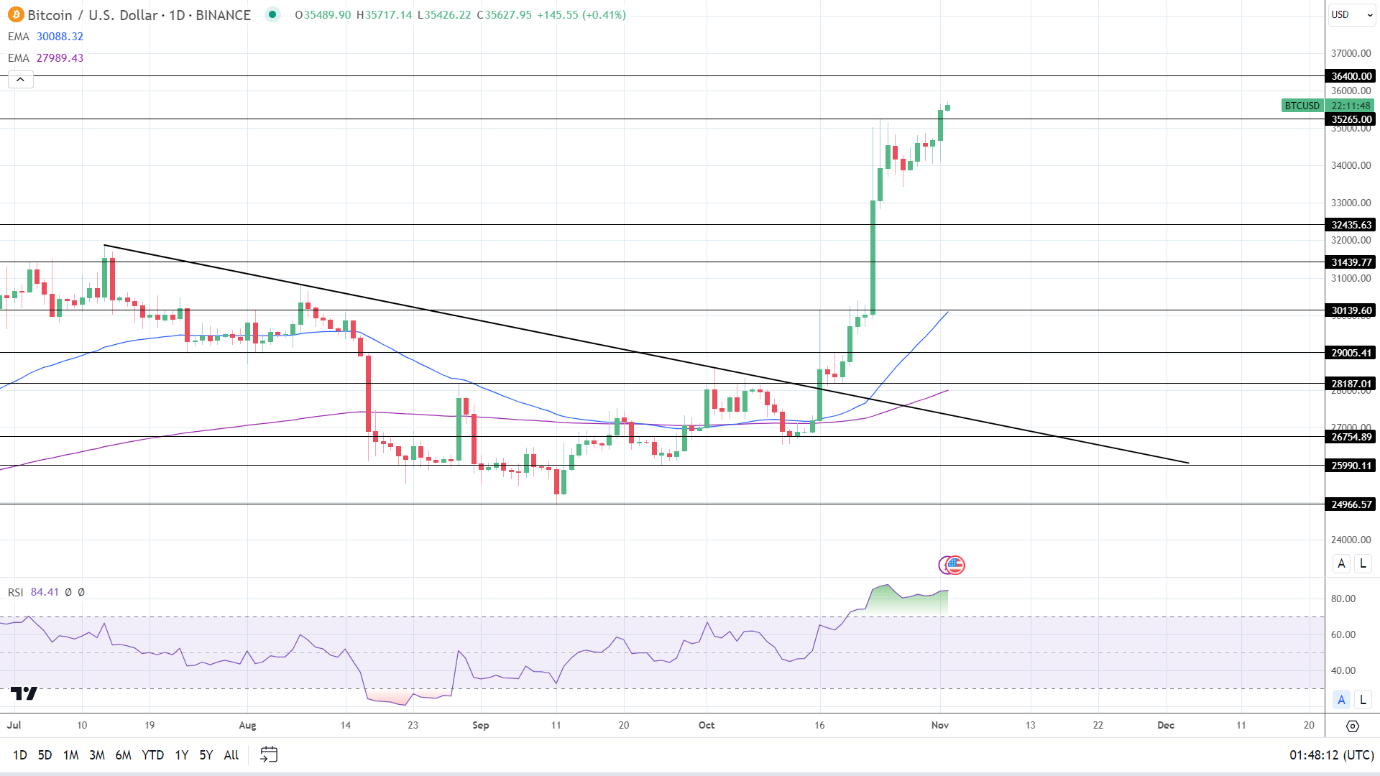
BTC rallied 2.30% and ended the Wednesday session at $35,482. Significantly, BTC struck a new 2023 high of $35,717 on Thursday morning as the Asian markets reacted to the latest Fed forward guidance.

Trading Derivatives carries a high level of risk to your capital and you should only trade with money you can afford to lose. Trading Derivatives may not be suitable for all investors, so please ensure that you fully understand the risks involved, and seek independent advice if necessary. A Product Disclosure Statement (PDS) can be obtained either from this website or on request from our offices and should be considered before entering into a transaction with us. Raw Spread accounts offer spreads from 0.0 pips with a commission charge of USD $3.50 per 100k traded. Standard account offer spreads from 1 pips with no additional commission charges. Spreads on CFD indices start at 0.4 points. The information on this site is not directed at residents in any country or jurisdiction where such distribution or use would be contrary to local law or regulation.

MicroStrategy Third Quarter Earnings Showcased 158,400 BTC Holding

MicroStrategy (MSTR) rose by a modest 0.77% on Wednesday vs. a 1.64% Nasdaq Composite Index gain. However, the recent acquisition of BTC coincided with the BTC breakout from sub-$30,000.

On Wednesday, MSTR released its Q3 earnings results. According to the presentation, MicroStrategy held 158,400 BTC as of October 31, 2023, at a total cost of $4.69 billion, or $29,586 per bitcoin. Since October, MicroStrategy has made a cool $934 million on its BTC holdings.

Jury to Begin Deliberations in Sam Bankman-Fried Trial

On Wednesday, the Prosecution and the Defense delivered closing arguments. Sam Bankman-Fried’s (SBF)lawyer Cohen closed, saying,

“Here we are, finally, before you, in your hands. You’ll find Sam acted in good faith. He didn’t want to defraud. Find him not guilty.”

During closing arguments, the Defense counsel noted the plea agreements, immunity to prosecution, and non-prosecution agreements signed by prosecution witnesses. Caroline Ellison, Nishad Singh, and Gary Wang signed plea deals for testimony. Adam Yedidia signed an immunity agreement, with Can Sun executing a non-prosecution agreement.

Altcoins in Breakout Mode

Uniswap (UNI) rallied 15.60% to lead the crypto top 100 by market cap on Wednesday. Other notables included Near Protocol (NEAR) and Oasis Network (ROSE).

NEAR and ROSE ended the day up 14.67% and 14.27%, respectively.

Technical Analysis

Bitcoin Analysis

BTC remained above the 50-day and 200-day EMAs, affirming bullish price signals.

A BTC return to $36,000 would support a break above the $36,400 resistance level to target $37,000.

BTC-spot ETF-related news and SEC activity will be the focal points. However, shifts in sentiment toward Fed monetary policy also warrant consideration. Hotter-than-expected labor market numbers could refuel bets on a December Fed rate hike.

A BTC break below the $35,265 support level would bring the $32,436 support level into view.

The 14-Daily RSI reading of 84.41 shows BTC sitting in overbought territory, signaling a pickup in selling interest.

BTC Daily Chart sends bullish price signals.

BTCUSD 021123 Daily Chart

Ethereum Analysis

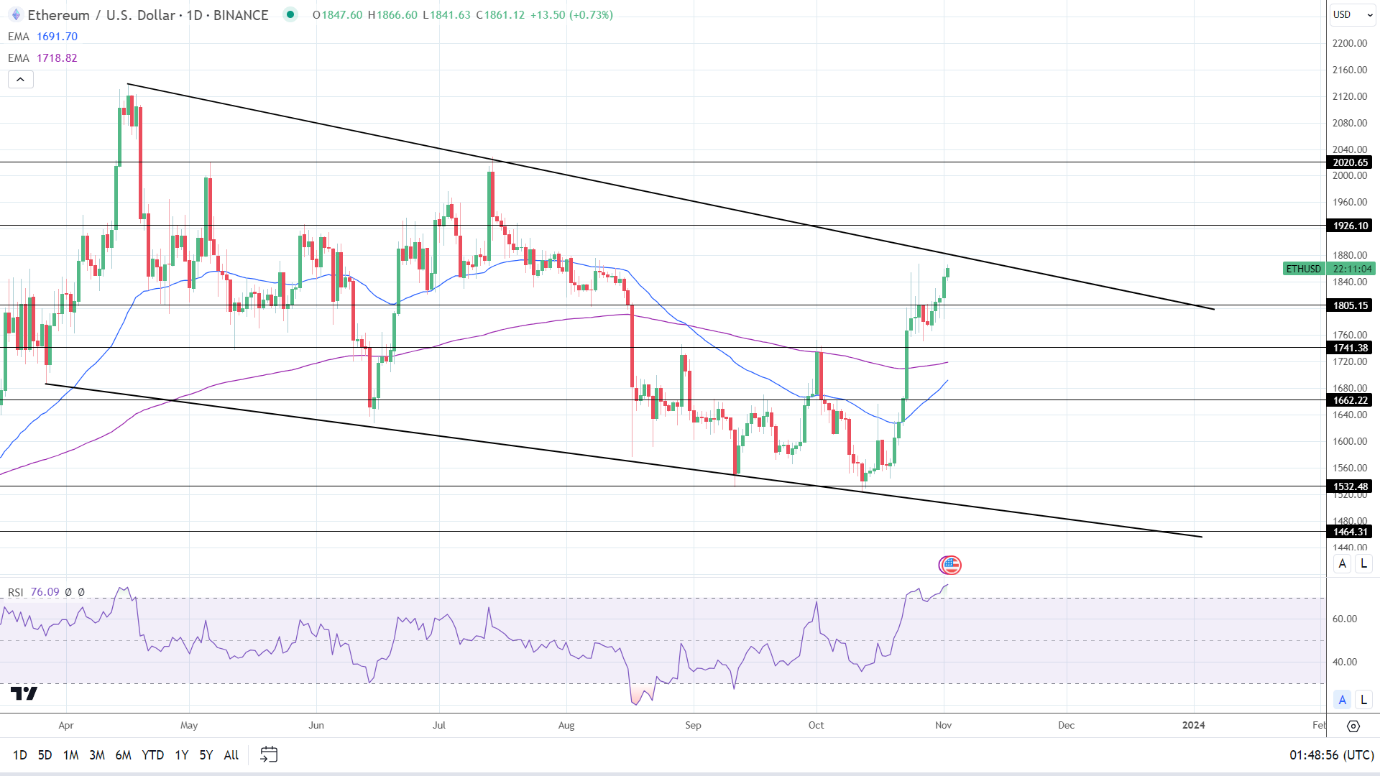
ETH sat above the 50-day and 200-day EMAs, sending bullish price signals.

An ETH break above the trend line would give the bulls a run at the $1,926 resistance level. ETH-spot ETF-related news will also influence buyer appetite.

Failure to break above the trend line would leave the $1,805 support level in play.

ETH sits in overbought territory with a 14-Daily RSI reading of 76.09. Seller pressure could intensify at current levels.

ETH Daily Chart sends bullish price signals.
ETHUSD 021123 Daily Chart
Dow, Nasdaq 100 and CAC40 Continue to Rally​​​​

Dow, Nasdaq 100 and CAC40 Continue to Rally​​​​

Dow Jones, Nasdaq 100, CAC 40 Analysis and Charts

​​​Dow stronger in wake of Fed decision

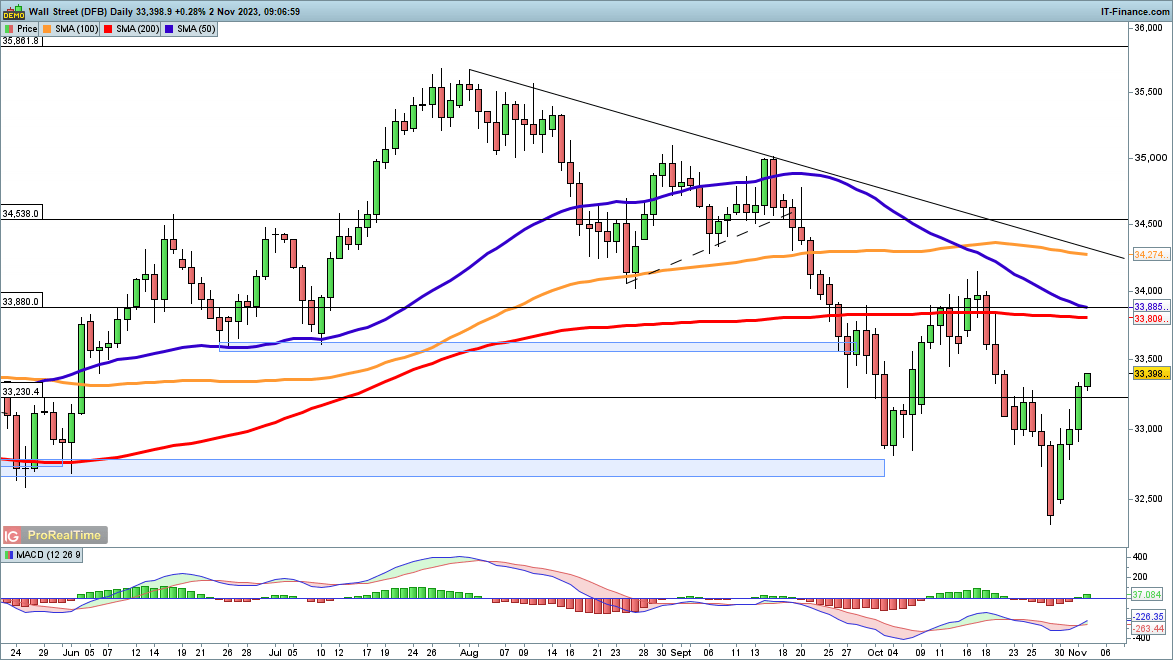
​The index’s rally was given fresh impetus by the Fed decision last night, which saw a more balanced outlook from Jerome Powell. ​The index has climbed to its highest level in two weeks, continuing its rebound from the lower low. The next target is the 200-day SMA, followed by the 34,000 level.

​Sellers will need a reversal back below 33,000 to negate the short-term bullish view.

Dow Jones Daily Chart

​Nasdaq 100 rebound goes on

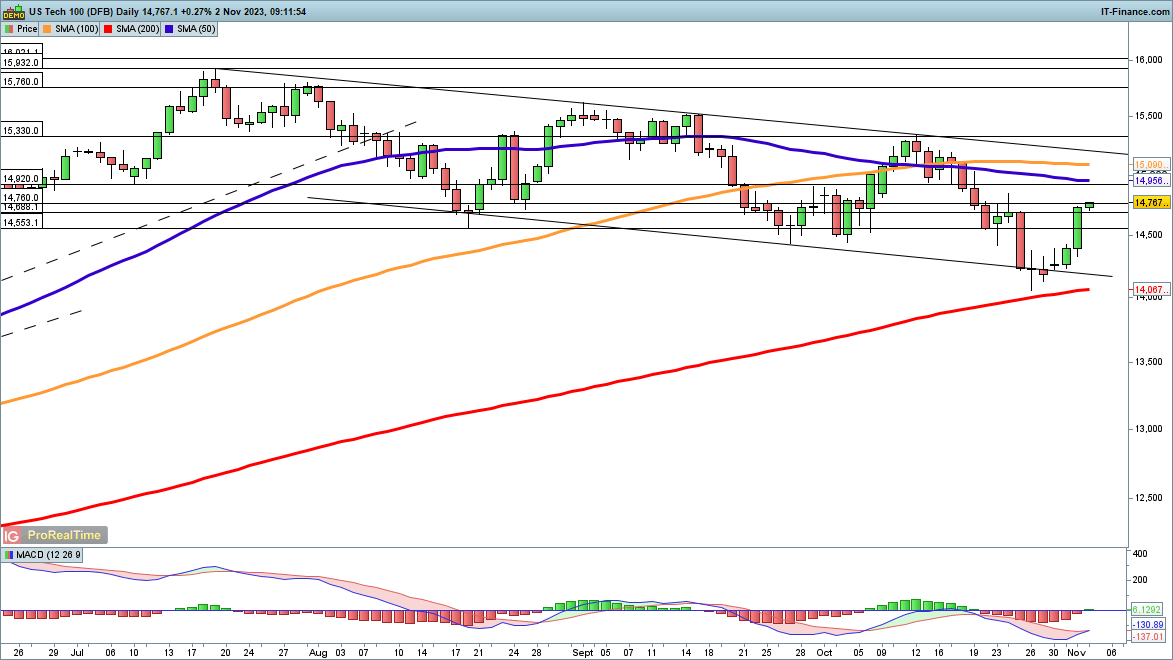
​The rally in this index gathered pace yesterday too. The upper bound of the current descending channel now comes into play as a potential near-term target.​Beyond this, the early October high at 15,330 comes into view. This would then see the price back above the 50- and 100-day SMAs helping to revive the medium-term bullish view.

​A reversal back below 14,500 cancels out this view for now.

Nasdaq 100 Daily Chart

​CAC40 sees fresh gains

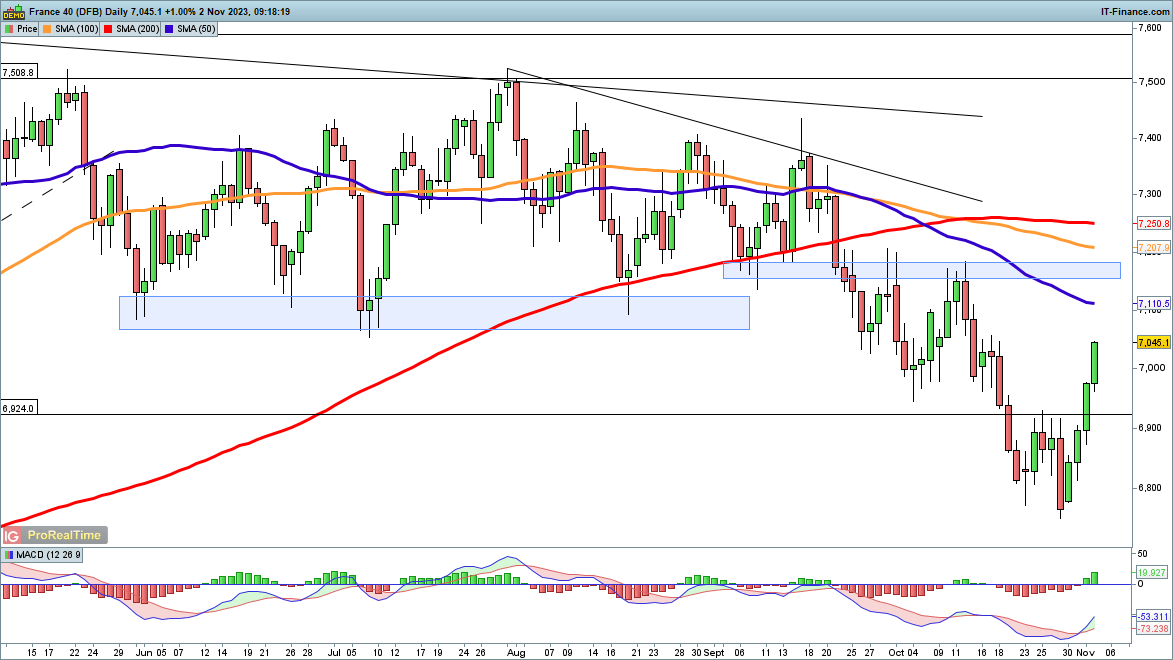
​A solid rebound continues here, though from a lower low within the context of a broader downtrend from the July highs.​Further gains target the 7170 area that marked resistance in late September and was previously support in late August.

​A failure to break above 7170 could mark a short-term top, and indeed a reversal below 7100 could also result in fresh selling pressure developing.

CAC 40 Daily Chart

The Bank of England: A Forex Trader’s Guide

The Bank of England: A Forex Trader’s Guide

The Bank of England: A Forex Trader’s Guide

The Bank of England (BOE) is the UK’s central bank. Their mission is to promote and maintain monetary and financial stability. It is important for forex traders to keep up to date with the Bank of England’s latest changes to monetary policy because it can have a large effect on the Sterling Pound (GBP) and relevant currency pairs, like the EUR which is highly correlated to the Pound.

Central Bank of England

What is the Bank of England (BOE)?

Established in 1694, the Bank of England is the banker to, and owned by, the British government but is independent when setting monetary policy. Its roles include the setting of monetary policy – which includes targeting interest rates and using other tools to stimulate or contract the economy – producing the UK’s bank notes, supervising some bank payment systems, and ensuring the stability and safety of the financial system.

For traders, the BOE’s setting of monetary policy is a key factor to consider as it can have a big impact on the financial markets. Other factors, like the independence of the central bank are also important but are more prevalent issues in emerging market economies.

Key Economic Mandates of the Bank of England

According to the Bank of England, their two core purposes or mandates are:

1) Monetary stability – which is price stability or inflation

2) Financial stability – which is the stability and health of the economy

Monetary Stability

Monetary policy is extremely important for the entire economy. It prevents runaway inflation and attempts to ground inflation expectations so that the economy can grow at a regular pace. In order to maintain price stability, the Bank of England and their monetary policy committee (MPC) have set an inflation target of 2%.

If inflation goes above the target of 2% the Bank of England may increase interest rates. The increase in interest rates may cause an appreciation in the Pound as investors increase capital flows into the higher yielding currency. It may also have a negative affect on the stock market, as businesses will have to pay higher rates to lend and equity valuations will be discounted at a higher interest rate. Monetary policy data can be found on our economic calendar.

However, it is not always the case that the Bank of England will increase interest rates if inflation is above target. In some cases, like when GDP growth is still low or negative, the Bank of England may keep interest rates low to stimulate the economy. It is important to know the Bank of England will be looking for a balance between healthy inflation and economic growth.

Join our central bank webinar to watch our senior currency strategist discuss and analyze current central bank trends.

Financial Stability

The resilience of the financial system is paramount to the health of the UK economy and therefore necessary for the Bank of England to accommodate. To support Financial Stability mandates, the bank also has a Financial Policy Committee or FPC which was established in June 2011. From an FX point of view, the Monetary Stability is the key driver of spot rates for the GBP.

How BOE interest rates affect the Pound

Interest rate impact on the Pound

The Bank of England can affect the value of the Pound through changes in interest rate expectations. Traders should understand that currencies appreciate when interest rate expectations increase, not just from increases in the nominal interest rate.

For example, if the Bank of England keeps interest rates unchanged but issues forward guidance (tells the market) that they expect more interest rate hikes in future, the value of the Pound will appreciate. Likewise, decreases in future interest rate hike expectations, or expectations of an interest rate cut can lead to a decrease in the value of the Pound.

This is the general principle for how interest rates affect the Pound and stock market, although they sometimes react differently:

  1. Higher interest rate expectations increase the strength of the Pound (GBP) and negatively affect equity values.
  2. Lower interest rate expectations decrease the strength of the Pound (GBP) and positively affect equity values.

Interest rates aren’t the only monetary policy tool that can affect the currency, tools like quantitative easing can also lead to increases and decreases in the value of a currency. If the Bank of England announces that it plans to start a quantitative easing program (QE), the pound will likely depreciate as a large amount of liquidity enters the market, increasing the supply of money in the market and leading to a decrease in interest rates, or, simply to maintain current rates.

Interest rate impact on the economy

The Bank of England lowers interest rates when it is trying to stimulate the economy (GDP) and increases interest rates when it is trying to contain inflation caused by an economy operating above potential (overheating).

Lower interest rates stimulate an economy in a few ways:

  1. Businesses can borrow money and invest in projects that will receive more than the risk borrowing rate.
  2. When interest rates are lower the stock market is discounted at a lower rate, leading to an appreciation in stock market values which causes a wealth effect.
  3. People invest their money into the economy (stocks and other assets) because they can earn more in these assets than at currently low interest rates.

How to trade BOE interest rate decisions

The table below displays the possible scenarios that come from a change in interest rate expectations. Traders can use this information to forecast if the currency is likely to appreciate or depreciate and how to trade it.

Market expectations Actual Results Resulting FX Impact
Rate Hike Rate Hold Depreciation of currency
Rate Cut Rate Hold Appreciation of currency
Rate Hold Rate Hike Appreciation of currency
Rate Hold Rate Cut Depreciation of currency

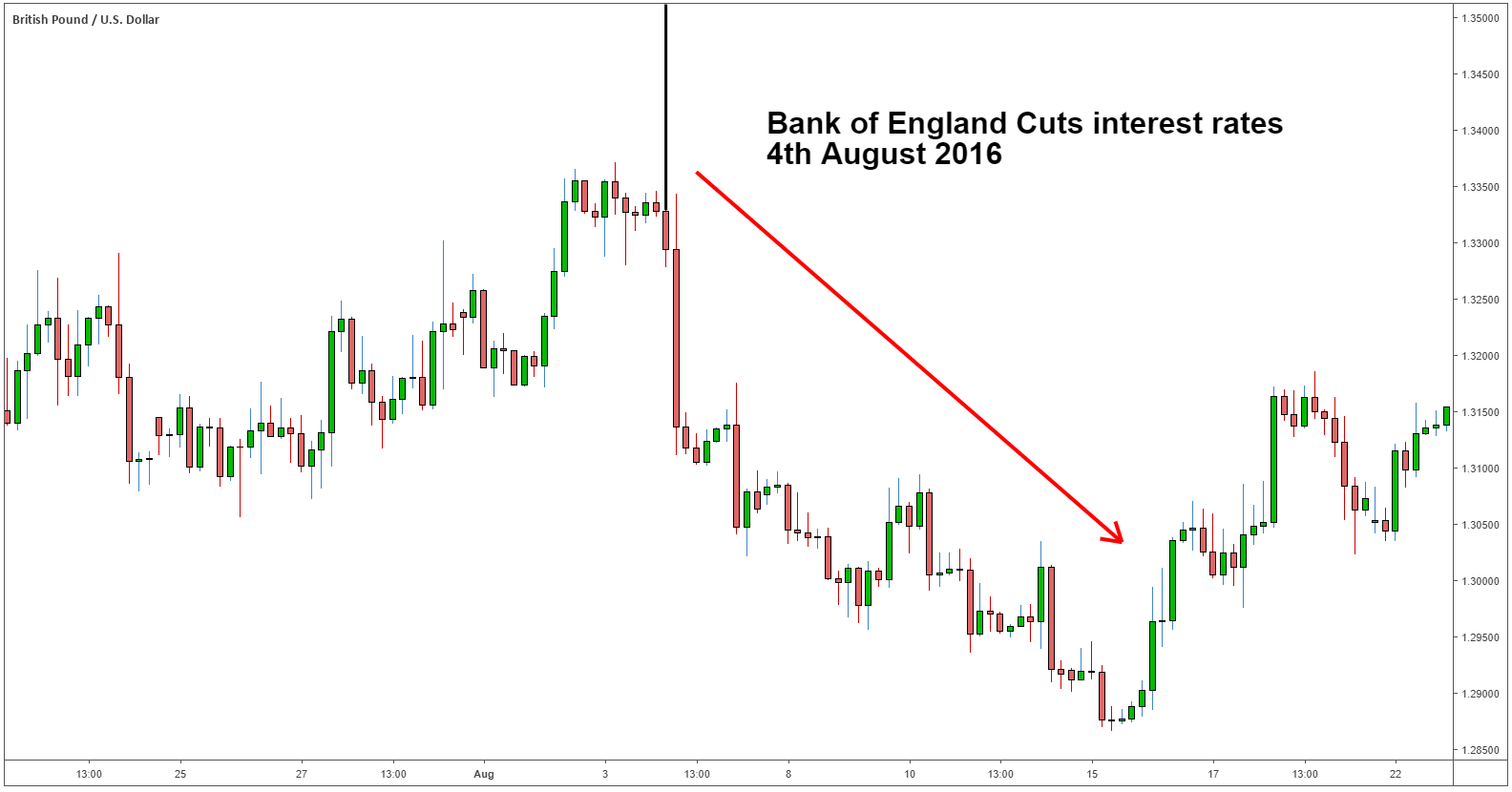
Let’s look at the example below on GBP/USD. On August 4, 2016 the Bank of England cut interest rates and announced a stimulus package (quantitative easing program). The market reacted negatively and the Pound depreciated.
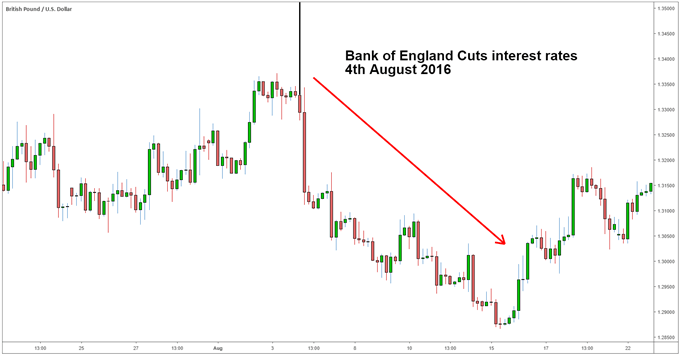
Bank of England cuts interest rate to new low

Top Takeaways of the BOE and Forex Trading

  • The Bank of England is fundamental to the value of the Pound
  • The Pound will appreciate or depreciate depending on changes in interest rate expectations, not just on actual changes.
  • Quantitative easing has a similar effect to changes in interest rates. Changes in expectations of quantitative easing will have an effect on the Pound.
  • Rising inflation does not mean the Bank of England will increase interest rates, it depends on the balance between economic growth and inflation.

Bank of England Leaves Rates Unchanged, GBP/USD Grabs a Small Bid

Bank of England Leaves Rates Unchanged, GBP/USD Grabs a Small Bid

The Bank of England (BoE) left the Bank Rate unchanged today at 5.25%, for the second meeting in a row. Six members of the MPC voted to keep rates unchanged, while three members voted for a 25 basis point increase. The central bank expects to keep interest rates sufficiently restrictive to bring inflation down to target and will raise interest rates again if it is deemed necessary.

image1.png

The Bank of England noted signs of weakness in the UK labour market….

‘The MPC continues to consider a wide range of data to inform its view on developments in labour market activity, rather than focusing on a single indicator. The increasing uncertainties surrounding the Labour Force Survey underline the importance of this approach. Against a backdrop of subdued economic activity, employment growth is likely to have softened over the second half of 2023, and to a greater extent than projected in the August Report. Falling vacancies and surveys indicating an easing of recruitment difficulties also point to a loosening in the labour market. Contacts of the Bank’s Agents have similarly reported an easing in hiring constraints, although persistent skills shortages remain in some sectors.’

….while the central bank also expects headline inflation…

‘to continue to fall sharply, to 4¾% in 2023 Q4, 4½% in 2024 Q1 and 3¾% in 2024 Q2. This decline is expected to be accounted for by lower energy, core goods and food price inflation and, beyond January, by some fall in services inflation.’

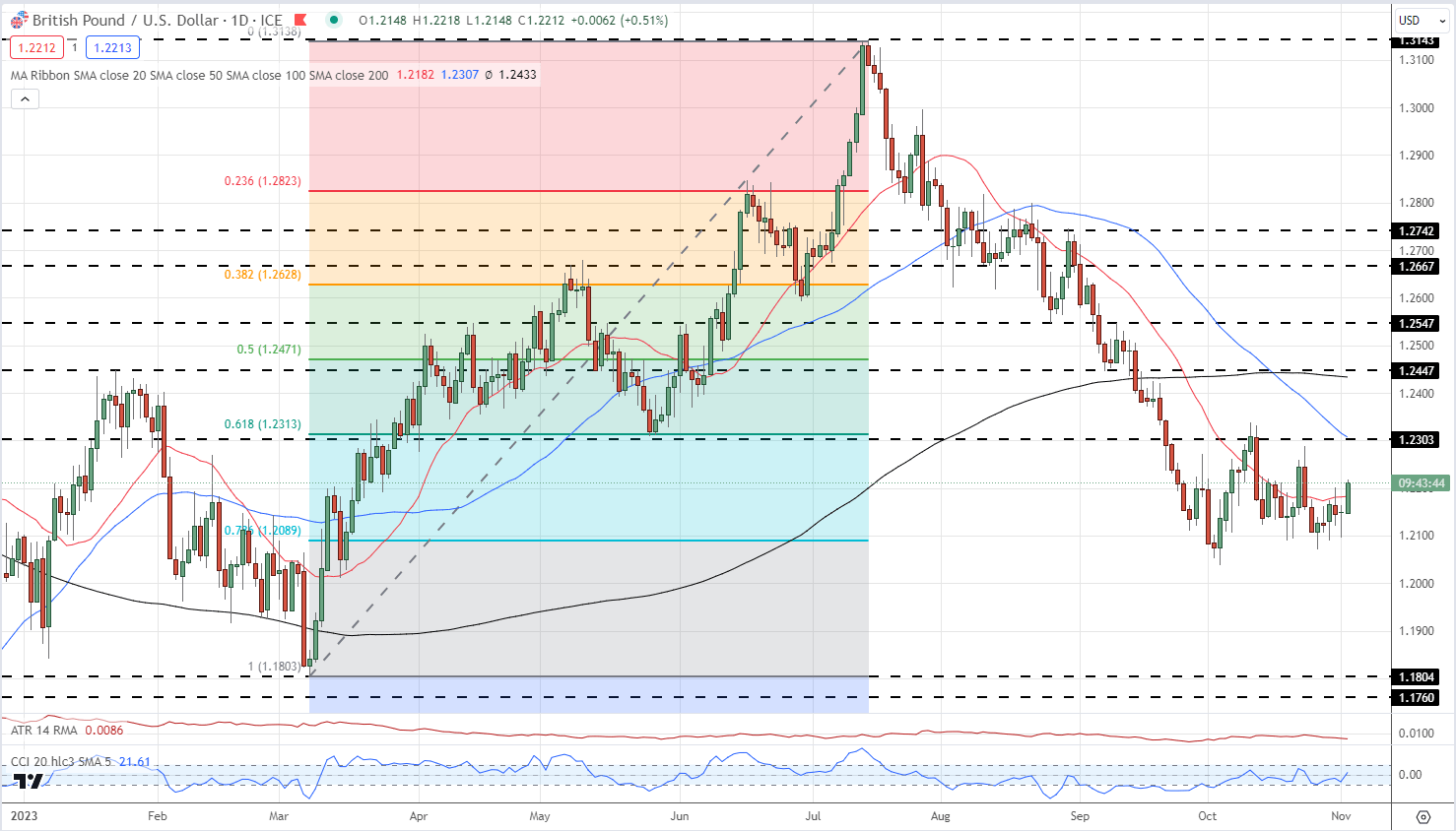
Cable is trading at a fresh one-week high as traders price in a mildly hawkish central bank meeting. The pair are now in the middle of a range defined by the 78.6% Fibonacci retracement at 1.2089 and the 61.8% retracement at 1.2313. The driver of GBP/USD will be Friday’s US Labor Report (NFP) at 12:30 UK.

GBP/USD Daily Price Chart

image2.png

Chart via TradingView

USD Price Update: DXY Drops after FOMC and a Likely Peak in Rates

USD Price Update: DXY Drops after FOMC and a Likely Peak in Rates

Fed holds interest rates but acknowledges Further tightening conditions

Yesterday the Federal Reserve held interest rates steady at 5.25 – 5.50% for the second consecutive meeting. This was largely expected but markets had been pricing in the possibility of a one more rate hike before the end of the year after an impressive run of U.S. economic data which saw U.S. GDP canter to 4.9% (annualized) growth in Q3.

In the FOMC statement The Fed upgraded its language describing the strong performance of the U.S. economy from “solid” to “strong”. In the ensuing press a conference Jerome Powell acknowledged that the economy was however starting to feel the effects of tighter monetary policy but that the committee still sees a greater chance of a further rate hike than it does rate cuts over the coming months. This makes sense as the Fed does not wish to provide a signal for the markets to go ahead and price in immediate rate cuts which would run the risk of loosening financial conditions, posing a risk to inflation.

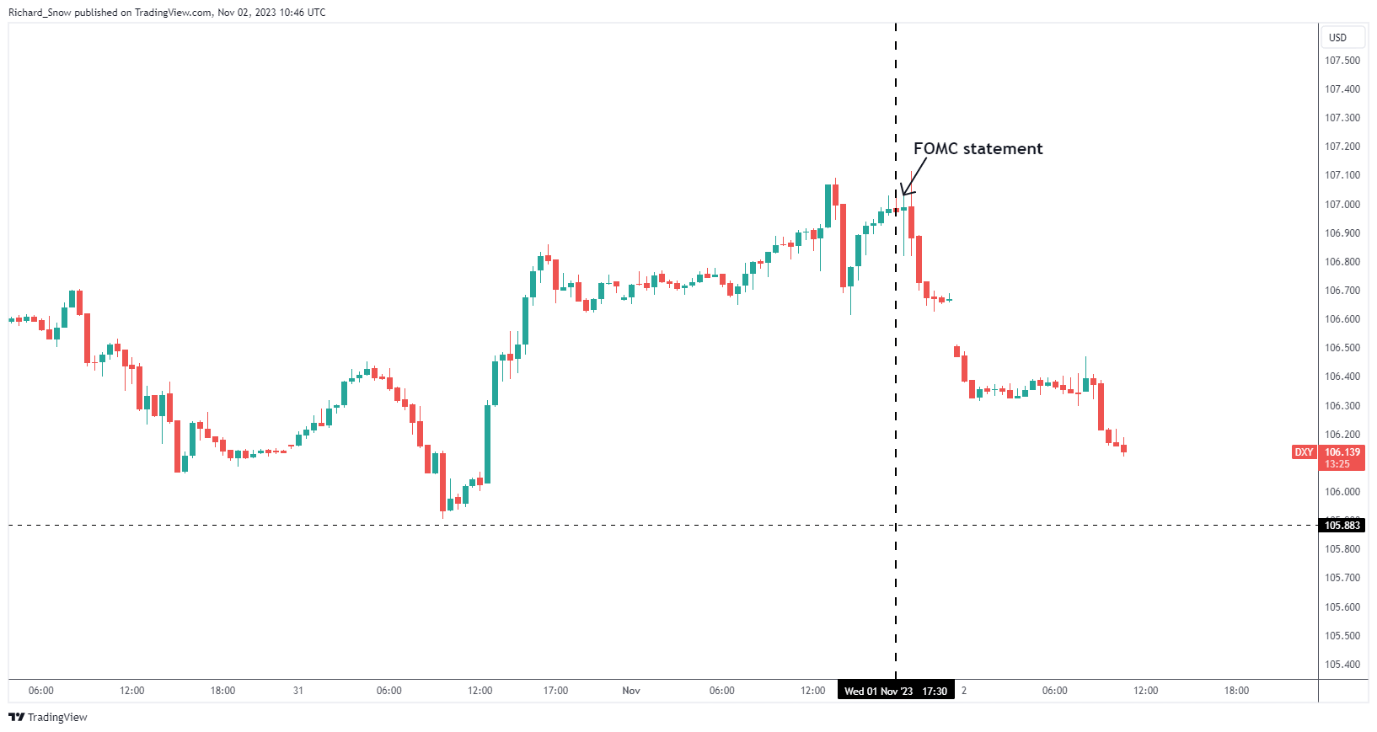
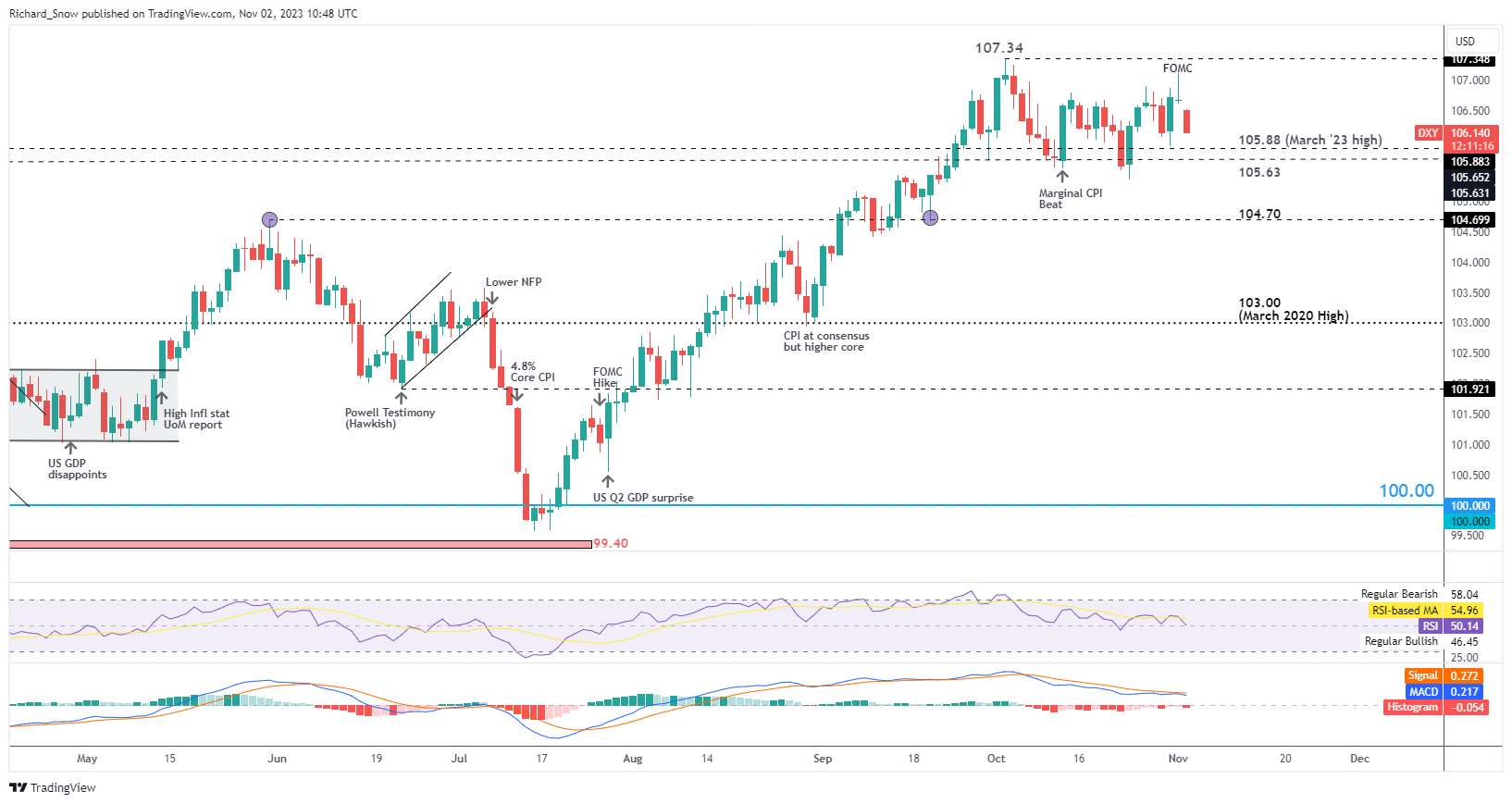
Immediately after the FOMC statement the dollar basket eased in similar fashion to U.S. yields which posted a notable decline in the run up to the meeting. The bar for an extended bullish continuation in the dollar still remains high despite the fact that U.S. data is strong, due to the continuing tightening thanks to elevated yields.

US Dollar Basket (DXY) 30-minute chart

image1.png

Elevate your trading skills and gain a competitive edge. Get your hands on the U.S. dollar Q4 outlook today for exclusive insights into key market catalysts that should be on every trader’s radar:

Are US Treasuries Signaling a Peak in US Interest Rates?

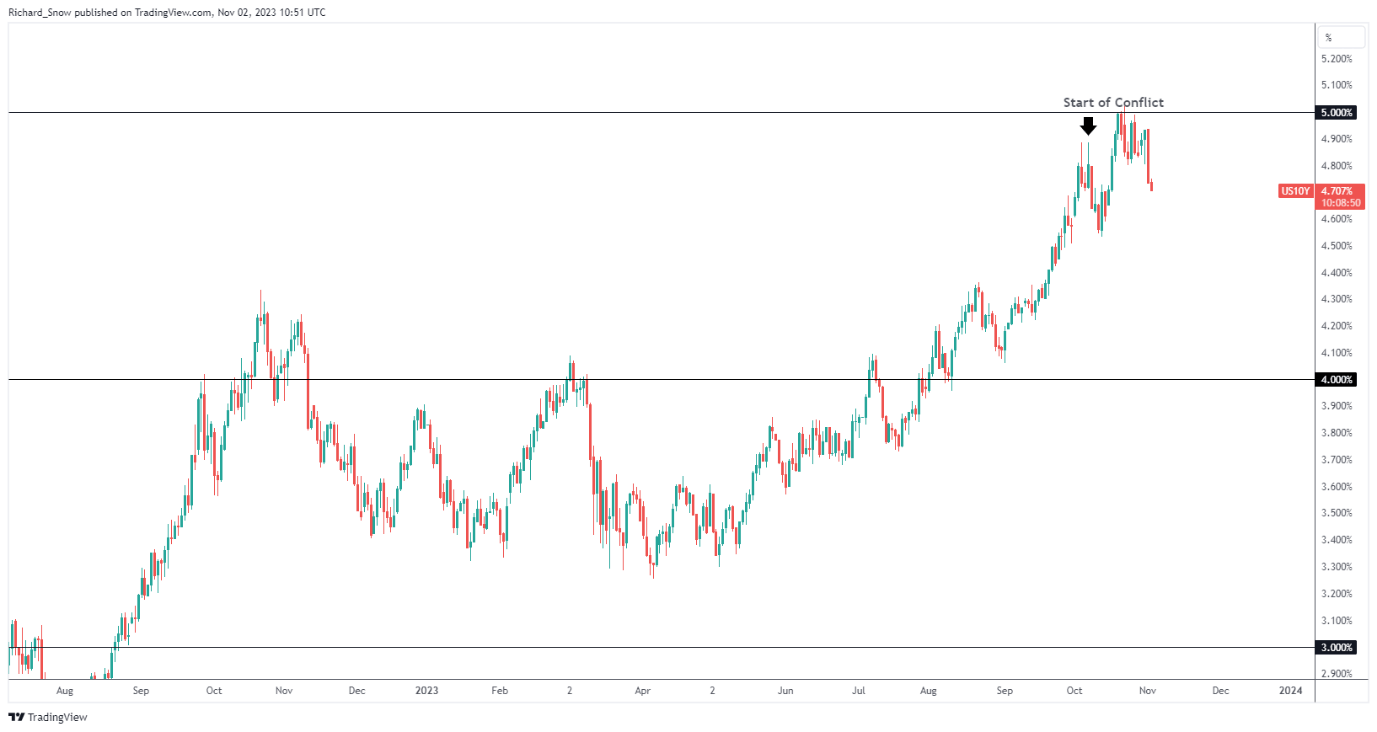
U.S. Treasury yields eased in the lead up to the FOMC announcement potentially suggesting a peak in U.S. interest rates. Longer dated U.S. yields have been extremely elevated through a number of weeks now placing further pressure on financial conditions and credit markets.

US 10 Year Treasury Note Yield

image2.png

Fed funds futures have been rather telling, with recent moves suggesting a lesser likelihood of another rate hike before the end of this year. One month ago markets had priced in just under 40% chance of a rate hike in December and this has slowly been declining. Now it sits at just under 20%.

FedWatch Tool Showing Market Implied Probabilities of Another Rate Hike

image3.png

Markets Turn to Fundamental Data to Gauge the Effect of Restrictive Policy

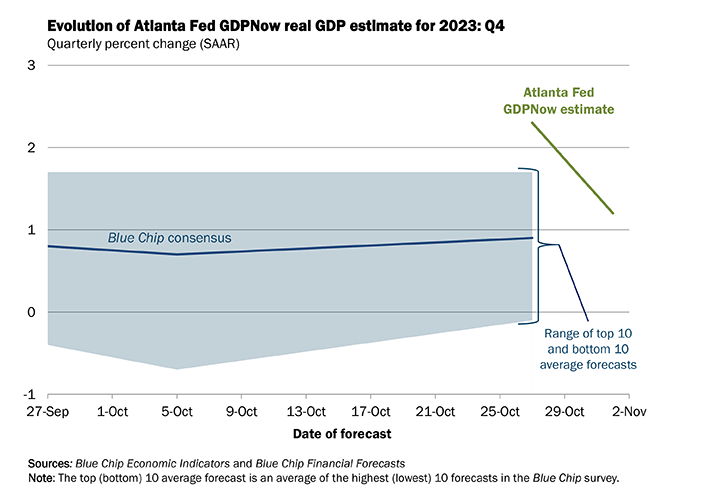
U.S. data has generally been outperforming it’s peers, but yesterday’s ISM manufacturing PMI data missed estimates by some margin and the Atlanta feds very own ‘GDP Now’ forecast has come crashing down from around 4% to a mere 1.2% for fourth quarter growth – based on current data.

It will take a lot to change the narrative of U.S. exceptionalism and these are only a couple of data points but what it does do is highlight the importance of future data as far as it refers to potential stresses within the US economy. Up next we get U.S. ISM services PMI and NFP.

Atlanta Fed’s GDPNow Forecast for Q4 (Based on Current Data)

image4.png

US Dollar Reversed off Yesterday’s High

The dollar reversed sharply after the intraday spike witnessed yesterday and continues the selloff in the London session today. Softer yields have contributed towards the decline along with the notion that interest rates have risen for the final time in this hiking cycle, at least, this is what the market is implying after digesting the statement and words of Jerome Powell.

given all of this it is still difficult to sell be dollar which remains at elevated levels. in the absence of pockets of stress or dislocations appearing in the broader U.S. market conditions may favour a range bound approach, looking to fade USD strength at elevated levels.

US Dollar Basket (DXY) Daily Chart

image5.png


USD/ZAR Price Forecast: Rand Bolstered by Weaker Dollar

USD/ZAR Price Forecast: Rand Bolstered by Weaker Dollar

The South African rand rallied yesterday and this morning against the US dollar after the Federal Reserve decided to keep interest rates on hold (expected). Markets viewed the pause in a dovish light despite Fed Chair Jerome Powell eluding to strong economic data – GDP, high inflation and a strong labor market.

ZAR strength followed amongst weaker South African and Chinese manufacturing PMI’s showing the influence of the US economy on the local currency. Furthermore, total vehicle sales in South Africa fell reaching two month lows.

Yesterday, the Medium-Term Budget Policy Statement (MTBPS) highlighted some of the country’s headwinds including weak economic growth, increasing debt levels and ongoing blackouts (loadshedding). The impact on the rand was minimal but will keep traders wary of the vulnerable economic backdrop within South Africa.

Today’s economic calendar (see below) is fairly light and will be focused on additional US jobs data. Volatility should pick up from tomorrow’s slew of US centric high impact data including the Non-Farm Payroll (NFP) report and ISM services data – US is primarily services driven.

USD/ZAR image1.png

TECHNICAL ANALYSIS

USD/ZAR DAILY CHART

image2.png


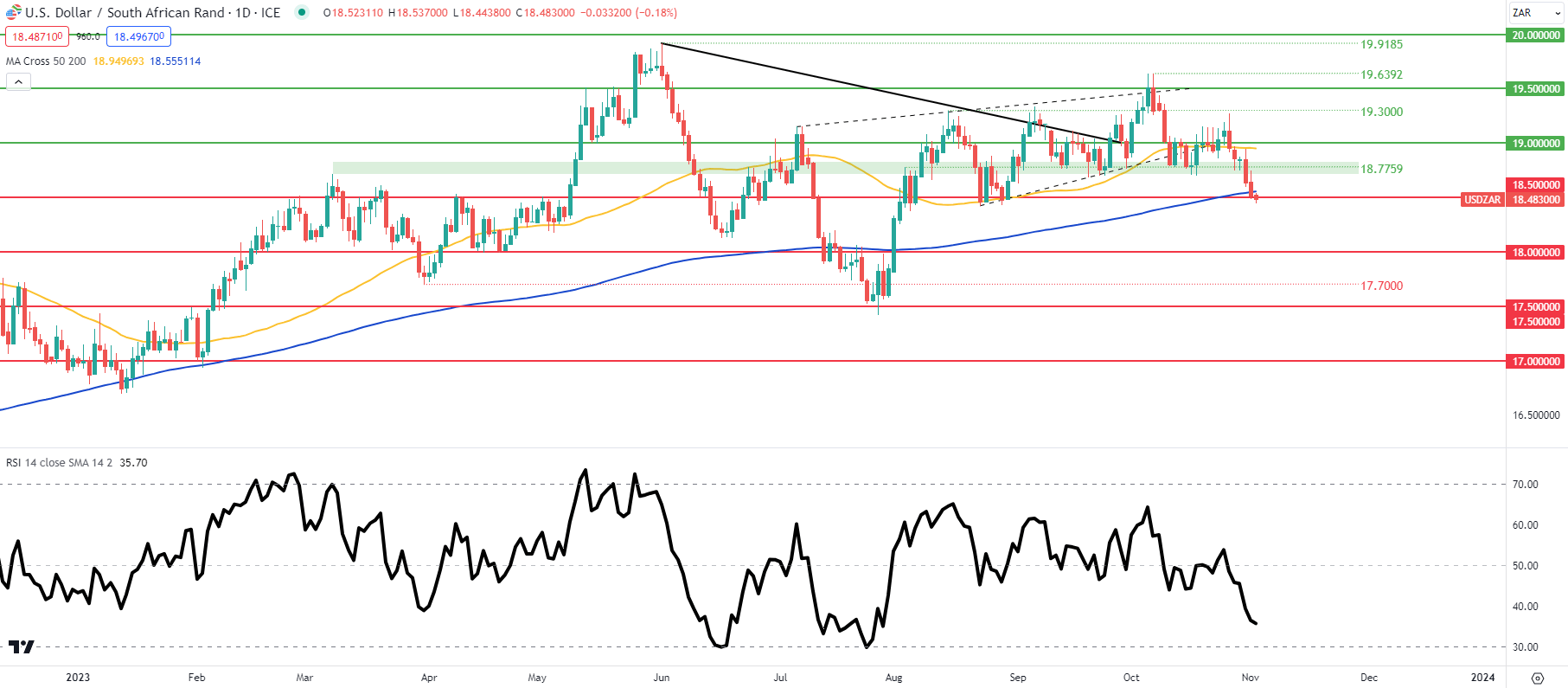
As mentioned in my prior analysis, a break below the zone in and around the 18.7759 level would open up the 200-day moving average (blue) and 18.5000 psychological handle respectively. This key area of support could slowdown ZA

EUR/USD Forecast – Euro Gets Hammered Again

EUR/USD Forecast – Euro Gets Hammered Again

Euro vs US Dollar Technical Analysis

During the trading session on Wednesday, traders will be waiting to see what the Federal Reserve has to say. Here, early in the session, we have seen the euro take a significant amount of selling pressure, as the market is now testing the bottom of the bearish flag. Because of this, the market is likely to continue to be tenuous at best, and I suspect we have a situation where the market has to sort out what the Federal Reserve is going to end up doing, because quite frankly, it’s all about the US dollar at this point.

Trading Derivatives carries a high level of risk to your capital and you should only trade with money you can afford to lose. Trading Derivatives may not be suitable for all investors, so please ensure that you fully understand the risks involved, and seek independent advice if necessary. A Product Disclosure Statement (PDS) can be obtained either from this website or on request from our offices and should be considered before entering into a transaction with us. Raw Spread accounts offer spreads from 0.0 pips with a commission charge of USD $3.50 per 100k traded. Standard account offer spreads from 1 pips with no additional commission charges. Spreads on CFD indices start at 0.4 points. The information on this site is not directed at residents in any country or jurisdiction where such distribution or use would be contrary to local law or regulation.

We already know that the European Union is likely to be in a nasty recession this winter, and of course there are the well-known energy issues that are going to be facing the Europeans shortly. With that being the case, the market is likely to continue to see a lot of selling pressure on the Euro going forward. Furthermore, it is noted that perhaps the Federal Reserve has at least one more interest rate hike between now and the end of the year coming, although it’s not expected to happen on Wednesday itself.

Rallies at this point in time should be selling opportunities, at least until we break above the 50-Day EMA, something that doesn’t look very likely to happen in the short term. Beyond that, we also have to pay close attention to the 200-Day EMA above there. All things being equal, this is a situation where the markets will continue to be more or less a “fade the rallies” type of situation, and while I would anticipate that the market eventually sells off, there could be a bit of a rally after the Federal Reserve announcement/statement, as traders will try to find a reason to believe that the Federal Reserve is on the sidelines.

That being said, we have seen this pattern before, and it’s very likely that we will continue to see volatility that favors the downside. If we can break down below the 1.05 level, then it opens up the possibility of a move down to the 1.0250 level. After that, we could be talking about a move down to the parity level.