silver 3

Silver Price is showing clear negative signals

Silver prices (SILVER) declined in their last intraday trading, after testing minor bearish trend line on short-term basis, accompanied by reaching EMA50’s resistance, forming double technical barrier that turned the selling pressures back, this decline indicates the importance of technical levels, especially with the absence of momentum to breach and hold above it.


The negative overview is reinforced with the emergence of weakness signals from relative strength indicators, after recording negative divergence after reaching exaggerated overbought levels compared to the price, indicating the likelihood of the decline continuation on near-term basis, unless it surpassed these technical resistance levels and confirmed a positive price reversal

gbp

GBPUSD price breaks our expected target

GBPUSD kept declining in its last intraday trading, to break 1.3510 support in its last intraday trading, this support represents an expected target in our previous analysis, amid the continuation of the negative pressure due to its trading below EMA50, reinforcing the stability and dominance of the bearish corrective trend on short-term basis, with its trading alongside supportive trend line for this path, besides the emergence of negative signals from relative strength indicators, despite reaching oversold levels.

images

EURUSD price settles after reaching our expected target

The (EURUSD) price settles near its lowest intraday trading, after a series of consecutive losses that led it to approach the expected target that we mentioned in our previous reports, to begin cautious attempts to offload its oversold conditions on relative strength indicators, especially with the emergence of positive overlapping signals that indicates the likelihoods of limited technical rebound on short-term basis.


Despite these corrective attempts, the price remains under clear negative pressure due to its stability below EMA50, reinforcing the continuation of the dominant bearish corrective trend on short-term basis, especially with its trading alongside supportive trend line for this path.


images

Crude oil prices reach our expected target

Crude oil prices settle near their highest intraday levels, keeping strong gains after its stability at the previously expected target at $65.35 key resistance, the price is attempting to take a breather to gain the required bullish momentum to breach this key resistance and holding above, opening the way for a new bullish wave.


The price is attempting to offload some of the overbought conditions on relative strength indicators, especially with the emergence of negative overlapping signals that might indicate temporary slow momentum, but the continuation of the main bullish trend dominance on short-term basis, besides the dynamic support that is represented by the trading above EMA50 reinforced the chances of resuming the bullish trend and extending its gains.

gold

Gold prices show clear negative signals

Gold prices declined in their recent trading on the intraday basis, after reaching EMA50’s resistance, to suffer renewed selling pressures that limited the recovery attempts, accompanied by forming negative divergence on relative strength indicators, after reaching severe overbought levels compared to the price move, with the emergence of negative signals from there.


Amid the continuation of the bearish corrective trend dominance on short-term basis, the technical outlook prefers more pressure unless surpassing the EMA50 and holding above it, trading below this key level supports the bearish scenario and keeps the possibilities of targeting lower levels in the upcoming period.

mmmm

How To Trade A Breaker Block

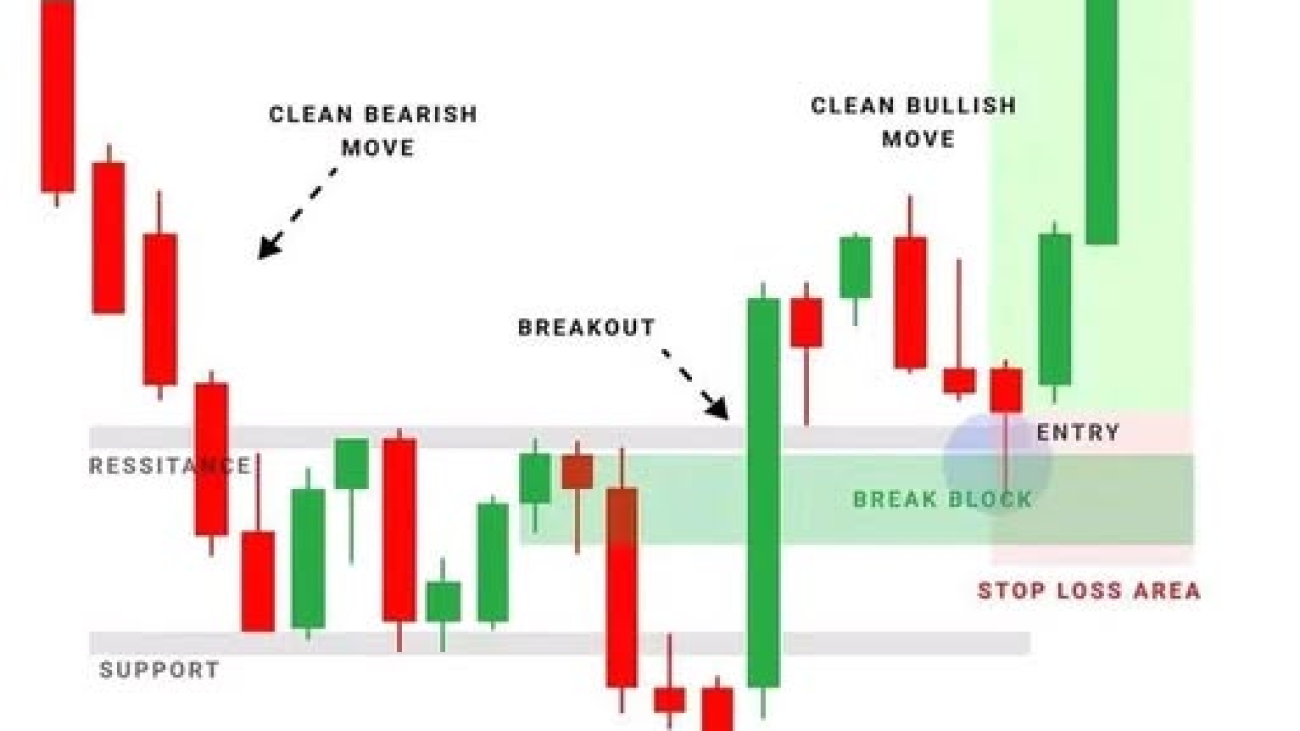
Trading a Breaker Block is an advanced Smart Money Concept (SMC) strategy. It forms when an Order Block fails and price breaks through it — then uses that same zone as support or resistance.

Think of it as a role-reversal institutional zone.

What Is a Breaker Block?

A Breaker Block is:

A former Order Block that gets violated (broken) and then becomes a new reaction zone.

  • Bullish OB broken → becomes Bearish Breaker

  • Bearish OB broken → becomes Bullish Breaker

It shows where smart money trapped traders and flipped direction.

 How To Identify a Breaker Block

 Find a Valid Order Block First

Look for:

  • Last bullish candle before a strong bearish move (Bearish OB)

  • Last bearish candle before a strong bullish move (Bullish OB)

  • Must cause displacement / BOS

Watch for Failure of That OB

A breaker only forms when the OB fails.

Signs of failure:

  • Price closes beyond the OB

  • Liquidity sweep happens first

  • Structure shifts against the OB direction

This traps traders who entered at the OB.

Confirm Break of Structure (BOS)

Structure must break in the new direction.

Example:

  • Bearish OB fails

  • Price breaks prior high Bullish BOS confirms Bullish Breaker

No BOS = no valid breaker.

Mark the Breaker Zone

Mark:

  • The body of the failed OB candle

  • Or full wick-to-body range (advanced traders refine)

This becomes your reaction zone for entry.

 How To Trade a Breaker Block

 Bullish Breaker Trade (Buy Setup)

Step-by-step:

  1. Bearish Order Block forms

  2. Price breaks above it (failure)

  3. Bullish BOS occurs

  4. Price retraces back to the failed OB

  5. Enter buy at breaker zone

Targets:

  • Equal highs

  • Liquidity pools

  • Premium zones

Stop loss:

  • Below breaker low

 Bearish Breaker Trade (Sell Setup)

  1. Bullish Order Block forms

  2. Price breaks below it

  3. Bearish BOS occurs

  4. Price retraces to the failed OB

  5. Enter sell at breaker zone

Targets:

  • Equal lows

  • Sell-side liquidity

Stop loss:

  • Above breaker high

 Entry Confirmation Techniques

Refine entries using:

  • Lower timeframe BOS

  • Fair Value Gap (FVG) inside breaker

  • Liquidity sweep before entry

  • Rejection candles

Aggressive entry → at zone touch
Conservative entry → after LTF structure shift

 Breaker Block vs Order Block

Feature Order Block Breaker Block
Status Valid Failed OB
Direction Original trend Opposite trend
Entry style Reversal Continuation / flip
Reliability High Very high with BOS

 Common Mistakes

❌ Trading breaker without BOS
❌ Marking random candles as OB
❌ Ignoring liquidity sweep
❌ Entering without displacement

 Pro Trading Tips

  • Best breakers form after liquidity sweeps

  • Strongest on HTF (H1–Daily)

  • Combine with Premium/Discount zones

  • London & NY sessions give cleaner reactions

mun

Gold tries to recover before Fed’s minutes

Gold prices rose in European trading on Wednesday for the first time in three sessions, as part of a rebound attempt from a two-week low, supported by buying activity at corrective levels. Those recovery attempts are being capped by the rise of the US dollar in the foreign exchange market.

With the probability of a US interest rate cut in March receding, global money markets are awaiting later today the release of the minutes of the Federal Reserve’s latest meeting, which are expected to contain strong clues about the path of US monetary policy this year.

Price Overview

• Gold prices today: Gold rose by 1.3% to $4,942.30, from an opening level of $4,878.63, and recorded a session low at $4,854.25.

• At Tuesday’s settlement, gold prices fell by about 2.3%, marking the second consecutive daily loss, and hit a two-week low at $4,841.43 per ounce, due to slower safe-haven demand amid positive political developments, in addition to upward pressure from the stronger US dollar.

US Dollar

The dollar index rose by 0.2% on Wednesday, extending gains for the third straight session, and trading near its highest level in about two weeks, reflecting continued strength in the US currency against a basket of major and minor currencies.

As is known, a stronger US dollar makes dollar-denominated gold bullion less attractive to buyers holding other currencies.

This advance comes as investors focus on buying the dollar as one of the best available opportunities in the FX market, especially with rising expectations that US interest rates will remain unchanged through the first half of this year.

US Interest Rates

• Chicago Federal Reserve President Austan Goolsbee said on Friday that interest rates may decline, but noted that inflation in the services sector remains elevated.

• Goolsbee said on Tuesday that the Federal Reserve could approve “several” additional rate cuts this year if inflation resumes its decline toward the central bank’s 2% target.

• According to the CME FedWatch tool, pricing for keeping US interest rates unchanged at the March meeting is steady at 90%, while the probability of a 25 basis point rate cut is priced at 10%.

• To reprice those probabilities, investors are awaiting later today the release of the minutes of the Federal Reserve’s latest monetary policy meeting.

Gold Performance Outlook

Senior analyst at Reliance Securities, Jigar Trivedi, said that overall gold prices are expected to range between $4,700 and $5,100 throughout the year.

SPDR Fund

Holdings of the SPDR Gold Trust, the largest gold-backed ETF in the world, fell on Tuesday by about 1.43 metric tons, bringing the total down to 1,075.61 metric tons, the lowest level since January 15.


Untitled

Kiwi skids to two-week trough after RBNZ decision

The New Zealand dollar declined broadly in Asian trading on Wednesday against a basket of major and minor currencies, hitting a two-week low versus its US counterpart, due to heavy selling after the results of the first Reserve Bank of New Zealand monetary policy meeting of 2026.

In line with expectations, the New Zealand central bank kept interest rates unchanged at their lowest level in three and a half years, and signaled the need to keep monetary policy accommodative to support the country’s economic recovery.

The Reserve Bank of New Zealand’s comments were less hawkish than markets had expected, which lifted the probability of a 25 basis point New Zealand rate cut at the upcoming April meeting.

Price overview

• New Zealand dollar price today: The New Zealand dollar fell against the US dollar by about 0.9% to 0.5996, the lowest level since February 6, from the day’s opening level at 0.6049, and recorded a session high at 0.6053.

• The New Zealand dollar ended Tuesday’s session up about 0.3% against the US dollar, marking its second gain in the past three days, within a narrow trading range.

Reserve Bank of New Zealand

The Reserve Bank of New Zealand (RBNZ) on Wednesday left the benchmark interest rate unchanged at 2.25%, the lowest level since July 2022, in line with most global market expectations.

The New Zealand central bank holds interest rates at their lowest level in 3.5 years.

The RBNZ confirmed that monetary policy needs to remain accommodative for some time to support the weak economic recovery, and that consumer inflation is expected to return to the target range of 1%–3% in the coming months if conditions evolve as expected.

Updated economic projections from the New Zealand central bank indicate the possibility of starting a gradual normalization cycle (rate hikes) by the fourth quarter of 2026 or early 2027, later than some had anticipated.

The RBNZ expects the official cash rate to reach 2.50% in March 2027 versus 2.75% in its previous projections.

New Zealand interest rates

• Following the meeting above, pricing for a 25 basis point New Zealand rate cut at the April 8 meeting rose to above 80%.

• To reprice those expectations, investors will monitor a series of key economic data from New Zealand in the coming period, including inflation, unemployment, and economic growth figures

sterling

Sterling trades near four-week trough before UK inflation data

The British pound declined in European trading on Wednesday against a basket of global currencies, extending its losses for the third straight day versus the US dollar, and heading toward testing a four-week low, as investors focused on buying the US currency as the most attractive available investment.

Gloomy data on the UK labor market increased the probability that the Bank of England will cut British interest rates next March. To reprice those expectations, investors are awaiting the release later today of the main UK inflation data for January.

Price overview

• British pound price today: The pound fell against the dollar by more than 0.1% to $1.3550, from the opening level at $1.3565, and recorded a session high at $1.3573.

• On Tuesday, the pound lost 0.45% against the dollar, marking its second consecutive daily loss, and hit a four-week low at $1.3496, due to UK labor market data.

US dollar

The dollar index rose by 0.1% on Wednesday, maintaining gains for the third straight session, and trading near its highest level in nearly two weeks, reflecting continued strength in the US currency against a basket of major and minor currencies.

This rise comes as investors focus on buying the dollar as one of the best available opportunities in the foreign exchange market, especially with growing expectations that the Federal Reserve will keep interest rates unchanged during the first half of this year.

To reprice those expectations, investors await later today the release of the minutes of the Federal Reserve’s latest meeting, which are expected to include strong clues about the future path of US monetary policy.

British interest rates

• Data released yesterday in the United Kingdom showed the unemployment rate rising to its highest level in about ten years in December, alongside a larger-than-expected increase in jobless claims in January.

• Following those data, pricing for a 25 basis point Bank of England rate cut at the March meeting rose from 60% to 85%.

UK inflation data

To reprice current expectations around British interest rates, investors are waiting later today for the release of the main UK inflation data for January, which are expected to have a strong impact on the Bank of England’s monetary policy path.

At 07:00 GMT, headline CPI is expected to rise by 3.0% year-on-year in January, down from 3.4% in December, while core CPI is expected to rise by 3.0% year-on-year from 3.2% in the previous reading.

Outlook for the British pound

We expect here at FX News Today that if UK inflation data come in below market expectations, the probability of a Bank of England rate cut in March will increase, which would lead to further negative pressure on British pound levels.