Untitled

EUR/USD: Interim downside pressure – OCBC

Euro (EUR) continued to drift lower amid broad US Dollar (USD) rebound. Pair was last at 1.1250 levels, OCBC’s FX analysts Frances Cheung and Christopher Wong note.

Alternative reserve currencies including the EUR may benefit

“Daily momentum is not showing a clear bias now while RSI fell. On price action, rising wedge pattern is playing out — typically associated with a bearish reversal. Support at 1.1235 (23.6% fibo retracement of 2025 low to high) and 1.1180 (50 DMA). Resistance at 1.1420/30 levels.”

“A potential deal between EU-US may lead to EUR backing off from its recent highs in the near term. But more importantly, if the ‘sell USD’ trade remains alive amid diversification flows, alternative reserve currencies including the EUR may benefit.”

Untitled

EUR/USD holds losses near 1.1250 on firmer US Dollar

EUR/USD consolidates losses near 1.1250 in early Europe on Thursday. The pair bears the brunt of the renewed US Dollar demand, spurred by a US court’s ruling to block Trump’s reciprocal tariffs and cautious Fed Minutes. The focus now remains on the mid-tier US data and Fedspeak for further impetus.

The Relative Strength Index (RSI) indicator on the 4-hour chart stays slightly above 40 after recovering from near-30, suggesting that the bearish bias remains intact.

EUR/USD faces a pivot level at 1.1270, where the 100-period Simple Moving Average (SMA) and the Fibonacci 38.2% retracement of the latest uptrend align. In case the pair fails to stabilize above this level, technical sellers could remain interested. In this scenario, 1.1180 (Fibonacci 50% retracement) could be seen as the next support level before 1.1080 (Fibonacci 61.8% retracement).

On the upside, 1.1315 (200-period SMA) could be seen as the next resistance level ahead of 1.1380 (Fibonacci 23.6% retracement) and 1.1430 (static level).

EUR/USD came under renewed selling pressure and dropped to its weakest level in over a week near 1.1200 in the Asian session on Thursday. Although the pair erased a large portion of its daily losses, it could have a difficult time extending its rebound in the second half of the day.

The US Dollar (USD) gathered strength in the late American session on Wednesday and continued to outperform its rivals early Thursday on easing fears over United States (US) President Donald Trump’s trade policy causing an economic downturn.

The Court of International Trade announced late Wednesday that President Trump’s reciprocal tariffs will be blocked from going into effect, explaining that Trump overstepped his authority by imposing across-the-board duties on imports from the US’ trading partners, per Reuters. The USD Index, which tracks the USD’s valuation against a basket of six major currencies, shot higher with the immediate reaction to this development. Meanwhile, US stock index futures gathered bullish momentum and were last seen rising between 1.4% and 2.1%.

The US Bureau of Economic Analysis will release its second estimate of the annualized Gross Domestic Product (GDP) growth for the first quarter later in the day. A positive revision to the initial estimate, which showed a contraction of 0.3%, could help the USD hold its ground and cause EUR/USD to turn south. Additionally, weekly Initial Jobless Claims will be featured in the US economic calendar.

In case Wall Street’s main indexes rally after the opening bell on improving sentiment around the US economic outlook, investors are likely to refrain from betting on an extended rebound in EUR/USD.

China-US trade talks: The art of the deal – Standard Chartered

China-US trade talks: The art of the deal – Standard Chartered

Our baseline scenario is that US tariffs on China will likely stay around current levels after the 90-day truce. The tit-for-tat tariff war in April and subsequent truce indicate more caution on both sides. Even in case of aggressive tariff re-escalation, exemptions will likely be considered to mitigate business impact, Standard Chartered’s economists note.

What can we expect at the end of the 90-day truce?

“The trade trajectory following the end of the US-China 90-day tariff truce remains uncertain. Our baseline assumption is that the truce will likely be extended further and that average tariff levels may remain around current rates (see Figure 1). This approach would allow the continued flow of bilateral trade between the two nations and buy more time for negotiations on more complex and contentious issues.”

“We believe the worst of tariff headlines is behind us, and our baseline assumes limited room for further tariff hikes from current levels in 2025. The tit-for-tat trade war in April and subsequent sharp reduction in bilateral tariffs in May indicate more caution on future tariff action from both the US and China. In addition, there are plenty of unresolved issues on the table, including existing bilateral tariffs, non-tariff barriers, and the exchange rate. Furthermore, the US may be prioritising negotiations with other trade partners, with the 90-day tariff pause on other countries ending one month earlier than with China. Taking all of these factors into consideration, 90 days are likely not enough for the two countries to conclude a comprehensive deal; we, therefore, expect the tariff truce to be extended to allow for continued negotiations.”

“With our baseline assumption on tariffs, we maintain our 2025 GDP growth forecast at 4.8%. China’s existing stimulus package is likely to largely offset the tariff impact. However, if the US hikes tariffs much higher than our baseline assumption, imposes other significant non-tariff measures against China, or if China’s housing market and consumption recovery falls short of expectations, additional fiscal support will likely be rolled out to prevent GDP growth from undershooting the growth target significantly.”

Untitled

USD/CAD extends gains above 1.3800 with all eyes on the FOMC minutes

The US Dollar is showing a moderate advance on Wednesday, extending gains after Tuesday’s rebound. Upbeat US Consumer Confidence data and easing fears about trade wars are supporting the Greenback, with the release of the Fed minutes on focus.

The Conference Board’s Consumer Confidence reading beat expectations on Wednesday with a 12.3 point rebound to a 98.0 reading, after having deteriorated steadily during the last five months, on the back of tariff uncertainty.

Upbeat US data sends debt fears to the background

The same survey revealed improving expectations on income, business conditions, and employment, while the percentage of consumers fearing an economic recession in the next 12 months declined, compared to the previous month.

These figures offset a significant decline in US Durable Goods orders, which fell by 6.3% in April, on the back of lower demand for aircraft. Likewise, the risk-on sentiment pushed government debt fears to the back seat, at least for now.

The Canadian Dollar, on the other hand, remains on the defensive, with Oil prices ticking lower, weighed by expectations that OPEC+ countries will increase supply from July. Furthermore, last week’s data strengthened the case for further BoC easing in June, adding selling pressure on the Loonie.

Today, the focus is on the minutes of the latest Fed meeting, which are expected to shed some more light on the bank’s upcoming monetary policy decisions. The tone of the minutes is likely to determine the US Dollar’s reaction until Friday’s PCE inflation release.

Untitled

AUD/JPY falls below 93.00, downside seems limited as Japan considers debt issuance changes

AUD/JPY halts its three-day winning streak, trading around 92.90 during the European hours on Wednesday. The currency cross depreciates as the Japanese Yen (JPY) gains ground, possibly driven by the expectations that the Bank of Japan (BoJ) will continue raising interest rates amid the broadening inflation in Japan.

However, the AUD/JPY may regain its ground as the Japanese Yen may struggle again as Japan signaled potential cuts in government debt issuance. On Monday, Japan’s Ministry of Finance asked for feedback from market participants on bond issuance and the current market situation, according to Bloomberg.

On Tuesday, Reuters reported that Japan’s Ministry of Finance will consider reducing its super-long bond issuance to adjust the composition of its bond program for the current fiscal year. On Wednesday, Japan’s Finance Minister Shunichi Kato said that the government is concerned about the recent spike in yields and will closely monitor bond market situations.

The AUD/JPY cross also faced challenges as the Australian Dollar (AUD) struggled despite a higher-than-expected Monthly Consumer Price Index (CPI) release on Wednesday. The Australian Bureau of Statistics reported that monthly inflation, in the price of a fixed basket of goods and services acquired by household consumers, remained steady at a 2.4% increase year-over-year in April, higher than the expected 2.3% rise.

National Australia Bank (NAB) anticipates that the Reserve Bank of Australia (RBA) may adopt a less dovish stance and expects the central bank to return the cash rate to a neutral stance over the coming months. However, the NAB has lifted terminal rate expectation to 3.1% from the previous 2.6%.

Untitled

European Gas rally pauses amid Norwegian outages – ING

The rally in European natural gas took a breather yesterday, with the Title Transfer Facility (TTF) settling 0.66% lower on the day, ING’s commodity experts Ewa Manthey and Warren Patterson note.

TTF slips as storage builds, JKM spread narrows

“Some weakness in the JKM-TTF spread is dragging TTF lower. Meanwhile, outages in Norway have led to lower gas flows to Europe over the last week. The Troll field had power-related issues following maintenance last week; the outage might persist until this weekend.”

“EU gas storage continues to tick higher, standing at just under 47% full, down from 69% at the same stage last year and below the 5-year average of 58% full.”

Untitled

Gold price holds above $3,300, upside seems capped amid modest USD strength, ahead of FOMC Minutes

Gold price (XAU/USD) attracts some dip-buyers on Wednesday and reverses a part of the previous day’s heavy losses, though it lacks bullish conviction amid mixed cues. The uncertainty surrounding US President Donald Trump’s trade tariffs, US fiscal concerns, and geopolitical risks keep a lid on the market optimism, which, in turn, revive demand for the safe-haven bullion. Apart from this, bets that the Federal Reserve (Fed) will cut rates further in 2025 act as a tailwind for the non-yielding yellow metal.

Meanwhile, Tuesday’s better-than-expected US economic releases assist the US Dollar (USD) to gain positive traction for the second straight day. This, along with a generally positive tone around the equity markets, contributes to capping gains for the Gold price. Traders also seem reluctant to place aggressive directional bets around the XAU/USD pair and now look to FOMC Minutes for some meaningful impetus. This, in turn, warrants some caution before positioning for the resumption of the recent uptrend.

Gold price bounces off 200-SMA pivotal support on H4; not out of the woods yet
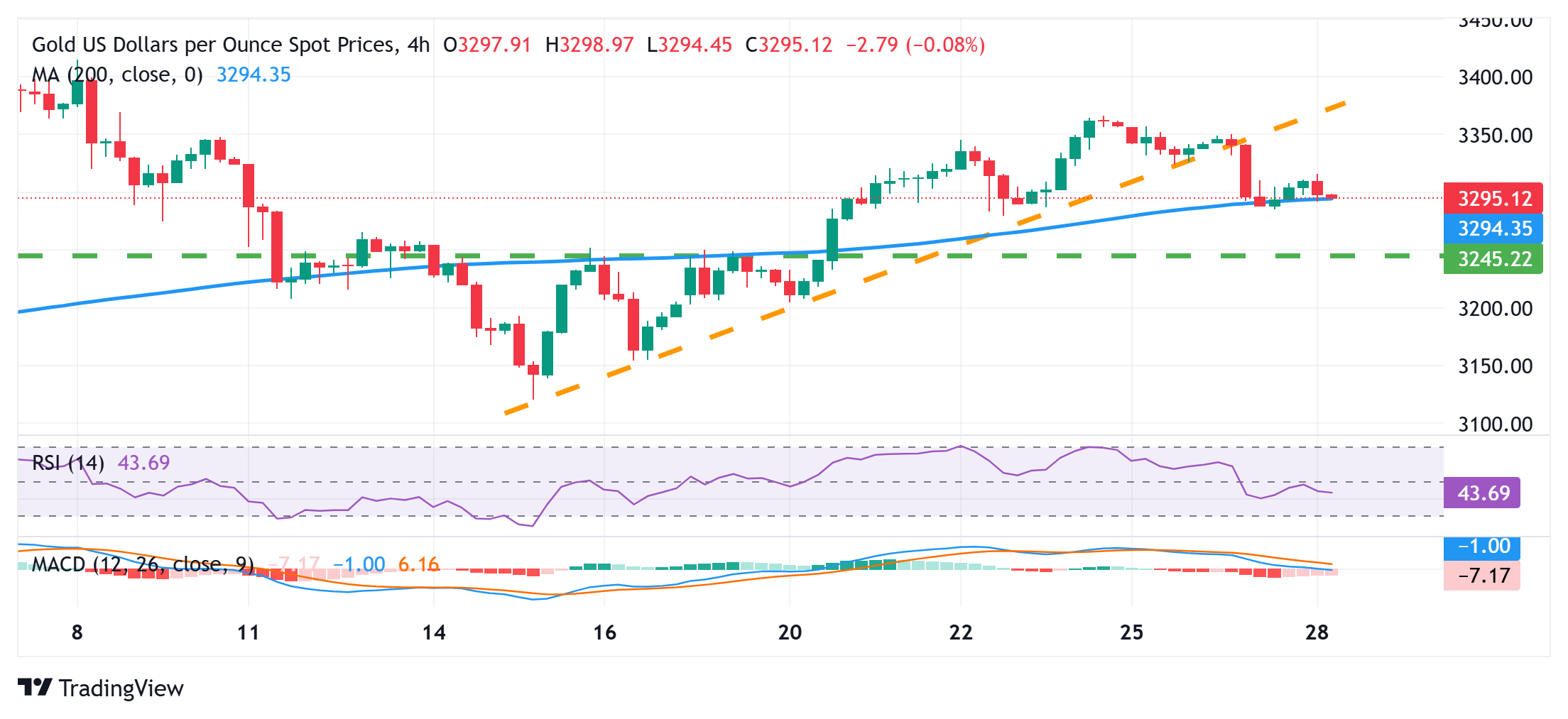
From a technical perspective, the overnight breakdown through a short-term ascending trend line was seen as a key trigger for bearish traders. Some follow-through selling below the 200-period Simple Moving Average (SMA) and acceptance below the $3,300 mark will reaffirm the negative bias. However, oscillators on the daily chart – though they have been losing traction – are yet to confirm the negative outlook. Hence, any subsequent fall could attract some buyers and find decent support near the $3,250-3,245 horizontal zone. The latter should act as a pivotal point, which if broken would set the stage for a further near-term depreciating move for the Gold price.

On the flip side, momentum beyond the Asian session peak, around the $3,315-3,316 area, now seems to confront some hurdle near the $3,340-3,345 region. The latter coincides with the ascending trend-line breakpoint, above which a fresh bout of a short-covering could lift the Gold price to over a two-week high, around the $3,365-3,366 zone touched last Friday. The subsequent move up should allow the XAU/USD pair to reclaim the A sustained strength beyond would be seen as a fresh trigger for bulls and should allow the Gold price to reclaim the $3,400 mark and climb further to the next relevant barrier near the $3,465-3,470 zone.


Untitled

GBP a relative outperformer despite softer CBI data – Scotiabank

Pound Sterling (GBP) is soft, down 0.15% against the US Dollar (USD) while showing relative outperformance against the G10 currencies, Scotiabank’s Chief FX Strategist Shaun Osborne notes.

Trend for GBP/USD is bullish

“Domestic data were weak, with CBI reported sales figures for May reflecting a sizeable deterioration. The near-term data release calendar remains limited and rate expectations remain steady, with markets pricing a minimal chance of a 25bpt cut in June and 39bpts of easing by December.”

“The trend for GBP/USD is bullish, given the sequence of higher lows and higher highs, as well as the recent push to fresh multiyear highs. The momentum indicators are bullish, providing confirmation to the moves in the spot, and the RSI’s current reading of 64 leaves ample space for further upside. We look to near-term support at 1.35 and near-term resistance at 1.36.”

eurozone-02_Small

Oil prices remain stable: Possible production increases here and sanctions policy there – Commerzbank

The oil market is showing strength ahead of the OPEC+ meeting and the production decision due on Saturday by the eight cartel members who voluntarily cut production and are now considering a further significant withdrawal of these cuts in July, Commerzbank’s commodity analyst Barbara Lambrecht notes.

Brent crude oil prices fall

“A barrel of Brent crude oil cost $65 again yesterday, although trading was thinner due to public holidays in the US and the UK. The strength is likely due to relief that the threat of new US tariffs against the EU has been postponed for the time being. However, many uncertainties remain, especially with regard to (US) sanctions policy.”

“On the one hand, there are the nuclear negotiations between the US and Iran. Although these were so far inconclusive, both sides remained optimistic after the fifth round of talks and want to meet again in the near future. A possible easing of sanctions against Iran therefore remains on the table.”

“On the other hand, however, the mood between Russian President Putin and US President Trump has deteriorated: following Russia’s massive attacks on Ukraine, Trump has reiterated that he will absolutely consider new sanctions against Russia. Russia, however, seems keen to play down Trump’s reaction.”

Untitled

EUR/CAD hesitates above 1.5600 with higher Oil prices supporting the loonie

The Euro is trading without a clear direction, as the enthusiasm of the delay on Trump’s 50% tariffs wears out, while the moderate rebound on Oil prices is providing some support to the loonie.

The pair has been losing momentum after hitting one-month highs, right above 1.5750 last week, yet with downside attempts contained above 1.5880 so far.

Mixed Eurozone data and dovish comments from ECB’s Villeroy

In the macroeconomic domain, Eurozone data has been mixed. The German GFK consumer Confidence Index remained at downbeat levels, while the Eurozone Economic Sentiment and Industrial Confidence figures have shown a moderate improvement.

Earlier today, ECB’s Villeroy struck a dovish tone, noting that there is still room for further monetary easing and warning about the potential impact of a trade war on the Eurozone’s financial stability and economic growth prospects.

The Canadian Dollar, on the other hand, is firming up on the back of a moderate pickup in Oil prices.

Beyond that, the positive Retail Sales data released on Friday has eased concerns triggered by the weak employment figures seen earlier this month, and prompted investors to dial back BoC easing expectations for next month.

Canadian Dollar PRICE Today

The table below shows the percentage change of Canadian Dollar (CAD) against listed major currencies today. Canadian Dollar was the strongest against the New Zealand Dollar.

USD EUR GBP JPY CAD AUD NZD CHF
USD 0.34% 0.17% 0.71% 0.19% 0.65% 0.77% 0.60%
EUR -0.34% -0.18% 0.36% -0.14% 0.22% 0.34% 0.24%
GBP -0.17% 0.18% 0.57% 0.03% 0.38% 0.51% 0.38%
JPY -0.71% -0.36% -0.57% -0.48% -0.06% -0.00% -0.10%
CAD -0.19% 0.14% -0.03% 0.48% 0.43% 0.49% 0.35%
AUD -0.65% -0.22% -0.38% 0.06% -0.43% 0.03% -0.10%
NZD -0.77% -0.34% -0.51% 0.00% -0.49% -0.03% -0.16%
CHF -0.60% -0.24% -0.38% 0.10% -0.35% 0.10% 0.16%

The heat map shows percentage changes of major currencies against each other. The base currency is picked from the left column, while the quote currency is picked from the top row. For example, if you pick the Canadian Dollar from the left column and move along the horizontal line to the US Dollar, the percentage change displayed in the box will represent CAD (base)/USD (quote).