Pound Sterling grips gains against US Dollar as investors doubt US economic strength

Pound Sterling grips gains against US Dollar as investors doubt US economic strength

The Pound Sterling (GBP) clings to gains slightly above 1.2900 against the US Dollar (USD) in Monday’s European session. The GBP/USD pair strengthens as the US Dollar struggles to gain ground amid growing concerns over the United States (US) economic outlook. The US Dollar Index (DXY), which tracks the Greenback’s value against six major currencies, trades cautiously near the four-month low of 103.50.

Market participants have become increasingly worried over US economic prospects after comments from US President Donald Trump on Friday indicated that his “American First” policies could lead to economic turbulence in the near term.

US President Trump refrained from guiding the impact of his policies on the economy but said in the interview with Fox News that there is a “period of transition”, because what we are doing is very “big”. His comments came after being asked whether his policies could lead to a recession in the economy.

Donald Trump reiterated that reciprocal tariffs will be announced on April 2. Last week, Trump imposed 25% tariffs on imports from Canada and Mexico but exempted many products that come under the purview of the United States-Mexico-Canada Agreement (USMCA) for a month. He also increased surcharges on Chinese imports to 20% by imposing an additional 10%.

Market experts continue to believe that Trump’s tariff policies would be inflationary for the economy, but they have changed their perception of its impact on the economic outlook. At one point when Trump’s agenda was expected to accelerate economic expansion, it is now anticipated to fracture the economy. This has led to global brokerages revising their growth forecasts for the US economy. Goldman Sachs has downgraded its Q4 2025 Gross Domestic Product (GDP) growth forecast to 1.7%, from 2.2% previously anticipated, and raised its 12-month recession probability to 20% from 15%.

Investors also expect the Federal Reserve (Fed) would be forced to resume the policy-easing cycle as early as June. However, Fed Chair Jerome Powell reiterated in an economic forum at the University of Chicago Booth School on Friday that the interest rate policy is in “good shape” and the central bank wants clarity on Trump’s policies before making any monetary policy adjustment.

Technical Analysis: Pound Sterling stays above 200-day EMA
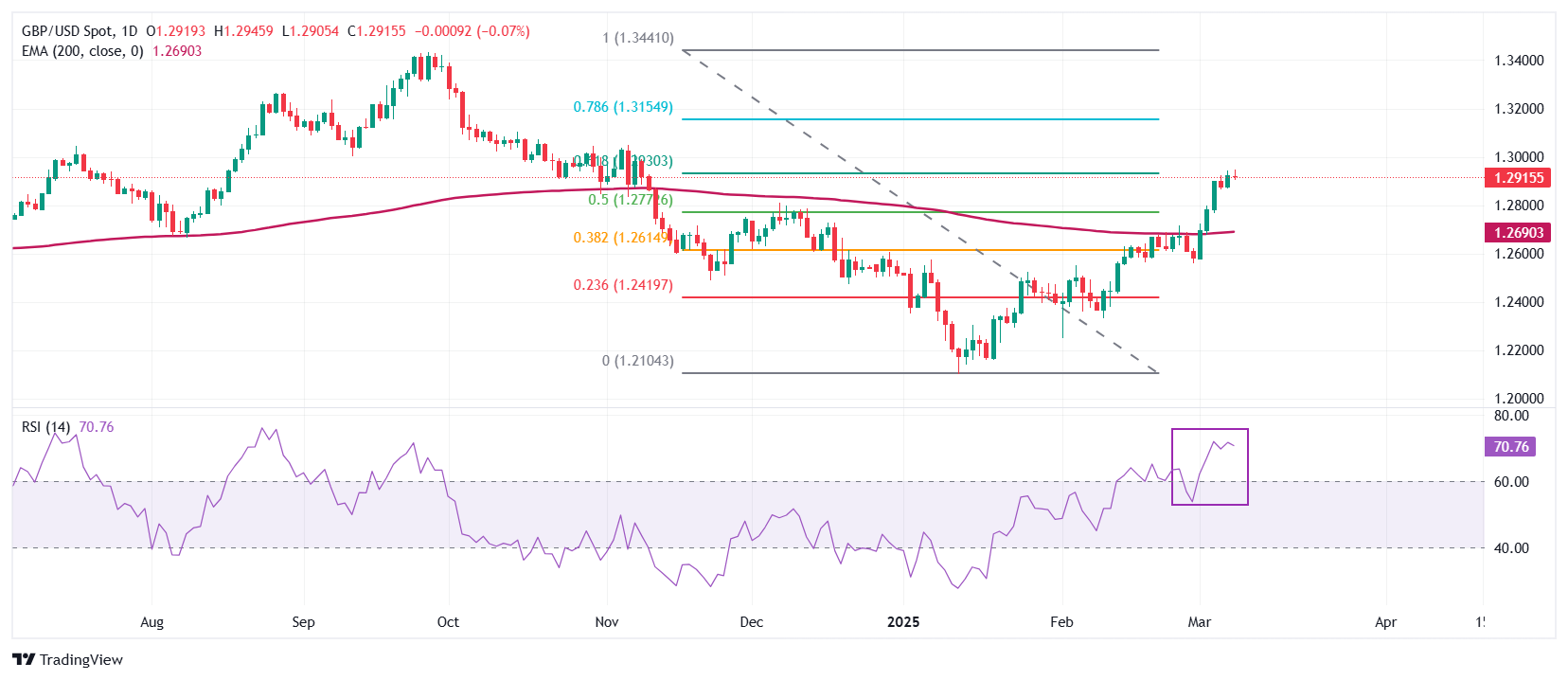
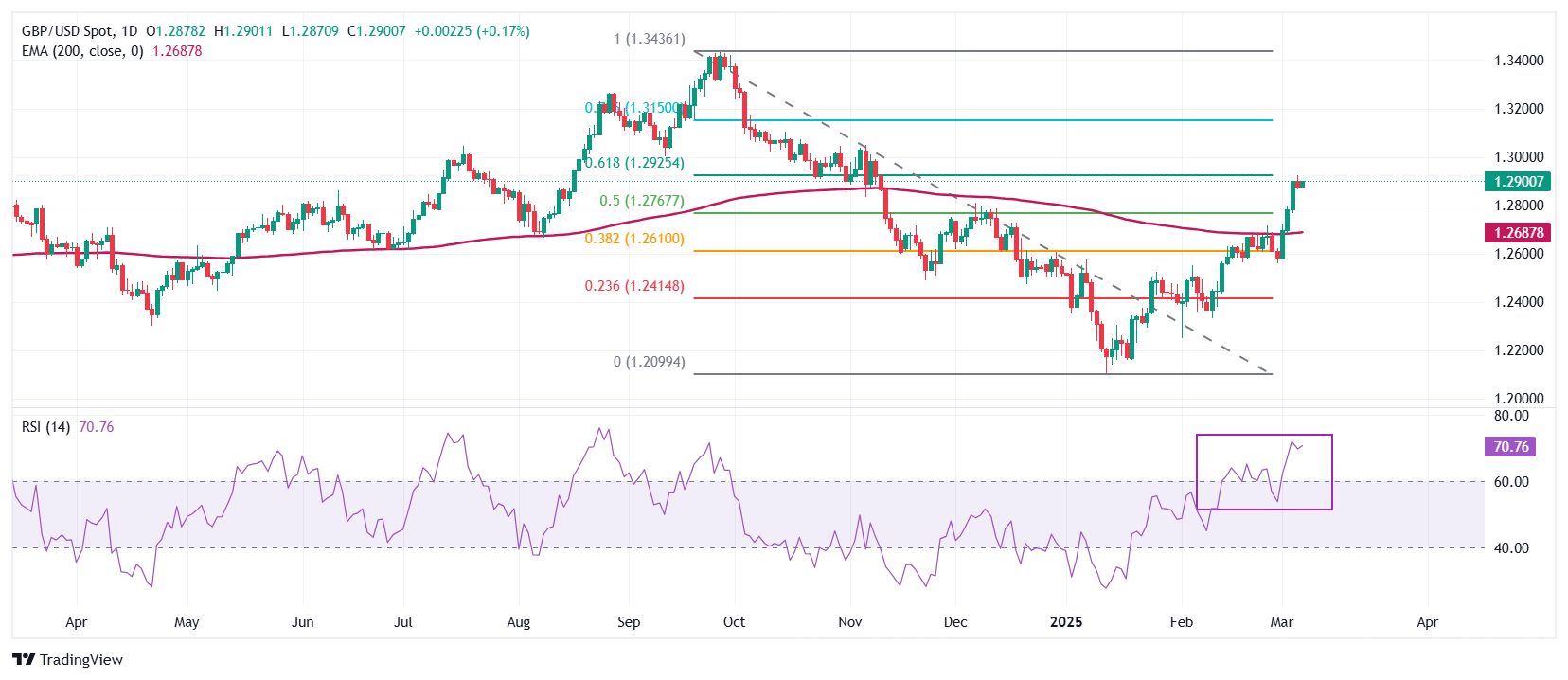
The Pound Sterling strives to break above the 61.8% Fibonacci retracement plotted from the late September high to mid-January low around 1.2930 on Friday. The long-term outlook of the GBP/USD pair has turned bullish as it holds above the 200-day Exponential Moving Average (EMA), which is around 1.2690.

The 14-day Relative Strength Index (RSI) climbs above 70.00, suggesting a strong bullish momentum.

Looking down, the 50% Fibo retracement at 1.2767 and the 38.2% Fibo retracement at 1.2608 will act as key support zones for the pair. On the upside, the psychological 1.3000 level will act as a key resistance zone.


mmty

US: An underwhelming jobs report with government shrinkage featuring in Feb payrolls

The latest US Employment Situation report by the Bureau of Labor Statistics (BLS) last Fri (7 Mar) was weaker than expected as jobs creation came in below projections with a surprise uptick in the unemployment rate while wage growth was within estimates, UOB Group’s Senior Economist Alvin Liew notes.

US reports a slightly weaker-than-expected jobs creation

“The US reported a slightly weaker-than-expected jobs creation at 151,000 in Feb (versus Bloomberg est 160,000) while unemployment rate also surprised with an uptick to 4.1% (from 4.0% in January). Job creation was still broad-based, but surprisingly, professional services and leisure recorded back-to-back losses, while government hiring slowed visibly as BLS reported that federal employment fell by -10,000 in February.”

Untitled

Gold price slips below $2,900 as USD rebounds from multi-month low

Gold price (XAU/USD) slips below the $2,900 mark during the first half of the European session on Monday and moves back closer to the lower end of a nearly one-week-old trading range. As investors look past Friday’s weaker US jobs report, the US Dollar (USD) stages a modest bounce from its lowest level since November and turns out to be a key factor undermining the precious metal.

However, bets that the Federal Reserve (Fed) will cut interest rates multiple times this year and a steep intraday decline in the US Treasury bond yields might hold back the USD bulls from placing fresh bets. Furthermore, worries about the economic fallout from US President Donald Trump’s trade tariffs and global trade war fears could offer some support to the safe-haven Gold price and help limit losses.

Gold price could accelerate the intraday slide once the trading range support, around the $2,893 area is broken decisively

fxsoriginal

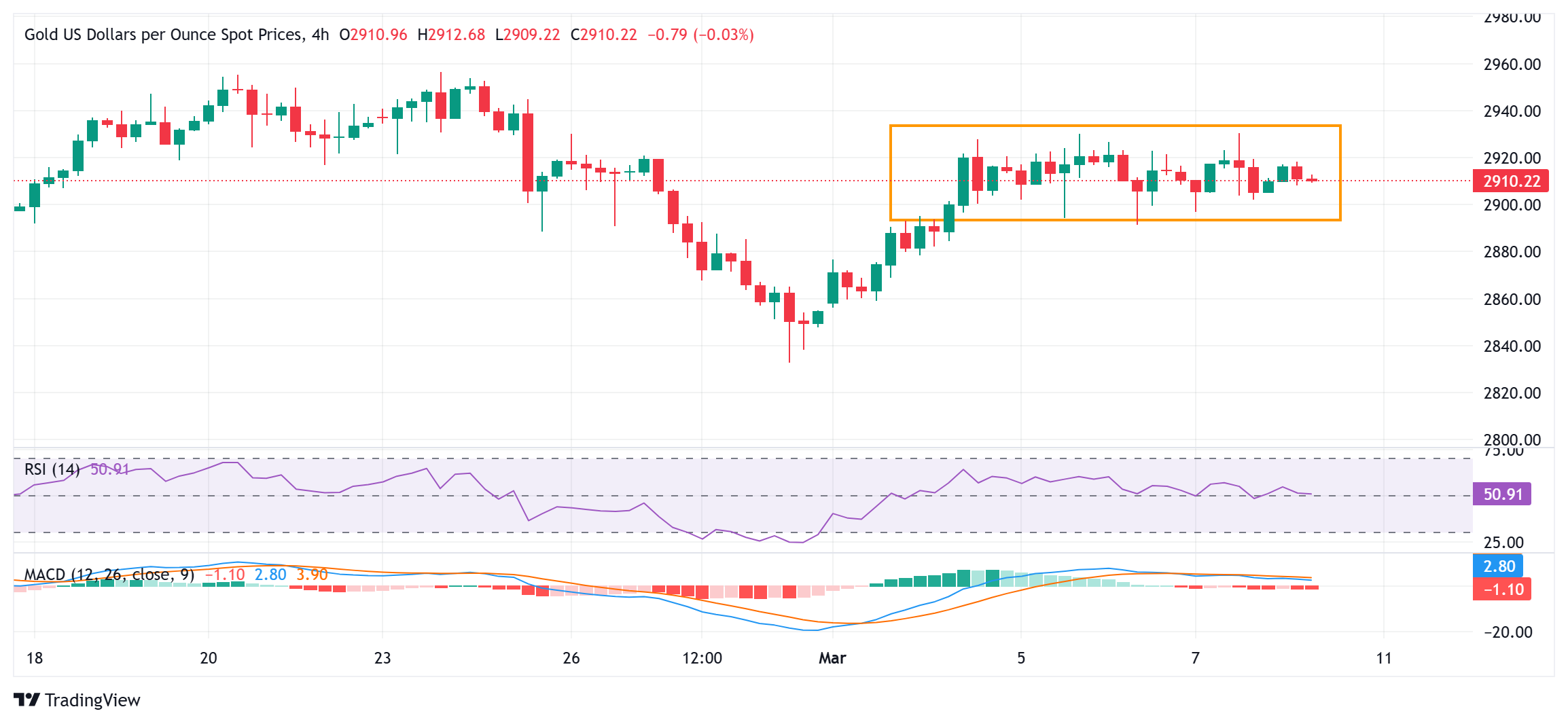
From a technical perspective, the Gold price has been showing some resilience below the $2,900 mark. Moreover, oscillators on the daily chart – though they have been losing traction – are still holding in positive territory. That said, the recent repeated failures to make it through the $2,925-2,930 supply zone make it prudent to wait for strong follow-through buying before placing fresh bullish bets. The XAU/USD might then aim to challenge the all-time peak, around the $2,956 region touched on February 24.

On the flip side, acceptance below the $2,900-2,895 horizontal zone might prompt some technical selling and drag the Gold price to the $2,860-2,858 horizontal zone. The downward trajectory could extend further towards the February 28 swing low, around the $2,833-2,832 area, before the XAU/USD eventually drops to the $2,800 round-figure mark.

arr

NZD/USD: Set to trade in a range of 0.5710/0.5760

Further range trading in New Zealand Dollar (NZD) vs US Dollar (USD) seems likely; probably in a range of 0.5710/0.5760. In the longer run, current price movements are likely part of a recovery phase that could reach 0.5775, UOB Group’s FX analysts Quek Ser Leang and Peter Chia note.

Current price movements are likely part of a recovery phase

24-HOUR VIEW: “While we expected NZD to ‘rise further’ yesterday, we indicated that ‘overbought conditions suggest the major resistance at 0.5775 is out of reach for now.’ However, NZD did not quite ‘rise further,’ as it traded in a higher range of 0.5721/0.5760, closing modestly higher by 0.13% at 0.5734. Further range trading seems likely today, probably in a range of 0.5710/0.5760.”

1-3 WEEKS VIEW: “Our update from yesterday (06 Mar, spot at 0.5720) remains valid. As highlighted, the ‘current price movements are likely part of a recovery phase that could reach 0.5775.’ Our view will be invalidated if NZD breaks below 0.5660 (‘strong support’ level was at 0.5640 yesterday).”

usdchef

Pound Sterling gains further against US Dollar ahead of US NFP report

The Pound Sterling (GBP) refreshes an almost four-month high near 1.2930 against the US Dollar (USD) in the European trading session on Friday. The GBP/USD pair exhibits strength ahead of the United States (US) Nonfarm Payrolls (NFP) report for February, which will be published at 13:30 GMT.

Investors will pay close attention to the US official employment report as it will influence market expectations for the Federal Reserve’s (Fed) monetary policy outlook. Economists expect the US economy to have added 160K fresh workers, higher than 143K recorded in January. The Unemployment Rate is seen steady at 4%.

Market participants will also focus on the US Average Hourly Earnings data, a key measure of wage growth, which is anticipated to have risen steadily by 4.1% year-over-year. On month, the wage growth measure is estimated to have grown by 0.3%, slower than the 0.5% growth seen in January.

Signs of strong labor demand and wage growth momentum would boost expectations that the Fed will keep interest rates in the current range of 4.25%-4.50% for longer. On the contrary, soft numbers would diminish them. According to the CME FedWatch tool, the central bank is almost certain to keep borrowing rates unchanged in the March meeting, but there is a 50% chance that it could cut them in May.

On Thursday, Atlanta Fed Bank President Raphael Bostic said at an event hosted by the Birmingham Business Journal that interest rates should stay in their current range before late spring or summer amid uncertainty over the economy due to US President Donald Trump’s economic agenda. Bostic warned that Trump’s tariffs could fuel inflationary pressures.

Technical Analysis: Pound Sterling aims to break above above 61.8% Fibo retracement at 1.2930

The Pound Sterling gathers strength to break above the 61.8% Fibonacci retracement plotted from the late September high to mid-January low around 1.2930 on Friday. The long-term outlook of the GBP/USD pair has turned bullish as it holds above the 200-day Exponential Moving Average (EMA), which is around 1.2688.

The 14-day Relative Strength Index (RSI) climbs above 60.00, suggesting a strong bullish momentum.

Looking down, the 50% Fibo retracement at 1.2767 and the 38.2% Fibo retracement at 1.2608 will act as key support zones for the pair. On the upside, the psychological 1.3000 level will act as a key resistance zone.
EUR/USD advances as US Dollar slumps ahead of US NFP

EUR/USD advances as US Dollar slumps ahead of US NFP

EUR/USD jumps above 1.0850 in Friday’s European session and revisits a four-month high. The major currency pair exhibits strength as the US Dollar (USD) weakens ahead of the United States (US) Nonfarm Payrolls (NFP) data for February, which will be published at 13:30 GMT. The US Dollar Index (DXY), which tracks the Greenback’s value against six major currencies, extends its losing streak for the fifth trading day and slumps to a four-month low of around 103.60.

The Greenback has remained on the backfoot as investors have become increasingly concerned over the United States (US) economic outlook due to uncertainty over President Donald Trump’s tariff agenda. Market participants believe that the pressure of higher tariffs will be borne by US importers, who would pass on the impact to consumers. Such a scenario would diminish their purchasing power and, eventually, the domestic demand.

On Thursday, Trump announced tariff relaxations on a number of products, which come under the purview of the United States-Mexico-Canada Agreement (USMCA) until April 2, the same day when he is expected to introduce reciprocal tariffs. The US President imposed 25% levies on Canada and Mexico on Tuesday but provided a one-month exemption on automobiles after discussing with the big three US carmakers on Wednesday.

The US NFP report is expected to show that the economy added 160K fresh workers, higher than the 143K recorded in January. The Unemployment Rate is seen steady at 4%. Meanwhile, Average Hourly Earnings, a key measure of wage growth, is anticipated to have risen steadily by 4.1% year-on-year. Month-on-month wage growth measure is estimated to have grown at a slower pace of 0.3%, compared to 0.5% in January. The official labor market data will significantly influence market expectations for the Federal Reserve’s (Fed) monetary policy outlook.

Technical Analysis: EUR/USD rallies above 1.0850

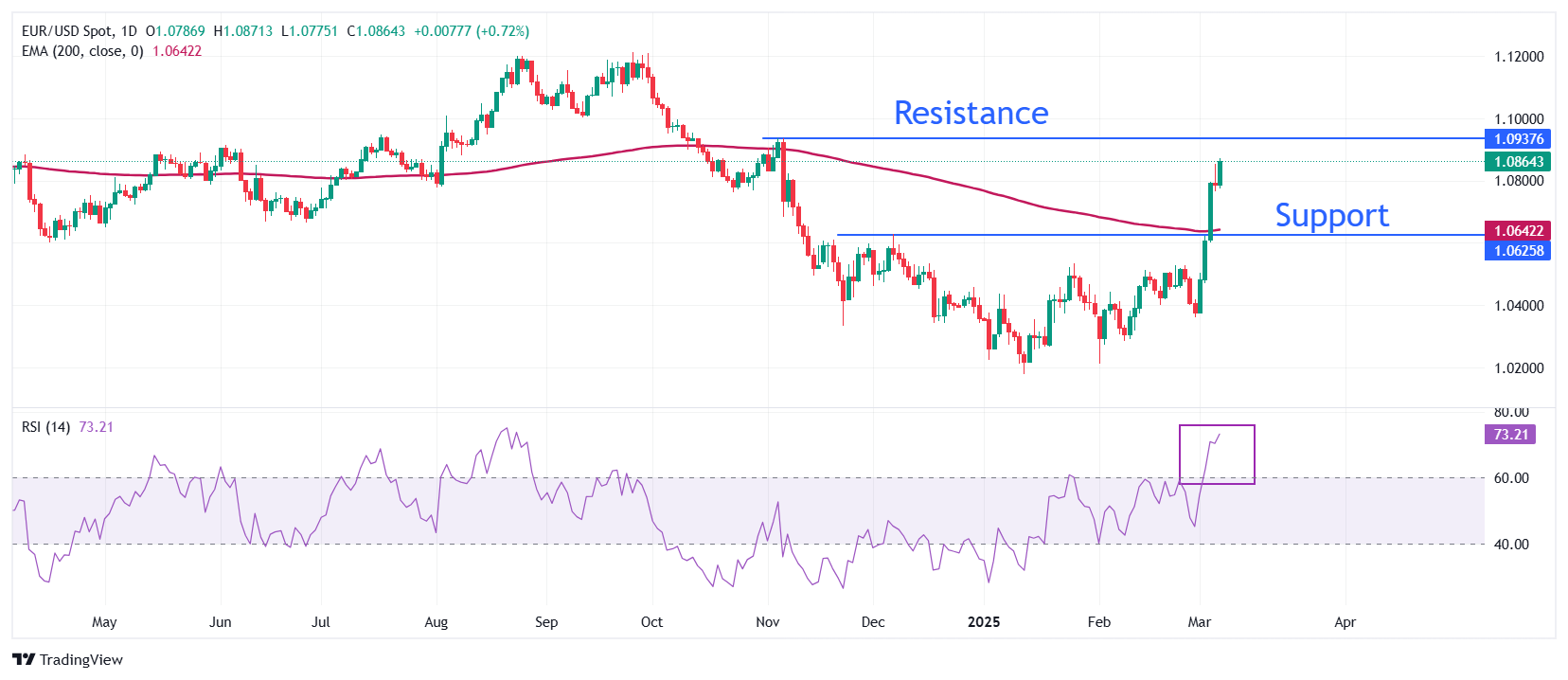
EUR/USD surges to over 1.0850 on Friday after a decisive breakout above the December 6 high of 1.0630 earlier this week. The long-term outlook of the major currency pair is bullish as it holds above the 200-day Exponential Moving Average (EMA), which trades around 1.0640.

The 14-day Relative Strength Index (RSI) jumps above 70.00, indicating a strong bullish momentum.

Looking down, the December 6 high of 1.0630 will act as the major support zone for the pair. Conversely, the November 6 high of 1.0937 and the psychological level of 1.1000 will be key barriers for the Euro bulls.

gold-bar-and-dollar-bills-42586628_XtraLarge

Gold consolidates further while weekly gains look to be set

Gold’s price (XAU/USD) ticks up slightly and consolidates for the third day in a row this week. The rally in Bullion stalls after US President Donald Trump shielded off all goods from Mexico and Canada that fall under the USMCA trade agreement from its freshly baked tariffs that got implemented earlier this week. Meanwhile, US equity markets trade below where they were on President Trump’s inauguration day.

On the rates side, traders got some support from Federal Reserve (Fed) official Christopher Waller, who said on Thursday that he wouldn’t support lowering interest rates in March but sees room to cut two, or possibly three, times this year. This coincides with what markets expected, with June being the first pivotal moment for the Fed to cut interest rates this year.

Technical Analysis: Small pause

Bets on interest rate cuts by the Federal Reserve are now starting to get support from the central bank’s policymakers. This should support Gold’s price throughout the year, though it might not be enough to push Gold to fresh all-time highs for now. For that, a fresh catalyst, such as new tariffs or another page in the trade war book, would need to occur.

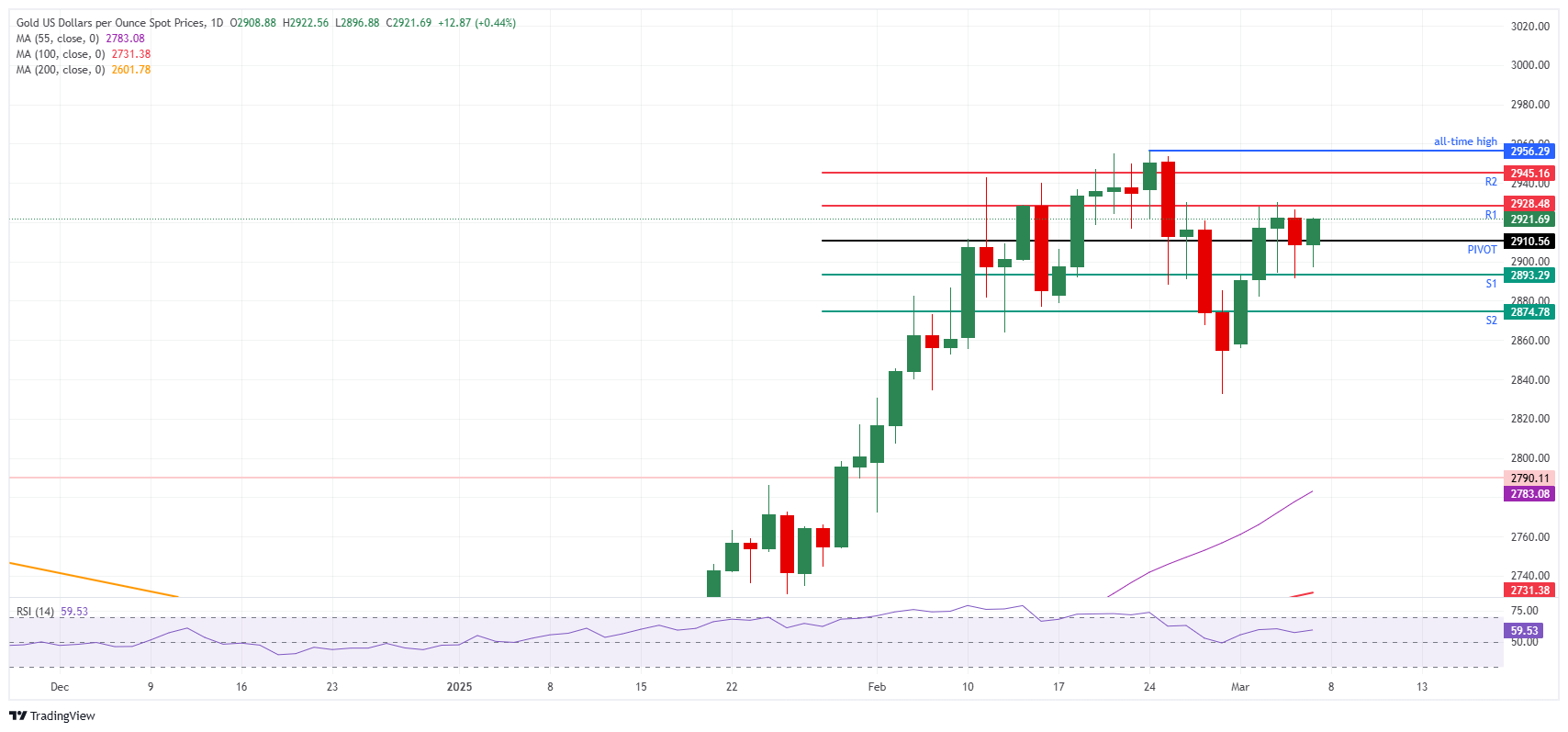
While Gold trades near $2,917 at the time of writing, the daily Pivot Point at $2,910 and the daily R1 resistance at $2,928 are the key levels to watch for on Friday. In case Gold sees more inflows, the daily R2 resistance at $2,945 will possibly be the final cap ahead of the all-time high of $2,956 reached on February 24.

On the downside, the $2,900 psychological big figure and the S1 support at $2,893 acts as a double support barrier. If Bullion bulls want to avoid another leg lower, that zone must hold. Further down, the daily S2 support at $2,874 should be able to catch any additional downside pressure.

XAU/USD: Daily Chart

XAU/USD: Daily Chart

mmty

USD/CAD: US postpones the imposition of tariffs on Canada

The United States has once again postponed the imposition of tariffs on Canada until April 2nd. Coupled with the continuous weakening of the US Dollar (USD) and the stabilization of oil prices, the Canadian Dollar (CAD) continued to rise, by 0.30% on Thursday, against the US dollar, OCBC’s FX analysts Frances Cheung and Christopher Wong note.

USD/CAD to trade in a wider range between 1.4194-1.4793

“The temporary tariff deferral only applies to Canadian export products that meet the requirements of the Canada-United States-Mexico Agreement, and approximately 62% of Canadian imported products may still face a 25% tariff.”

“Canada stated that it will not lift the tariffs previously imposed on US goods worth CAD 30 billion but agreed to postpone the second round of retaliatory tariffs worth CAD 125 billion until April 2nd. It is expected that the currency pair will continue to be volatile in the short term, with two-way trades.”

“Pay attention to the trading range of 1.4300-1.4542, and a wider range is between 1.4194-1.4793.”

images

EUR/USD climbs to multi-month highs above 1.0850

EUR/USD gathers bullish momentum and trades at its highest level since early November above 1.0850 on Friday. The US Dollar struggles to shake off the bearish pressure as investors await February employment data, allowing the pair to stretch higher.

The Relative Strength Index (RSI) indicator on the 4-hour chart stays near, suggesting that EUR/USD remains technically overbought.

On the upside, first resistance could be spotted at 1.0900 (static level, round level) ahead of 1.0940 (static level from November) and 1.1000 (round level, psychological level). Looking south, supports could be spotted at 1.0800 (round level, static level), 1.0760 (static level) and 1.0730 (200-day SMA).

Following the March policy meeting, the European Central Bank (ECB) decided to lower key rates by 25 basis points (bps), as widely anticipated. In its policy statement, the ECB repeated that future interest rate decisions will be based on “the assessment of inflation outlook in light of incoming economic and financial data, dynamics of underlying inflation, and strength of monetary policy transmission.” While speaking to reporters in the post-meeting press conference, ECB President Christine Lagarde said that they will remain data-dependent and make decisions on a meeting-by-meeting basis. Amid a lack of fresh clues on the ECB policy outlook, EUR/USD spent the day fluctuating in a relatively tight range.

Nonfarm Payrolls (NFP) in the US are forecast to rise by 160,000 in February, following the disappointing 143,000 increase recorded in January. A reading close to 200,000 could support the US Dollar (USD) with the immediate reaction. Investors could also see that as an opportunity to book some profits, triggering a downward correction in EUR/USD.

On the other hand, a disappointing jobs report could feed into concerns over an economic downturn in the US and make it difficult for the USD to hold its ground. According to the CME FedWatch Tool, markets are currently pricing in about 50% probability of a Federal Reserve policy hold in May, suggesting that the USD is facing a two-way risk heading into the event.

mail

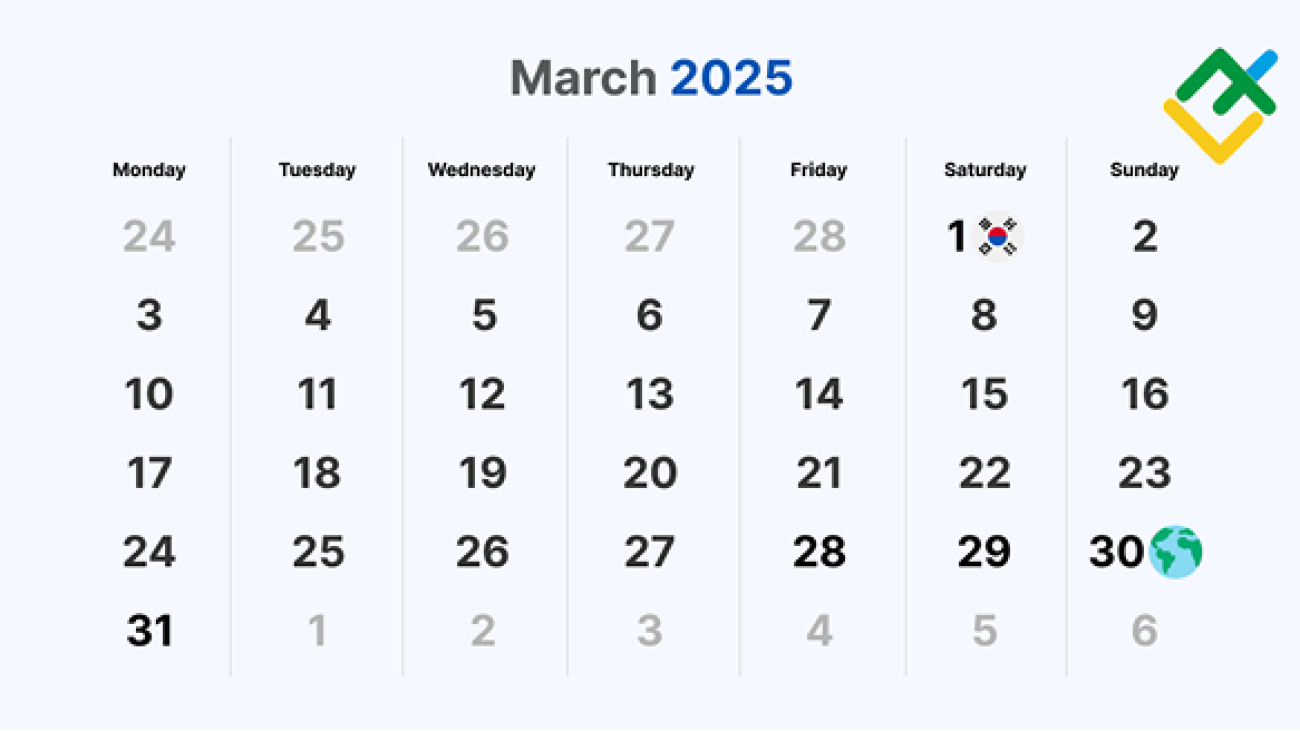
World stock market holidays: March 2025

LiteFinance has updated its trading schedule for March 2025 due to international holidays and weekends, and you are advised to check the new schedule on their website for any additional changes.

Note

  • Review the updated trading schedule on LiteFinance’s website. here
  • Contact LiteFinance’s support team for any questions. here
World stock market holidays
We would like to inform you about the changes in LiteFinance’s trading schedule during this month due to the upcoming international holidays and weekends on stock exchanges.
You can find out about changes to the trading schedule on our website.
This information is for reference only and is subject to change. Please check the current schedule in the Company news section on the official website for any additional changes.
You can always find the trading schedule for each trading instrument in the Info on the instrument section in your Client Profile.
Should you have any questions, please contact our support team.