Markets Week Ahead: Gold, EUR/USD, GBP/USD, USD/JPY, US Inflation, Fed, ECB, BoE

Markets Week Ahead: Gold, EUR/USD, GBP/USD, USD/JPY, US Inflation, Fed, ECB, BoE

The week ahead is likely to bring elevated market volatility, courtesy of impactful and high-risk events on the economic calendar, including US inflation data, UK GDP figures, and significant monetary policy announcements from the FOMC, the Bank of England and the European Central Bank. Against this backdrop, precious metals, stocks and currency pairs, such as USD/JPY, EUR/USD and GBP/USD could experience large swings, creating interesting trading opportunities.

Traders should keenly monitor the U.S. inflation report to assess the validity of prevailing interest rate expectations for the upcoming year. Although price pressures are projected to continue to cool, progress towards the Fed’s target is likely to be limited, a situation that could reduce the likelihood of the Federal Reserve adopting a more pessimistic stance at its December meeting.

In terms of the central bank announcements, the Fed, ECB and BoE are seen holding their policy settings steady. For this reason, it is vital to pay close attention to their forward guidance and projections.

With growth flagging in both the Eurozone and the UK, there is little appetite for Lagarde or Bailey to be aggressive in their outlook. Powell, however, may have room to be somewhat more hawkish, given the remarkable resilience of the American economy. This may leave the U.S. dollar well positioned to extend its recovery against its major peers, such as the euro, British pound and the Japanese yen, to name a few.

In the event of a US dollar rally resulting from a resurgence in Treasury yields, gold (XAU/USD) and silver (XAG/USD) are likely to suffer. Risk assets could also come under pressure, sending the Nasdaq 100 sharply lower. For a thorough analysis of the forces that may shape financial markets and drive volatility in the coming days, consult DailyFX’s meticulously prepared week-ahead forecasts.

For a complete analysis of the euro’s medium-term outlook, request a copy of our latest forecast!

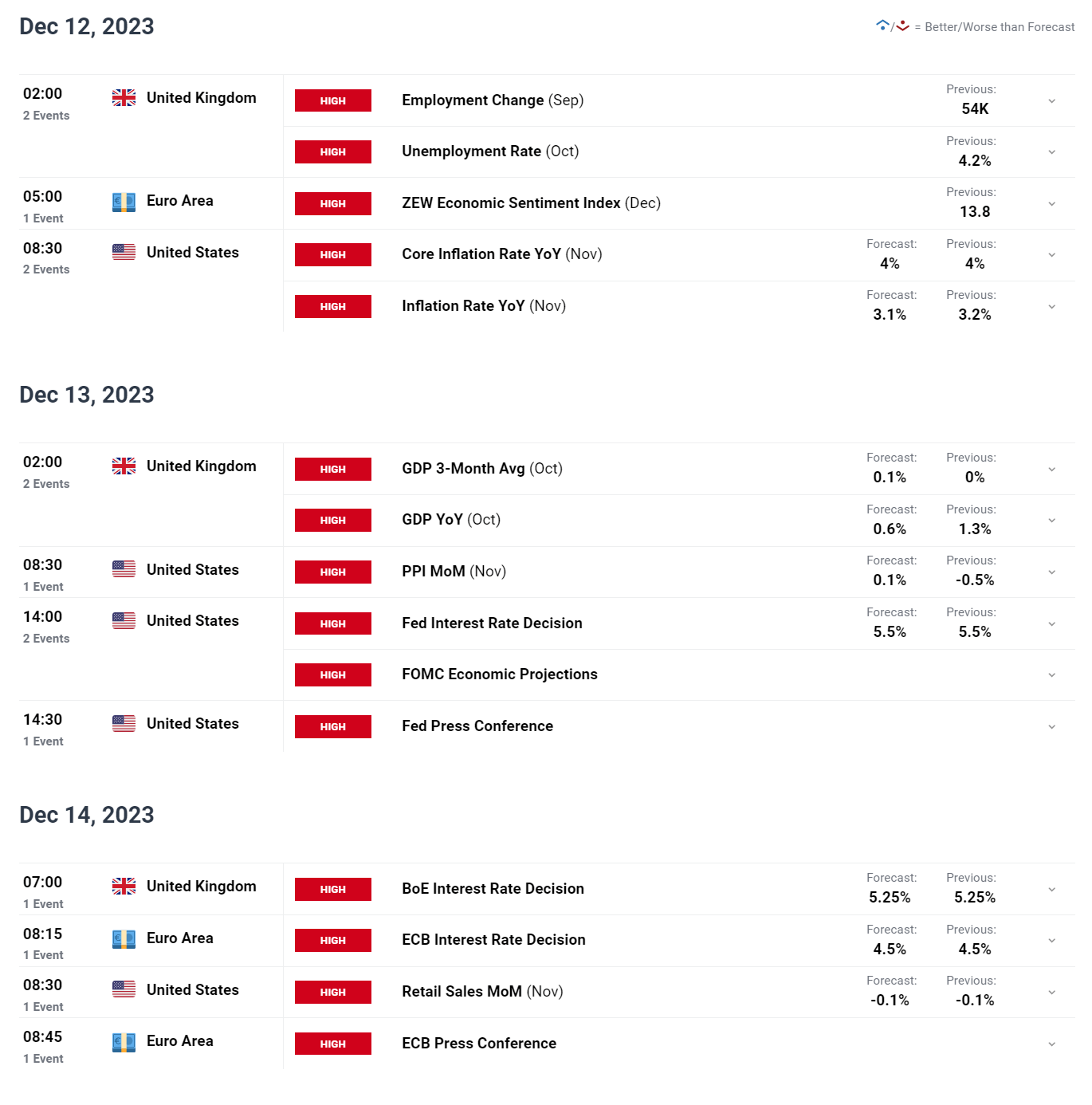
KEY ECONOMIC EVENTS THIS WEEK

image1.png

Wondering about the U.S. dollar’s technical and fundamental prospects? Find all the answers you are looking for in our quarterly forecast. Download a free copy of the guide now!

FUNDAMENTAL AND TECHNICAL FORECASTS

British Pound Outlook: GBP/USD Rattled by NFPs, BoE, ECB, Fed Decisions Ahead

Cable dropped around half-a-point after a slightly stronger-than-expected NFP report hit the screens, but next week is all about three central bank policy decisions.

USD/JPY Weekly Forecast: Markets Peel Back Hopes for BoJ Policy Change

JPY upside may be slowing as NFPs showed a robust US labor market. This week sees the FOMC in action and US inflation to drive volatility.

Euro Weekly Forecast: ECB Expected to Hold Rates but How Will Projections Differ from Market Expectations?

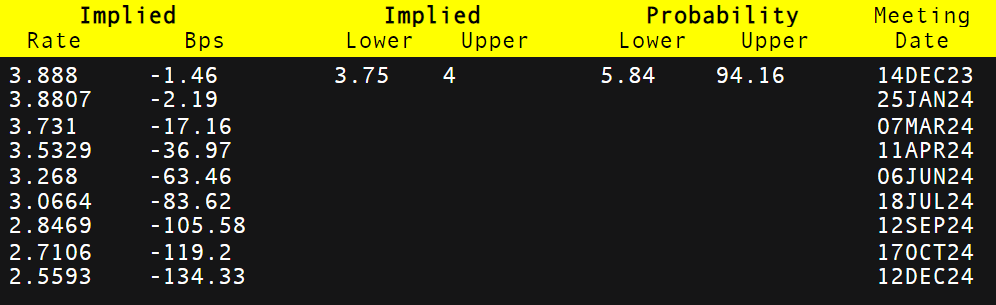
The ECB projections will hold the key in the week ahead as market participants still price in 125bps of rate cuts in 2024. Can the Central Bank arrest the Euro’s slide?

Gold, Silver & Oil Forecast: Commodities Prepare for a Busy Week

The updated Fed forecast next week can guide the dollar, and by extension, gold prices in the last weeks of 2023 as can the US CPI report. Oil hints at a bullish pullback.

US CPI, Fed Decision to Guide US Dollar, Setups on EUR/USD, USD/JPY, GBP/USD

This article examines the technical outlook for major US dollar FX pairs such as EUR/USD, USD/JPY and GBP/USD, dissecting the critical price thresholds that could come into play this week ahead of US inflation data and the Fed’s decision.

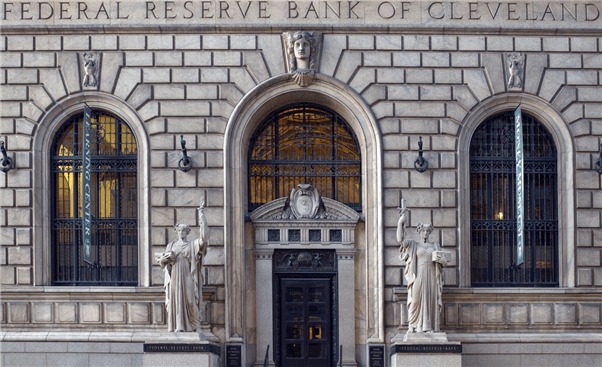
The Federal Reserve Bank: A Forex Trader’s Guide

The Federal Reserve Bank: A Forex Trader’s Guide

What is the Federal Reserve?

The Federal Reserve is the central bank of the United States. It was founded to create a stable, flexible monetary and financial system for the nation. Its general duties are to set monetary policy and oversee effective economic operation, ultimately serving the public interest.

To meet these top-level directives, the Fed performs five general functions:

  1. Promote maximum employment, stable pricing and moderate interest rates long term
  2. Reduce risk where possible to create a stable financial system
  3. Develop safety within financial institutions
  4. Champion safety within payment and settlement systems
  5. Advocate consumer protection through a supervisory stance.

To execute day-to-day operations, the nation is divided up into 12 Federal Reserve Districts, each of which is served by a separately incorporated Reserve Bank. These districts and member banks operate independently while being supervised by the Federal Reserve Board of Governors.

Who owns the Fed?

The Fed is both a private and public institution. The Board of Governors is a government agency, while the banks themselves are structured like private corporations – member banks hold stock and earn dividends.

Who is the Federal Reserve chairman?

As of August 2019, the chairman of the Federal Reserve is Jerome Powell, who has served in this office since February 5, 2018. He is the 16th person to have held the position and will serve a four-year term. Before his appointment, Mr Powell served as a member of the Board of Governors from May 25, 2012. He also currently serves as Chairman of the Federal Open Market Committee, which looks after monetary policy.

Which banks make up the Fed?

The 12 Federal Reserve Districts, each with their own Reserve Bank, are:

  • Boston
  • New York
  • Philadelphia
  • Cleveland
  • Richmond
  • Atlanta
  • Chicago
  • St. Louis
  • Minneapolis
  • Kansas
  • Dallas
  • San Francisco

How is the Fed held accountable to its functions?

The Fed is accountable to the public, as well as to the US Congress. The Chair and Federal Reserve officials testify in front of Congress, while the system of setting monetary policy is designed to be clear and transparent. In the interests of accountability, the Federal Open Market Committee (FOMC) will publish statements following all annual meetings. All financial statements are audited independently once a year to ensure financial accountability as well.

Key Economic Mandates of the Federal Reserve System

US monetary policy is the core mandate of the Federal Reserve bank. The statutory objectives of this monetary policy are outlined by the Congress and are:

  • Maximum employment: The monetary policy set out by theFOMC should ensure unemployment remains low, working to boost the economy where needed so that businesses thrive, make a profit and hire more staff to grow
  • Price stability: The Fed defines price stability as an inflation rate of 2% in the long term
  • Moderate long-term interest rates: This works alongside price stability – when an economy is stable, long-term interest rates remain at a moderate level

The Fed aims to achieve its monetary policy through its influence over interest rates and the general financial climate. This can lead to volatility of the US Dollar, ahead of Fed announcements and changes to policies.

Federal Open Market Committee

Monetary policy is set by the Federal Open Market Committee (FOMC), which oversees the open market operations of the Federal Reserve System. They set a target for the federal funds rate at FOMC meetings; this is the interest rate that they want banks to offer to each other for overnight loans. While the FOMC doesn’t control the rate, it can influence it in three main ways:

  • Open market operations. This means the buying and selling of government bonds on the open market – selling bonds decreases monetary supply with the aim of increasing interest rates. Buying bonds puts money back into the economy, with the aim of decreasing interest rates
  • Discount rate. This is the rate that banks pay to borrow money from the Fed. When this rate is lower, then it is also more likely the federal funds rate will be lower too
  • Reserve requirements. Banks need to hold a certain percentage of customers’ deposits to cover withdrawals – this is the reserve requirement. When these are raised, banks can’t loan as much money and must ask for higher interest rates. When lowered, banks can loan more money and ask for lower interest rates.

How Does the Federal Funds Rate Affect the US Dollar?

The Fed’s interest rate, also known as the Fed funds rate, is set by the Board of Governors of the Federal Reserve System. The current interest rate and the expectations of future interest rate changes can both affect the value of the US Dollar. If traders anticipate a change in interest rates based on announcements from the Board of Governors, this can cause the Dollar to appreciate or depreciate in value against other currencies.

This table sets out the way in which market expectations and rate changes can affect the value of the dollar:

Market expectations Actual Results Resulting FX Impact
Rate Hike Rate Hold Depreciation of currency
Rate Cut Rate Hold Appreciation of currency
Rate Hold Rate Hike Appreciation of currency
Rate Hold Rate Cut Depreciation of currency

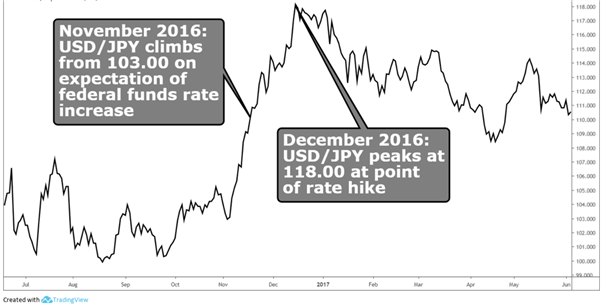
As you can see in the chart below, the Dollar strengthened against the Yen in the leadup to the Fed’s interest rate announcement in December 2016 because it was widely expected that the fed funds rate would increase. The pair peaked at around 118.371 on the day of the announcement, December 14, 2016.

USD/JPY chart before and after Fed hikes in 2016

Chart to show the impact of Fed hikes on USD/JPY

The Bank of England: A Forex Trader’s Guide

The Bank of England: A Forex Trader’s Guide

The Bank of England: A Forex Trader’s Guide

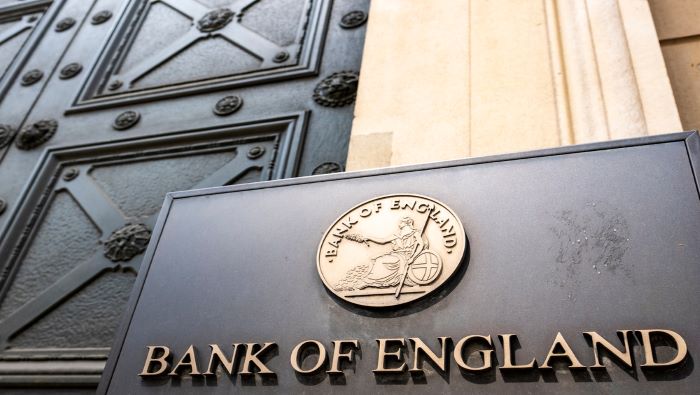
The Bank of England (BOE) is the UK’s central bank. Their mission is to promote and maintain monetary and financial stability. It is important for forex traders to keep up to date with the Bank of England’s latest changes to monetary policy because it can have a large effect on the Sterling Pound (GBP) and relevant currency pairs, like the EUR which is highly correlated to the Pound.

Central Bank of England

What is the Bank of England (BOE)?

Established in 1694, the Bank of England is the banker to, and owned by, the British government but is independent when setting monetary policy. Its roles include the setting of monetary policy – which includes targeting interest rates and using other tools to stimulate or contract the economy – producing the UK’s bank notes, supervising some bank payment systems, and ensuring the stability and safety of the financial system.

For traders, the BOE’s setting of monetary policy is a key factor to consider as it can have a big impact on the financial markets. Other factors, like the independence of the central bank are also important but are more prevalent issues in emerging market economies.

Key Economic Mandates of the Bank of England

According to the Bank of England, their two core purposes or mandates are:

1) Monetary stability – which is price stability or inflation

2) Financial stability – which is the stability and health of the economy

Monetary Stability

Monetary policy is extremely important for the entire economy. It prevents runaway inflation and attempts to ground inflation expectations so that the economy can grow at a regular pace. In order to maintain price stability, the Bank of England and their monetary policy committee (MPC) have set an inflation target of 2%.

If inflation goes above the target of 2% the Bank of England may increase interest rates. The increase in interest rates may cause an appreciation in the Pound as investors increase capital flows into the higher yielding currency. It may also have a negative affect on the stock market, as businesses will have to pay higher rates to lend and equity valuations will be discounted at a higher interest rate. Monetary policy data can be found on our economic calendar.

However, it is not always the case that the Bank of England will increase interest rates if inflation is above target. In some cases, like when GDP growth is still low or negative, the Bank of England may keep interest rates low to stimulate the economy. It is important to know the Bank of England will be looking for a balance between healthy inflation and economic growth.

Join our central bank webinar to watch our senior currency strategist discuss and analyze current central bank trends.

Financial Stability

The resilience of the financial system is paramount to the health of the UK economy and therefore necessary for the Bank of England to accommodate. To support Financial Stability mandates, the bank also has a Financial Policy Committee or FPC which was established in June 2011. From an FX point of view, the Monetary Stability is the key driver of spot rates for the GBP.

How BOE interest rates affect the Pound

Interest rate impact on the Pound

The Bank of England can affect the value of the Pound through changes in interest rate expectations. Traders should understand that currencies appreciate when interest rate expectations increase, not just from increases in the nominal interest rate.

For example, if the Bank of England keeps interest rates unchanged but issues forward guidance (tells the market) that they expect more interest rate hikes in future, the value of the Pound will appreciate. Likewise, decreases in future interest rate hike expectations, or expectations of an interest rate cut can lead to a decrease in the value of the Pound.

This is the general principle for how interest rates affect the Pound and stock market, although they sometimes react differently:

  1. Higher interest rate expectations increase the strength of the Pound (GBP) and negatively affect equity values.
  2. Lower interest rate expectations decrease the strength of the Pound (GBP) and positively affect equity values.

Interest rates aren’t the only monetary policy tool that can affect the currency, tools like quantitative easing can also lead to increases and decreases in the value of a currency. If the Bank of England announces that it plans to start a quantitative easing program (QE), the pound will likely depreciate as a large amount of liquidity enters the market, increasing the supply of money in the market and leading to a decrease in interest rates, or, simply to maintain current rates.

Interest rate impact on the economy

The Bank of England lowers interest rates when it is trying to stimulate the economy (GDP) and increases interest rates when it is trying to contain inflation caused by an economy operating above potential (overheating).

Lower interest rates stimulate an economy in a few ways:

  1. Businesses can borrow money and invest in projects that will receive more than the risk borrowing rate.
  2. When interest rates are lower the stock market is discounted at a lower rate, leading to an appreciation in stock market values which causes a wealth effect.
  3. People invest their money into the economy (stocks and other assets) because they can earn more in these assets than at currently low interest rates.

How to trade BOE interest rate decisions

The table below displays the possible scenarios that come from a change in interest rate expectations. Traders can use this information to forecast if the currency is likely to appreciate or depreciate and how to trade it.

Market expectations Actual Results Resulting FX Impact
Rate Hike Rate Hold Depreciation of currency
Rate Cut Rate Hold Appreciation of currency
Rate Hold Rate Hike Appreciation of currency
Rate Hold Rate Cut Depreciation of currency

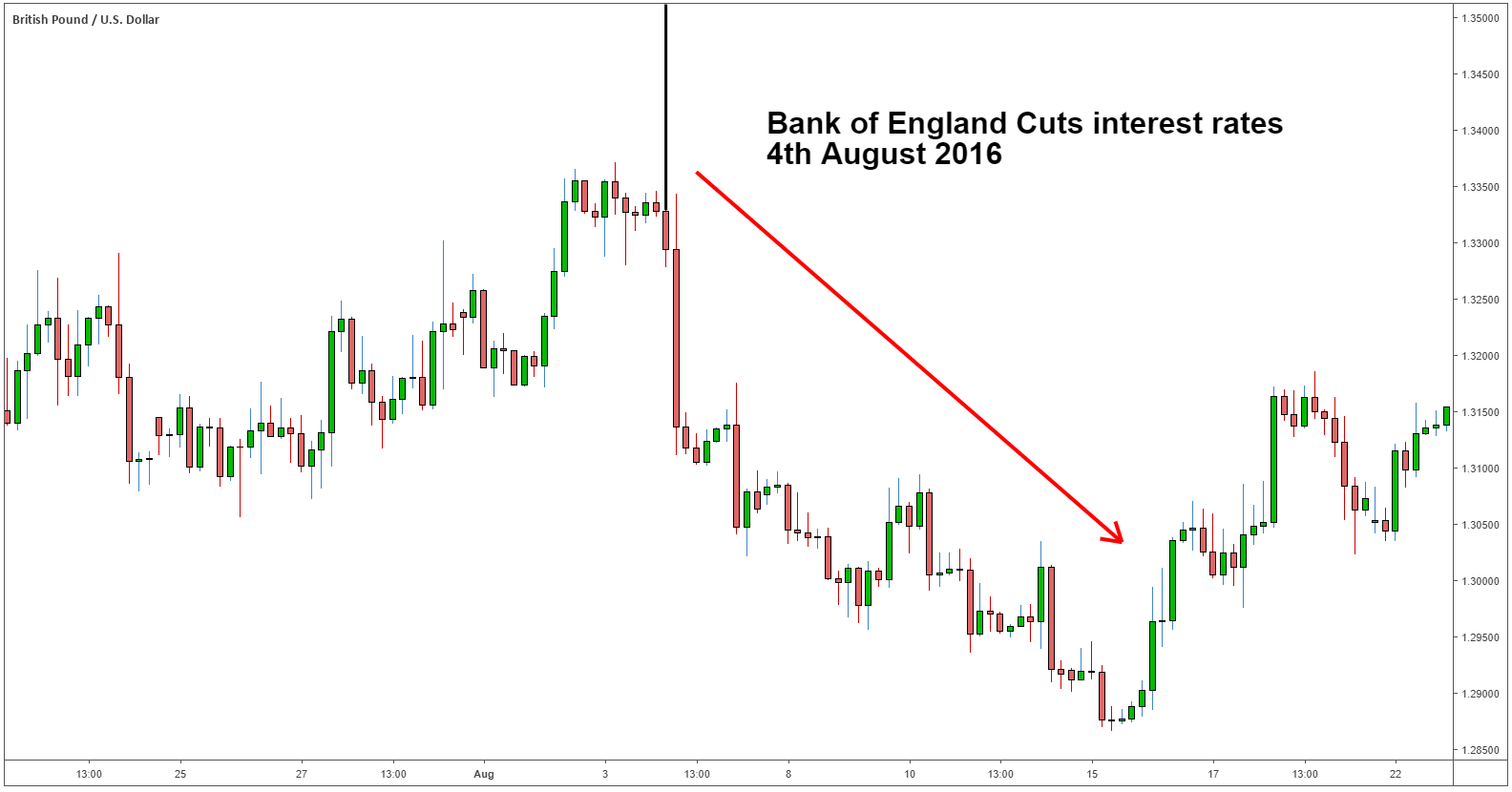
Let’s look at the example below on GBP/USD. On August 4, 2016 the Bank of England cut interest rates and announced a stimulus package (quantitative easing program). The market reacted negatively and the Pound depreciated.

Bank of England cuts interest rate to new low

Top Takeaways of the BOE and Forex Trading

Euro Price Forecast: Colossal Data Filled Week for EUR/USD

Euro Price Forecast: Colossal Data Filled Week for EUR/USD

EURO FUNDAMENTAL BACKDROP

The euro opened the week pretty flat as markets prepare for central bank decisions later this week alongside some supplementary data that could sway the messaging provided by the two central banks. Leading up to these announcements, European Central Bank (ECB) interest rate expectations have been ‘dovishly’ repriced after taking into account eurozone data while the Federal Reserve may be less inclined to rush into heavy rate cuts due to its comparatively more resilient economy. This resilience was reinforced by last week’s Non-Farm Payrolls (NFP) report that highlighted the robust labor market in the US. Money markets currently price in the first ECB cut around March/April next year. From a Fed perspective, Goldman Sachs stated this morning that they expect the Fed to deliver its first rate cut in Q3 2024 vs Q4 2024 in their previous forecast. In summary, the euro area is showing signs of significantly weaker economic data relative to the US and could weigh negatively on the EUR moving forward.

ECB INTEREST RATE PROBABILITIES

image1.png

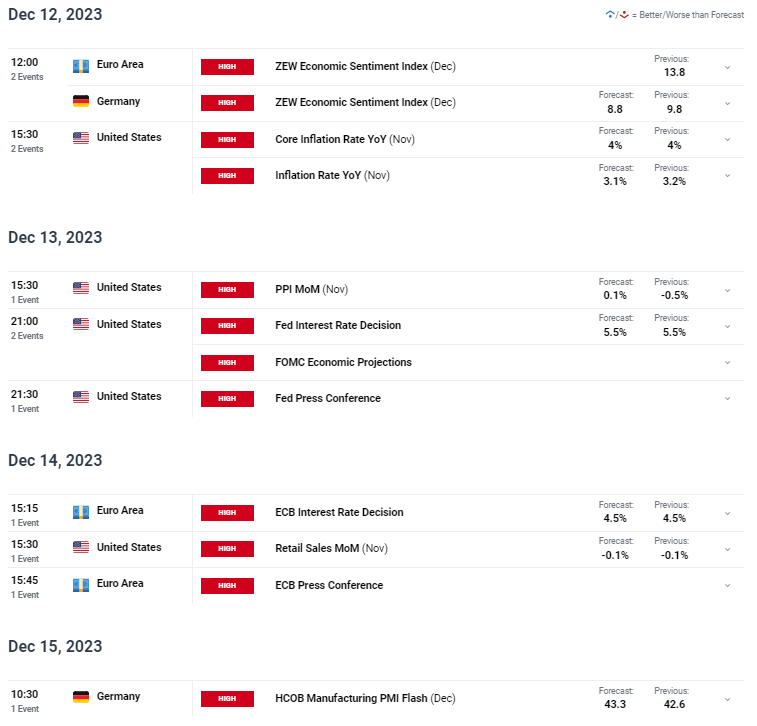
The economic calendar later today does not hold much in terms of market moving information and EUR/USD is likely to remain around current levels. The week ahead will be focused on US CPI and PPI to give an indication as to the narrative Fed Chair Powell may adopt but the US has the benefit of continuing with a ‘wait and see’ approach while the ECB may be more pressed to loosen monetary policy. Other important data points include ZEW economic sentiment for Germany and the euro area as well as US retail sales and German manufacturing PMI’s.

ECONOMIC CALENDAR (GMT+02:00)

image2.png

TECHNICAL ANALYSIS

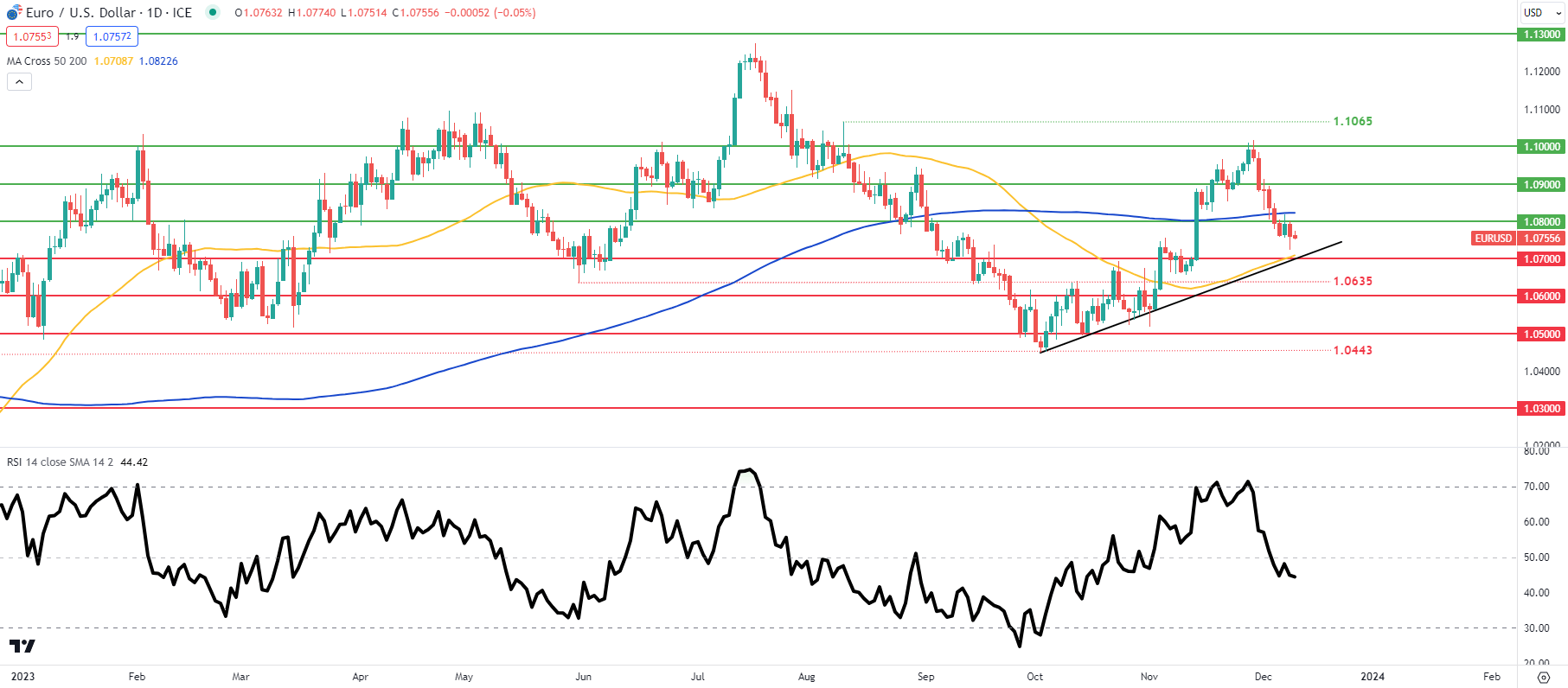
EUR/USD DAILY CHART

image3.png

The daily EUR/USD chart above stays below the 1.0800 psychological handle and looks to be heading towards the longer-term trendline support/50-day moving average (yellow). Short-term directional bias could be heavily swayed by US CPI and PPI as mentioned above. EUR/USD traders remain cautious as reflected by the Relative Strength Index (RSI) hovering around its midpoint.

The Bank of Japan: A Forex Trader’s Guide

The Bank of Japan: A Forex Trader’s Guide

The Bank of Japan (BoJ) is a major central bank, setting the monetary policies that aim to maintain price stability and a strong Japanese financial system. As a central bank, the BoJ directly impacts the forex market, so policy meetings and the decisions they bring about are important for FX traders to follow.

What is the Bank of Japan?

The Bank of Japan, or Nichigin, is the Japanese central bank. It implements monetary policy and issues currency to maintain stability of the financial system. The bank’s Policy Board holds regular monetary policy meetings, deciding on their approach to interest rates, and how they intend to influence inflation.

Who Owns the Bank of Japan?

The government of Japan has a 55% ownership of the bank, and 100% voting interest. The remaining 45% is a public float, traded as JASDAQ. As of August 2019, the BoJ governor is Haruhiko Kuroda, who has held the position since March 2013 and is currently serving his second five-year term, which is due to run until April 2023.

Key Economic Mandates of Japan’s Central Bank

The BoJ considers its core mandates to be:

  1. Maintaining stability of the financial system
  2. Maintaining price stability

Maintaining stability of the financial system

The BoJ implements its monetary policy with the aim of maintaining financial system stability, which involves currency control, monetary control and the issuing of banknotes. This also feeds into the BoJ’s other core aim, as currency and monetary control is part of the plan to achieve price stability and develop the economy.

Maintaining price stability

Maintaining price stability is the other central aim of the BoJ. Exports are essential to Japan, so the BoJ tries to keep prices as stable as possible and will manipulate interest rates with the intention of developing the national economy. The bank defines ‘price stability’ as a 2% increase year on year in the Consumer Price Index (CPI).

How does the BoJ carry out its mandates?

The BoJ holds regular monetary policy meetings (MPMs), where it sets the official interest rate and other monetary policies in the hope that they will achieve price stability and financial system stability. MPMs are held eight times a year and last for two days, during which time the Policy Board (the Governor, two Deputy Governors and six other members) will discuss and implement monetary policy. As of July 2018, the base rate remains set at -0.1% in the hope of growing the economy.

How Bank of Japan Monetary Policies Affect the Yen

Japan has suffered from an ailing economy with very low inflation over the course of the last few decades, consistently failing to achieve 2% inflation. The BoJ has adopted what is known as a loose monetary policy, maintaining a low interest rate in the hope of boosting the economy.

When there is little incentive to save due to a low interest rate, the idea is that people will spend more, put money into the economy and encourage inflation. This has seen the yen becoming increasingly weak against major currencies, including the US Dollar and the Euro, ever since Kuroda took office.

USD/JPY went from 94.00 in March 2013 to over 125.00 in June 2015, after Kuroda announced his first raft of policy measures. And while it has fluctuated since then, the yen’s value has remained well below its level when he became governor, with USD/JPY sitting around 108.00 in July 2019.

USD/JPY chart showing the fluctuations in value around major BoJ announcements

Chart showing USD/JPY fluctuations around major BoJ announcements

Following a period from 2012 to 2013 when the yen was relatively strong against the US Dollar, it fell to USD/JPY 125.00 in June 2015 after the announcement of Kuroda’s initial policy measures. The value fell once again in January 2016, when Kuroda made the shock announcement that the bank would implement a negative interest rate for the first time ever, charging -0.1% on deposits held with the bank. This policy aims to get financial institutions to withdraw their cash to invest elsewhere, rather than making a loss by hoarding cash.

This announcement caught the markets by surprise as Kuroda had only recently told the parliamentary budget committee that he was not looking to introduce any policy changes for the time being. The yen fell against currencies including the dollar and pound, while the Japan 225 went up in the hours following his announcement.

How to trade BOJ interest rate decisions

BoJ interest rate decisions are made with the aim of increasing spending and investment, influencing inflation. Changes in demand for stocks and currency as interest rates change can create forex trading opportunities. Even when interest rates remain the same, the anticipation surrounding important events like monetary policy meetings can affect the forex market.

Euro Price Action Setups: EUR/USD, EUR/GBP Post GDP Revision

Euro Price Action Setups: EUR/USD, EUR/GBP Post GDP Revision

EURO GDP REVISION AND FUNDAMENTAL BACKDROP

The Euro outlook continues to look bleak despite a resilient day against the Greenback. EUR/GBP as well seems to be setting up for a bounce following a massive selloff since November 20.

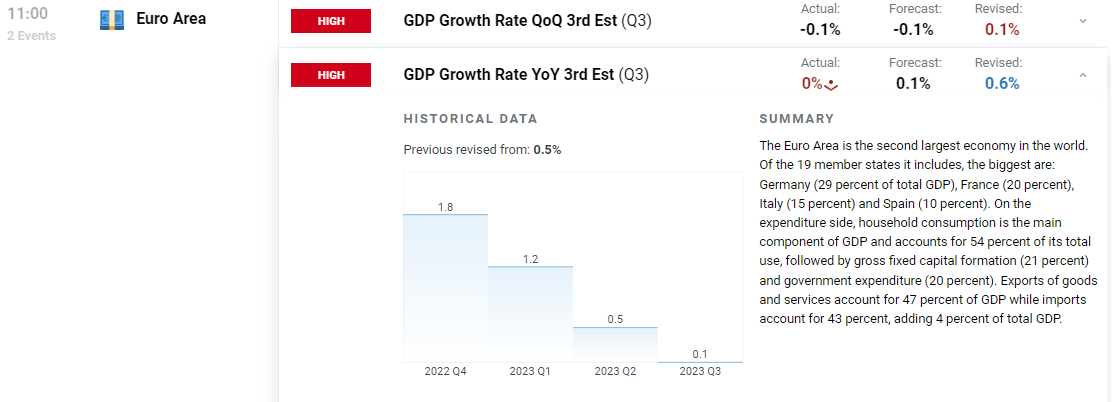
The Euro Area GDP 3rd estimate was out this morning confirming stagnation in Q3 as the Euro area economy feels the pinch. The YoY print managed to avoid a contraction being revised lower to 0% with many sectors struggling in the Euro Area which has prompted market participants to aggressively reprice rate cut expectations. This has weighed on the Euro of late with many believing the ECB may have to cut the most in 2024 to potentially stimulate a sluggish economy.

image1.png

Earlier today Goldman Sachs stated their belief that they see rate cuts as early as April by the ECB. The Bank cited a stronger than expected drop in inflation in the months ahead, which could in part be driven by a serious drop-off in demand. Heading into next week Central Bank meetings it will be interesting to gauge the updated economic projections by the ECB and if there any clues as to potential rate cuts.

PRICE ACTION AND POTENTIAL SETUPS

EUR/USD

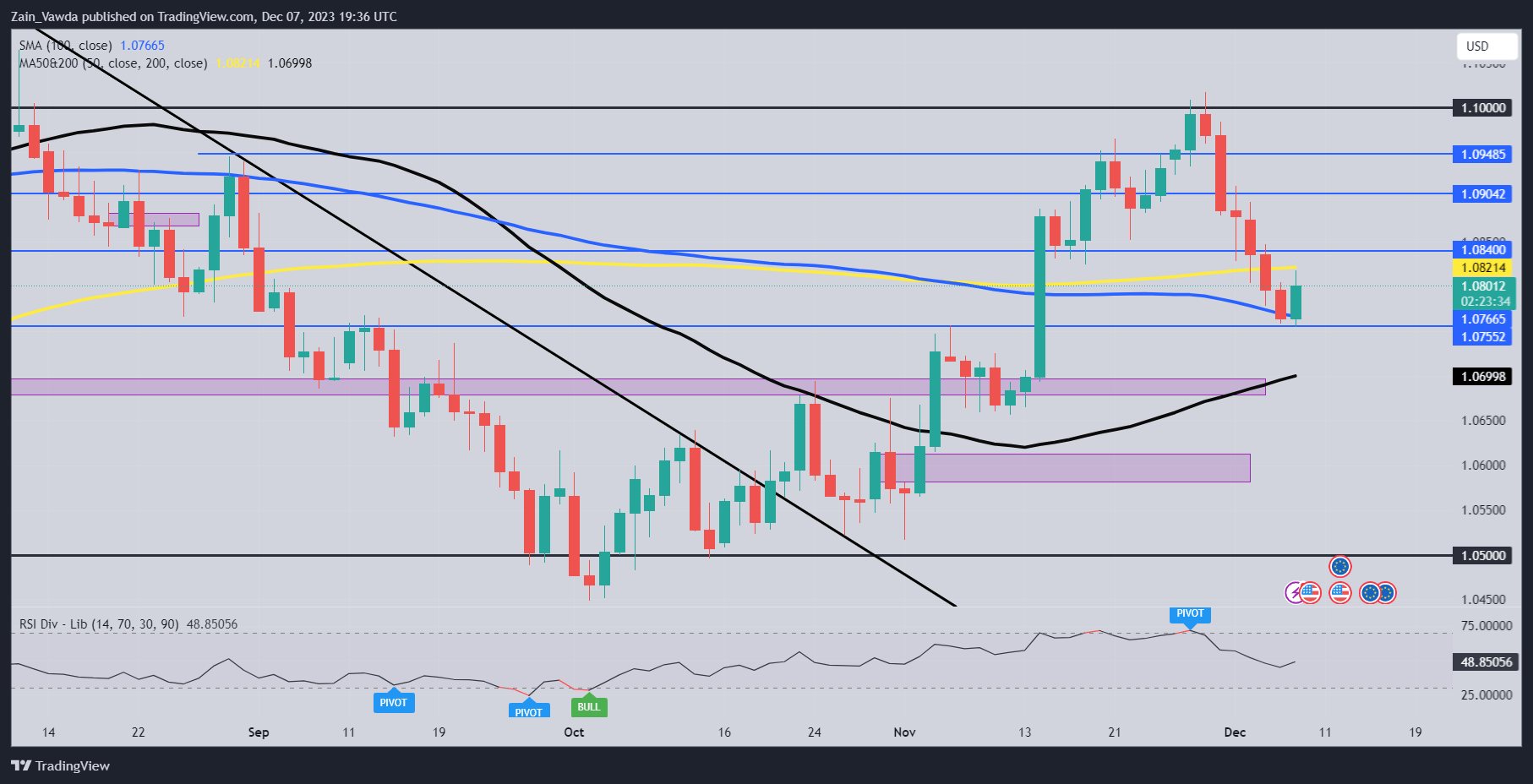
EURUSD finally arrested its slide in the US session in particular bouncing back above the 1.0800 handle. Not surprising given the key area of support around the 1.0760-1.0750 area, the question now being whether the recovery can continue. US Jobs data may play a key role tomorrow but let’s take a look at key areas of support and resistance that may provide some opportunity.

Immediate resistance for EURUSD rests at the 200-day MA which was tapped today and rests around the 1.0821 handle. A break above this may face some opposition at 1.0840 and 1.0900 respectively.

A continued push back toward and potentially below support at the 1.0750 mark may see EURUSD drop toward the 1.0700 handle where the 50-day MA rests.

Key Levels to Keep an Eye On:

Support levels:

  • 1.0760
  • 1.0700
  • 1.0656

Resistance levels:

  • 1.0821
  • 1.0840
  • 1.0900

EUR/USD Daily Chart

EUR/GBP

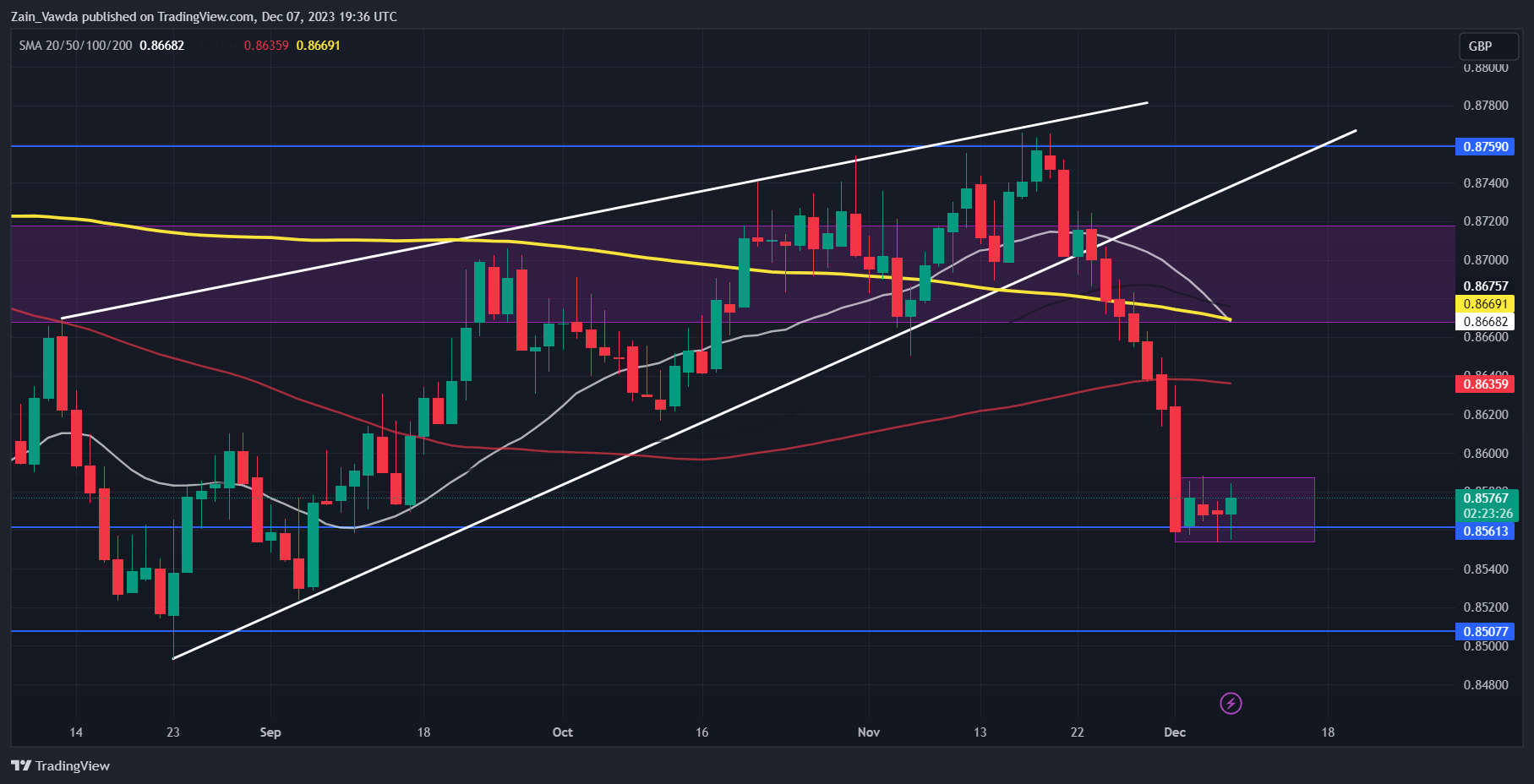
EURGBP has been caught in a 40-pip range for the last 4 days as you can see by the pink/purple box on the chart below. A breakout of the box could be a sign of further upside. There are conflicting signals however as we have just seen a death cross take place with the 20-day MA crossing below the 200-day MA. This of course hints at bearish momentum while the candlesticks themselves tell a different story, hence my confusion.

There is of course every chance that EURGBP may remain rangebound heading into next week. The ECB Central Bank meeting may provide some clarity for the pair.

Key Levels to Keep an Eye On:

Support levels:

  • 0.8550
  • 0.8500
  • 0.8487

Resistance levels:

  • 0.8587
  • 0.8636
  • 0.8668

EUR/GBP Daily Chart

IG CLIENT SENTIMENT

IG Client Sentiment datatells us that 73% of Traders are currently holding LONG positions on EURGBP. Given the contrarian view to client sentiment adopted here at DailyFX, does this mean we are destined to revisit the lows at the 0.8500 mark?

US Jobs Report Preview: What’s Next for Gold, US Dollar, Yields & Nasdaq 100?

US Jobs Report Preview: What’s Next for Gold, US Dollar, Yields & Nasdaq 100?

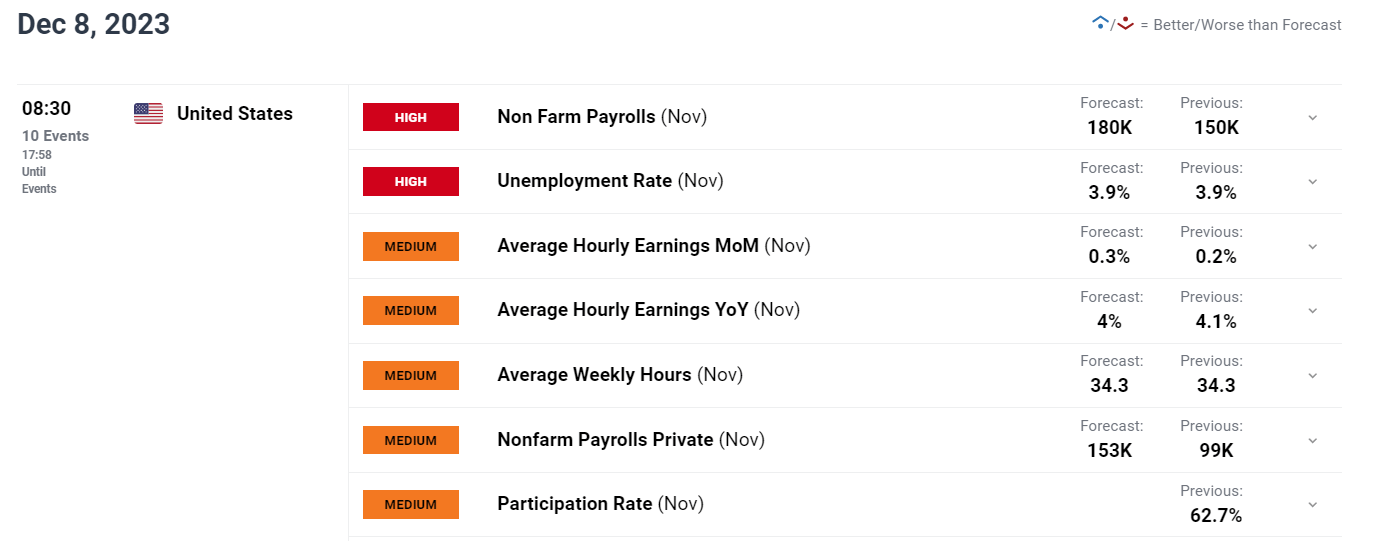
The U.S. Bureau of Labor Statistics will release the November employment report on Friday morning, an event that could bring significant volatility to financial markets and give rise to attractive trading setups heading into the weekend.

According to consensus estimates, the U.S. economy generated 180,000 jobs last month after an increase of 150,000 payrolls in October. With this result, the unemployment rate is expected to remain unchanged at 3.9%.

Elsewhere, average hourly earnings, a powerful inflation gauge closely followed by the central bank, are forecast to have risen 0.3% m-o-m, bringing the 12-month reading from 4.1% to 4.0%, a positive, albeit small, directional improvement for policymakers.

Unsure about the U.S. dollar’s trend? Gain clarity with our latest quarterly forecast. Download a free copy of the guide now!

UPCOMING US JOBS REPORT

image1.png

To sustain recent market dynamics—keeping Treasury yields and the U.S. dollar biased lower while maintaining the broader bullish momentum going for risk assets and precious metals, incoming data will have to validate overly dovish interest rate expectations by showing that the economy is starting to slow down sharply.

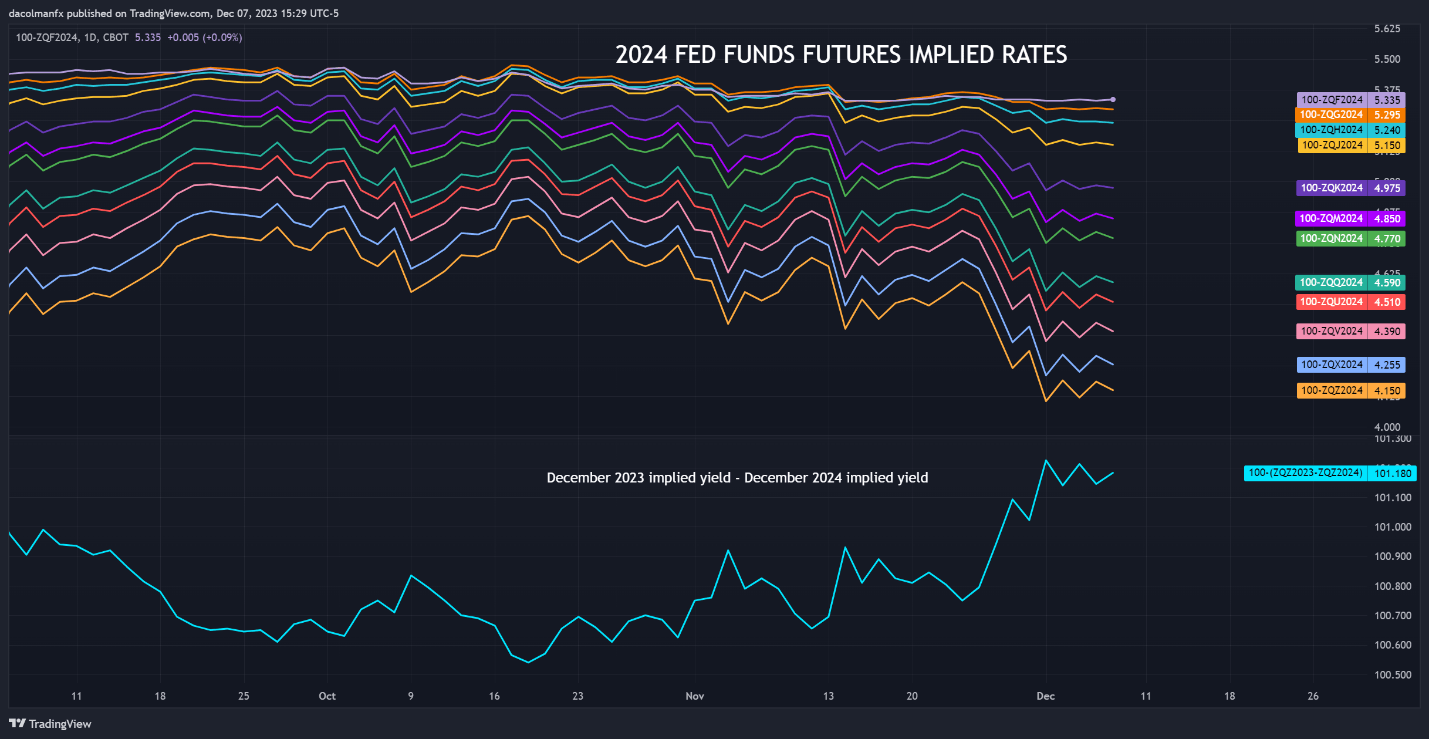
In the chart below, which displays the implied yield on all 2024 Fed funds futures contracts, we can see that rate-cut bets have risen aggressively in recent weeks, with traders discounting over 100 basis points of easing by the end of next year. Markets may be sniffing trouble on the horizon, or they may be dead wrong.

Stay ahead of the curve! Request your complimentary gold forecast for a thorough overview of the precious metal’s technical and fundamental outlook

2024 FED FUNDS FUTURES CONTRACTS (IMPLIED YIELDS)

A graph of different colored lines Description automatically generated


Any data from the November employment report that contradicts the premise of broadening economic weakness and is inconsistent with too much easing over the next 12 months, such as robust job creation or extremely hot wage growth, could push traders to unwind extremely dovish monetary policy wagers, boosting yields and this U.S. dollar. This scenario would weigh on gold and the Nasdaq 100.

Conversely, disappointing NFP figures that surprise to the downside by a wide margin could have the opposite effect on markets by justifying concerns about brewing economic challenges and by supporting the case for several rate cuts in the coming quarters. This scenario, likely to apply downward pressure on yields and the U.S. dollar, could prove beneficial for gold prices and the Nasdaq 100.

AUD Forecast: Australian Households Managing Tough Financial Conditions, RBA’s Brischetto

AUD Forecast: Australian Households Managing Tough Financial Conditions, RBA’s Brischetto

AUSTRALIAN DOLLAR FUNDAMENTAL BACKDROP

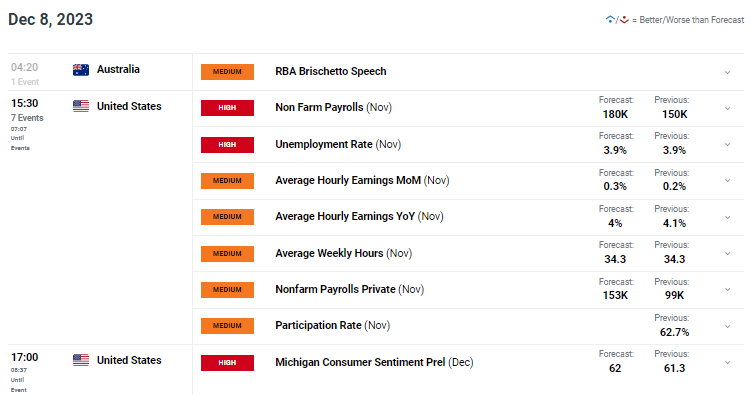
The Australian dollar followed improving risk sentiment this Friday as markets dismissed fears of the upcoming Non-Farm Payrolls (NFP) report (see economic calendar below). Misses ADP employment change and flat jobless claims could have been contributing factors but with the recent disconnect between ADP and NFP, there is still room for an NFP surprise to the upside. Weaker US consumer credit supplemented the AUD but as mentioned above, NFP will be the key driver for short-term guidance. Average earnings will be scrutinized whether or not the recent downtrend continues with the US trading session capping off with Michigan consumer sentiment data.

AUD/USD ECONOMIC CALENDAR (GMT +02:00)

image1.png

From an Australian perspective, the Reserve Bank of Australia’s (RBA) Andrea Brischetto issued an alert around Australians risk of financial stress due to the current high interest rate environment and increasing unemployment. Although early days, the seed has been planted for households to adopt more cautious pending habits to meet their financial obligations. Overall, households are coping well and highlight the resilience of the Australian economy – net positive for the AUD.

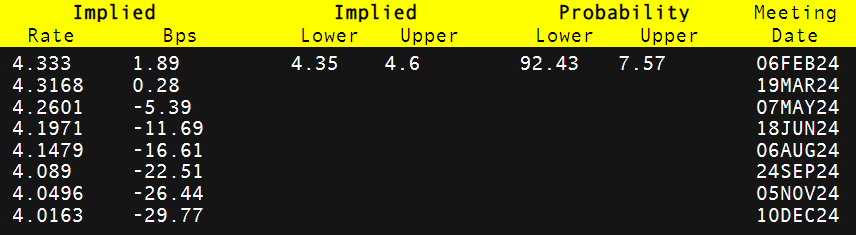
Money market pricing below may be a positive sign for Australian households with expectations showing a dovish repricing this week by around 12bps (December 2024) as well as little hope for an additional rate hike. We have seen this trend ripple across central bank forecasts as the lagged impact of tight monetary policy takes effect.

RBA INTEREST RATE PROBABILITIES

image2.png

Option expiries for today for AUD/USD are shown below with preference to the upside relative to current levels.

  • AUD/USD: 0.6700 (AUD727.9M), 0.6850 (AUD642.3M), 0.6525 (AUD505.4M)

TECHNICAL ANALYSIS

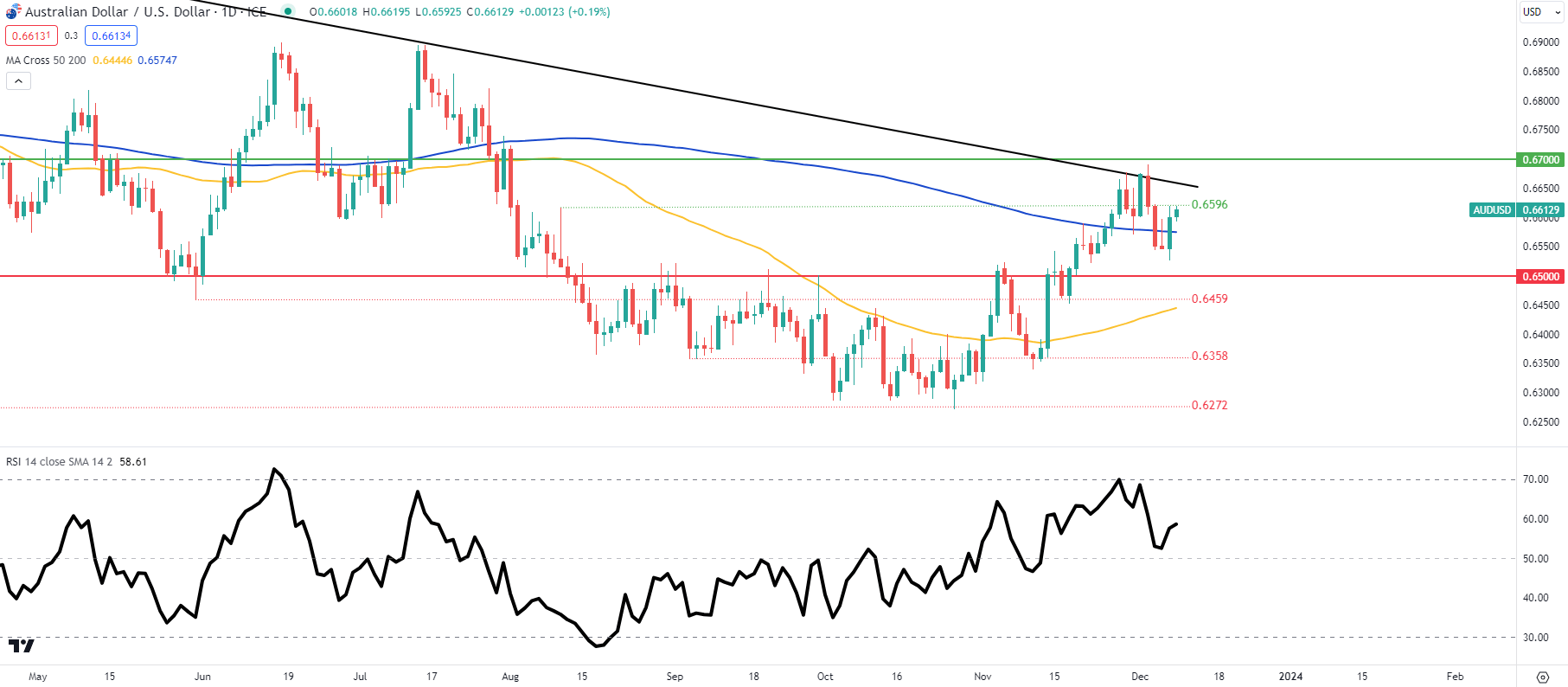
AUD/USD DAILY CHART

image3.png

AUD/USD daily price action above shows hesitancy by traders to favor a directional bias at this point with NFPs looming. It would be wise to remain cautious and potentially look for opportunities post-NFP. A beat could see AUD/USD bulls breach the long-term trendline resistance (black) and look to test July swing highs. On the contrary, a miss may push the Aussie dollar below the 200-day moving average (blue) once more and retest the 0.6500 psychological handle.

  • 0.6700
  • Trendline resistance
  • 0.6596

Key support levels:

  • 200-day MA
  • 0.6500
  • 0.6459
  • 50-day MA
  • 0.6358
NFP and Forex: What is NFP and How to Trade It?

NFP and Forex: What is NFP and How to Trade It?

What is the NFP?

The non-farm payroll (NFP) figure is a key economic indicator for the United States economy. It represents the number of jobs added, excluding farm employees, government employees, private household employees and employees of nonprofit organizations.

US Non Farm Payroll historical results

NFP releases generally cause large movements in the forex market. The NFP data is normally released on the first Friday of every month at 8:30 AM ET. This article will explain the role NFPs play in economics and how to apply NFP release data to a forex trading strategy.

How does the NFP affect forex?

NFP data is important because it is released monthly, making it a very good indicator of the current state of the economy. The data is released by the Bureau of Labor Statistics and the next release can be found on an economic calendar.

Employment is a very important indicator to the Federal Reserve Bank. When unemployment is high, policy makers tend to have an expansionary monetary policy (stimulatory, with low interest rates). The goal of an expansionary monetary policy is to increase economic output and increase employment.

So, if the unemployment rate is higher than usual, the economy is thought to be running below its potential and policy makers will try to stimulate it. A stimulatory monetary policy entails lower interest rates and reduces demand for the Dollar (money flows out of a low yielding currency). To learn exactly how this works, see our article on how interest rates effect forex.

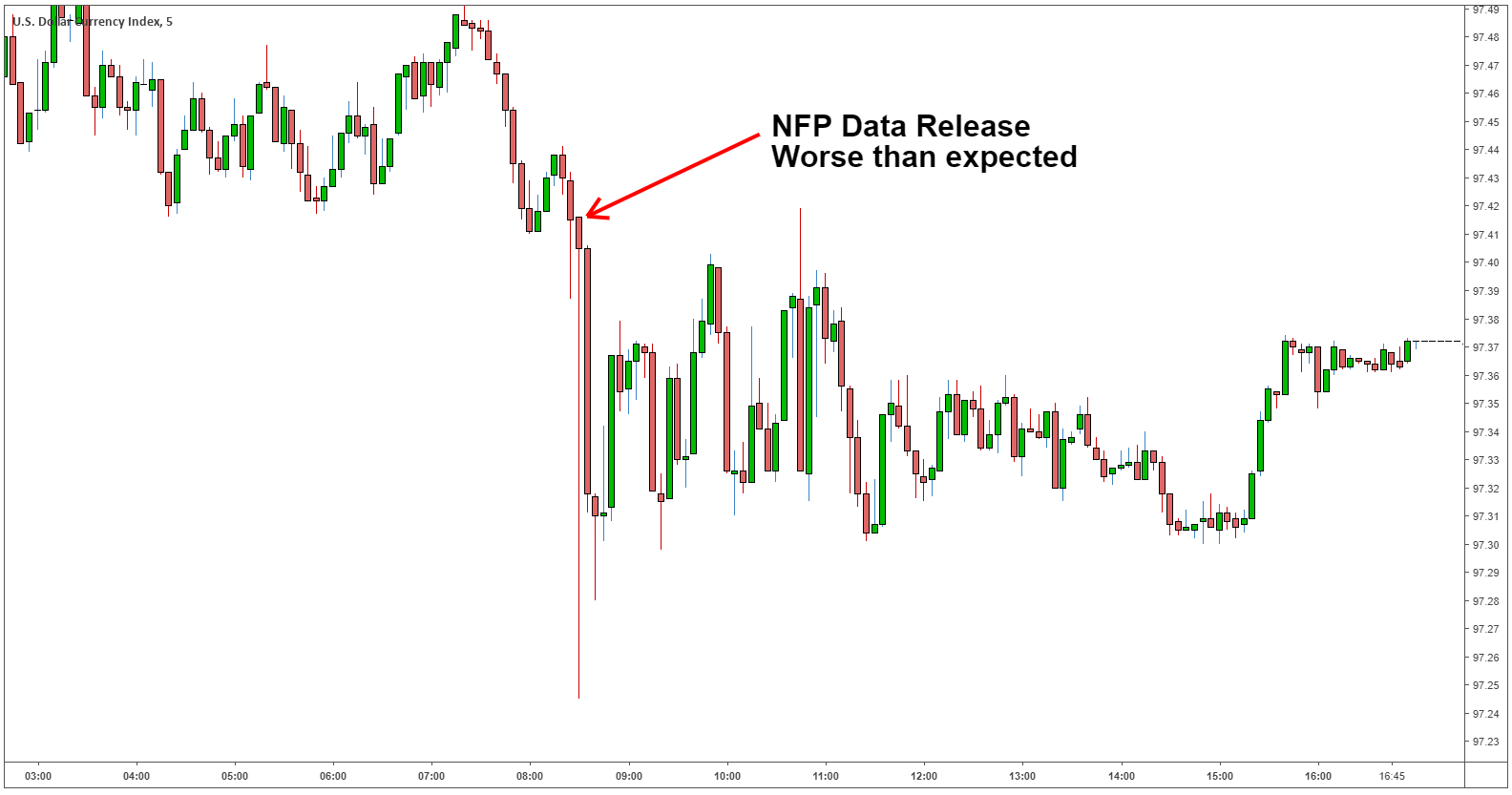
The chart below shows how volatile forex can be after an NFP release. The expected NFP results for March 8, 2019 were 180k (job additions), the actual result disappointed with only 20k jobs being added. As a result, the Dollar Index (DXY) depreciated in value and volatility increased.

NFP forex reaction

Forex traders must be wary of data releases like the NFP. Traders could get stopped-out due to the sudden increase in volatility. When volatility increases, spreads do too, and increased spreads can lead to margin calls.

Which currency pairs are most affected by NFP

The NFP data is an indicator of American employment, so your currency pairs that include the US Dollar (EUR/USD, USD/JPY, GBP/USD, AUD/USD, USD/CHF and others) are most affected by the data release.

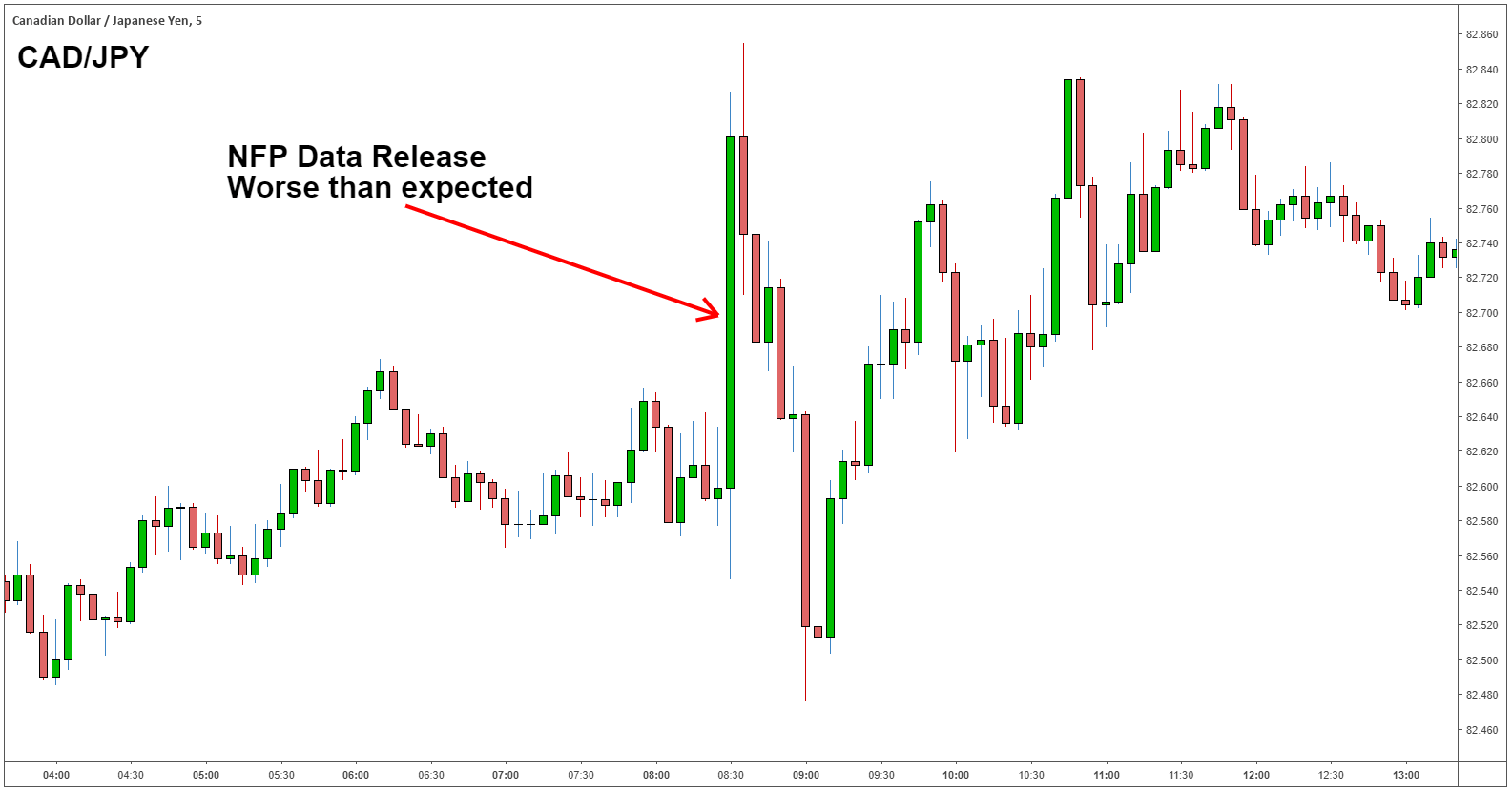
Other currency pairs also display an increase in volatility when the NFP releases, and traders must be aware of this as well, because they may get stopped out. The chart below shows the CAD/JPY during the NFP data release. As you can see, the increase in volatility could stop a trader out of their position even though they are not trading a currency pair linked to the US Dollar.

CAD/JPY NFP reaction

Non-farm payroll release dates

The Bureau of Labor statistics normally releases the NFP data on the first Friday of each month at 8:30 AM ET. The release dates can be found on the Bureau of Labor Statistic’s website.

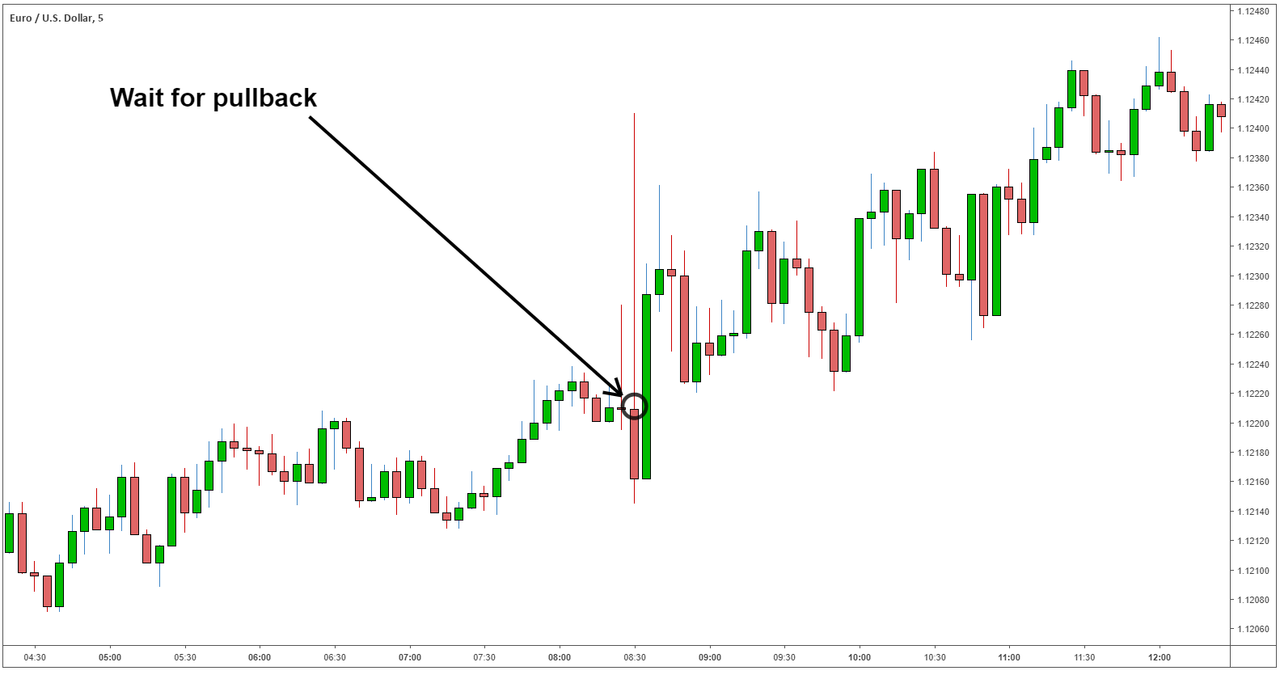
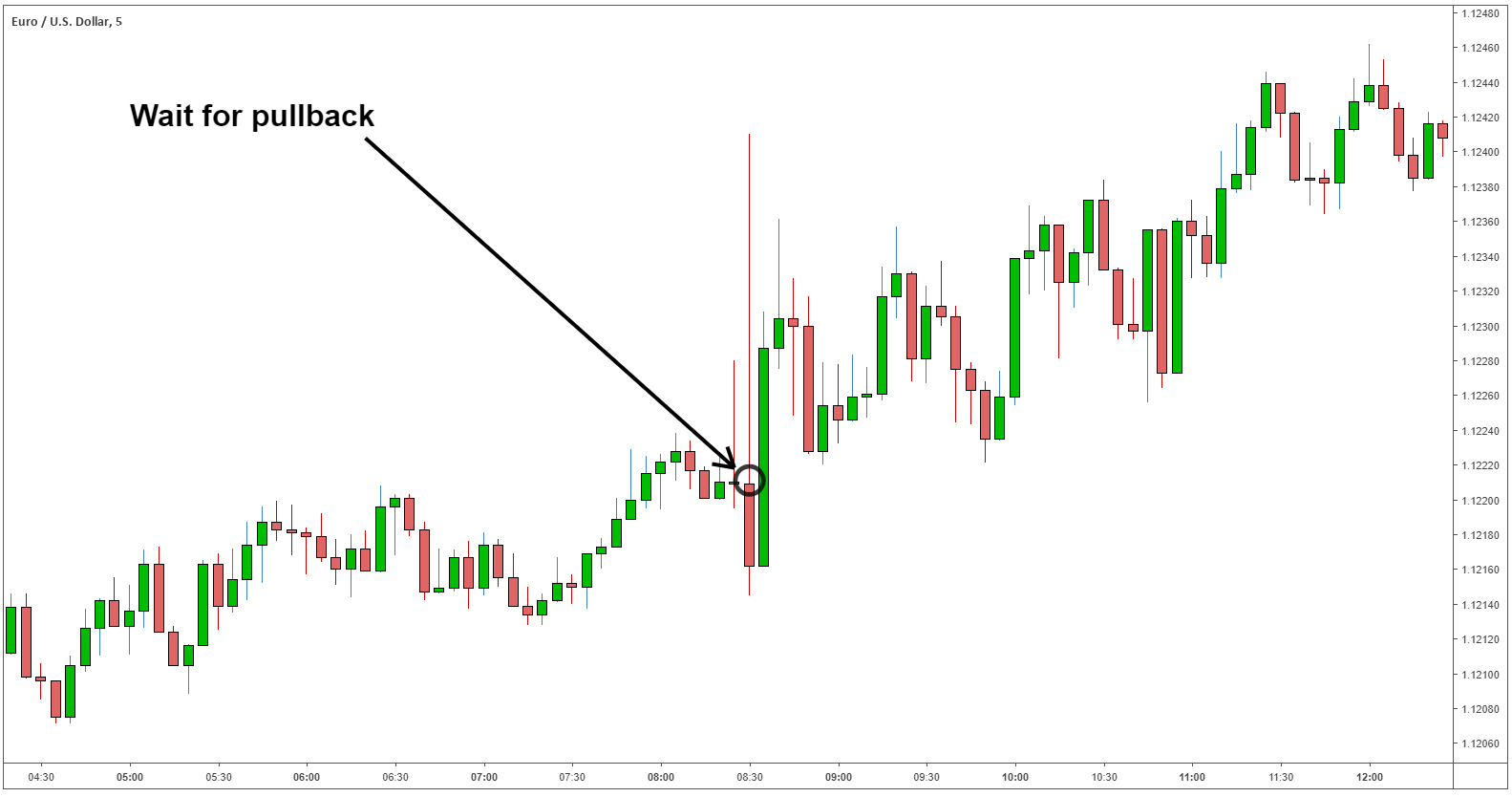
Due to the volatile nature of the NFP release, we recommend using a pull-back strategy rather than a breakout strategy. Using a pullback strategy, traders should wait for the currency pair to retrace before entering a trade.

Using the same example as above (NFP results 20k vs 180k expected) we expect the US Dollar to depreciate. In the example below, we use the EUR/USD. Because the NFP data came out worse than expected, we forecast the EUR/USD to appreciate.

EUR/USD NFP data pullback strategy

Trading the NFP data releases: Top tips & further reading

Here are a few tips to remember when using NFP data releases to inform your forex trading:

  1. NFP data is released on the first Friday of every month.
  2. The NFP data release is accompanied with increased volatility and widening spreads.
  3. Currency pairs not related to the US Dollar could also see increased volatility and widening spreads.
  4. Trading the NFP data release can be dangerous due to the increase in volatility and possible widening of spreads. To combat this, and to avoid getting stopped-out, we recommend using the appropriate leverage, or no leverage at all.

Other important data releases to watch:

While the NFP generally moves the market, data like CPI (inflation), Fed funds rates, and GDP growth are important data releases too.

If you want to know more about trading the news and data releases, see our trading the news beginner guide. We also suggest reading our traits of successful traders guide to avoid the number one mistake traders make when trading forex.

Further reading on forex fundamentals

We also recommend finding out more about the role of central banks in the forex market, and what central bank interventions involve.

Use the DailyFX economic calendar to keep an eye on all the important economic data releases, including central bank speeches and interest rate data. Don’t forget to bookmark our Central Bank Rates Calendar so you can prepare for regular announcements.

Understanding Inflation and its Global Impact

Understanding Inflation and its Global Impact

What is Inflation?

Inflation is the rise in prices of goods and services in an economy over a period of time, and is often displayed in percentage form. For example, if inflation is 2%, this suggests that prices are (on average) 2% higher than the previous period. Therefore, if a bottle of water cost $1 last year then this year it should be around $1.02. Inflation can result in significant costs to an economy as the purchasing power of individuals fall.

Deflation

Deflation is the opposite of inflation where prices fall. This suggests low demand for goods and services and often leads low interest rates. Deflation is atypical amongst developed countries.

Stagflation vs Hyperinflation

Stagflation occurs when an economy is stagnant (low growth) but inflation is still prevalent. This can occur when external factors impact an economy such as the price of oil.

Hyperinflation is an extremely high rate of inflation within an economy. Hyperinflation can be caused by an increase in money supply which consequently results in increased consumer spending and higher demand for goods and services.

Both deflation and hyperinflation can be detrimental to an economy and can result in higher rates of unemployment and lower growth. This makes the role of central banks critically important to control inflation as a lack of stability may have the potential for destructive penalties.

Measuring Inflation

Consumer Price Index (CPI)

This is one of the more common ways of measuring inflation, calculating inflation is based on a basket of goods and services which are often referred to as a ‘cost-of-living index’. Common cost-of-living indexes are the Consumer Price Index (CPI) and Retail Price Index (RPI). These measures relate to inflation experienced by consumers on a daily basis. Each central bank faces unique headwinds in selecting appropriate items to include within their inflation calculation.

Core CPI vs Headline CPI:

Two common phrases when dealing with inflation is ‘core’ and ‘headline’ CPI. This differentiating factor between the two terms is quite simple. Core CPI refers to the omission of food and energy prices from the Consumer Price Index while headline CPI includes both food and energy prices.

Producer Price Index (PPI)

The Producer Price Index (PPI) focuses on inflation at the early stages of production which can provide essential information for manufacturers and industry. The chart below shows the historical comparison between the different inflation measures (CPI, PPI and GDP Deflator). It is clear that PPI is the most volatile which can be explained in part by producers being unable to pass on relatable costs to the consumer in difficult periods such as the global financial crisis.

GDP Deflator

Another way to measure inflation is via the GDP deflator which takes into account domestic goods only while CPI and/or RPI includes foreign goods, as well. A second key difference is that the GDP deflator method encompasses all goods and services while CPI and/or RPI only measures the price of goods and services bought by consumers. Because the GDP deflator is not restricted by a fixed basket of goods, it has an advantage over the others.

GDP Deflator = (Nominal GDP/Real GDP) x 100

Each measure has bespoke properties that may appeal to different individuals. Therefore, there is no ‘best’ way to calculate inflation but rather each measure has unique aspects that will be suited for different requirements and applications.

PPI vs CPI vs GDP Deflator
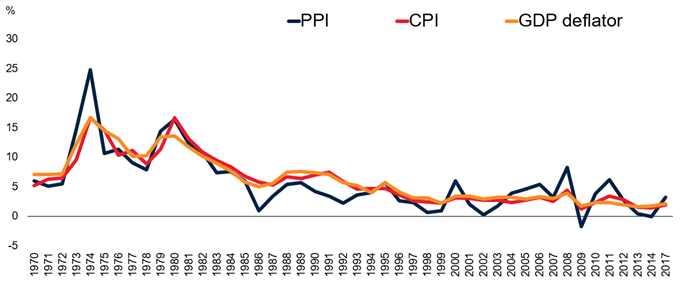
PPI vs CPI vs GDP Deflator

Source: World Bank

Sources of Inflation

Inflation can begin via many avenues in isolation or combination. Below are a few of the primary sources of inflation that can distress any nation across the globe:

Exchange Rates

A weakening local currency means that more local currency is required to purchase imports. This increased cost gets passed on to the end consumer which can contribute to inflation.

Essential Commodity Prices

Most manufacturers require inputs to produce a certain good. These often come in the form of commodities such as iron ore or oil. If these inputs increase in price due, then those costs can be passed on to consumers and the higher costs are a form of inflation.

Interest Rates

Lower interest rates theoretically lead to more spending by consumers, ultimately resulting in greater demand and cost of goods; which should lead to inflation, all factors held equal.

Government Debt

Increases in government debt may infer that there is a greater potential of a government default, which leads to higher yields on treasury securities to compensate potential investors for the higher risk. The effect this has on the public is that more tax revenue will be allocated to the higher interest payments on government debt obligations which reduces living standards. Businesses in turn increase the prices of goods and services to offset the lessened government expenditures, and this can lead to inflation.

The sources listed above generally fall into two broad categories of inflation which are:

  1. Demand-Pull Inflation – This type of inflation comes as a result of an increase in aggregate demand inclusive of households, governments, foreign buyers and businesses.
  2. Cost-Push Inflation – Supply is the driver of inflationary pressure for cost-push inflation. When supply falls due to higher production costs, the outcome is higher final prices for consumers.

Consequences of Inflation

Value of Money

The most obvious penalty of inflation from a consumer point of view is the higher cost of goods and services. This translates to a decrease in the value of money as individuals can now purchase fewer goods and services with the same amount of money prior to an inflationary rise.

Wealth Gaps

The inequitable distribution of inflationary pressure amongst individuals can lead to changes in wealth. For example, individuals with loans during periods of high inflation will benefit as the real value of their debt repayments will fall over time while others may not.

Inflation Volatility

Fluctuating or erratic inflation data complicates business operations as businesses do not know where to set prices, and this can have a negative effect on the economy as both businesses and consumers adjust to the higher rates of inflation. Long-term business deals will also incur higher costs as volatile inflation causes a higher risk premia on hedging costs, which can reduce foreign investor confidence.

Central banks use of Inflation Targeting

Inflation targeting is quite simple in theory as involves a central bank setting a specific inflation goal in percentage terms. This strategy is achieved by manipulating monetary policy. The goal of inflation targeting allows central banks along with the public to have more clarity in terms of future expectations. The reason behind inflation targeting is control with regards to price stability, and price stability can be attained by governing inflation.

Generally an inflation target of 1% – 2% is familiar as it allows governments and central banks some flexibility at this low base. As a rule of thumb, any deviation greater than 1% either side of the targeted figure is cause for concern and has generally lead to policy intervention.

How do Governments Control Inflation?

There are many ways governments go about controlling inflation which can have knock-on effects (positive and negative) to the economy depending on current economic conditions. The most common way is via contractionary monetary policy which is used by central banks to curb inflation by restricting liquidity. This is achieved via 3 main avenues:

1. Decrease Money Supply

Decreasing money supply simply gives consumers less money to spend overall and should help limit inflation. One way this can be realized is by increasing interest on sovereign bond payments which can attract more investors to buy bonds.

2. Reserve Constraints

Restricting the amount of money banks are allowed to keep can influence the amount of money being lent to consumers. That is, if banks are required to keep higher amounts of money as a legal threshold, then naturally banks will have less money to lend. This should decrease consumer spending and thus, inflation.

3. Raising Interest Rates

Higher interest rates which result in fewer individuals willing to borrow and therefore leads to a decrease in spending. There’s also a greater opportunity cost of investing capital into a business given the higher rates of return that could be had through capital markets.

Global Inflation and Key Relationships

Advanced vs Developing Economies
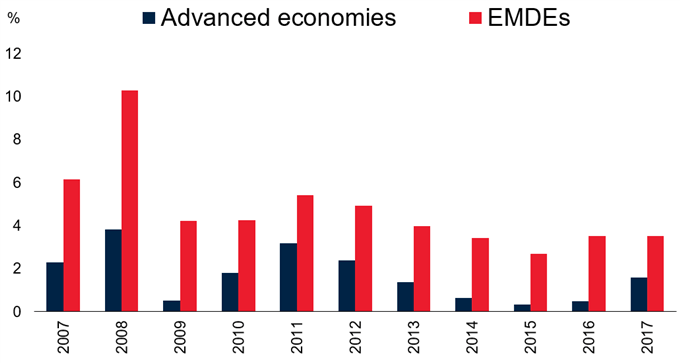
Advanced vs Developing economies

Source: World Bank

The chart above shows a consistent and logical pattern whereby the historical inflation rate in developed countries is generally less than emerging and developing economies (EMDE).There are two primary reasons behind this:

  1. EMDE generally have higher growth rates which can lead to excess demand.
  2. Volatile currencies are present in many EMDE which makes central banks’ management of monetary policy more difficult than those in advanced economies.

The Phillips Curve

The historical relationship between unemployment and inflation has been largely inverse which means that high levels of unemployment correlates with lower inflation and vice versa. The reason why the inverse relationship exists is best explained with basic economics. For example, an increase in aggregate demand which is a consequence of demand-pull inflation, results in higher prices of goods and services and lower unemployment. This lower unemployment means that there is more income available in the economy to spend on goods and services. Both elements have recurrent effects on one another and is best represented by the basic Phillips Curve (see chart below).
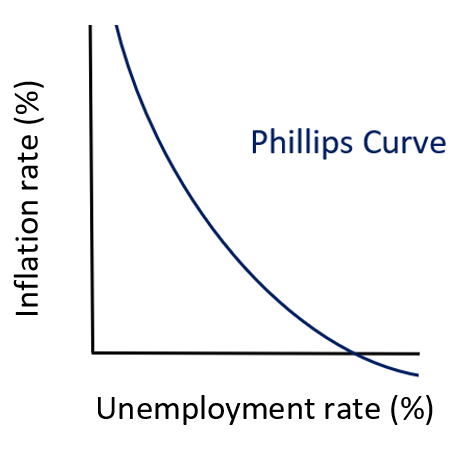
The Phillips Curve

Source: Created by Warren Venketas

Inflation: Conclusion

This article has demonstrated the wide reaching implication of inflation from more concentrated effects to wide-ranging systemic global impacts. Inflation is an important economic tool from a macroeconomic perspective but also can be powerful if understood and implemented within a trading strategy as inflation data can cause changes in price in many financial markets.