EUR/USD rebounds while US Trump’s tariffs threats keep it on tenterhooks

EUR/USD rebounds while US Trump’s tariffs threats keep it on tenterhooks

EUR/USD recovers above 1.0300 in Monday’s European session after a weak opening around 1.0280. The major currency opened on a weak note as investors rushed to the safe-haven fleet on renewed United States (US) President Donald Trump’s tariff fears. The US Dollar Index (DXY), which tracks the Greenback’s value against six major currencies, gives up some of its intraday gains but is still 0.15% higher, around 108.25.

Over the weekend, President Trump threatened to raise 25% tariffs on imports of steel and aluminum, as well as reciprocal tariffs on those nations where he saw unfair trade practices. The biggest casualty of Trump’s decision of 25% tariffs on metals is expected to be Canada, the largest exporter of aluminum to the US. The pressure of higher levies on metals will also be borne by Mexico, Brazil, Vietnam, and South Korea, leading exporters to the US.

The impact of reciprocal tariffs is expected to be lethal on the Eurozone, which charges 10% tariffs on automobile imports from the US and pays 2.5% import duty for domestic autos supplied to it. Such a scenario will be unfavorable for the Euro (EUR), which is already vulnerable due to growing economic contraction risks and inflation undershooting the European Central Bank’s (ECB) target of 2%.

Last week, analysts at Macquarie warned that a US tariff bomb would likely find “fertile ground in the EU,” escalating unresolved issues rapidly into trade tensions, given that “Europe is target-rich”.

The ECB is about to continue reducing interest rates, and a few policymakers have also warned that the central bank might need to go below the neutral rate as the Eurozone economy is not strong enough to support inflation at 2%.

Economists at the ECB have predicted that the bank’s so-called neutral rate will probably be between 1.75% and 2.25%.

In Monday’s session, investors will focus on ECB President Christine Lagarde’s speech at the European Parliament at 14:00 GMT. Lagarde will participate in the plenary debate on ECB Annual Report 2023.

Technical Analysis: EUR/USD struggles around 1.0300
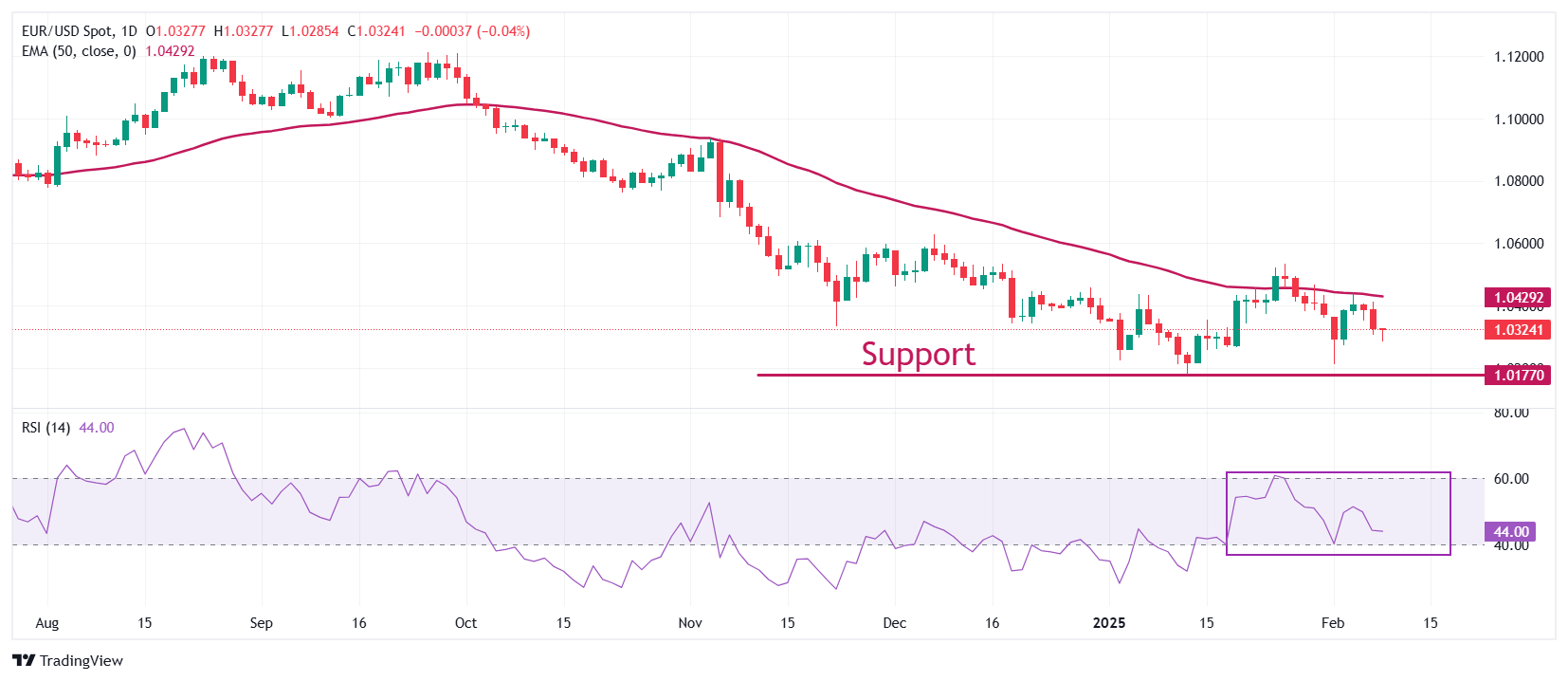
EUR/USD stays under pressure at around 1.0300 in European trading hours on Monday. The major currency pair declined after facing pressure near the 50-day Exponential Moving Average (EMA) around 1.0436 last week, suggesting that the overall trend is still bearish.

The 14-day Relative Strength Index (RSI) oscillates in the 40.00-60.00 range, indicating a short-term sideways trend.

Looking down, the January 13 low of 1.0177 and the round-level support of 1.0100 will act as major support zones for the pair. Conversely, the psychological resistance of 1.0500 will be the key barrier for the Euro bulls.


EUR/USD keeps the red above 1.0300 amid Trump’s tariff threats

EUR/USD keeps the red above 1.0300 amid Trump’s tariff threats

EUR/USD is off the lows but remains in the red above 1.0300 in the European morning on Monday, pressured by a stronger US Dollar amid Trump’s fresh tariff threats. Traders await the Eurozone Sentix data and Lagarde’s speech for fresh trading incentives

The Relative Strength Index (RSI) indicator on the 4-hour chart stays below 40, highlighting the bearish stance. On the downside, 1.0290-1.0300 (Fibonacci 23.6% retracement of the latest downtrend, round level) aligns as first support area before 1.0250 (static level) and 1.0200 (round level, static level).

In case EUR/USD rises above 1.0350-1.0360 (Fibonacci 38.2% retracement, 200-period Simple Moving Average) and flips that area into support, technical buyers could take action. In this scenario, 1.0400 (Fibonacci 50% retracement) and 1.0440 (Fibonacci 61.8% retracement) could be seen as next resistance levels.

EUR/USD holds steady above 1.0300 after starting the week under modest bearish pressure. The near-term technical outlook suggests that buyers remain hesitant.

January labor market data and US President Donald Trump’s comments on trade policy helped the US Dollar (USD) gather strength heading into the weekend, causing EUR/USD to push lower late Friday.

The Bureau of Labor Statistics (BLS) reported that Nonfarm Payrolls (NFP) rose by 143,000 in January, missing the market expectation for an increase of 170,000. On a positive note, November’s increase of 256,000 were revised higher to 307,000, while the Unemployment Rate edged lower to 4.1% from 4% in December. In the meantime, US President Donald Trump said that he will announce “reciprocal tariffs” on many countries this Tuesday or Wednesday. Additionally, Trump announced over the weekend that he plans to impose 25% tariffs on all steel and aluminum imports into the US.

French Foreign Minister Jean-Noel Barrot responded to Trump early Monday, noting that France and its European partners should not hesitate to defend their interests in the face of the US tariff threats.

The economic calendar will not feature any high-tier data releases on Monday. Later in the day, European Central Bank (ECB) President Christine Lagarde will brief the European Parliament on the state of European and global economic affairs and the ECB’s activities.

The uncertainty surrounding EU-US trade relations could make it difficult for the Euro to find demand in the near term.

Japanese Yen stands firm against USD; looks to US ADP for fresh impetus

Japanese Yen stands firm against USD; looks to US ADP for fresh impetus

The Japanese Yen (JPY) retains bullish bias through the early European session on Wednesday, with the USD/JPY pair hanging just above the 153.00 mark or its lowest level since December 13. A rise in Japan’s real wages reaffirms bets that the Bank of Japan (BoJ) will raise interest rates again, which, in turn, provides a strong boost to the JPY. Moreover, the prospects for more policy easing by the Federal Reserve (Fed) would result in a further narrowing of the rate differential between the US and Japan. This turns out to be another factor driving flows toward the lower-yielding JPY.

Meanwhile, expectations that the Fed will lower borrowing costs further by the end of this year drag the US Dollar (USD) to a fresh weekly low and contribute to the heavily offered tone surrounding the USD/JPY pair. However, worries that Japan would also be an eventual target for US President Donald Trump’s tariffs, along with the prevalent risk-on environment, might hold back traders from placing fresh bullish bets around the safe-haven JPY. Traders now look forward to the US ADP report and the US ISM Services PMI for short-term opportunities later during the early North American session.

Gold price bulls not ready to give up yet; overbought conditions warrant some caution

Gold price bulls not ready to give up yet; overbought conditions warrant some caution

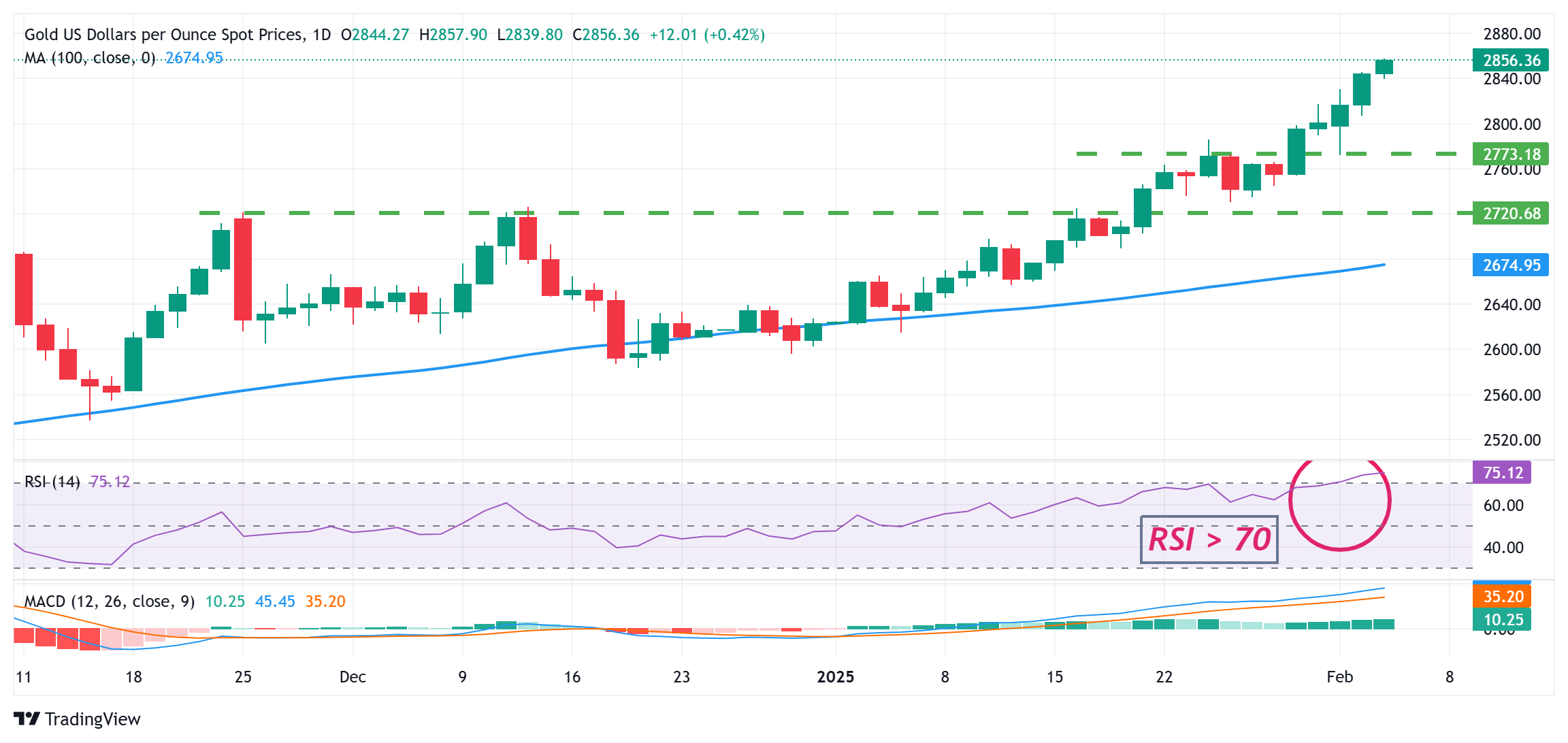
Gold price (XAU/USD) continues scaling higher through the Asian session on Wednesday and advances to a fresh all-time peak, around the $2,858 region in the last hour. Concerns about the economic fallout from US President Donald Trump’s trade tariffs continue to underpin demand for the safe-haven bullion. Furthermore, expectations that the Federal Reserve (Fed) would maintain its easing cycle, bolstered by signs of slowing momentum in the US labor market, contribute to driving flows towards the non-yielding yellow metal.

Meanwhile, the US Dollar (USD) languishes near the weekly low amid the prospects for further policy easing by the Fed and turns out to be another factor lending additional support to the Gold prices. That said, Trump’s decision to delay tariffs against Canada and Mexico remains supportive of the risk-on mood, which could cap gains for the XAU/USD amid slightly overbought conditions on the daily chart. This makes it prudent to wait for a near-term consolidation or a modest pullback before positioning for an extension of the recent upward trajectory. Traders now look to the US ADP report on private-sector employment and the US ISM Services PMI for some impetus.

Gold price needs to consolidate its recent gains amid overbought conditions on the daily chart

fxsoriginal

From a technical perspective, the Relative Strength Index (RSI) on hourly and daily charts is flashing slightly overbought conditions, warranting some caution for bullish traders. That said, the recent breakout momentum beyond the $2,800 mark suggests that the path of least resistance for the Gold price remains to the upside. This, in turn, supports prospects for an extension of the recent well-established uptrend from the December 2024 swing low.

In the meantime, any corrective slide now seems to find some support near the $2,830 area ahead of the $2,800 mark. A further decline could be seen as a buying opportunity and is more likely to remain limited near the $2,773-2,772 horizontal resistance breakpoint, now turned support. A convincing break below the latter, however, might prompt some technical selling and pave the way for deeper losses.

Australian Dollar moves little as traders put eyes on US-China tariff situation

Australian Dollar moves little as traders put eyes on US-China tariff situation

The Australian Dollar (AUD) edges lower against the US Dollar (USD) amid an increased risk aversion following rising fears over US-China trade tensions. The AUD/USD pair failed to draw support from the improved Judo Bank Purchasing Managers Index (PMI) released on Wednesday.

Australia’s Judo Bank Composite PMI climbed to 51.1 in January from 50.2 in December, reflecting modest growth in private sector activity. Meanwhile, the Judo Bank Services PMI rose to 51.2 from 50.8, marking the twelfth consecutive month of expansion in the services sector. Although growth was moderate, it was the strongest since August.

The AUD may further depreciate amid the increased likelihood that the Reserve Bank of Australia (RBA) could consider a rate cut in February. The RBA has maintained the Official Cash Rate (OCR) at 4.35% since November 2023, emphasizing that inflation must “sustainably” return to its 2%-3% target range before any policy easing.

The Aussie Dollar faces challenges as market volatility remains a concern as investors closely watch the ongoing trade war between the United States (US) and China, Australia’s key trading partner. China retaliated against the new 10% US tariff that took effect on Tuesday. However, Trump stated on Monday afternoon that he would likely speak with China within the next 24 hours. He also warned, “If we can’t reach a deal with China, the tariffs will be very, very substantial.”

Technical Analysis: Australian Dollar breaks above nine-day EMA and descending channel

The AUD/USD pair trades near 0.6250 on Wednesday. Sustained price action above the descending channel pattern on the daily chart indicates a potential bullish shift. The 14-day Relative Strength Index (RSI) sits at the 50 level, reflecting neutral momentum. A sustained break above 50 on the RSI could confirm a stronger bullish trend.

On the upside, the AUD/USD pair could explore the area around its seven-week high at 0.6330 level, which was recorded on January 24.

The AUD/USD pair may find immediate support at the nine-day Exponential Moving Average (EMA) near 0.6240, followed by the upper boundary of the descending channel. A pullback to the channel would reinforce the bearish bias, potentially driving the pair toward the lower boundary of the descending channel around 0.6140.

AUD/USD: Daily Chart

EUR/USD rebounds while US Trump’s tariffs threats keep it on tenterhooks

EU prepares to hit Big Tech in retaliation for Trump’s tariffs

Citing two officials with knowledge of the plans, the Financial Times (FT) reported on Wednesday that the European Commission is preparing to deploy its “anti-coercion instrument” (ACI) in a potential retaliation to US President Donald Trump’s tariffs, which would enable the European Union (EU) to target US service sectors like Big Tech.

One of the officials said that “all options are on the table” and emphasized that the ACI was the most forceful response possible without violating international law.

Market reaction

EUR/USD appears unperturbed by these headlines, adding 0.14% on the day to retest 1.0400.

EUR/USD lacks firm intraday direction, stuck in a range around 1.0375-1.0380 zone

EUR/USD lacks firm intraday direction, stuck in a range around 1.0375-1.0380 zone

EUR/USD consolidates in a range near the weekly high touched earlier this Wednesday. The USD struggles to lure buyers amid Fed rate cut bets and lends support to the major. Concerns about Trump’s trade tariffs and dovish ECB weigh on the Euro and cap the pair.

The EUR/USD pair struggles to capitalize on this week’s solid recovery from the 1.0200 neighborhood, or the lowest level since January 13, and oscillates in a range near the weekly top touched earlier this Wednesday. Spot prices currently trade around the 1.0375-1.0380 region, nearly unchanged for the day amid mixed fundamental cues.

The Job Openings and Labor Turnover Survey (JOLTS) published on Tuesday pointed to a slowdown in the US labor market and supports prospects for further policy easing by the Federal Reserve (Fed). In fact, the markets are pricing in the possibility that the US central bank will lower borrowing costs twice this year. Apart from this, the risk-on mood keeps the safe-haven US Dollar (USD) depressed near the weekly low, which, in turn, is seen acting as a tailwind for the EUR/USD pair.

Traders, however, seem reluctant to place aggressive bullish bets in the wake of concerns that US President Donald Trump would slap tariffs on goods from the European Union. Adding to this, the European Central Bank’s (ECB) dovish stance, which overshadowed a rise in the Eurozone Harmonized Index of Consumer Prices (HICP) at an annual rate of 2.5% in January, is seen undermining the Euro and contributing to keeping a lid on any meaningful upside for the EUR/USD pair.

Traders now look forward to the release of the final Eurozone Services PMI. Meanwhile, the US economic docket features the release of the ADP report on private-sector employment and ISM Services PMI. Apart from this, speeches by influential FOMC members will drive the USD demand and provide a fresh impetus to the EUR/USD pair. The focus, however, remains glued to the US monthly employment details – popularly known as the Nonfarm Payrolls (NFP) report on Friday.

kl

EUR/USD: Continues to trade in a choppy manner

Euro (EUR) could continue to trade in a choppy manner, probably between 1.0255 and 1.0370. In the longer run, risk is for further EUR weakness; it remains to be seen if it can break and remain below 1.0100, UOB Group’s FX analysts Quek Ser Leang and Peter Chia note.

Risk is for further EUR weakness

24-HOUR VIEW: “EUR gapped lower and plummeted when it opened yesterday. We noted that ‘while it is already oversold, the weakness has not stabilized, and EUR could continue to decline.’ We pointed out ‘support levels are at 1.0175 and 1.0100, and the latter level is likely out of reach for now.’ The subsequent price movements did turn out as we expected. EUR fell to 1.0210 before soaring to close at 1.0344 (-0.17%). The volatile price action has resulted in a mixed outlook. Today, EUR could continue to trade in a choppy manner, probably between 1.0255 and 1.0370.”

1-3 WEEKS VIEW: “We continue to hold the same view as yesterday (03 Feb, spot at 1.0245). As indicated, ‘the risk is for further EUR weakness.’ However, we highlighted that ‘it remains to be seen if it can break and remain below 1.0100.’ Overall, only a breach of 1.0380 (no change in ‘strong resistance’ level) would indicate that the weakness in EUR has stabilized.”

Oil: No change to OPEC+ output policy – ING

Oil: No change to OPEC+ output policy – ING

The oil market gave back a lot of its gains yesterday after Mexico and Canada came to a deal with the US, which saw a delay in the implementation of tariffs. Both Mexico and Canada agreed to put more resources on their border to combat the flow of fentanyl to the US. The delay has seen crude oil prices coming under further pressure in early morning trading today with NYMEX WTI down more than 1%, while NYMEX RBOB and ULSD are under relatively more pressure, ING’s FX analysts Francesco Pesole notes.

OPEC+ recommends no change to its output policy

“Unsurprisingly fears over tariffs on Canadian oil saw the differential for West Canada Select (WCS) widening relative to WTI. The differential widened by US$1.55/bbl to a discount of US$17.84/bbl yesterday – the weakest the differential has been since July 2024. The differential has been weakening for much of this year, given concerns over tariffs. Clearly, with still plenty of uncertainty over trade it would be wise for Canada to start investing in further pipeline capacity from its producing regions to its east and west coasts.”

“OPEC+ held its Joint Ministerial Monitoring Committee (JMMC) meeting yesterday, and as widely expected the group recommended no change to its output policy. This suggests that the group is likely to go ahead with the unwinding of their additional voluntary supply cuts from April. The group is scheduled to bring back around 2.2m b/d of supply over an 18-month period starting in April. Obviously, the return of this supply will still be dependent on market conditions.”

“Preliminary production numbers show that OPEC production fell by 70k b/d MoM to 27.03m b/d in January according to a Bloomberg survey. Iraq led the declines, with its output falling by 110k b/d to 4.01m b/d. This reduction was largely due to a fire at the Rumaila oilfield.”

mmm

EUR/USD holds losses near 1.0300 amid mounting trade tensions

EUR/USD trades with sizeable losses near 1.0300 in early Europe on Tuesday. The pair loses ground on renewed haven demand for the US Dollar as China retaliates to US tariffs with counter-tariffs, hitting risk sentiment. Markets remain wary of potential US tariffs on the Euro area.

Technically, EUR/USD is navigating uncertain waters. The pair finds initial support at the weekly low of 1.0209 (February 3), prior to 1.0176, its lowest point this year. A drop below this level could pave the way for a move toward 1.0000.

On the upside, resistance is spotted at 1.0532 (the YTD peak from January 27), with further hurdles at the December peak of 1.0629 and the 100-day Simple Moving Average at 1.0651.

Momentum indicators add to the caution: the Relative Strength Index (RSI) has dipped below 40, hinting at weakening momentum, while the Average Directional Index (ADX) near 22 suggests the current trend is losing steam.

In quite a dreadful start to the new trading week, the Euro (EUR) gapped lower and plummeted to multi-week lows around the 1.0200 region on the back of the abrupt resumption of the demand for the US Dollar (USD).

The strong uptick in the Greenback came as market participants adjusted to news over the weekend that President Donald Trump unleashed a 25% tariff on Canadian and Mexican goods and a 10% charge on Chinese imports.

Against that backdrop, the US Dollar Index (DXY) surged to new three-week highs just below the key 110.00 hurdle. The pronounced advance in the US Dollar, however, lost some traction afterwards in response to some delay in the implementation of tariffs in Mexico. Despite the latter, the tariffs narrative remained a strong support for the Greenback and emerged as a strong driver behind the expected bullish outlook for the currency in the current year.

Fed-ECB divergence to weigh further on EUR

Central banks are now under the microscope. The Federal Reserve (Fed) chose to keep interest rates unchanged on Wednesday, offering little hint about when a cut might come. Despite robust economic growth, persistent inflation, and low unemployment, the Fed remains cautious. In a notable shift, it moved from saying inflation “has made progress” to describing price pressures as “elevated,” signaling a more watchful approach as it waits for clearer signs of cooling inflation. The decision to maintain the federal funds rate at 4.25%-4.50% highlights a wait-and-see strategy amid concerns over the impact of Trump’s trade and fiscal policies.

Across the Atlantic, the European Central Bank (ECB) met expectations by cutting rates by 25 basis points and hinted at more easing in the future. The ECB remains hopeful that eurozone inflation will gradually come under control, even as global trade worries persist. While the eurozone economy is still sluggish, recent surveys suggest some improvement, and with inflation just above the ECB’s 2% target, the rate cut was seen as justified.

In her press conference, President Christine Lagarde emphasized that the ECB isn’t planning to lower rates below neutral levels to stimulate the economy. She explained that decisions are data-driven, without any commitment to a rapid pace of easing. Lagarde made it clear that a drastic 50 basis point cut was never on the table—only a 25 basis point reduction had unanimous support. She expressed confidence that bloc inflation would reach the 2% target by 2025 but warned that rising global trade tensions could continue to slow economic growth in the near term.

Profit amid the turmoil: Who gains in a trade war?

Tariff tensions, especially those driven by US policy, could further complicate the path of the euro in the near-to-medium term. If tariffs persist, they might fuel US inflation and prompt the Fed to adopt an even more hawkish stance, thereby strengthening the dollar and pressuring its rivals—potentially paving the way for EUR/USD to return to the key parity level.

Negative outlook

Looking ahead, the euro faces a challenging road. The US Dollar’s resilience, divergent central bank policies between the ECB and the Fed, and structural issues within the eurozone—such as Germany’s slowing economy—could all hinder sustained gains for the single currency. While short-term rallies might occur, the overall outlook for the euro remains uncertain.