mmty

USD/CAD: US postpones the imposition of tariffs on Canada

The United States has once again postponed the imposition of tariffs on Canada until April 2nd. Coupled with the continuous weakening of the US Dollar (USD) and the stabilization of oil prices, the Canadian Dollar (CAD) continued to rise, by 0.30% on Thursday, against the US dollar, OCBC’s FX analysts Frances Cheung and Christopher Wong note.

USD/CAD to trade in a wider range between 1.4194-1.4793

“The temporary tariff deferral only applies to Canadian export products that meet the requirements of the Canada-United States-Mexico Agreement, and approximately 62% of Canadian imported products may still face a 25% tariff.”

“Canada stated that it will not lift the tariffs previously imposed on US goods worth CAD 30 billion but agreed to postpone the second round of retaliatory tariffs worth CAD 125 billion until April 2nd. It is expected that the currency pair will continue to be volatile in the short term, with two-way trades.”

“Pay attention to the trading range of 1.4300-1.4542, and a wider range is between 1.4194-1.4793.”

images

EUR/USD climbs to multi-month highs above 1.0850

EUR/USD gathers bullish momentum and trades at its highest level since early November above 1.0850 on Friday. The US Dollar struggles to shake off the bearish pressure as investors await February employment data, allowing the pair to stretch higher.

The Relative Strength Index (RSI) indicator on the 4-hour chart stays near, suggesting that EUR/USD remains technically overbought.

On the upside, first resistance could be spotted at 1.0900 (static level, round level) ahead of 1.0940 (static level from November) and 1.1000 (round level, psychological level). Looking south, supports could be spotted at 1.0800 (round level, static level), 1.0760 (static level) and 1.0730 (200-day SMA).

Following the March policy meeting, the European Central Bank (ECB) decided to lower key rates by 25 basis points (bps), as widely anticipated. In its policy statement, the ECB repeated that future interest rate decisions will be based on “the assessment of inflation outlook in light of incoming economic and financial data, dynamics of underlying inflation, and strength of monetary policy transmission.” While speaking to reporters in the post-meeting press conference, ECB President Christine Lagarde said that they will remain data-dependent and make decisions on a meeting-by-meeting basis. Amid a lack of fresh clues on the ECB policy outlook, EUR/USD spent the day fluctuating in a relatively tight range.

Nonfarm Payrolls (NFP) in the US are forecast to rise by 160,000 in February, following the disappointing 143,000 increase recorded in January. A reading close to 200,000 could support the US Dollar (USD) with the immediate reaction. Investors could also see that as an opportunity to book some profits, triggering a downward correction in EUR/USD.

On the other hand, a disappointing jobs report could feed into concerns over an economic downturn in the US and make it difficult for the USD to hold its ground. According to the CME FedWatch Tool, markets are currently pricing in about 50% probability of a Federal Reserve policy hold in May, suggesting that the USD is facing a two-way risk heading into the event.

mail

World stock market holidays: March 2025

LiteFinance has updated its trading schedule for March 2025 due to international holidays and weekends, and you are advised to check the new schedule on their website for any additional changes.

Note

  • Review the updated trading schedule on LiteFinance’s website. here
  • Contact LiteFinance’s support team for any questions. here
World stock market holidays
We would like to inform you about the changes in LiteFinance’s trading schedule during this month due to the upcoming international holidays and weekends on stock exchanges.
You can find out about changes to the trading schedule on our website.
This information is for reference only and is subject to change. Please check the current schedule in the Company news section on the official website for any additional changes.
You can always find the trading schedule for each trading instrument in the Info on the instrument section in your Client Profile.
Should you have any questions, please contact our support team.
dollar

CAD holds range on the day

So, the 25% tariff regime might have had a very short shelf life after all and we might be looking at low double digit border tariffs now, Scotiabank’s Chief FX Strategist Shaun Osborne notes.

Market awaits developments

“That’s still not great, only relatively less painful. But it might be about where markets have priced broader tariff risks into the Canadian Dollar (CAD) at this point which means downward pressure on the CAD may ease as we assess the outlook for additional tariffs moving forward. The CAD has gained little in overnight trade after rallying into the close yesterday and may struggle to push much higher while tariff uncertainty persists.”

“A rebound in risk appetite and narrower US/ Canada spreads are modest tailwinds for the CAD but rightsizing spot to its estimated fair value equilibrium (currently 1.4224) may have to wait for clarity on what the ultimate tariff regime facing Canada looks like. Note markets have pared expectations for next week’s BoC policy decision somewhat, pricing in 18-19bps of cuts, from all but fully pricing in a 1/4 -point cut yesterday.”

“Spot has swung sharply between 1.4370 and 1.4545 since the start of the week, defining near-term ranges. Those ranges are holding this morning, with the market reluctant to lean too hard on USD/CAD. A break under 1.4350/70 should drive spot lower, potentially towards 1.4200/50 on a range extension trade, however.”

nm

GBP pulled through 200-day MA by softer USD tone

Pound Sterling (GBP) is enjoying the ride provided by the generally softer USD and the additional tow from the EUR lifting its European peers, Scotiabank’s Chief FX Strategist Shaun Osborne notes.

Sterling gains push through Cable’s 200-day MA

“UK PMI data was left largely unchanged from the preliminary reports; February Services activity was marked down a tenth to 51.0 while the Composite index was left unchanged at 50.5.”

“Sterling gains have pushed through Cable’s 200-day MA (1.27896) and retracement resistance at 1.2764 (50% Fib of the September/January decline). Look for support on dips to the upper 1.27s from here and a further push on towards 1.29.”

mun

Silver Price Forecast: XAG/USD climbs to $31.80-$31.85 zone; upside potential seems limited

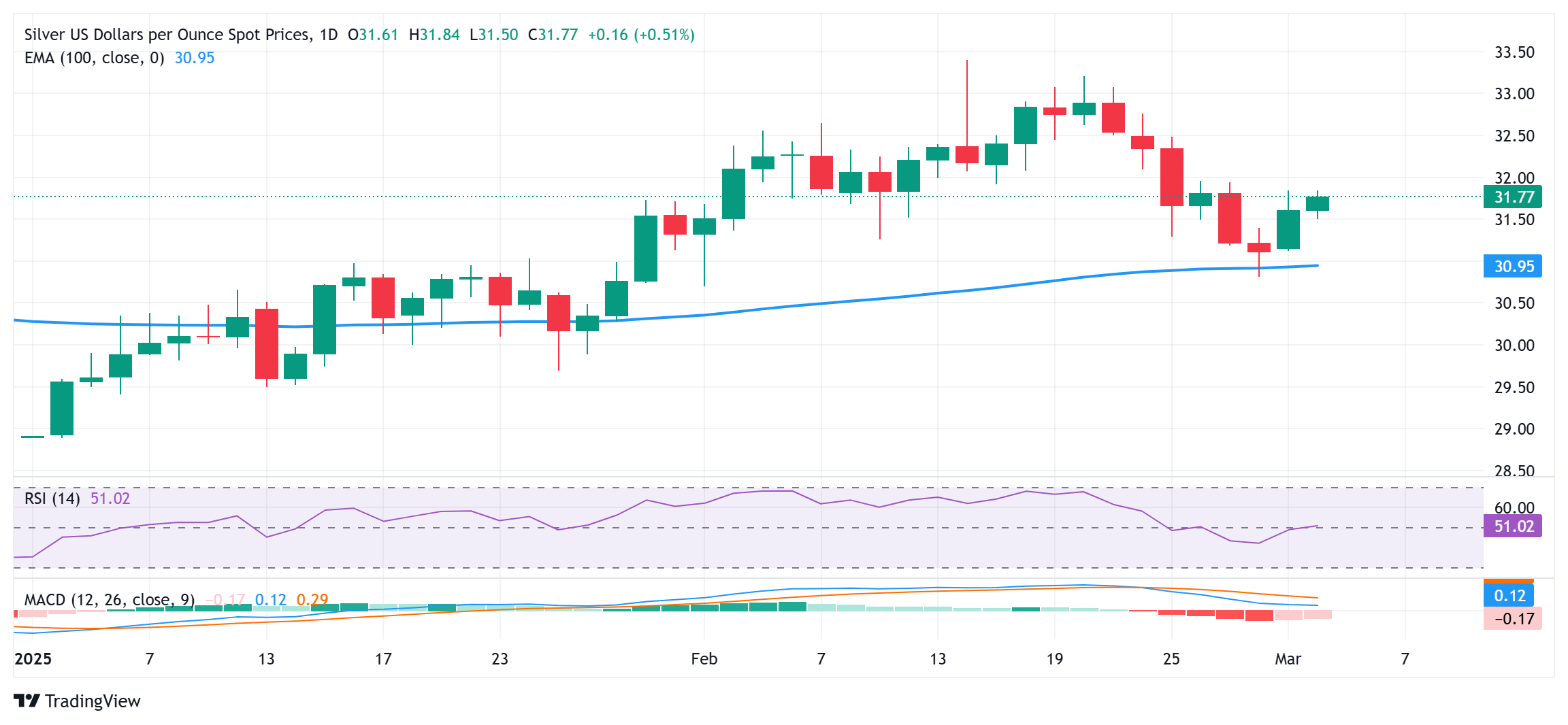
Silver (XAG/USD) attracts buyers for the second straight day on Tuesday and moves further away from a nearly four-week low, around the $30.85-$30.80 region touched last Friday. The white metal climbs to the $31.80-$31.85 region during the first half of the European session, back closer to the overnight swing high, and seems poised to appreciate further.

From a technical perspective, the XAG/USD showed some resilience below the 100-day Exponential Moving Average (EMA) last Friday. The subsequent move up validates the near-term constructive outlook for the commodity. That said, oscillators on the daily chart are yet to confirm a positive bias and warrant some caution before positioning for any further appreciation.

Hence, any further move up is likely to confront some resistance near the $31.65 region ahead of the $32.00 mark. Some follow-through buying beyond the latter could trigger a short-covering rally and lift the XAG/USD to the $32.40-$32.45 hurdle. Bulls might then aim to surpass the $33.00 round-figure mark and test the February monthly swing high, around the $33.40 area.

On the flip side, the daily trough, around mid-$31.00s, now seems to protect the immediate downside ahead of the $31.20 area and the $31.00 mark. The latter coincides with the 100-day EMA pivotal support, which if broken decisively will be seen as a key trigger for bearish traders and make the XAG/USD vulnerable to accelerate the fall towards the $30.25 support zone.

The downward trajectory could extend further toward the $30.00 psychological mark en route to the $29.55-$29.50 horizontal support. The XAG/USD could eventually drop to the $29.00 round figure and December 2024 swing low, around the $28.80-$28.75 area.

XAG/USD daily chart

fxsoriginal

mmm

EUR/USD treads water below 1.0500 amid risk-off mood

EUR/USD trades with caution below 1.0500 in the European session on Tuesday. The pair struggles as traders refrain from placing fresh bets on escalating global tariff war and US recession fears, fuelling a risk-off market environment. The focus remains Trump’s tariffs and Fedspeak.

EUR/USD is testing the critical 1.0500 barrier, reversing much of last week’s leg lower.

Should the pair stage a recovery, the first resistance appears at the monthly peak of 1.0528 (February 26), just before the YTD high of 1.0532 (January 27). Further up, traders will watch the 1.0572 Fibonacci retracement (of the September–January slide) and the December 2024 peak of 1.0629.

On the downside, immediate support lies at the weekly low of 1.0359 (February 28), followed by another weekly low of 1.0282 (February 10) and the February low of 1.0209 (February 3). Down from here comes the 2025 bottom of 1.0176 (January 13).

Momentum indicators offer mixed signals, as the Relative Strength Index (RSI) near 55 suggests a pick-up in the bullish momentum, while the Average Directional Index (ADX) near 12 indicates an overall weak trend.

EUR/USD staged a noticeable comeback on Monday, advancing more than a cent from Friday’s two-week lows and reclaiming the area beyond 1.0500 the figure on the back of a pronounced retracement in the US Dollar (USD).

The deep decline in the Greenback prompted the US Dollar Index (DXY) to abandon the area of recent highs and recede to the 106.50 zone amid declining US yields across the curve and steady jitters surrounding US tariffs.

Tariff tensions and geopolitical hopes

Trade issues remained centre stage as President Trump announced last week that 25% tariffs on imports from Canada and Mexico would take effect on March 4. Tariffs can influence currency markets in different ways: if they stoke inflation, the Federal Reserve (Fed) may lean toward tighter monetary policy, which often boosts the USD. However, a significant slowdown in economic activity caused by prolonged trade barriers could push the Fed to adopt a more dovish stance. In Europe, any US move to impose tariffs on EU goods carries the potential to weaken the Euro (EUR) and thus weigh on EUR/USD.

However, the geopolitical factor returned to the scene on Monday, as talks over a potential peace deal in the Russia-Ukraine war lifted spirits and lent much needed oxygen to the riskier assets, all following the disastrous Trump-Zelenskyy meeting at the White House last week.

Central banks in the spotlight

The Fed recently held its policy rate steady at 4.25%–4.50%, citing robust US growth, steady inflation, and a healthy labour market. Fed Chair Jerome Powell has emphasised that it is too soon to consider rate cuts given ongoing inflationary pressures and strong employment figures. Other Fed officials have echoed these concerns, particularly as trade disputes could boost consumer prices and complicate the inflation outlook.

Meanwhile, the European Central Bank (ECB) is expected to lower its main rate by 25 basis points at its meeting on Thursday, as it aims to stimulate sluggish eurozone growth.

Following the bank’s latest event, ECB President Christine Lagarde rejected calls for a larger 50-basis-point cut, choosing to remain data-dependent. Despite the uncertainty surrounding trade, she expressed confidence that inflation will reach the ECB’s target by 2025, implying that any additional easing will be measured.

Short-Term Outlook

For now, EUR/USD remains caught between shifting trade policies, contrasting central bank moves, subdued eurozone growth, and political developments in Germany. Until there is greater clarity on tariffs or a clearer stance from both the Fed and the ECB, the pair may continue to trade within a range.