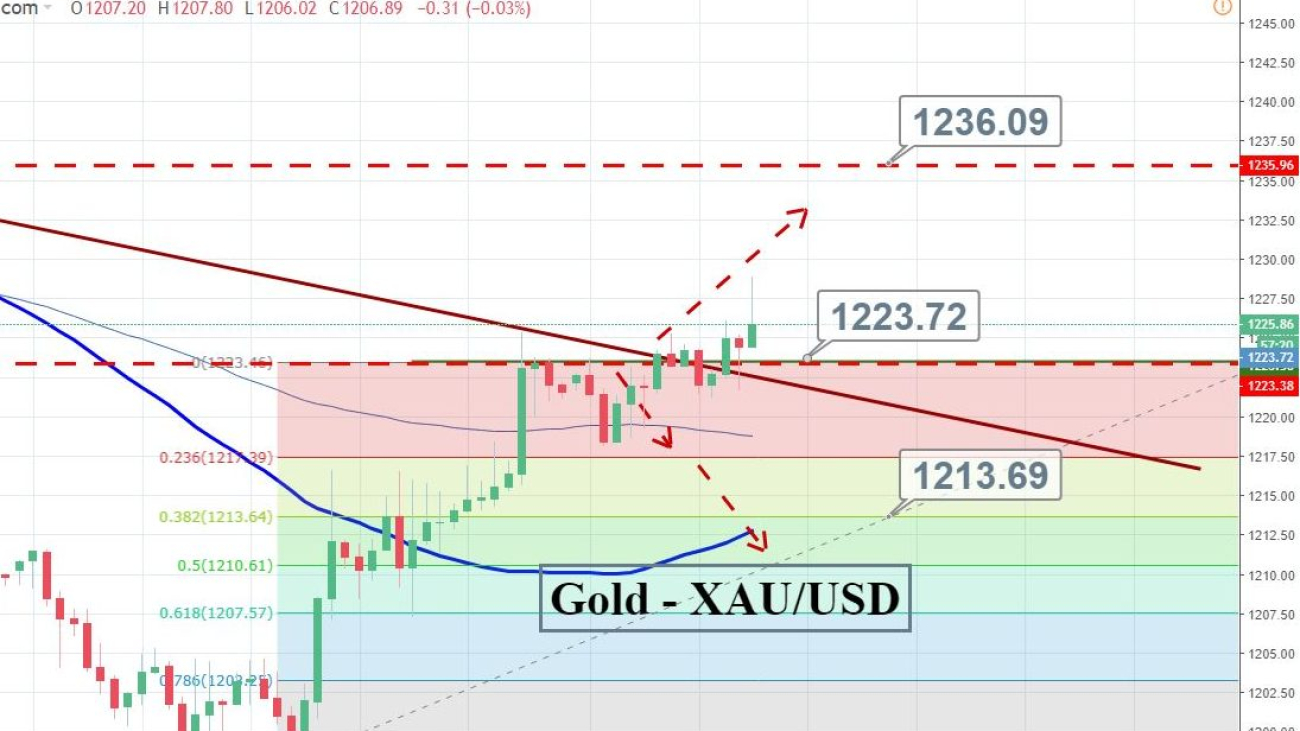
The (silver) price declined in its last intraday trading, with the emerging of the negative signals on the (RSI), after reaching overbought levels lower that the price current move, to form a negative divergens that caused a pressure on the current trading, on the other hand, the price take advantage of the dynamic support that is represented by its trading above EMA50, and under the dominance of the main bullish trend and its trading alongside a minor bias line on the short-term basis.
The GBPUSD dominates bearish correctional wave
The (GBPUSD) price declined in its last intraday trading, affected by the dominance of bearish correctional wave on the short-term basis, which decreases the positive momentum and limits the recovery attempts. This decline came amid the continuation of the trading below EMA50, reinforcing the current negative overview on the near-term basis.
The emergence of the negative signals on the (RSI) increases the selling pressure, indicating the situation of losing the buying momentum and supports the continuation of the bearish correction, these factors keep the eyes on the next support levels that might be tested if the selling pressure continues.
EURUSD witnesses calm trading
The (EURUSD) declined in its last intraday trading, amid calm trading in tight sideways range trading, after a previous bullish wave that pushed the (RSI)indicators to overbought levels, causing the emergence of bearish signs that might push the price to decline temporarily to offload these conditions.
Despite this limited decline, the main bullish trend remains the dominant in the short- term basis trading, supported by its trading above EMA50, besides its move alongside a bullish bias line, we expect that the price may take advantage of this correctional momentum to gain new power that pushes it to resume the rise.
Crude oil is under negative pressure
The (crude oil) declined in its last intraday trading, affected by the negative signs on the (RSI), after reaching overbought areas, which indicates losing the bullish momentum and might put more selling pressure on the price in the near period, this decline caused surpassing EMA50, intensifying the negative pressures and opening the way for more potential declines.
This decline came amid the continuation of the bearish correctional trend dominance on the short-term basis, as the markets need strong signs for near technical support to stop this decline, which increases the possibilities for completing the current bearish wave unless rebound signals appear or the price settles clearly.
Performance of Gold, Forex, and Oil Signals from BestTradingSignal: +1920 Pips
This is the performance summary of last week’s trading signals as shared on Best Trading Signals, one of the trusted providers featured on the trading signals page of Economies.com. The summary includes results for gold, oil, forex pairs, indices, and crypto.
Summary of Pips/Points Performance
| Asset | Performance |
|---|---|
| Gold | +200 |
| Dow Jones | +210 |
| EUR/USD | -90 |
| US Oil | +250 |
| USD/JPY | +60 |
| US Oil | +90 |
| Gold | -100 |
| Bitcoin | +550 |
| GBP/USD | +180 |
| Gold | +220 |
| Gold | +40 |
| Gold | +160 |
| EUR/USD | +90 |
Note: These signals were provided by Best Trading Signals. Economies.com does not provide trading signals directly, but highlights the top-performing providers on its trading signals page.
Bitcoin inches down amid tariff, interest rate concerns
Bitcoin prices declined on Friday after surrendering recent gains, as traders braced for the upcoming implementation of U.S. President Donald Trump’s trade tariffs and markets scaled back expectations of near-term interest rate cuts — adding pressure on digital assets.
Broader cryptocurrencies also pulled back, despite U.S. lawmakers announcing the long-awaited “Crypto Week,” which will see the discussion of major regulatory bills for the sector.
Bitcoin, the world’s largest cryptocurrency, dropped 0.9% to $108,933.4 by 09:22 GMT, after climbing as high as $110,500 overnight.
Those initial gains were driven by optimism surrounding progress in U.S.–China trade talks, which helped the coin break out of a narrow trading range between $103,000 and $108,000 that had persisted for nearly a month.
Despite the retreat, Bitcoin remained on track for a second consecutive weekly gain.
However, the positive momentum faded under renewed concerns over steep U.S. tariffs and a diminished likelihood of an imminent rate cut. Adding to the pressure was Congress’ approval of Trump’s sweeping tax and spending package, which is estimated to significantly expand the national debt in the coming years.
Trading volumes were expected to remain subdued Friday amid the U.S. Independence Day holiday.
Bitcoin retreats amid tariff and rate cut concerns
Bitcoin pulled back from Thursday’s highs after Trump announced plans to begin sending letters to major economies outlining the new tariff regime, starting Friday.
According to Trump, between 10 and 12 countries would receive the letters, detailing tariffs ranging from 10% to 20%, and potentially as high as 60%–70%, set to take effect on August 1.
His remarks sparked renewed concerns over the economic fallout of such measures, which could cause major disruptions to global trade.
Analysts noted that the lack of clarity surrounding U.S. trade policy has also been a key reason why the Federal Reserve has held interest rates steady. Fed Chair Jerome Powell recently warned of the inflationary risks such tariffs could trigger.
Meanwhile, Thursday’s stronger-than-expected U.S. jobs report reduced market bets on a July rate cut, and expectations for September easing were also scaled back.
It’s worth noting that digital assets typically react negatively to higher interest rates, as they reduce the liquidity available for riskier investments.
Crypto market softens despite legislative buzz in Washington
The broader crypto market saw modest declines Friday, despite the announcement of Crypto Week in the U.S. Congress — which, so far, has failed to spark an immediate rebound in prices.
Members of the House of Representatives declared that the week of July 14 will be dedicated to digital asset legislation, with three major bills expected to advance:
The GENIUS Act: A comprehensive framework for regulating stablecoins
The CLARITY Act
The Anti-CBDC Surveillance State Act
Speaker of the House Mike Johnson said in a Thursday statement: “House Republicans are taking decisive action to implement President Trump’s full digital asset and cryptocurrency agenda.”
Was Bitcoin’s move to $110,000 a breakout or a bull trap?
With Bitcoin hovering below the $110,000 threshold, traders remained divided over the coin’s next move.
Prominent trader Byzantine General posted a chart suggesting the coin may be gearing up for a breakout above $112,000, citing futures data. He noted that rising open interest alongside price movement often precedes sharp price expansions.
However, market order books began to reflect increasing sell pressure. A large block of sell orders appeared around the $110,000 level — often interpreted as profit-taking or resistance from major holders.
On the other hand, trader KillaXBT noted that Bitcoin had recently swept liquidity above resistance and below support, only to reverse quickly — a behavior typical of “fakeouts” aimed at liquidating leveraged traders before a genuine directional move.

Gold on track for weekly gains amid fiscal concerns
Gold prices rose in European trading on Friday, resuming gains that had briefly paused the previous day, and heading toward a weekly advance. The metal found support from safe-haven demand amid mounting concerns over U.S. fiscal stability linked to former President Donald Trump’s tax and spending legislation.
The U.S. dollar’s recent rebound also lost steam in forex markets, with traders awaiting further clarity on whether the Federal Reserve could cut interest rates before September.
The Price
Gold rose 0.55% to \$3,345.14 per ounce, after opening at \$3,326.30 and touching a session low of \$3,323.72.
On Thursday, the metal had fallen 0.95%, marking its first loss in three sessions following strong U.S. labor market data.
Trump’s Tax Bill
Trump’s proposed tax-cut legislation cleared its final hurdle in Congress on Thursday. The bill would fund his immigration agenda, make the 2017 tax cuts permanent, and introduce new tax breaks pledged during his 2024 campaign.
The nonpartisan Congressional Budget Office estimates the bill would add \$3.4 trillion to the U.S. national debt — which currently stands at \$36.2 trillion — over the next decade.
U.S. Dollar
The U.S. Dollar Index fell 0.25% on Friday, resuming losses after two sessions of recovery from a three-year low of 96.38. The decline reflects renewed weakness in the greenback against a basket of major and minor currencies.
As commonly observed, a weaker dollar boosts the appeal of dollar-denominated gold for holders of other currencies.
U.S. Interest Rates
Labor market data released Thursday showed the U.S. economy added 147,000 jobs in June, beating expectations of 111,000. The unemployment rate fell to 4.1% from 4.2%, while forecasts had pointed to a rise to 4.3%.
Following the report, CME Group’s FedWatch tool showed odds of a 25-basis-point rate cut at the July meeting dropping from 25% to just 5%, while the chance of rates staying unchanged rose from 75% to 95%.
Market pricing for a 25-basis-point cut in September also dropped, from 95% to 70%, with the probability of no change in rates increasing from 5% to 30%.
Fed Chair Jerome Powell noted that tariffs have altered the central bank’s rate trajectory.
Outlook for Gold
Edward Meir, analyst at Marex, commented: “Trump’s bill does nothing to restore U.S. fiscal order. Over the long run, that’s bearish for the dollar and bullish for gold.”
Meir added: “If Trump holds firm on July 9 as a deadline and reimposes tariffs, the dollar will almost certainly weaken, potentially pushing gold higher.”
SPDR Holdings
Holdings in the SPDR Gold Trust — the world’s largest gold-backed exchange-traded fund — were unchanged on Thursday, holding steady at 947.66 metric tons, the lowest level since June 18.
Yen rebounds after strong Japanese spending data
The Japanese yen rose in Asian trading on Friday against a basket of major and minor currencies, beginning to recover after two days of losses against the U.S. dollar. The rebound followed the release of strong household spending data in Japan, renewing hopes for solid growth in the world’s third-largest economy.
Household spending surged in May at the fastest pace in nearly three years, boosting optimism for a rebound in domestic consumption, even as U.S. tariffs continue to weigh on sentiment and economic momentum.
The Price
The dollar fell 0.25% against the yen to ¥144.57, down from the day’s opening level of ¥144.91. The session high was ¥144.97.
On Thursday, the yen had lost 0.9% against the dollar, marking its second consecutive daily decline and touching a one-week low of ¥145.23 following stronger-than-expected U.S. employment data.
Jump in Japanese Household Spending
Data released Friday in Tokyo showed household spending in Japan rose by 4.7% year-over-year in May — the fastest increase since August 2022 — well above market expectations of a 1.3% rise. In April, spending had declined 0.1%.
A Ministry of Internal Affairs official attributed the better-than-expected figures to increased outlays on one-off items such as auto-related products and dining out.
The official added that the three-month moving average of household spending has been positive since last December, signaling a recovery in consumption.
Spending and wage trends remain key indicators the Bank of Japan monitors to assess the strength of the economy and to determine the timing of future interest rate hikes.
Strong wage growth is seen as essential to offset surging living costs fueled by inflation.
Japanese companies have agreed to raise wages by 5.25% this year, the biggest annual pay hike in 34 years, according to labor union confederation Rengo on Thursday.
Yutaro Suzuki, an economist at Daiwa Securities, noted that with the yen appreciating and crude oil prices trending lower, real wages are expected to turn positive year-over-year in the second half of 2025 as inflation slows — paving the way for a gradual recovery in consumer spending.
Rate Hike Expectations
Following the data, market pricing for a potential 25-basis-point rate hike by the Bank of Japan at its July meeting rose from 40% to 45%.
Investors now await further data on inflation, unemployment, and wage growth to reassess the likelihood of a rate move.
The USDJPY gathers its gains
The (USDJPY) price declined in its last intraday trading, gathering the gains of its last rises and attempts to recover and rise again, and it is attempting to offload some of the clear overbought conditions on the (RSI), especially with the emergence of negative overlapping signals from them, amid the dominance of bullish correctional wave on the short-term basis and its trading alongside a bias line, supported by its trading above EMA50.
Silver Price gathers its positive strength
The (silver) price declined in its last intraday trading, with the emerging of the negative signals on the (RSI), attempting to offload the overbought conditions, to gather its positive strength that might assist it to recover and rise again, taking advantage of the dynamic support that is represented by its trading above EMA50, and under the dominance of the main bullish trend and its trading alongside a minor bias line on the short-term basis.