The Bank of England: A Forex Trader’s Guide

The Bank of England: A Forex Trader’s Guide

The Bank of England: A Forex Trader’s Guide

The Bank of England (BOE) is the UK’s central bank. Their mission is to promote and maintain monetary and financial stability. It is important for forex traders to keep up to date with the Bank of England’s latest changes to monetary policy because it can have a large effect on the Sterling Pound (GBP) and relevant currency pairs, like the EUR which is highly correlated to the Pound.

Central Bank of England

What is the Bank of England (BOE)?

Established in 1694, the Bank of England is the banker to, and owned by, the British government but is independent when setting monetary policy. Its roles include the setting of monetary policy – which includes targeting interest rates and using other tools to stimulate or contract the economy – producing the UK’s bank notes, supervising some bank payment systems, and ensuring the stability and safety of the financial system.

For traders, the BOE’s setting of monetary policy is a key factor to consider as it can have a big impact on the financial markets. Other factors, like the independence of the central bank are also important but are more prevalent issues in emerging market economies.

Key Economic Mandates of the Bank of England

According to the Bank of England, their two core purposes or mandates are:

1) Monetary stability – which is price stability or inflation

2) Financial stability – which is the stability and health of the economy

Monetary Stability

Monetary policy is extremely important for the entire economy. It prevents runaway inflation and attempts to ground inflation expectations so that the economy can grow at a regular pace. In order to maintain price stability, the Bank of England and their monetary policy committee (MPC) have set an inflation target of 2%.

If inflation goes above the target of 2% the Bank of England may increase interest rates. The increase in interest rates may cause an appreciation in the Pound as investors increase capital flows into the higher yielding currency. It may also have a negative affect on the stock market, as businesses will have to pay higher rates to lend and equity valuations will be discounted at a higher interest rate. Monetary policy data can be found on our economic calendar.

However, it is not always the case that the Bank of England will increase interest rates if inflation is above target. In some cases, like when GDP growth is still low or negative, the Bank of England may keep interest rates low to stimulate the economy. It is important to know the Bank of England will be looking for a balance between healthy inflation and economic growth.

Join our central bank webinar to watch our senior currency strategist discuss and analyze current central bank trends.

Financial Stability

The resilience of the financial system is paramount to the health of the UK economy and therefore necessary for the Bank of England to accommodate. To support Financial Stability mandates, the bank also has a Financial Policy Committee or FPC which was established in June 2011. From an FX point of view, the Monetary Stability is the key driver of spot rates for the GBP.

How BOE interest rates affect the Pound

Interest rate impact on the Pound

The Bank of England can affect the value of the Pound through changes in interest rate expectations. Traders should understand that currencies appreciate when interest rate expectations increase, not just from increases in the nominal interest rate.

For example, if the Bank of England keeps interest rates unchanged but issues forward guidance (tells the market) that they expect more interest rate hikes in future, the value of the Pound will appreciate. Likewise, decreases in future interest rate hike expectations, or expectations of an interest rate cut can lead to a decrease in the value of the Pound.

This is the general principle for how interest rates affect the Pound and stock market, although they sometimes react differently:

  1. Higher interest rate expectations increase the strength of the Pound (GBP) and negatively affect equity values.
  2. Lower interest rate expectations decrease the strength of the Pound (GBP) and positively affect equity values.

Interest rates aren’t the only monetary policy tool that can affect the currency, tools like quantitative easing can also lead to increases and decreases in the value of a currency. If the Bank of England announces that it plans to start a quantitative easing program (QE), the pound will likely depreciate as a large amount of liquidity enters the market, increasing the supply of money in the market and leading to a decrease in interest rates, or, simply to maintain current rates.

Interest rate impact on the economy

The Bank of England lowers interest rates when it is trying to stimulate the economy (GDP) and increases interest rates when it is trying to contain inflation caused by an economy operating above potential (overheating).

Lower interest rates stimulate an economy in a few ways:

  1. Businesses can borrow money and invest in projects that will receive more than the risk borrowing rate.
  2. When interest rates are lower the stock market is discounted at a lower rate, leading to an appreciation in stock market values which causes a wealth effect.
  3. People invest their money into the economy (stocks and other assets) because they can earn more in these assets than at currently low interest rates.

How to trade BOE interest rate decisions

The table below displays the possible scenarios that come from a change in interest rate expectations. Traders can use this information to forecast if the currency is likely to appreciate or depreciate and how to trade it.

Market expectations Actual Results Resulting FX Impact
Rate Hike Rate Hold Depreciation of currency
Rate Cut Rate Hold Appreciation of currency
Rate Hold Rate Hike Appreciation of currency
Rate Hold Rate Cut Depreciation of currency

Let’s look at the example below on GBP/USD. On August 4, 2016 the Bank of England cut interest rates and announced a stimulus package (quantitative easing program). The market reacted negatively and the Pound depreciated.
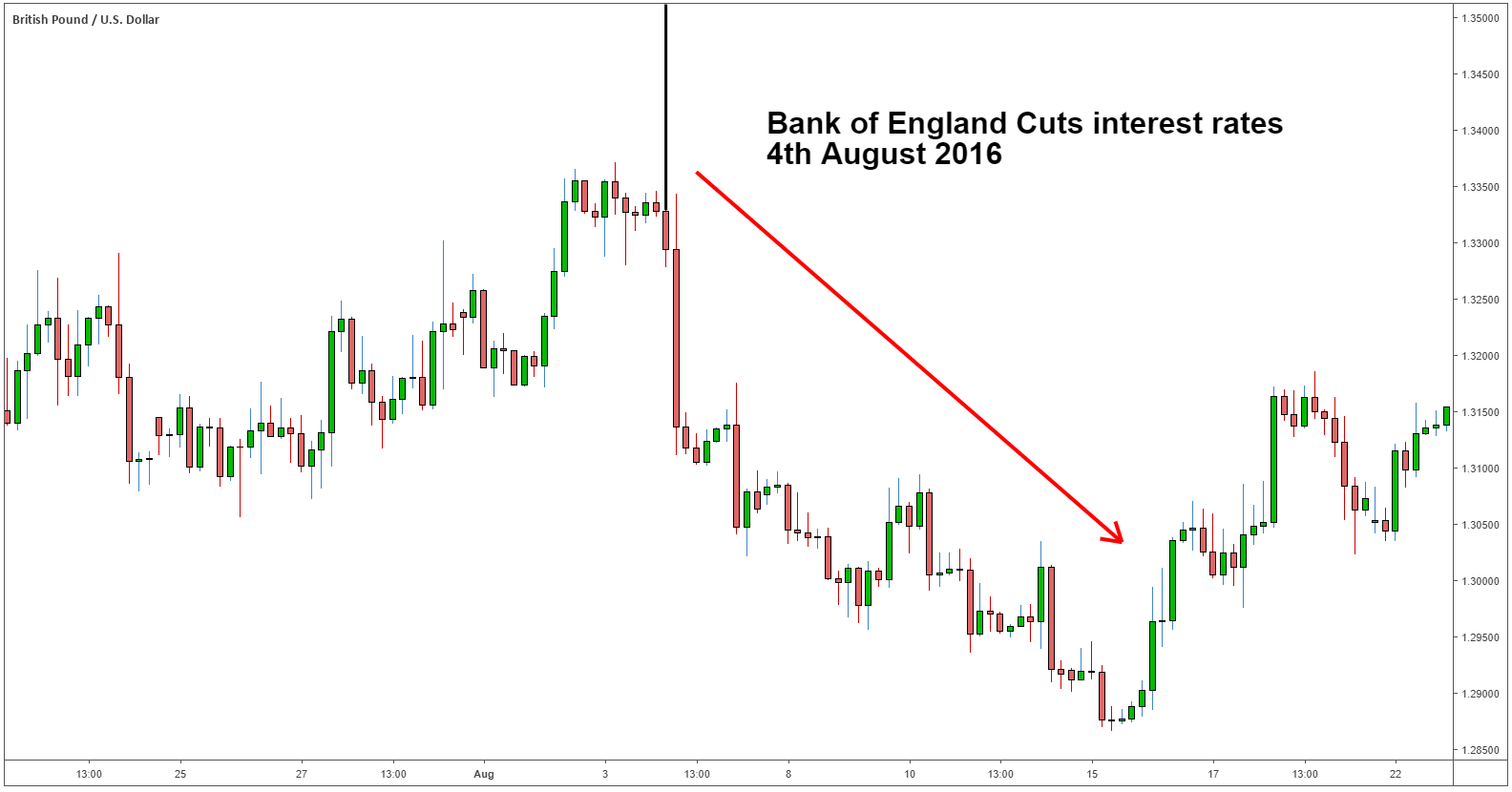
Bank of England cuts interest rate to new low

Top Takeaways of the BOE and Forex Trading

  • The Bank of England is fundamental to the value of the Pound
  • The Pound will appreciate or depreciate depending on changes in interest rate expectations, not just on actual changes.
  • Quantitative easing has a similar effect to changes in interest rates. Changes in expectations of quantitative easing will have an effect on the Pound.
  • Rising inflation does not mean the Bank of England will increase interest rates, it depends on the balance between economic growth and inflation.

Bank of England Leaves Rates Unchanged, GBP/USD Grabs a Small Bid

Bank of England Leaves Rates Unchanged, GBP/USD Grabs a Small Bid

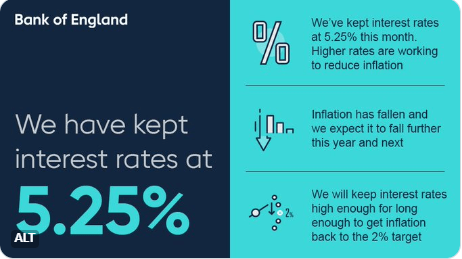
The Bank of England (BoE) left the Bank Rate unchanged today at 5.25%, for the second meeting in a row. Six members of the MPC voted to keep rates unchanged, while three members voted for a 25 basis point increase. The central bank expects to keep interest rates sufficiently restrictive to bring inflation down to target and will raise interest rates again if it is deemed necessary.

image1.png

The Bank of England noted signs of weakness in the UK labour market….

‘The MPC continues to consider a wide range of data to inform its view on developments in labour market activity, rather than focusing on a single indicator. The increasing uncertainties surrounding the Labour Force Survey underline the importance of this approach. Against a backdrop of subdued economic activity, employment growth is likely to have softened over the second half of 2023, and to a greater extent than projected in the August Report. Falling vacancies and surveys indicating an easing of recruitment difficulties also point to a loosening in the labour market. Contacts of the Bank’s Agents have similarly reported an easing in hiring constraints, although persistent skills shortages remain in some sectors.’

….while the central bank also expects headline inflation…

‘to continue to fall sharply, to 4¾% in 2023 Q4, 4½% in 2024 Q1 and 3¾% in 2024 Q2. This decline is expected to be accounted for by lower energy, core goods and food price inflation and, beyond January, by some fall in services inflation.’

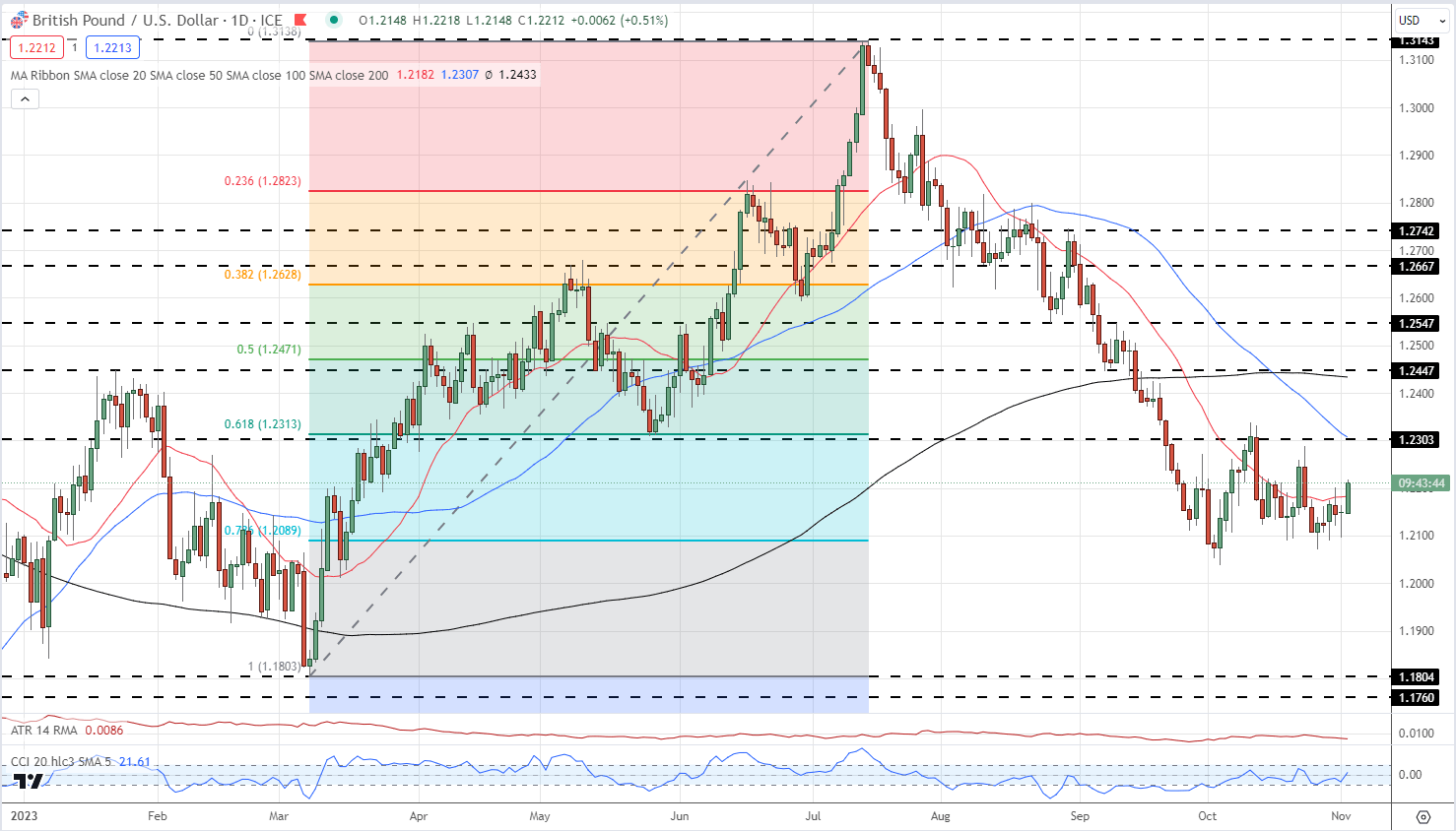
Cable is trading at a fresh one-week high as traders price in a mildly hawkish central bank meeting. The pair are now in the middle of a range defined by the 78.6% Fibonacci retracement at 1.2089 and the 61.8% retracement at 1.2313. The driver of GBP/USD will be Friday’s US Labor Report (NFP) at 12:30 UK.

GBP/USD Daily Price Chart

image2.png

Chart via TradingView

USD Price Update: DXY Drops after FOMC and a Likely Peak in Rates

USD Price Update: DXY Drops after FOMC and a Likely Peak in Rates

Fed holds interest rates but acknowledges Further tightening conditions

Yesterday the Federal Reserve held interest rates steady at 5.25 – 5.50% for the second consecutive meeting. This was largely expected but markets had been pricing in the possibility of a one more rate hike before the end of the year after an impressive run of U.S. economic data which saw U.S. GDP canter to 4.9% (annualized) growth in Q3.

In the FOMC statement The Fed upgraded its language describing the strong performance of the U.S. economy from “solid” to “strong”. In the ensuing press a conference Jerome Powell acknowledged that the economy was however starting to feel the effects of tighter monetary policy but that the committee still sees a greater chance of a further rate hike than it does rate cuts over the coming months. This makes sense as the Fed does not wish to provide a signal for the markets to go ahead and price in immediate rate cuts which would run the risk of loosening financial conditions, posing a risk to inflation.

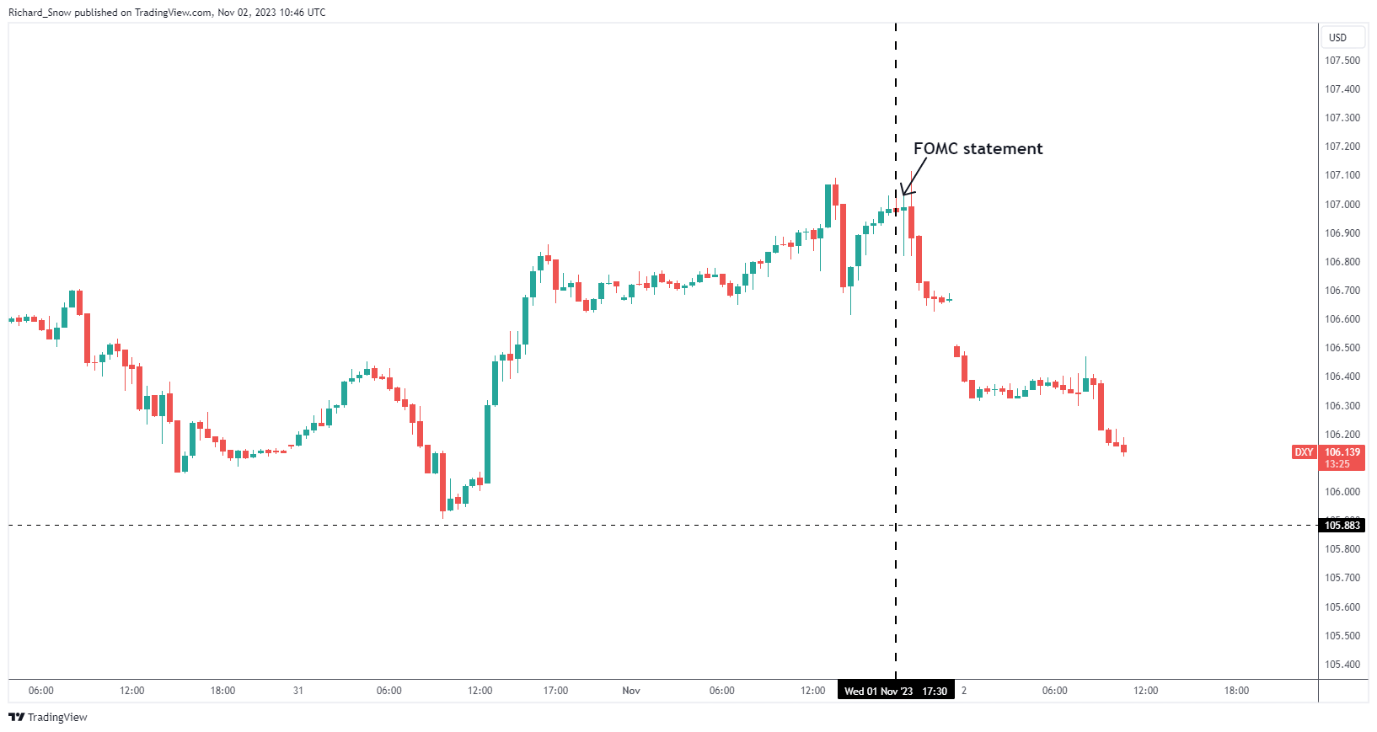
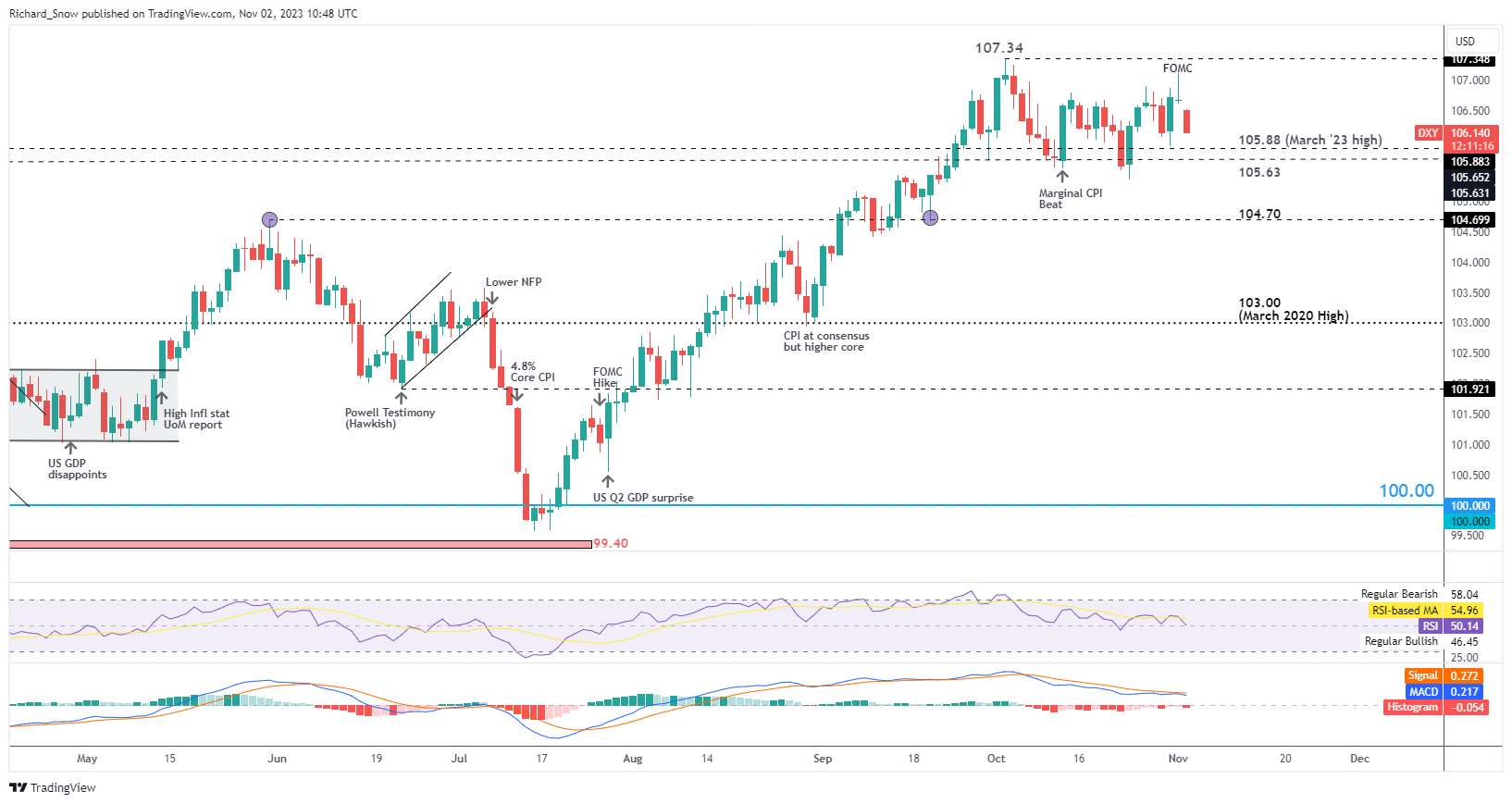
Immediately after the FOMC statement the dollar basket eased in similar fashion to U.S. yields which posted a notable decline in the run up to the meeting. The bar for an extended bullish continuation in the dollar still remains high despite the fact that U.S. data is strong, due to the continuing tightening thanks to elevated yields.

US Dollar Basket (DXY) 30-minute chart

image1.png

Elevate your trading skills and gain a competitive edge. Get your hands on the U.S. dollar Q4 outlook today for exclusive insights into key market catalysts that should be on every trader’s radar:

Are US Treasuries Signaling a Peak in US Interest Rates?

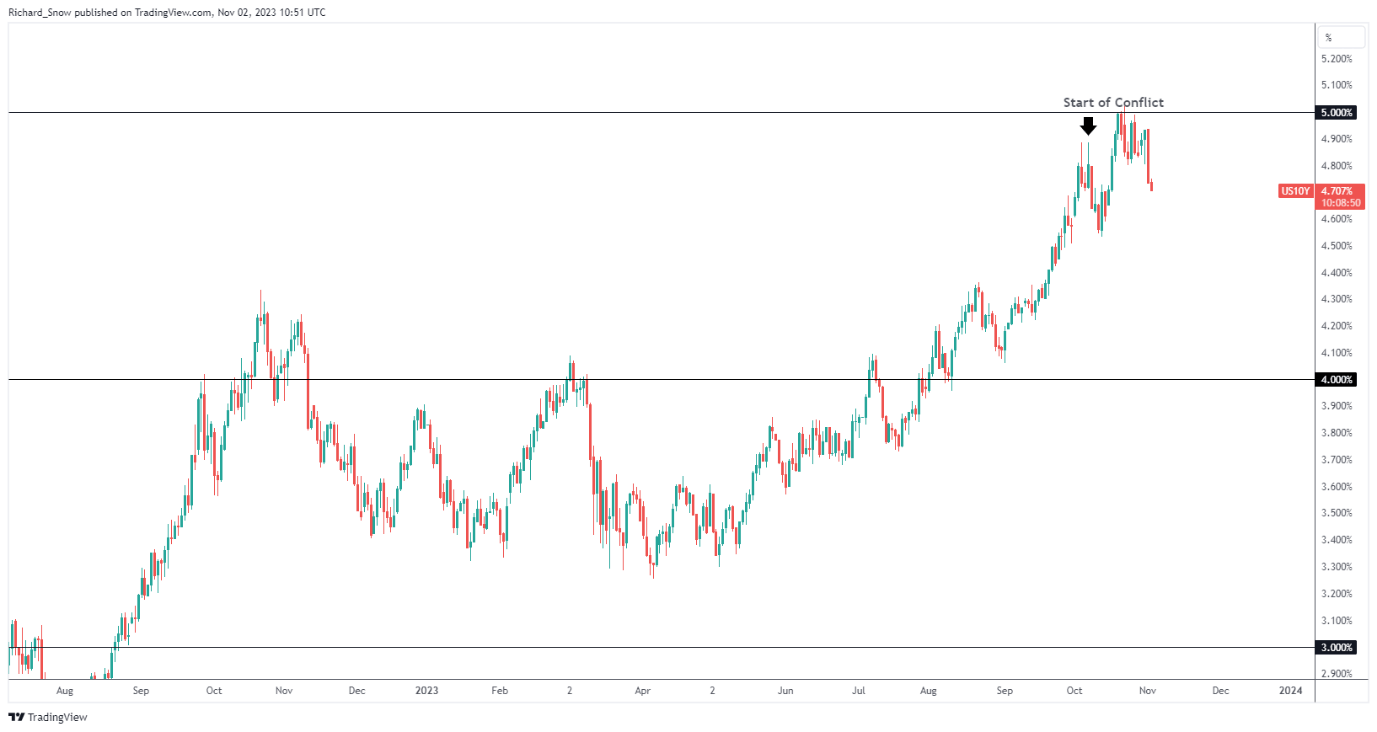
U.S. Treasury yields eased in the lead up to the FOMC announcement potentially suggesting a peak in U.S. interest rates. Longer dated U.S. yields have been extremely elevated through a number of weeks now placing further pressure on financial conditions and credit markets.

US 10 Year Treasury Note Yield

image2.png

Fed funds futures have been rather telling, with recent moves suggesting a lesser likelihood of another rate hike before the end of this year. One month ago markets had priced in just under 40% chance of a rate hike in December and this has slowly been declining. Now it sits at just under 20%.

FedWatch Tool Showing Market Implied Probabilities of Another Rate Hike

image3.png

Markets Turn to Fundamental Data to Gauge the Effect of Restrictive Policy

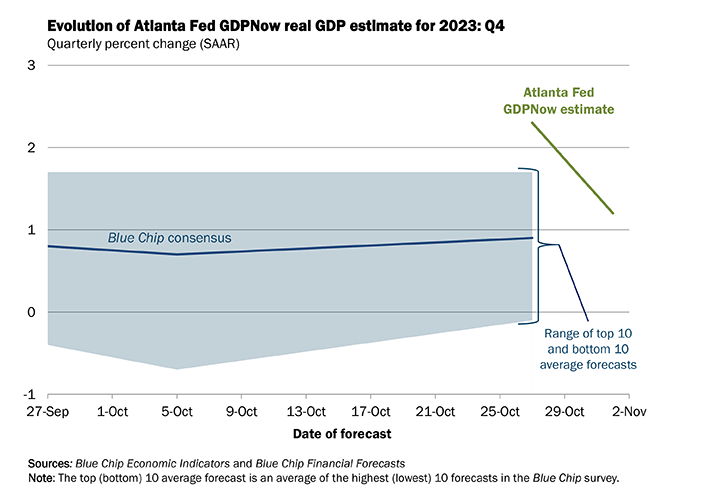
U.S. data has generally been outperforming it’s peers, but yesterday’s ISM manufacturing PMI data missed estimates by some margin and the Atlanta feds very own ‘GDP Now’ forecast has come crashing down from around 4% to a mere 1.2% for fourth quarter growth – based on current data.

It will take a lot to change the narrative of U.S. exceptionalism and these are only a couple of data points but what it does do is highlight the importance of future data as far as it refers to potential stresses within the US economy. Up next we get U.S. ISM services PMI and NFP.

Atlanta Fed’s GDPNow Forecast for Q4 (Based on Current Data)

image4.png

US Dollar Reversed off Yesterday’s High

The dollar reversed sharply after the intraday spike witnessed yesterday and continues the selloff in the London session today. Softer yields have contributed towards the decline along with the notion that interest rates have risen for the final time in this hiking cycle, at least, this is what the market is implying after digesting the statement and words of Jerome Powell.

given all of this it is still difficult to sell be dollar which remains at elevated levels. in the absence of pockets of stress or dislocations appearing in the broader U.S. market conditions may favour a range bound approach, looking to fade USD strength at elevated levels.

US Dollar Basket (DXY) Daily Chart

image5.png


USD/ZAR Price Forecast: Rand Bolstered by Weaker Dollar

USD/ZAR Price Forecast: Rand Bolstered by Weaker Dollar

The South African rand rallied yesterday and this morning against the US dollar after the Federal Reserve decided to keep interest rates on hold (expected). Markets viewed the pause in a dovish light despite Fed Chair Jerome Powell eluding to strong economic data – GDP, high inflation and a strong labor market.

ZAR strength followed amongst weaker South African and Chinese manufacturing PMI’s showing the influence of the US economy on the local currency. Furthermore, total vehicle sales in South Africa fell reaching two month lows.

Yesterday, the Medium-Term Budget Policy Statement (MTBPS) highlighted some of the country’s headwinds including weak economic growth, increasing debt levels and ongoing blackouts (loadshedding). The impact on the rand was minimal but will keep traders wary of the vulnerable economic backdrop within South Africa.

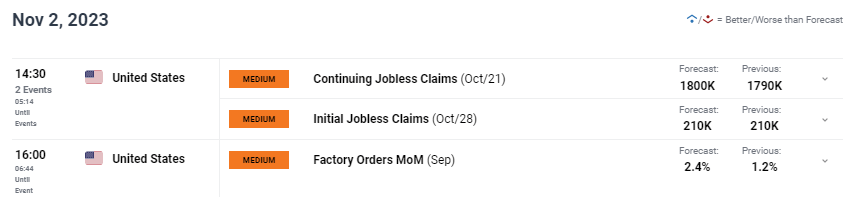
Today’s economic calendar (see below) is fairly light and will be focused on additional US jobs data. Volatility should pick up from tomorrow’s slew of US centric high impact data including the Non-Farm Payroll (NFP) report and ISM services data – US is primarily services driven.

USD/ZAR image1.png

TECHNICAL ANALYSIS

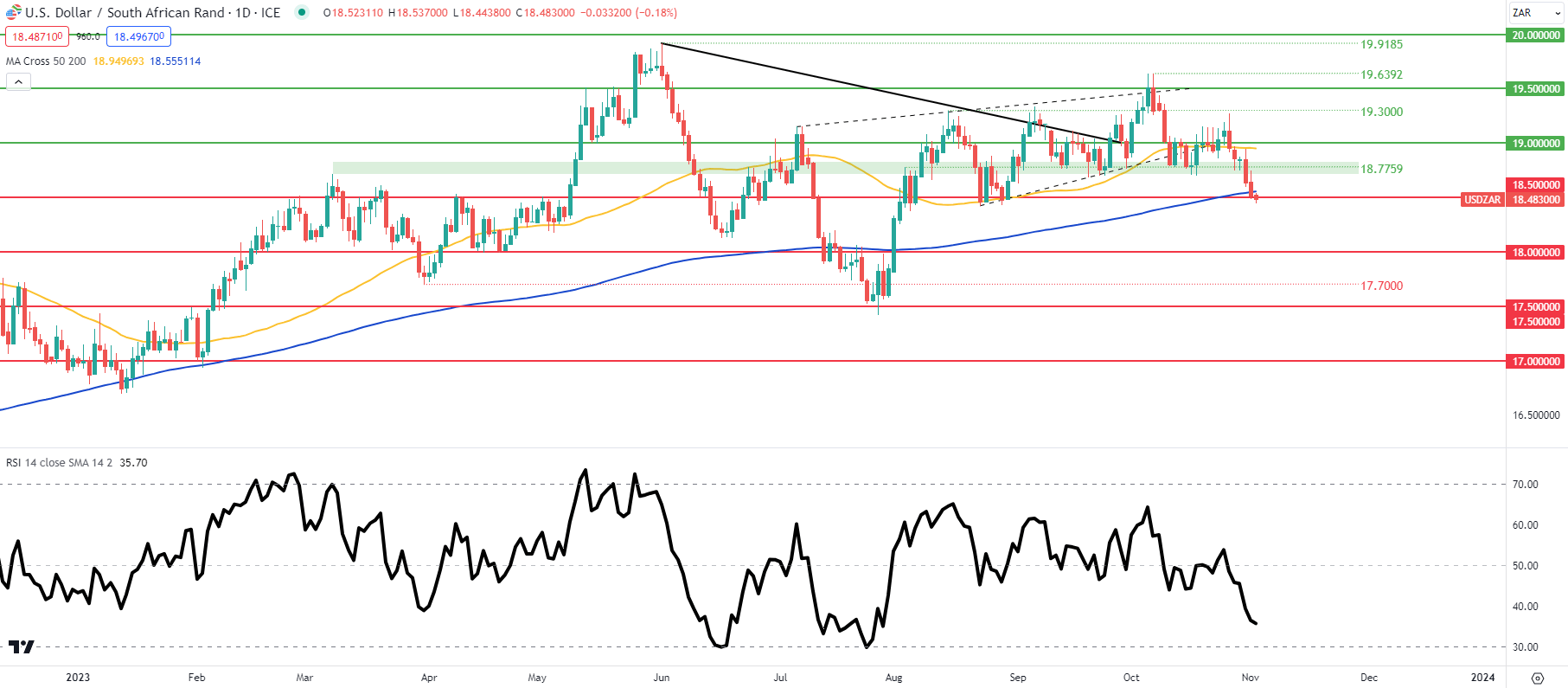
USD/ZAR DAILY CHART

image2.png


As mentioned in my prior analysis, a break below the zone in and around the 18.7759 level would open up the 200-day moving average (blue) and 18.5000 psychological handle respectively. This key area of support could slowdown ZA

EUR/USD Forecast – Euro Gets Hammered Again

EUR/USD Forecast – Euro Gets Hammered Again

Euro vs US Dollar Technical Analysis

During the trading session on Wednesday, traders will be waiting to see what the Federal Reserve has to say. Here, early in the session, we have seen the euro take a significant amount of selling pressure, as the market is now testing the bottom of the bearish flag. Because of this, the market is likely to continue to be tenuous at best, and I suspect we have a situation where the market has to sort out what the Federal Reserve is going to end up doing, because quite frankly, it’s all about the US dollar at this point.

Trading Derivatives carries a high level of risk to your capital and you should only trade with money you can afford to lose. Trading Derivatives may not be suitable for all investors, so please ensure that you fully understand the risks involved, and seek independent advice if necessary. A Product Disclosure Statement (PDS) can be obtained either from this website or on request from our offices and should be considered before entering into a transaction with us. Raw Spread accounts offer spreads from 0.0 pips with a commission charge of USD $3.50 per 100k traded. Standard account offer spreads from 1 pips with no additional commission charges. Spreads on CFD indices start at 0.4 points. The information on this site is not directed at residents in any country or jurisdiction where such distribution or use would be contrary to local law or regulation.

We already know that the European Union is likely to be in a nasty recession this winter, and of course there are the well-known energy issues that are going to be facing the Europeans shortly. With that being the case, the market is likely to continue to see a lot of selling pressure on the Euro going forward. Furthermore, it is noted that perhaps the Federal Reserve has at least one more interest rate hike between now and the end of the year coming, although it’s not expected to happen on Wednesday itself.

Rallies at this point in time should be selling opportunities, at least until we break above the 50-Day EMA, something that doesn’t look very likely to happen in the short term. Beyond that, we also have to pay close attention to the 200-Day EMA above there. All things being equal, this is a situation where the markets will continue to be more or less a “fade the rallies” type of situation, and while I would anticipate that the market eventually sells off, there could be a bit of a rally after the Federal Reserve announcement/statement, as traders will try to find a reason to believe that the Federal Reserve is on the sidelines.

That being said, we have seen this pattern before, and it’s very likely that we will continue to see volatility that favors the downside. If we can break down below the 1.05 level, then it opens up the possibility of a move down to the 1.0250 level. After that, we could be talking about a move down to the parity level.

US Dollar Index News: Powell’s Tone Sets Stage for DXY Amid Global Currency Flux

US Dollar Index News: Powell’s Tone Sets Stage for DXY Amid Global Currency Flux

Critical Moment for U.S. Dollar Ahead of Fed’s Rate Decision

As the Federal Reserve prepares to announce its interest rate decision, all eyes are on Chair Jerome Powell for cues on future monetary policy. With a 99% probability of rates holding steady, according to the CME FedWatch Tool, traders are zeroing in on Powell’s tone and commentary. The market’s focus is shifting towards the Fed’s ongoing quantitative tightening, which increasingly sets the tone for financial conditions.

Domestic Factors: Treasury Yields and Refinancing Plans

On the home front, Treasury yields remain a key variable. While the U.S. Treasury expects lower Q4 borrowing, traders eagerly await details on future refinancing plans. Should these plans hint at rolling a large chunk of this year’s $1.6 trillion in bill sales into longer-term securities through 2024, it could push the already high 10-year yields, currently at 4.89%, even higher.

Trading Derivatives carries a high level of risk to your capital and you should only trade with money you can afford to lose. Trading Derivatives may not be suitable for all investors, so please ensure that you fully understand the risks involved, and seek independent advice if necessary. A Product Disclosure Statement (PDS) can be obtained either from this website or on request from our offices and should be considered before entering into a transaction with us. Raw Spread accounts offer spreads from 0.0 pips with a commission charge of USD $3.50 per 100k traded. Standard account offer spreads from 1 pips with no additional commission charges. Spreads on CFD indices start at 0.4 points. The information on this site is not directed at residents in any country or jurisdiction where such distribution or use would be contrary to local law or regulation.

Economic Indicators: A Mixed Bag

Fed officials are closely watching various economic indicators. Recent data showed an increase in employment cost inflation and a rise in September’s house prices. However, these bullish signs are counterbalanced by softening U.S. consumer confidence and declining oil prices. Overseas demand is also waning, as evidenced by contracting factory activity in key economies like China, Japan, and South Korea.

Global Currency Dynamics

Internationally, the currency landscape is far from stable. The Japanese yen is near a three-decade low against the dollar, partly due to minor adjustments in Japan’s monetary policy. If the yen’s decline continues, Japan may reduce its U.S. Treasury holdings, adding another layer of complexity to Treasury yields. Meanwhile, both the Euro and the British Pound face their own headwinds, adding to the dollar’s uncertainty.

Short-Term Forecast: High Volatility Expected

In conclusion, while it’s likely that the Fed will keep rates stable this time, the U.S. Dollar stands at a precarious juncture. The market is rife with competing economic and financial indicators that traders are trying to decipher. As Powell’s upcoming statements could sway market sentiment, traders should brace for heightened volatility in the dollar, as well as its standing against other major currencies like the Euro, British Pound, and Japanese Yen.

Technical Analysis

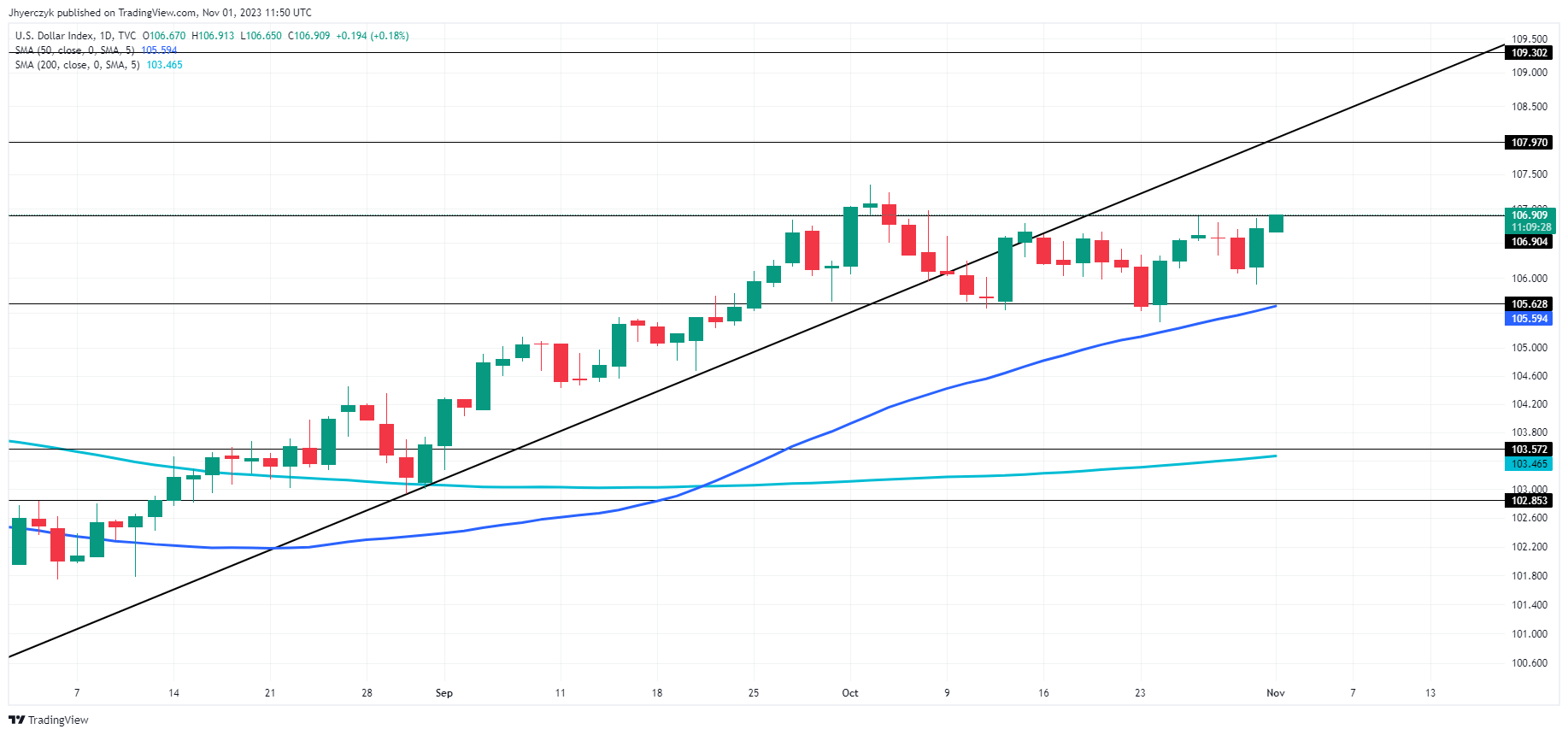
Daily US Dollar Index (DXY)The US Dollar Index (DXY) is currently trading at 106.892, which is near its minor resistance level of 106.904.

The 50-day moving average stands at 105.594, above this short-term average, signaling bullish momentum. Additioinally, it’s trading above its 200-day moving average of 103.464 as well, indicating a longer-term upward trend.

The current daily price is also notably above the main support level of 103.572. Based on the available figures, market sentiment appears bullish. However, it will be vulnerable to the downside if the 50-day moving average fails as support.

ADP Data Reveals Sluggish Wage and Employment Gains in October

ADP Data Reveals Sluggish Wage and Employment Gains in October

U.S. Private Sector Employment Below Expectations in October

October saw modest growth in private sector payrolls, falling short of market expectations, according to data released by ADP. The payroll processing firm reported an addition of 113,000 jobs, an increase from September’s 89,000 but significantly lower than the Dow Jones consensus forecast of 130,000. This development could signal a potential slowdown in the employment sector.

Pay and Sectoral Analysis

Wage growth was also less than stellar, registering a year-over-year increase of just 5.7%, the lowest since October 2021. The breakdown by sectors revealed a more nuanced story. Education and health services led job creation with 45,000 new positions, followed by trade, transportation, and utilities, which added 35,000 jobs. Financial activities and leisure and hospitality were not far behind, contributing 21,000 and 17,000 new jobs, respectively.

Mid-sized Firms Take the Lead

Interestingly, the bulk of the employment gains came from firms with 50-499 employees, which collectively added 78,000 jobs. Almost all the added jobs were in services-providing industries; goods producers made a marginal contribution of just 6,000 jobs. ADP chief economist Nela Richardson noted, “No single industry dominated hiring this month,” emphasizing that the era of large post-pandemic pay increases seems to be waning.

Upcoming Government Data

The ADP report sets the stage for the Labor Department’s upcoming nonfarm payrolls data, expected to show a gain of 170,000 jobs. It’s worth noting that these government figures, which include public sector jobs, have historically differed from ADP’s counts. In September, for instance, the Labor Department reported a staggering 336,000 job gains, more than tripling the ADP estimate.

Short-term Outlook: Cautiously Bearish

Given the miss on job expectations and the slowing pace of wage growth, the short-term outlook for the employment market appears cautiously bearish. Despite the slowdown, Richardson maintains that job growth rates are “still enough to support strong consumer spending.” Market participants should keep a close eye on the official government data for a more comprehensive view of the labor market.

EUR/USD Forecast: How US Labor Market and Fed Decisions Influence Exchange Rate Trends

EUR/USD Forecast: How US Labor Market and Fed Decisions Influence Exchange Rate Trends

Tuesday Overview

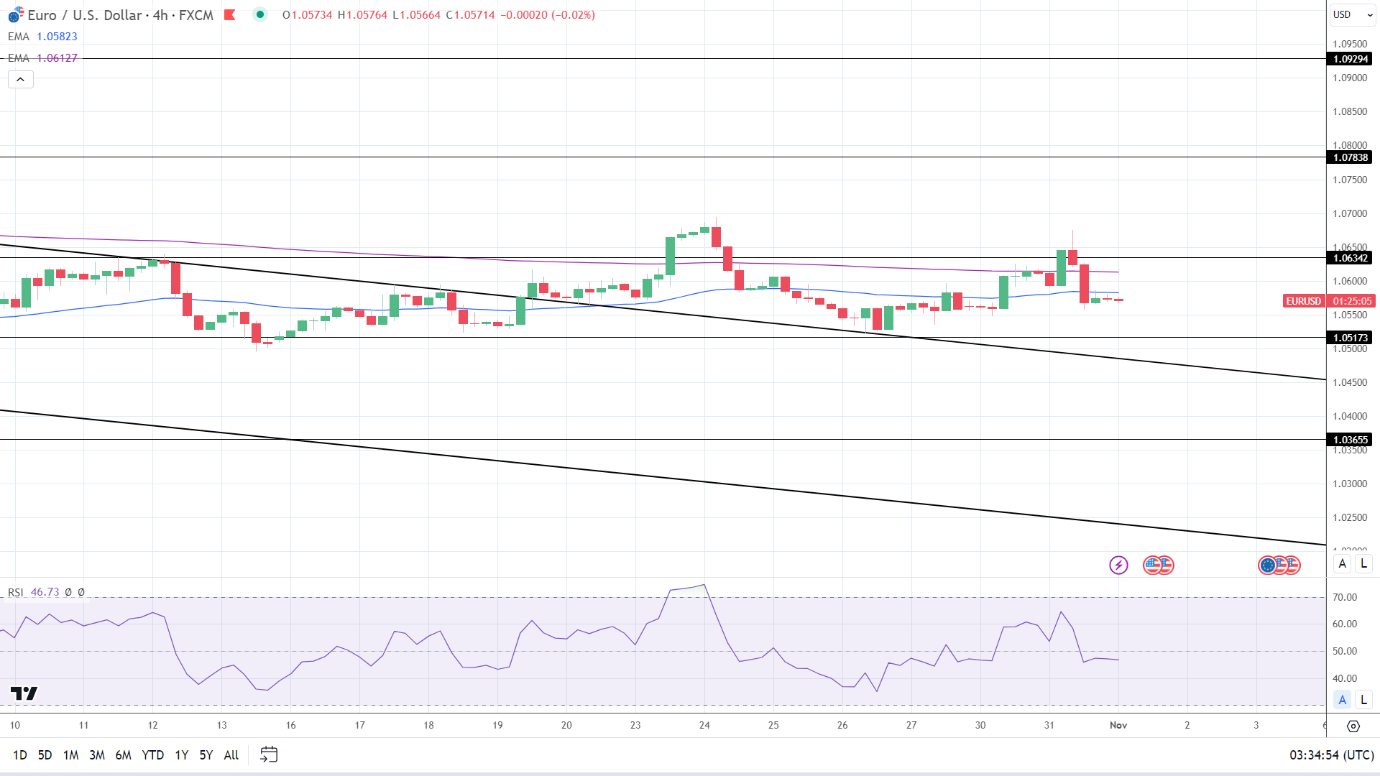
The EUR/USD declined by 0.38% on Tuesday. Following a 0.47% gain on Monday, the EUR/USD ended the day at $1.05744. The EUR/USD rose to a high of $1.06749 before falling to a low of $1.05574.

Macroeconomic Uncertainty to Test the EUR/USD

On Wednesday, investors may respond further to the recent GDP and inflation figures from the euro area. Weaker-than-expected GDP numbers from France and a quarterly contraction across the euro area could test buyer appetite for the EUR.

Trading Derivatives carries a high level of risk to your capital and you should only trade with money you can afford to lose. Trading Derivatives may not be suitable for all investors, so please ensure that you fully understand the risks involved, and seek independent advice if necessary. A Product Disclosure Statement (PDS) can be obtained either from this website or on request from our offices and should be considered before entering into a transaction with us. Raw Spread accounts offer spreads from 0.0 pips with a commission charge of USD $3.50 per 100k traded. Standard account offer spreads from 1 pips with no additional commission charges. Spreads on CFD indices start at 0.4 points. The information on this site is not directed at residents in any country or jurisdiction where such distribution or use would be contrary to local law or regulation.

Private sector PMIs from China suggest stimulus measures are failing to reboot the economy. Cracks are also forming in the US economy, signaling a further deterioration in the macroeconomic environment before any recovery.

On balance, the ECB may need to cut rates sooner than the Fed. Resilience in the US economy would allow the Fed to keep rates higher for longer. A euro area recession and softening inflation will be considerations for the ECB over the near term.

US Labor Market and the Fed to Take Center Stage

On Wednesday, ADP nonfarm employment and JOLTs Job Openings will set the tone for the session. A tighter US labor market supports wage growth and consumption.

An upward trend in consumption would fuel demand-driven inflationary pressures, forcing the Fed to keep rates higher for longer. An elevated interest rate environment impacts borrowing costs and disposable income. This leads to a pullback in spending.

Economists forecast the ADP to report a 150k increase in nonfarm payrolls in October vs. 89k in September. However, economists expect job openings to decline from 9.61 million to 9.25 million in September. Beyond the headline figure, a decline in quit rates could signal a weakening labor market.

A deteriorating labor market outlook could force consumers to curb spending, easing demand-driven inflation.

While the numbers will draw investor interest, the Fed interest rate decision and press conference will be the focal points.

The markets expect the Fed to leave interest rates at 5.5%. Barring a surprise Fed rate hike, the Fed press conference will move the dial. Investors must consider comments referencing the economic, inflation, and monetary policy outlook.

Short-Term Forecast:

The near-term trends for the EUR/USD hinge on US labor market numbers and Fed monetary policy goals. A hawkish Fed press conference and upbeat labor market figures could pressure the EUR/USD and bring sub-$1.05 into play. On Friday, the US Jobs report and ISM Non-Manufacturing PMI will also be pivotal.

EUR/USD Price Action

Daily Chart

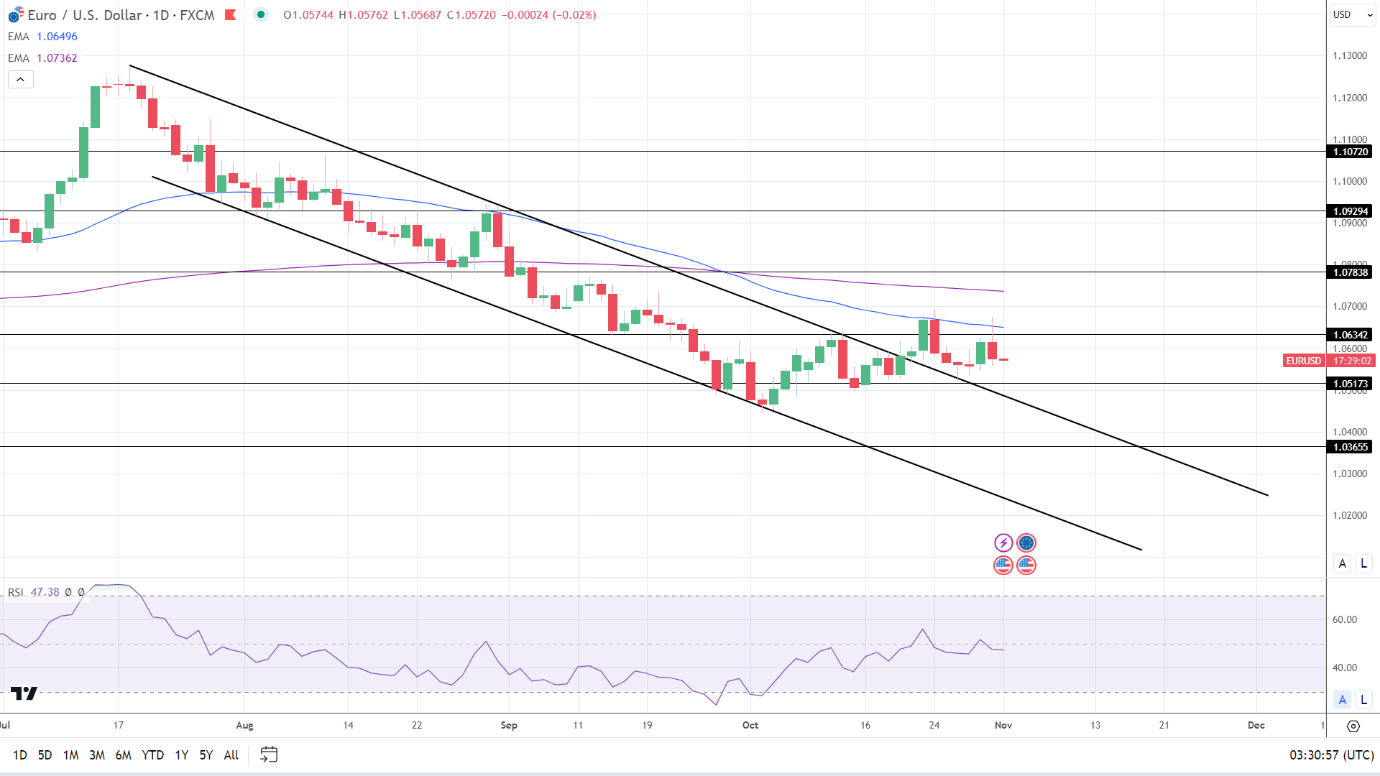
The EUR/USD sat below the 50-day and 200-day EMAs, affirming bearish price signals.

A EUR/USD break above the $1.06342 resistance level and 50-day EMA would support a move toward the 200-day EMA. US labor market data and the Fed will be focal points on Wednesday.

However, a EUR/USD drop below the $1.05173 support level would give the bears a run at the trend line.

The 14-period Daily RSI, 47.38, indicates a EUR/USD fall through the $1.05173 support level before entering oversold territory.

EUR/USD Daily Chart sends bearish price signals.
EURUSD 011123 Daily Chart

4-Hour Chart

The EUR/USD remains below the 50-day and 200-day EMAs, reaffirming bearish price signals.

A EUR/USD break above the 50-day EMA would support a move to the 200-day EMA and the $1.06342 resistance level.

However, a drop below $1.05500 would bring the $1.05173 support level and trend line into play.

The 14-period RSI on the 4-hour chart, 46.73, suggests a EUR/USD fall below the $1.05173 support level before entering oversold territory.

4-Hourly Chart affirms bearish price signals.
EURUSD 011123 4 Hourly Chart
DAX Index: The US Labor Market to Take Center Stage Pre-Fed

DAX Index: The US Labor Market to Take Center Stage Pre-Fed

DAX Tuesday Overview

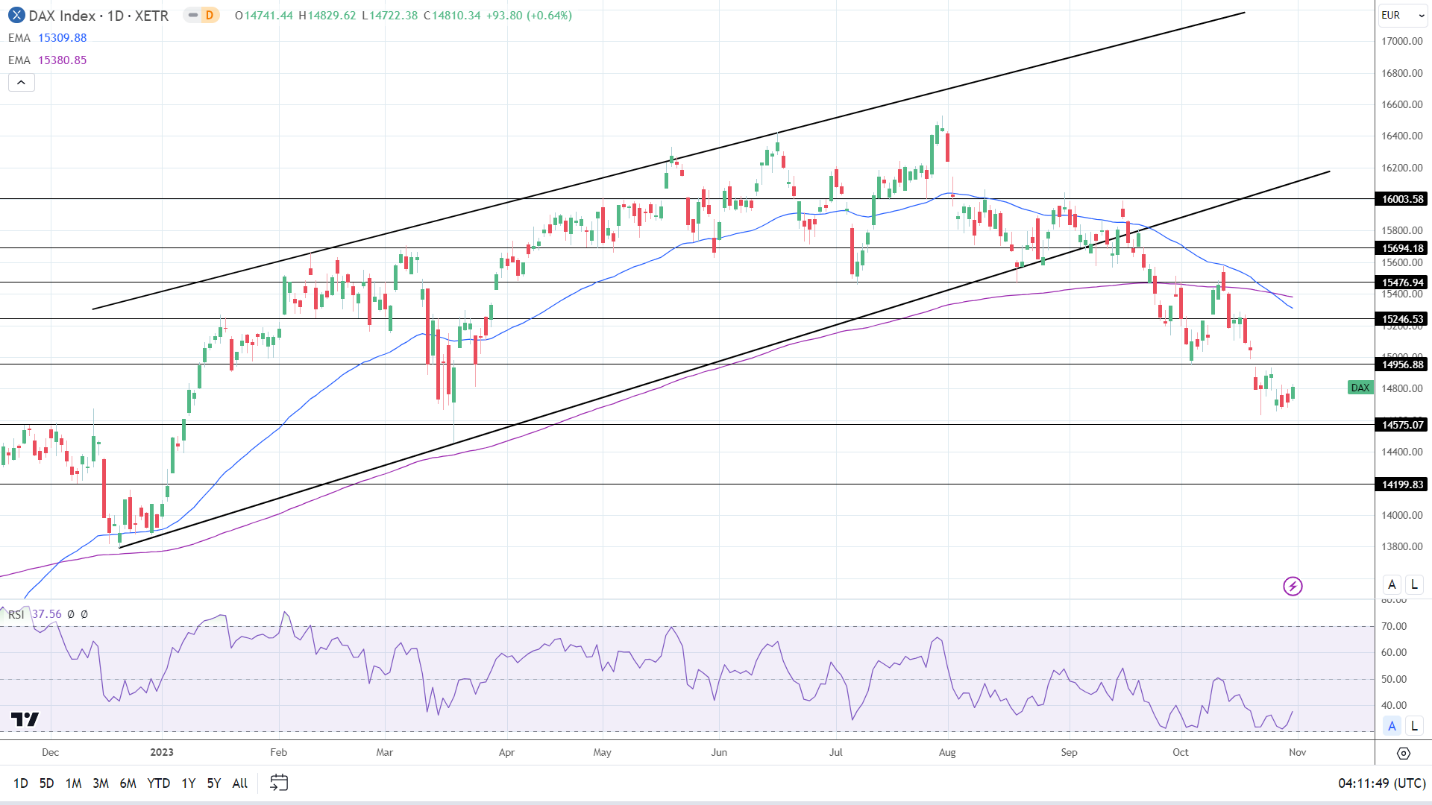
The DAX rose by 0.64% on Tuesday. Following a 0.20% gain on Monday, the DAX ended the day at 14,810.

German Retail Sales and Eurozone GDP Disappoint

German retail sales figures unexpectedly declined in September, fueling bets on a prolonged economic recession. GDP figures from France and for the Eurozone also disappointed.

Trading Derivatives carries a high level of risk to your capital and you should only trade with money you can afford to lose. Trading Derivatives may not be suitable for all investors, so please ensure that you fully understand the risks involved, and seek independent advice if necessary. A Product Disclosure Statement (PDS) can be obtained either from this website or on request from our offices and should be considered before entering into a transaction with us. Raw Spread accounts offer spreads from 0.0 pips with a commission charge of USD $3.50 per 100k traded. Standard account offer spreads from 1 pips with no additional commission charges. Spreads on CFD indices start at 0.4 points. The information on this site is not directed at residents in any country or jurisdiction where such distribution or use would be contrary to local law or regulation.

However, corporate earnings countered the disappointing economic indicators. BASF rallied despite a fall in Q3 core earnings and a downgrade to its full-year outlook. Investors showed relief on fears of worse results and a more significant downgrade to the outlook. Qiagen also contributed with better-than-forecasted earnings and revenues.

US economic indicators failed to send the DAX into negative territory despite inflationary signals. Market bets on the Fed holding interest rates unchanged at 5.5% on Wednesday supported riskier assets.

On Tuesday, the Dow rose by 0.38%. The Nasdaq Composite Index and the S&P 500 gained 0.48% and 0.65%.

The Tuesday Market Movers

BASF and Qiagen ended the session with gains of 5.31% and 4.45%, respectively. Siemens AG and Siemens Healthineers were also front-runners, rising by 1.02% and 1.20%. Restructuring plans for Siemens Energy offered support. However, Siemens Energy AG declined by 0.78% on plans to sell some of its stake in Siemens Ltd, an Indian-listed company.

The auto sector had a mixed session. Mercedes Benz Group fell further following the disappointing earnings results. Mercedes Benz Group declined by 0.27%, with BMW falling by 0.09%. However, Porsche and Volkswagen saw gains of 0.48% and 0.70%, while Daimler Truck Holding ended the day flat.

Focus Shifts to the Federal Reserve

On Wednesday, the US labor market will be in focus ahead of the Fed interest rate decision. ADP employment change and JOLTs Job Openings will garner investor interest. Better-than-expected figures could fuel inflationary jitters after the numbers from Tuesday.

Economists forecast the ADP to report a 150k increase in employment. However, economists expect JOLTs Job Openings to fall from 9.61 million to 9.25 million.

The numbers are out before the Fed interest rate decision and press conference. Market bets on the Fed holding interest rates unchanged could continue supporting riskier assets.

There are no economic indicators from the euro area to influence investor sentiment.

Beyond the economic calendar, the US earnings calendar also needs consideration. CVS Health Corp. (CVS), The Estee Lauder Companies Inc. (EL), and Kraft Heinz Co. (KHC) are among the big names releasing earnings results.

The futures markets point to a mixed start to the Wednesday session. The DAX gained 48 points, while the Nasdaq mini fell by 21 points.

Short-Term Forecast

Near-term trends depend on the Fed’s interest rate decision. A hawkish Fed could affect DAX-listed stock buyer appetite amid a worsening macroeconomic environment.

DAX Technical Indicators

Daily Chart

The DAX sat below the 50-day and 200-day EMAs, sending bearish price signals.

A DAX break above the 14,957 resistance level would support a return to 15,000. Bets on the Fed holding interest rates at 5.5% and Fed caution ahead would drive demand for riskier assets.

However, better-than-expected US labor market figures could test sentiment toward Fed monetary policy.

A break below the 14,575 support level would support a move toward the 14,200 support level.

The 14-day RSI reading of 37.56 suggests DAX fall to the 14,575 support level before entering oversold territory.

DAX Daily Chart sends bearish price signals.
DAX 011123 Daily Chart

4-Hourly Chart

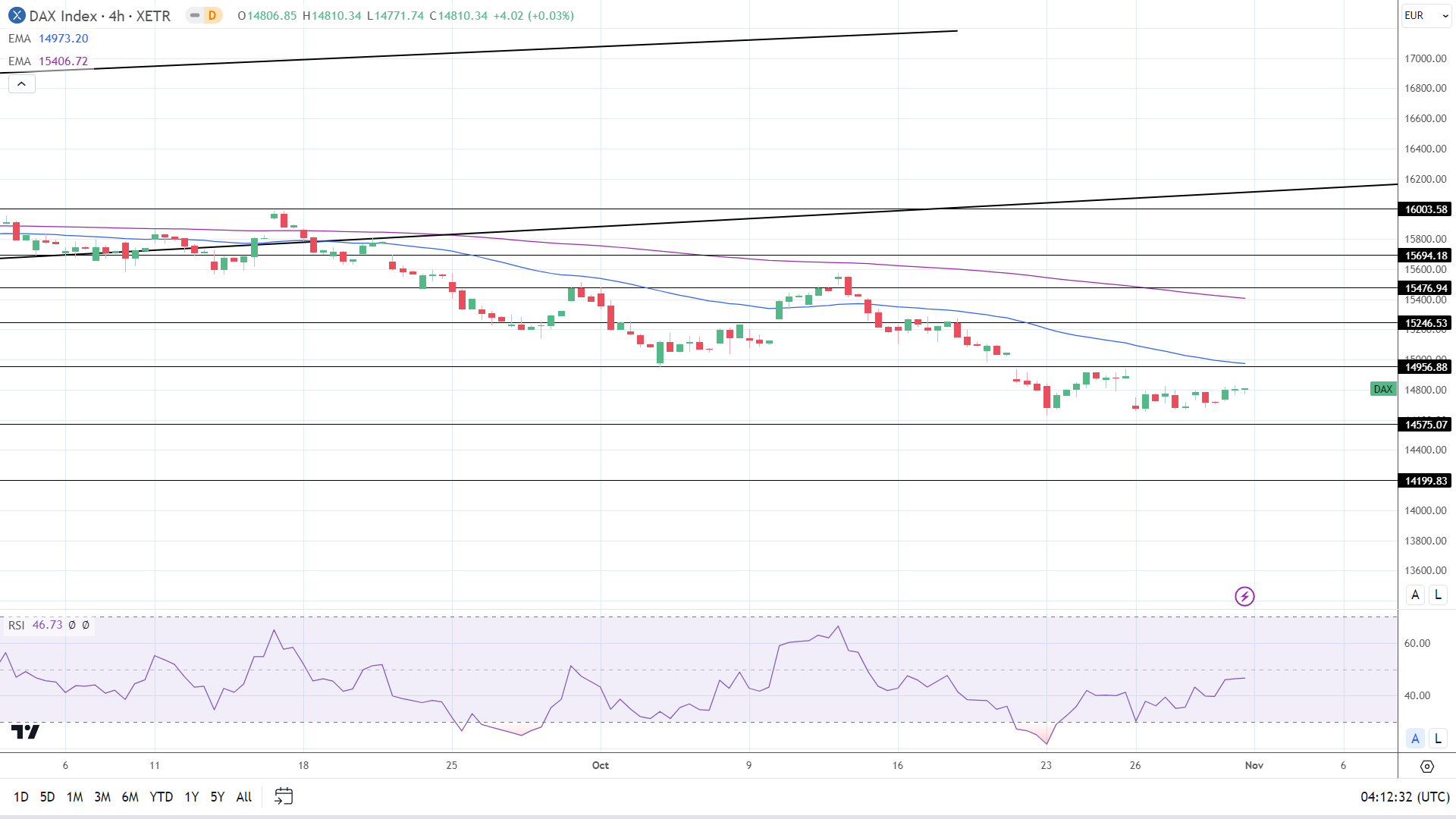
The DAX sits below the 50-day and 200-day EMAs, affirming bearish price signals. A DAX move through the 14,957 resistance level and the 50-day EMA would signal a return to 15,000. Selling pressure will likely intensify at 14,900. The 50-day EMA is confluent with the 14,957 resistance level.

However, a break below the 14,575 support level would bring the 14,200 support level into play.

The 46.73 14-4 hour RSI reading suggests a DAX drop below the 14,575 support level before entering oversold territory.

4-Hourly Chart affirms bearish price signals.
DAX 011123 4-Hourly Chart
Crypto News: SEC Chair Gary Gensler Targets Cryptos in Halloween Message

Crypto News: SEC Chair Gary Gensler Targets Cryptos in Halloween Message

SEC Chair Gary Gensler Sparks Crypto Community Ire

On Tuesday, SEC Chair Gary Gensler tweeted Halloween messages targeting the digital asset space.

Trading Derivatives carries a high level of risk to your capital and you should only trade with money you can afford to lose. Trading Derivatives may not be suitable for all investors, so please ensure that you fully understand the risks involved, and seek independent advice if necessary. A Product Disclosure Statement (PDS) can be obtained either from this website or on request from our offices and should be considered before entering into a transaction with us. Raw Spread accounts offer spreads from 0.0 pips with a commission charge of USD $3.50 per 100k traded. Standard account offer spreads from 1 pips with no additional commission charges. Spreads on CFD indices start at 0.4 points. The information on this site is not directed at residents in any country or jurisdiction where such distribution or use would be contrary to local law or regulation.


“If Satoshi Nakamoto went as Satoshi Nakamoto for Halloween, would we be able to tell? Happy 15th Anniversary to Satoshi’s famous white paper that started crypto. Any crypto companies that are tricking investors should start treating them to compliance with securities laws.”

The SEC Chair posted a second tweet, saying,

“Avoid getting tricked out of your money: Make sure you’re dealing with a registered investment professional. Take time when making investment decisions. Don’t fall for ‘can’t miss’ opportunities.”

Ripple Chief Legal Officer Stuart Alderoty responded to the Gensler snipes, saying,

“While Mr. Gensler is making bad Halloween jokes on X, his agency is being shamed for ignoring the law […].”

Alderoty referenced a federal agency analysis of SAB 121, where the SEC allegedly circumvented the rule-making process.

Illicit Use of Cryptos? Lawmakers Responded Further to the WSJ Article

On Tuesday, US Senator Cynthia Lummis reacted further to the WSJ Article stating Hamas raised millions in crypto.

Senator Cynthia Lummis had this to say about the WSJ claims,

“An inaccurate report last week claimed Hamas raised nearly $100 million via crypto assets. In reality, it was less than $500,000. This encapsulated the misconception that crypto is a tool for illicit finance when it accounts for less than 1% of global illicit finance activity.”

Senator Lummis shared the stats, which put total illicit finance at $2.9 trillion vs. $20 billion for crypto, 0.69%.

Senator Lummis went on to say,

“After the reports that Binance and Tether engaged in illicit activities, I sent a letter encouraging the DOJ to finish its investigation, follow the evidence, and consider criminal charges. Because illegal activity is illegal no matter who does it.”

Senator Lummis concluded,

“Make no mistake, crypto assets are NOT the problem. Bad actors, who exist in every sector, are. The future for crypto assets in America is brighter than ever.”

Coinbase Showcases the Success of StandWithCrypto

Coinbase (COIN) CEO Brian Armstrong reposted a Coinbase progress report on the StandWithCrypto movement. The statistics demonstrated the level of support for the US digital asset space. According to Coinbase,

    • 100k+ crypto advocate signups.
    • $2M+ in pro-crypto donations.
    • 16k+ calls and emails to Congress.

In September, Coinbase launched the StandWithCrypto campaign to expedite crypto regulations. The campaign highlighted 52 million Americans holding crypto.

Coinbase is in a legal battle with the SEC. Investors await a court ruling on the Coinbase motion to dismiss (MTD). A ruling in favor of Coinbase could materially alter the anti-crypto landscape.

In August, Senator Cynthia Lummis filed an Amicus Curiae brief supporting the MTD.

Technical Analysis

Bitcoin Analysis

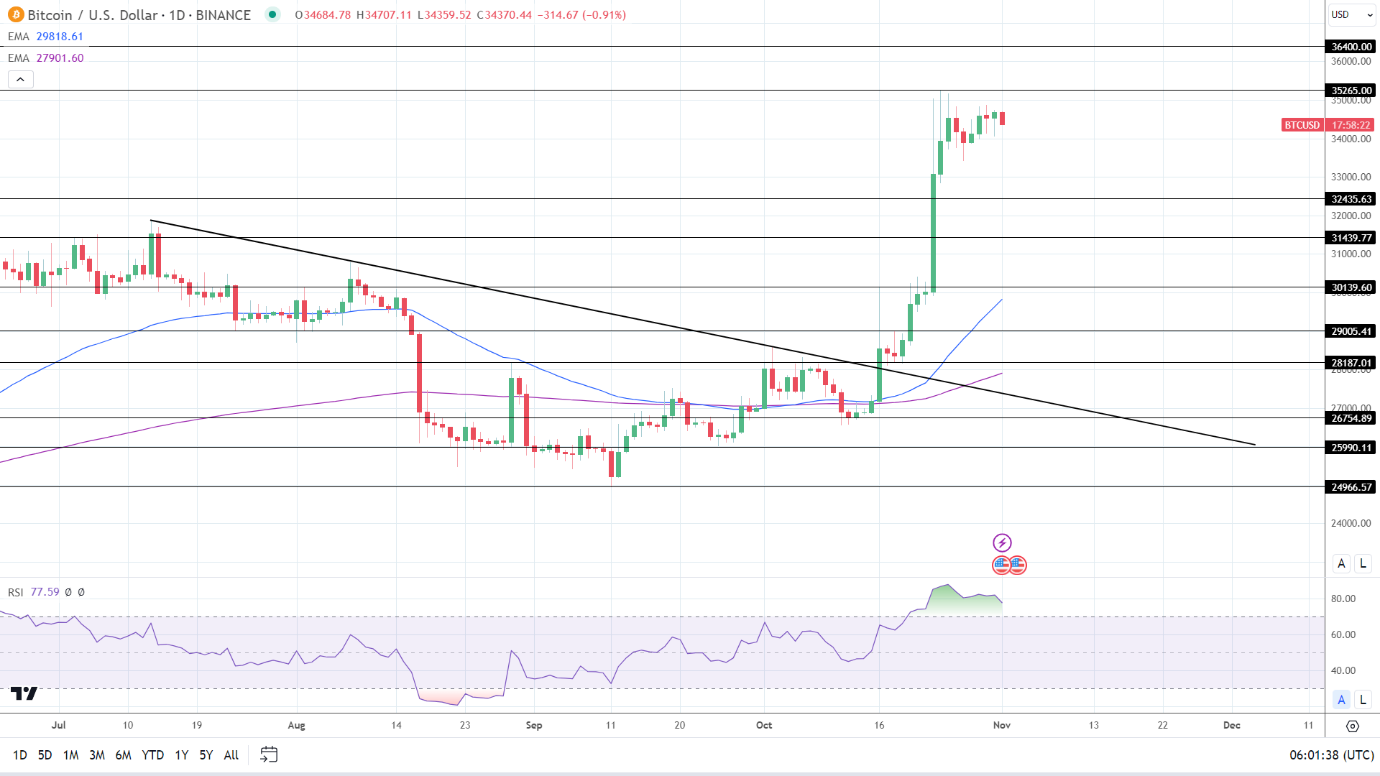
BTC held above the 50-day and 200-day EMAs, sending bullish price signals.

A BTC break above the October 24 high of $35,264 and the $35,265 resistance level would support a move to the $36,400 resistance level. BTC-spot ETF application-related news and SEC activity remain the focal points.

However, a BTC drop below $34,000 would give the bears a run at the $32,436 support level.

The 14-Daily RSI reading of 77.37 shows BTC sitting in overbought territory, suggesting intensifying selling pressure.

BTC Daily Chart sends bullish price signals.

BTCUSD 011123 Daily Chart

Ethereum Analysis

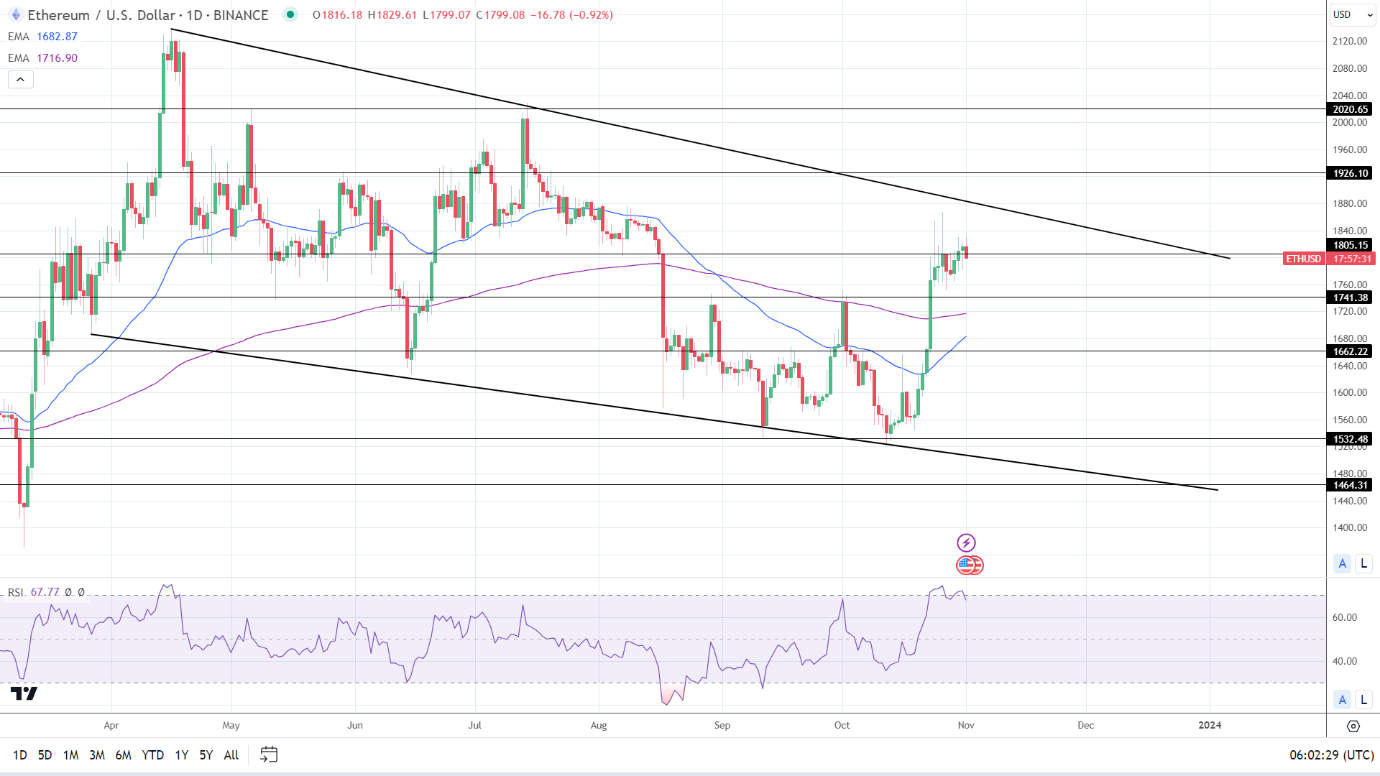
ETH remained above the 50-day and 200-day EMAs, affirming bullish price signals.

An ETH break above the $1,805 resistance level would support a move to the October 26 high of $1,868. A move through $1,868 would bring the trend line and the $1,926 resistance level into play.

SEC activity and ETH-spot ETF news are the focal points on Wednesday pre-Fed.

Failure to break above the $1,805 resistance level would give the bears a run at the $1,741 support level and the 200-day EMA.

ETH sits on the border of overbought territory with a 14-Daily RSI reading of 67.77. Seller pressure could intensify at $1,830.

ETH Daily Chart sends bullish price signals.
ETHUSD 011123 Daily Chart