The boomers boosting inflation as the RBA lifts rates to fight it

The boomers boosting inflation as the RBA lifts rates to fight it

In the fight to bring down inflation the Reserve Bank has smashed the more than one in three Australians with home loans by dramatically raising interest rates on repayments.

But a further third of our society have paid off their housing.

They tend to be older and they’re enjoying higher asset prices and bigger returns from their savings.

Data shows they’re spending at a rate far exceeding inflation — working against the goal of lowering the temperature of the economy.

This has a growing number of experts questioning whether interest rates should be used as almost the sole tool to tackle the inflation crisis.

Aquaculture expert Greg Jenkins has benefited from interest rates climbing at the steepest rate in the history of our economy.

On the verandah of his home on the outskirts of Perth, he’s looking forward to imminent retirement and some big trips.

Greg Jenkins 2

Greg Jenkins is recovering from surgery, considering retirement and reading up on road trips.(ABC News: Phil Hemingway)

“My wife and I, never been better,” he says.

“We don’t pay a mortgage, the stock market’s earned a 9 per cent increase in the year.

“The interest rates actually make it better for us because we’re earning more money on deposits.”

And that rising wealth has sent a clear signal: spend.

“We’ve probably spent more money in the last two years than we have in the last 20.”

But Greg isn’t happy about it.

“We’re not paying the price,” he says.

“I can guarantee that decades ago, when people got together and decided that interest rates were going to be the lever to control inflation, none of those people had mortgages.

“It doesn’t impact them, it doesn’t impact us. It’s not right.”

Asia Day Ahead: Lukewarm Reaction to Fed Meeting

Asia Day Ahead: Lukewarm Reaction to Fed Meeting

In a widely expected move, the Federal Reserve (Fed) hiked its policy interest rate by 25 basis-point (bp) to the 5.25%-5.5% range and left the door open for another hike in September. But given that Fed Chair Jerome Powell also guided for rate decisions to be on a “meeting-by-meeting” basis, additional tightening moves still lack commitment at current point in time. In light of the Fed’s data-dependent stance, along with the broader trend of moderating US inflation, Fed rate expectations remained firm for an extended pause through the rest of the year.

Perhaps something to keep on the back of mind is that the Fed Chair still does not see inflation returning to the Fed’s 2% inflation goal until 2025, which may suggest that he foresees a more arduous process in pushing pricing pressures down moving forward. The abating of base effects and some firming in commodities prices lately could present some potential challenges.

Wall Street managed to pare earlier losses to close flat for the day, with after-market moves edging higher on Meta’s results. A beat on all fronts (top and bottom line, active users base, average revenue per user), along with a better-than-expected guidance for the third quarter, were more than sufficient to put a 6.8% gain in its share price in after-hours trading.

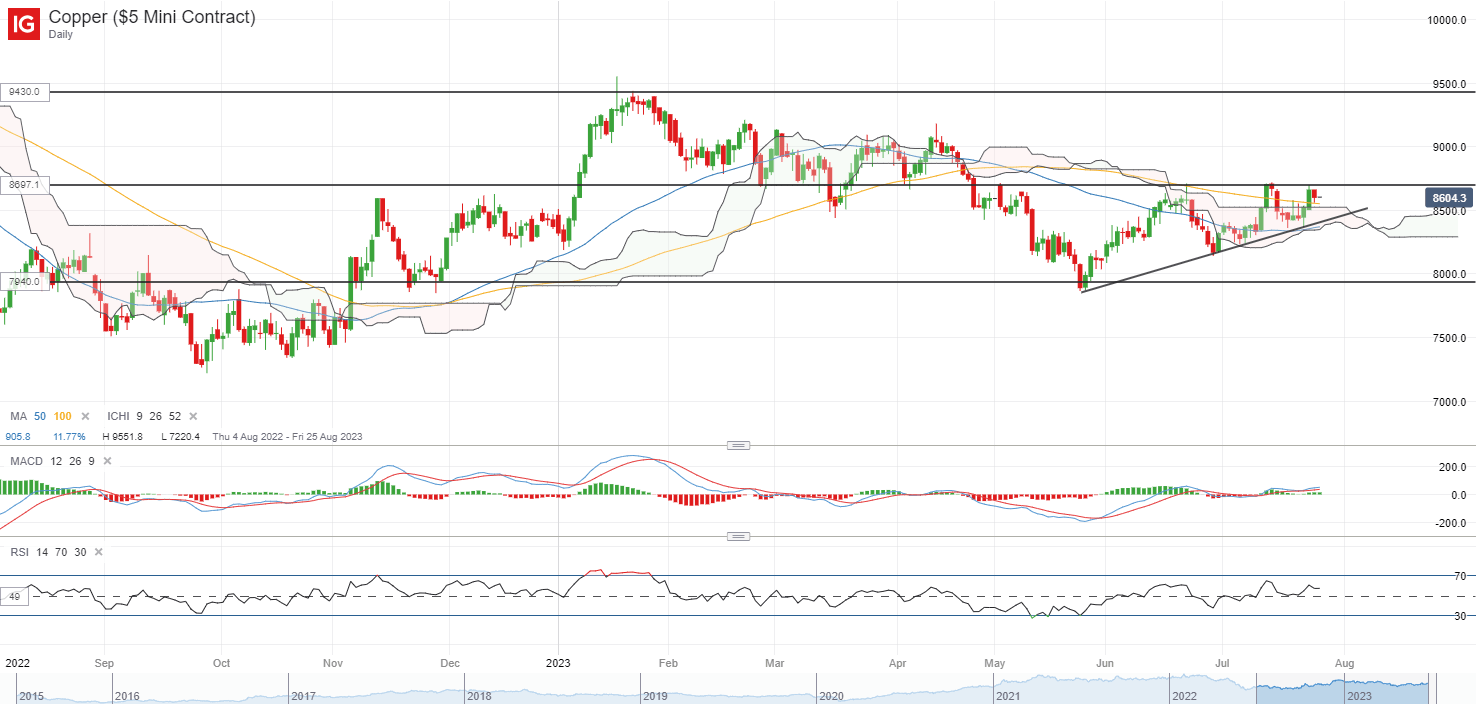
The US dollar were 0.3% lower, alongside a downtick in US Treasury yields. One to watch in the commodities space on a more subdued US dollar may be copper prices. Prices have been trading within an ascending triangle pattern over the past two months, with recent retest of the upper trendline resistance at the US$8,700/tonne level once more. Near-term upward momentum is supported by an increasing moving average convergence/divergence (MACD) and relative strength index (RSI) above 50, with any successful break above the level potentially paving the way to retest the US$9,000/tonne level next.

image1.png

Source: IG charts

Asia Open

Asian stocks look set for a slightly positive open, with Nikkei +0.11%, ASX +0.54% and KOSPI +0.57% at the time of writing. The Nasdaq Golden Dragon China Index were up 2.8% overnight, following a more lacklustre session in the earlier session, with cautious optimism still at play for further follow-through in China’s economic stimulus. Closer to home, the focus is on UOB’s 2Q 2023 result release this morning.

The bank continues to benefit from the net interest income tailwind, with a 31% year-on-year jump in the segment uplifting overall profits by 27%, in line with forecasts. Net interest margin continues to moderate for the second straight quarter (2.12% from previous 2.14%), but some may find comfort in the softer pace of decline, which could suggest some stabilising above the 2% level for the months ahead. Loan growth and net fee income remains more subdued with single-digit decline from a year ago, but thus far, management’s guidance may have provided a positive spin on outlook, pointing to some economic resilience in the region. Dividends were raised to S$0.85/share from last year’s S$0.60/share, potentially leaving a forward dividend yield of 5.5%.

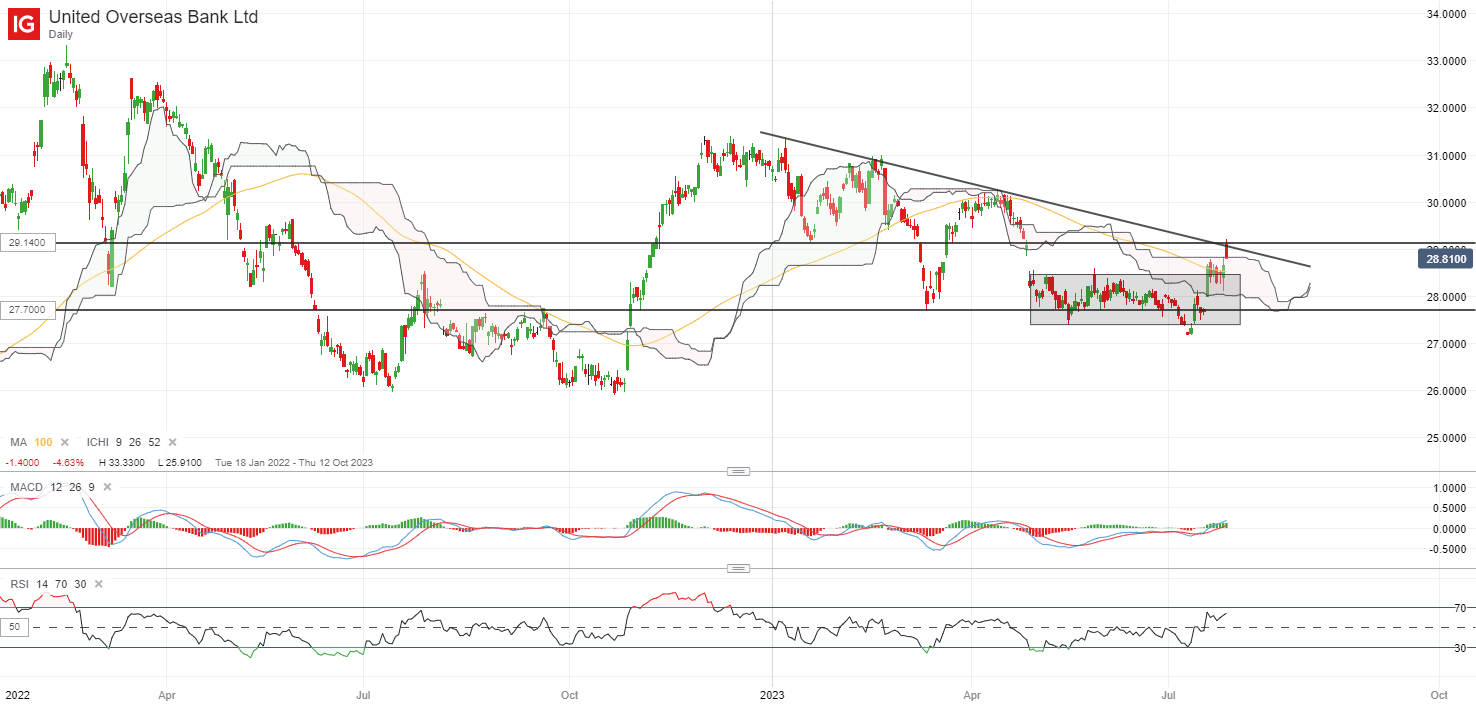
For UOB’s share price, a gap higher this morning has led to a retest of key resistance confluence at the S$29.14 level. While buyers remain in control, with its MACD heading above zero and RSI sustaining above the key 50 level, a break above the S$29.14 resistance may be warranted to support further upmove to the psychological S$30.00 level. On the downside, the previous consolidation range at the S$28.45 level may serve as near-term support.

image2.png

Source: IG charts

On the watchlist: EUR/USD resting at support ahead of European Central Bank (ECB) meeting

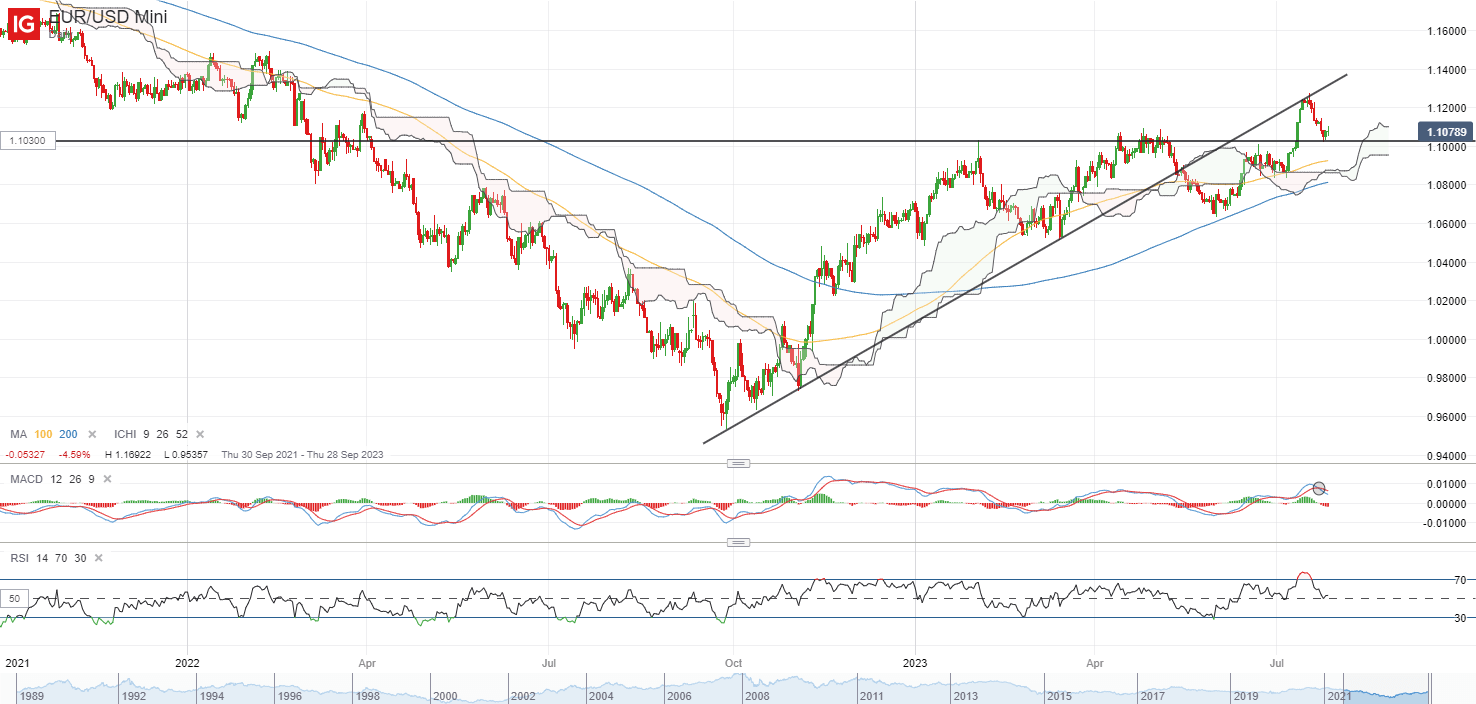
Thus far, the EUR/USD has been trading on an upward trend, with a series of higher highs and higher lows displayed since October last year. Following a lacklustre showing in the US dollar overnight post-FOMC, the EUR/USD is finding an attempt to stabilise at a near-term support around the 1.103 level, with all eyes on the ECB interest rate decision later today.

While rate expectations were firmly priced for an extended pause from the Fed moving forward, the ECB is expected to keep hiking over the next two meetings. Any validation on that front or more aggressive tone from the ECB could be supportive of the pair in the near term. With a bearish crossover on MACD and declining RSI pointing to some moderation in near-term momentum, the 1.103 level will have to see some defending ahead. Failing to do so may pave the way towards the 1.083 level as the next line of support.

image3.png

Source: IG charts

US Dollar Slips After Fed Rate Hike: What Has Changed for EUR/USD, GBP/USD, USD/JPY?

US Dollar Slips After Fed Rate Hike: What Has Changed for EUR/USD, GBP/USD, USD/JPY?

The US dollar slipped but held well within the recent range after the US Federal Reserve hiked interest rates by the widely expected quarter percentage point and on balance kept its options open for further tightening.

Powell’s remarks at the press conference came across as neutral, stopping short of committing either way. Meanwhile, the post-meeting statement was largely unchanged from the previous meeting, still containing the phrase “additional policy firming”, highlighting the slight hawkish tilt. On balance, the key takeaway appears to be the data-dependent/patient approach going into the next meeting.

For the US dollar, the balanced tone provides little cues. However, while risk sentiment remains resilient amid an encouraging start to the earnings season and hopes of additional stimulus from China, USD could stay on the back foot. In this regard, the USD hasn’t been able to recoup the losses triggered by the recent US jobs and inflation data. As long as the market believes US rates are near a peak, the appetite for the safe-haven USD could stay diminished.Meanwhile, key focus is now on the European Central Bank policy meeting (later Thursday) and the Bank of Japan meeting (Friday).


EUR/USD 240-minute Chart

image1.png

Chart Created by Manish Jaradi Using TradingView

EUR/USD: Holds above crucial support

EUR/USD on Wednesday held above stiff support around an uptrend line from early June, near the 200-period moving average on the 4-hour chart. Still, it would be too soon to conclude that the immediate bearish pressure has alleviated – the pair would need to clear the initial hurdle at Monday’s high of 1.1150. Until then, the bias appears to be of consolidation within a broadly constructive outlook. As highlighted in the previous update, only a fall below the mid-July lows of 1.0825 for the broader upward pressure to ease.

GBP/USD 240-minute Chart

image2.png

Chart Created by Manish Jaradi Using TradingView


GBPUSD: Bullish pressure is still intact

GBP/USD has managed to rebound from a fairly strong cushion on converged support around 1.2800, including an uptrend line from the end of June, and the mid-June high of 1.2850. A hold above the support was crucial to keep the short-term upward pressure intact. GBP/USD now needs to overcome the initial cap at Thursday’s high of 1.2965 to eliminate any imminent downside risks.

Any fall below Monday’s low of 1.2800 would confirm that the bullish pressure had faded in the near term, potentially opening the way toward the end-June low of 1.2600. Zooming out, the broader bias remains up, with a potential to rise toward 1.4200 in the coming months (see theprevious updatefor more details).

USD/JPY 240-minute Chart

image3.png

Chart Created by Manish Jaradi Using TradingView

USD/JPY: Growing odds of a false bullish candle

While EUR/USD and GBP/USD remained within the recent ranges, the reaction in USD/JPY was relatively convincing. Wednesday’s fall below immediate support at Monday’s low of 140.75 has raised the odds of a false move higher last week. For more on this, see “US Dollar Scenarios Ahead of Fed Rate Decision: EUR/USD, GBP/USD, USD/JPY Price Setups,” published July 26.

USD/JPY is now testing the vital converged support area at 139.50-140.00. Any break below could confirm that the sharp rebound on Friday above the 200-period moving average on the 240-minute chart was a false one. On the upside, a rise above Friday’s high of 142.00 remains a vital hurdle to clear.

Gold Prices Embrace Golden Cross as XAU/USD Looks to Beyond the Fed Next

Gold Prices Embrace Golden Cross as XAU/USD Looks to Beyond the Fed Next

Gold prices were left slightly higher in the aftermath of Wednesday’s rate hike from the Federal Reserve. The most meaningful development from the central bank was not the widely anticipated tightening, but rather commentary from Chair Jerome Powell that most officials do not envision a recession in the horizon, underscoring expectations of a soft landing.

With that in mind, it is widely anticipated that the Fed will do nothing in September. Anything beyond that will be dictated by incoming economic data. For now, let us examine how the technical landscape is shaping up in gold.

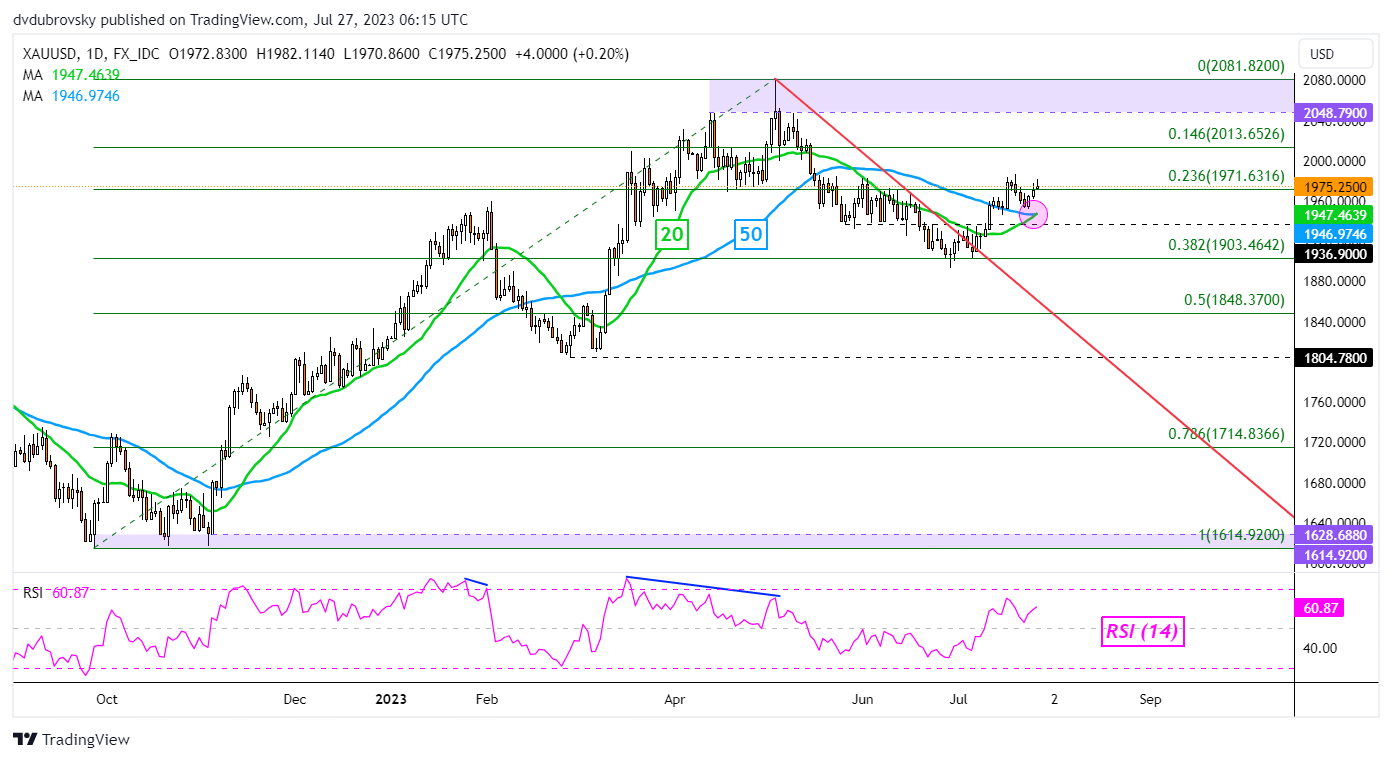
The most interesting development from the XAU/USD daily chart is that a bullish Golden Cross is taking shape between the 20-day and 50-day Moving Averages (MA). This is offering an increasingly upside technical bias and reverses the bearish Death Cross seen in May.

The Golden Cross has formed in the aftermath of prices breaking above a near-term falling trendline from May. Since then, gold seems to have found resistance around the 23.6% Fibonacci retracement level at 1971. Clearing higher exposes the minor 14.6% point at 2013 before May highs kick in. These make for a range of resistance between 2048 and 2081.

Otherwise, a turn lower and drop through the moving averages places the focus on immediate support, which is the 1936 inflection point. Beyond that sits the 38.2% level at 1903. Clearing the latter opens the door to a stronger bearish conviction.

image1.png


US Equity Indices Post FOMC: Nasdaq, S&P 500, Dow Price Setups

US Equity Indices Post FOMC: Nasdaq, S&P 500, Dow Price Setups

US equity indices were largely flat, hovering around year-to-date highs after the US Federal Reserve hiked interest rates by the widely expected quarter percentage point.

While the post-meeting statement kept the bias for “additional policy firming”, at the press conference, Fed Chair Powell seemed to have leaned toward the dovish side. “I would say it’s certainly possible that we will raise funds again at the September meeting if the data warranted,” said Powell. “And I would also say it’s possible that we would choose to hold steady and we’re going to be making careful assessments, as I said, meeting by meeting.” The data-dependent/ patient approach going into the next meeting has boosted the market’s perception that US interest rates are peaking, supporting risk appetite at the margin.

With the earnings season off to a good start, global growth being resilient, and additional China stimulus remaining a possibility, markets have reasons to cheer. Having said that, extreme optimism, overbought conditions, overcrowded positioning, and seasonality headwinds are potential risks. Dow Jones Industrial Average Weekly Chart

image1.png

Dow Jones Industrial Average: Scope for further gains

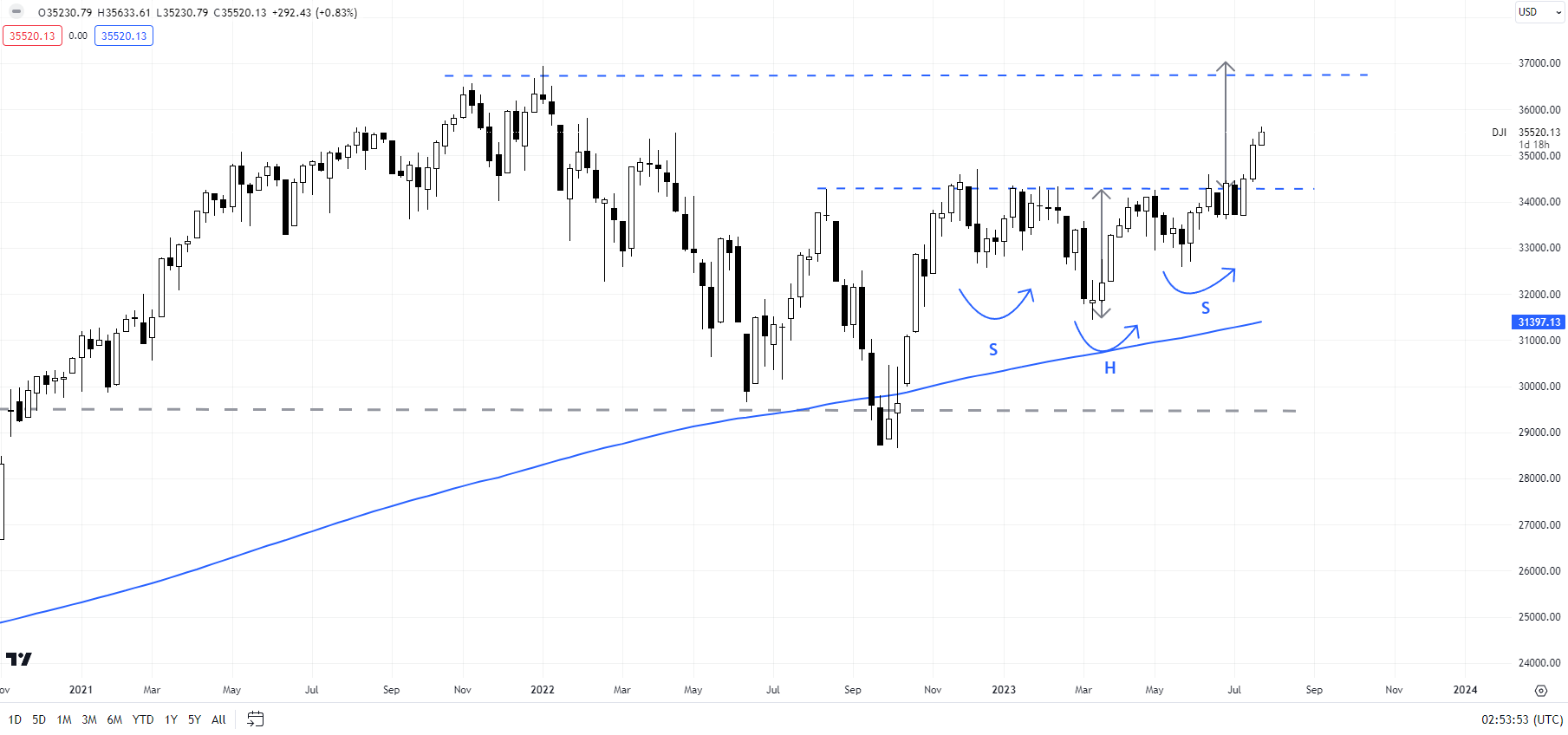
The Dow Jones Industrial Average’s recent break above a horizontal trendline from August at about 34280 has triggered a reverse head & shoulders pattern, first highlighted in “Dow, S&P 500, Nasdaq Technical Outlook: No Sign of a Reversal,” published July 9. The left shoulder is at the December low, the head is at the March low, and the right shoulder is at the May low. The bullish break has opened the way toward the 2022 high of around 37000.

NASDAQ 100 Monthly Chart

image2.png

Nasdaq 100: Overbought, but no sign of reversal

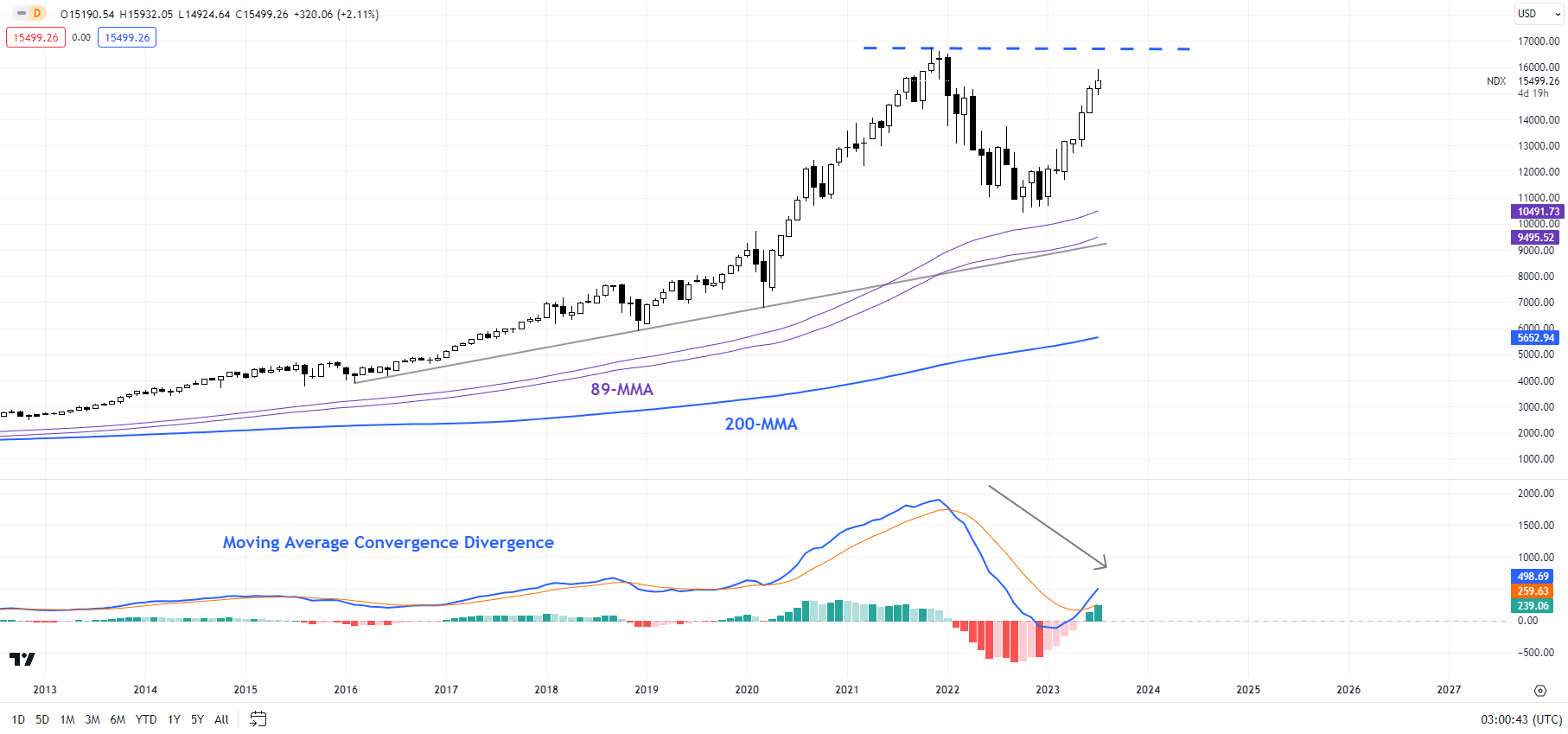
The Nasdaq 100 index is looking quite overbought, while diversity continues to remain low. For more on diversity, see “S&P 500, Nasdaq 100 Forecast: Overly Optimistic Sentiment Poses a Minor Setback Risk,” published July 23. Furthermore, the momentum on higher timeframe charts has failed to reflect the strength on shorter timeframe charts. For instance, on the monthly chart, the index is close to its 2021 peak, but the Moving Average Convergence Divergence indicator has hardly picked up.

To be sure, this doesn’t necessarily mean the index is bearish, not at least until there is a price confirmation. It probably means, from a risk: reward perspective, it may be prudent to turn cautious. Immediate support is at the mid-June high of 15285, around the 30-day moving average. Subsequent support is at the end-June low of 14690 – a break below this support would be needed for the immediate bullish pressure to ease.

S&P 500 Weekly Chart

image3.png

S&P 500: Uptrend intact as it nears a key hurdle

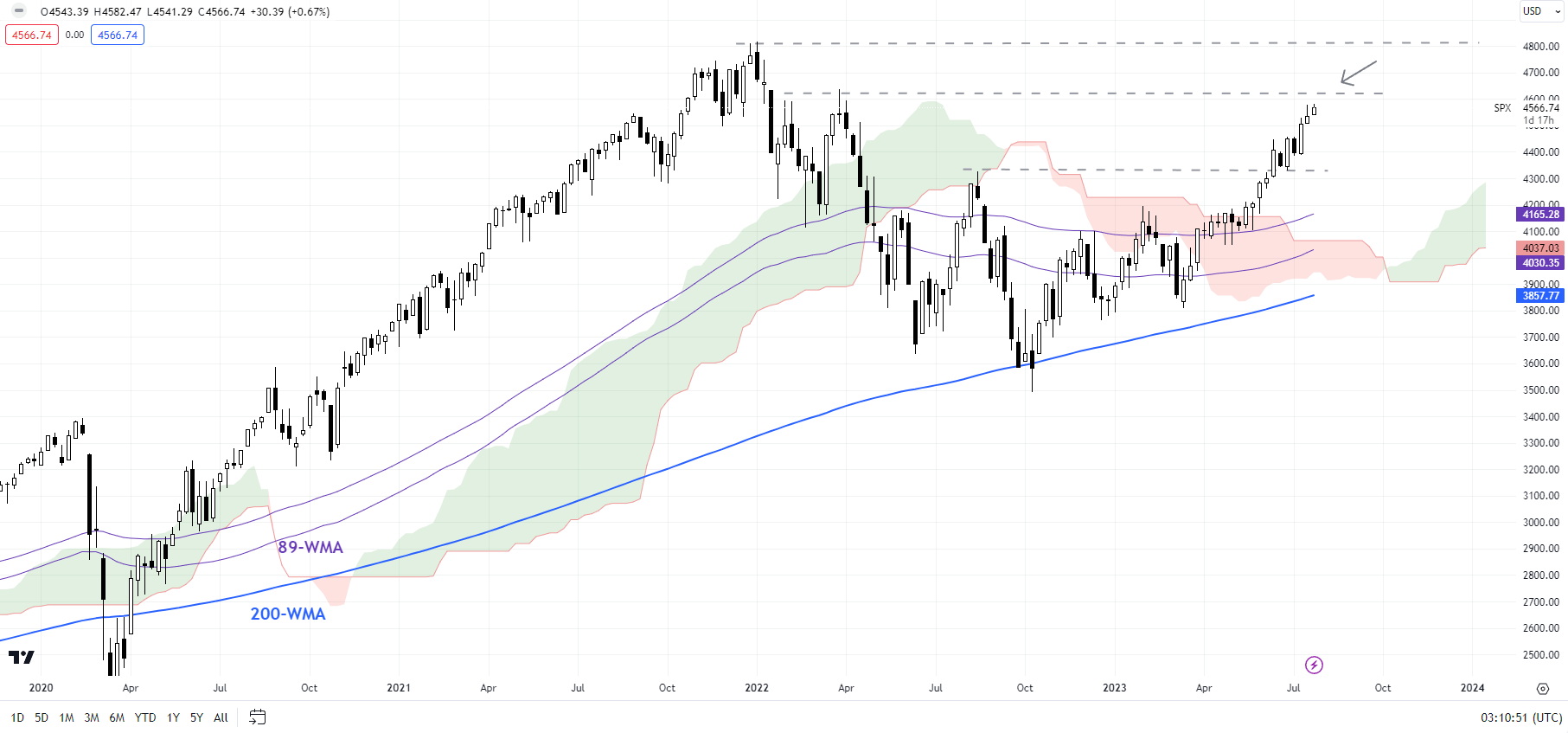
From a trend perspective, like the Nasdaq 100 index, there is no sign of a reversal of the uptrend on the S&P 500 index charts. Having said that, tentative signs of fatigue are emerging as the S&P 500 index nears the April 2022 high of 4637, slightly below the 2022 record high of 4819.

Still, unless the index breaks below immediate support at the mid-June high of 4450, the path of least resistance remains sideways to up in the near term – a point confirmed by still-solid momentum on the weekly charts. Only a break below 4450 would indicate that the bullish pressure had temporarily faded. For the broader bullish outlook to reverse, the index would need to fall below the 89-day moving average (now at about 4250).

Australian CPI data due today, preview – RBA will be comforted, no rate hike next week

Australian CPI data due today, preview – RBA will be comforted, no rate hike next week

ANZ’s preview of the data due today and the implications for the Reserve Bank of Australia policy meeting on August 1:

  • We expect both headline (+6.2% YoY) and trimmed mean inflation (+5.9% YoY) to have moderated in Q2.
  • The RBA will likely take comfort that inflation appears to be falling in line with, or a touch faster than, its May forecasts. The RBA forecast Q2 headline inflation of 6.3% YoY and trimmed mean of 6.0%, each 0.1ppt above our forecast.
  • While the August meeting is live, an inflation outcome around our forecast would support our expectation that, on balance, an extended pause from the RBA is now most likely (including no move in August).

Earlier previews take an opposite view of the RBA meeting next week:

76% of corporate leaders say Japan’s economy is ‘expanding’

76% of corporate leaders say Japan’s economy is ‘expanding’

Business confidence has dramatically improved after COVID-19 was downgraded to the equivalent of seasonal flu.

An Asahi Shimbun survey of business sentiment among 100 major companies nationwide found that 76 viewed the domestic economy as “expanding” or “gradually expanding.”

The finding represents an increase of 30 companies from the previous survey last November.

Many corporate leaders are optimistic that economic activity and personal consumption are on the rise now that the novel coronavirus has lost its “scare” factor.

However, concerns remain about labor shortages and a slowdown in overseas economies that could impact Japan.

The Asahi Shimbun conducted the survey from July 3 to 14.

Seventy-five companies responded that the domestic economy is “gradually expanding.” One company said it is “expanding.”

Twenty-two companies viewed the economy as “at a standstill.” The figure was half that of the previous survey late last year.

When asked to choose up to two reasons for their assessment, most companies, 71, cited “personal consumption.”

Asked about the prospects for personal consumption over the next three months, 74 companies expected a “gradual recovery,” up from 44 in the previous survey.

“The mindset of consumers toward spending has improved,” said Taro Fujie, president of Ajinomoto Co. “We are at the beginning of a cycle where wage increases are linked to appropriate price hikes.”

Chiharu Fujioka, managing officer of Mitsui Fudosan Co., noted that hotel occupancy rates exceeded 80 percent, and that “the average daily rate is higher than in 2019 before the pandemic.”

In addition to the easing of pandemic-related restrictions on social activities, the influx of foreign visitors following the lifting of entry curbs is a positive factor.

Tatsuya Yoshimoto, president of J. Front Retailing Co., said that along with an increase in domestic travelers and foreign tourists, “customer numbers and sales at department stores and shopping centers have grown.”

“Business activity at large-scale stores near stations, which had been slow to recover, has also significantly improved,” he said.

Forty-three companies cited “capital investment” as a reason for their assessment.

Fifty-one companies answered that they will increase their domestic capital investment in the current fiscal year compared to the previous fiscal year.

Ichiro Ozeki, president of Secom Co., said his company has received many inquiries about access control systems.

“Investments in facilities aimed at improving work efficiency and saving labor are increasing amid growing labor shortages caused by the recovery from the pandemic,” he said.

On the other hand, senior officials of companies who view the domestic economy as “at a standstill” voiced concern about labor shortages and the slowdown of overseas economies.

“While demand for construction is strong, there are delays in projects due to a lack of manpower,” said Nobuaki Nara, president of Tokyo Steel Manufacturing Co.

Turning to the global economy, 51 companies took a cautious view, saying it is “at a standstill.”

Takahiro Mori, vice president of Nippon Steel Corp., said, “There are also downside risks, such as the tightening of monetary policy by central banks in the United States and Europe and the downturn in the Chinese economy.”

Canadian dollar struggles to rise alongside oil

Canadian dollar struggles to rise alongside oil

Commodities and some commodity currencies caught a bid after China policymakers signaled more stimulus would soon help their struggling recovery, but that didn’t help the Canadian dollar.  Canada’s largest export has seen oil prices catch a bid over the past month, while the loonie has appreciated but mainly been rangebound over the past week.  It looks like FX traders are locked in with the Fed day.  USD/CAD has been consolidating between the 1.3150 to 1.3250 range over the past week.  If risk appetite remains in place post-FOMC decision, the Canadian dollar could make a run towards the 1.3000 level.  A hawkish surprise by the Fed could support an initial above 1.3250 , with 1.34 providing short-term resistance.

Oil

Crude prices are rising after the IMF raised their World GDP forecast from 2.8% to 3%.  The outlook for global growth is the key for the crude demand outlook and right now it seems that might only get better as we get more stimulus out of China and as soft landing hopes grow for the US.  WTI crude will likely face key resistance from the $80 level, which means the recent rally might consolidate until we get beyond the FOMC decision.

Gold

Gold prices are wavering ahead of the FOMC decision, slightly higher on the day as the $1950 level provides key support.  Gold is going to wander around for the next 24 hours as nothing else really matters except the Fed.  Massive earnings might provide a key catalyst for risk-appetite, so bullion traders might want to pay attention to what happens to Microsoft and Alphabet earnings.


UK Billionaire Joe Lewis Faces US Insider Trading Charges

UK Billionaire Joe Lewis Faces US Insider Trading Charges

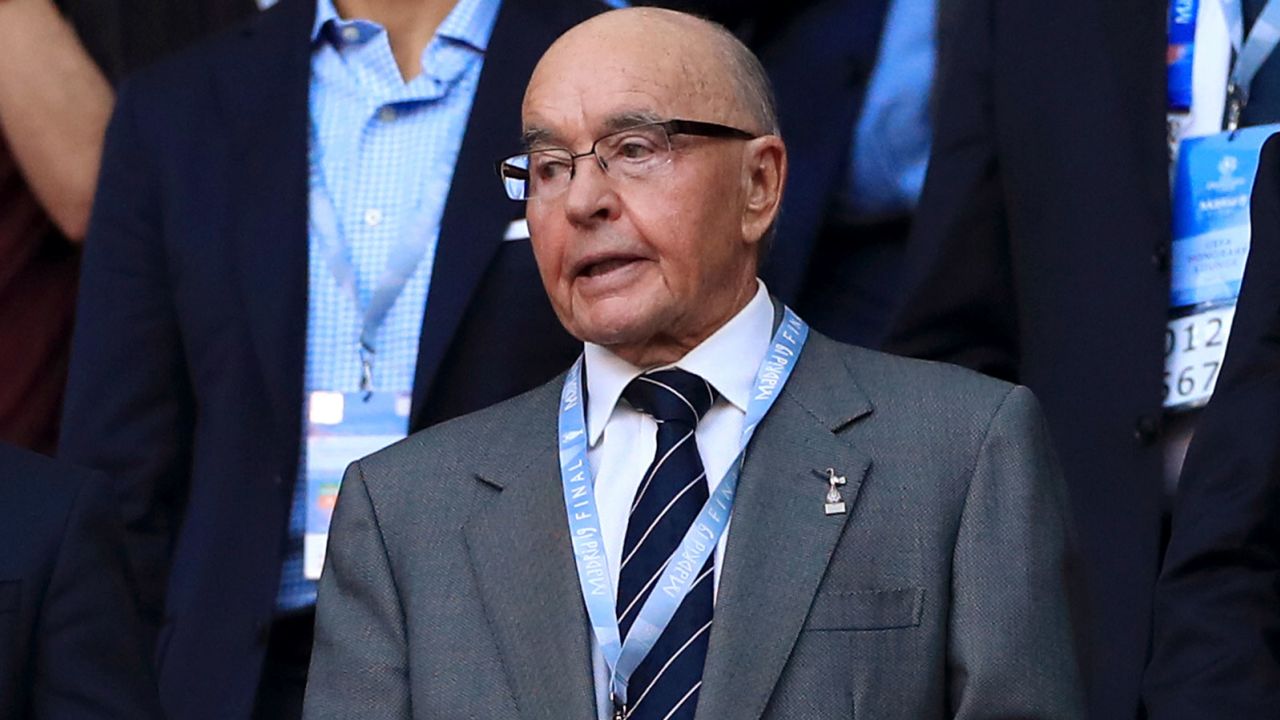
British billionaire Joe Lewis, the owner of the Tottenham Hotspur soccer club in London, has been charged with insider trading in the US.

Federal prosecutors alleged in an indictment in New York that the 86-year-old passed on inside information from companies in which he was a large investor to friends, including his personal pilots, assistants, and romantic partners. Lewis, the founder of investment firm Tavistock Group, faces more than a dozen charges, including securities fraud.

“None of this was necessary, Joe Lewis was a wealthy man,” Damian Williams, the US Attorney for the Southern District of New York, said in a statement Tuesday. “But as we allege he used inside information as a way to compensate his employees or shower gifts on his friends and lovers.”

Prosecutors didn’t announce Lewis’s arrest with the indictment.

“The government has made an egregious error in judgment in charging Mr. Lewis, an 86-year-old man of impeccable integrity and prodigious accomplishment,” Lewis’s lawyer David M. Zornow said in a statement. “Mr. Lewis has come to the US voluntarily to answer these ill-conceived charges, and we will defend him vigorously in court.”

Prosecutors claim Lewis was engaged in insider trading for eight years, passing on material non-public information about several companies, including Solid Biosciences, Australian Agricultural Co. and Mirati Therapeutics. In one instance, Lewis allegedly loaned his pilots $500,000 each so they could buy shares before a company’s clinical trial news became public.

Click here to read the indictment.

A call and email to Tavistock’s media team after hours weren’t immediately returned. Tottenham didn’t immediately respond to an emailed request for comment.

Lewis, who has a net worth of $6.6 billion according to the Bloomberg Billionaires Index, is the latest figure to be swept up in an insider-trading crackdown led by federal prosecutors in Manhattan. Last month, prosecutors announced criminal charges against 10 people in four separate cases, including investors in a special acquisition company poised to take Donald Trump’s fledgling media company public.

Read More: Trump SPAC Investors Charged in $22 Million Insider Scheme

But Lewis is the highest-profile investor the office has prosecuted for insider trading this year. The Bahamas-based businessman’s firm has stakes in more than 200 businesses, with investments across real estate, hotels and sports, in 13 countries.

Prosecutors also accuse Lewis of defrauding the US Securities and Exchange Commission and Mirati Therapeutics, by hiding his true ownership of shares through shell corporations and false filings.

For several years, authorities say, Lewis used his access to corporate boardrooms to tap valuable information and leak it to his associates before it became public. In 2019, members of Australian Agricultural’s board of directors told Lewis the company had suffered material losses following widespread flooding and that insurance wouldn’t cover its cattle losses.

According to the indictment, Lewis called his two personal pilots, tipped them to the material non public information and told them to sell their stock in the company immediately.

In the same year, he allegedly told his girlfriend in South Korea to purchase shares of Solid Biosciences, a biotech company, after learning about an upcoming private investment and clinical trial. The girlfriend paid $700,000 — “nearly all of her available funds” — to purchase 150,000 shares, according to the indictment. She sold the shares and made a $849,000 profit, prosecutors said.

Lewis also tipped two personal assistants working aboard his 322-foot (98-meter) superyacht “Aviva” to invest in special purpose acquisition company, BCTG, as the stock could “double, triple or even quadruple,” according to the indictment.

Before climbing the billionaire’s list, Lewis built a small fortune with a themed restaurant chain and then pivoted to currency trading in the late 70s. He made hundreds of millions betting against the British pound and Mexican peso in the 90s. He used his investment vehicle, Tavistock Group, to diversify into real estate, sports, luxury hotels and biotech.

Lewis is widely known in his home country for his stake in the Spurs, a North London Premier League soccer club.

In the US, Tavistock’s investments include the Boston Waterfront redevelopment, the Wellington Equestrian and Golf Club near Palm Beach, Florida, and the St. Regis hotel in Atlanta, Georgia, according to the company’s website.

Along with singer Justin Timberlake, golfers Tiger Woods and Ernie Els, Lewis also owns the exclusive Albany Bahamas Club, an enclave for the ultra rich that was home to former FTX founder Sam Bankman-Fried before his arrest last year.

An avid art collector, Lewis sold a David Hockney piece for $90.3 million in 2018 — setting a record at the time for the most expensive piece by a living artist to sell at auction.