
EUR/GBP falls back as UK Services PMI matches expectations

EUR/GBP falls back as UK Services PMI matches expectations

The EUR/GBP pair has retreated as the United Kingdom S&P Services PMI has matched expectations. The economic data has landed at 53.7 as expected by the market participants.

The Pound Sterling is expected to remain in a positive trajectory as inflationary pressures in the UK economy are expected to elevate further.  A poll from Reuters indicates that almost one in three female workers is expected to consider early retirement because of health issues. The economy is already facing issues of labor shortages due to Brexit and early retirements and now further increase in early withdrawal from work would propel red-hot inflation.

Considering the stubbornness in UK inflation, the Bank of England (BoE) is far from pausing the policy-tightening spell. UK Consumer Price Index (CPI) has turned sticky above 8.5% despite lower gasoline prices.

Meanwhile, UK firms are planning to shift investments to Germany to compensate for customs delays inspired by the Brexit event.

The Euro is expected to face pressure as preliminary Eurozone inflation has softened to 5.5% in June vs. the former release of 6.1%. Thanks to the drop in prices of oil but core inflation has marginally decelerated to 6.8% against the prior figure of 6.9%. This might allow the European Central Bank (ECB) to go slow on the policy-tightening spell. However, ECB policymaker Joachim Nagel has cited that the central bank has not reached the end of policy-tightening yet.

Higher interest rates by ECB President Christine Lagarde have pushed the Eurozone economy under threat. Citi has cut the real Gross Domestic Product (GDP) forecast in the Euro area to 0.3% and German’s GDP forecast to 0.2%.


UK Service sector growth loses momentum in June

UK Service sector growth loses momentum in June

June data indicated a sustained upturn in UK service sector output, but the rate of expansion eased to its weakest for three months amid a much softer rise in new orders. In contrast, staffing levels expanded at the fastest pace since last September as improving candidate availability helped to boost recruitment. Service providers recorded another sharp increase in their average cost burdens. Rising salary payments offset falling energy and transportation bills. However, the latest overall rise in business expenses was the weakest for just over two years. Prices charged by service companies meanwhile increased

Fed or ECB Policy Error Is Now a Big Risk, Allianz’s Subran Says

Fed or ECB Policy Error Is Now a Big Risk, Allianz’s Subran Says

The prospect that US or euro-zone policymakers might overdo tightening is now one of the most prominent threats to the global economy, according to Allianz Chief Economist Ludovic Subran.

Speaking to Bloomberg Television, he said his outlook for a so-called “soft landing” hinges on policymakers not going overboard in their drive to tame consumer prices.

“It depends vividly on central banks’ determination to kill inflation,” he said. “One of the main risks to the economy is the risk of policy mistakes from central banks, and this toxic policy mix risk between fiscal and monetary tightening at the same time.”

Policymakers from advanced economies are still showing a concerted bias toward more interest-rate hikes, with both the US Federal Reserve and the European Central Bank poised to deliver increases later this month. In Australia, officials kept borrowing costs unchanged on Tuesday, but held out the possibility of more action if needed.

For Subran, a danger of error might materialize if central banks keep policy too tight for too long. He referenced a discussion among officials at the ECB’s annual retreat last week.

“What would happen if the ECB were to hold rates high on top of adding a couple more hikes for the full of ‘24 to see the full transmission?” he asked. “This for me would qualify for a policy mistake because that would mean we would start seeing the real economy effect of this embedded tightening, so that would be already too late for the central bank to pivot.”

Memories of policy mistakes by the ECB this century still linger. Twice, in 2008 and 2011, officials began policy tightening cycles that were soon aborted.

Questioned on lingering risks to the financial system, Subran said that “they haven’t disappeared.”

“I stand by my call to be very cautious with the liquidity situation” for at least a year, he said. “I still see a lot of leverage and a lot of concern about credit risk, and to be fair a lot of financial institutions also that need to continue to do the right testing. Remember, financial accidents could also come from exogenous shocks, think about climate risks.”

FOMC Minutes: The Path Ahead

FOMC Minutes: The Path Ahead

Investors are going to be looking for some clarifications out of the minutes from the last FOMC meeting. The market and the Fed are at odds about the future of rate hikes. More importantly for how the dollar behaves, there is considerable disagreement about what happens at the September meeting. What FOMC members said at the last meeting could clarify that situation, and either push the dollar up, or bring it down.

The issue regarding the supposed “skip” as opposed to a pause seems to be largely settled. There was some initial doubt about it, since Fed Chair Jerome Powell made a point of not calling the lack of action at the meeting as a “skip”. We’ll recall that the main issue around that particular debate was whether or not there was an implication that there would be a rate hike now in the June meeting.

What the market says

Now, over 80% of traders are expecting a rate hike at the next meeting. This comes after Powell gave testimony before Congress, and made comments at the ECB Forum at Sintra saying that two more rate hikes were likely this year. That matches the so-called “dot plot” matrix which is the summary of forecasts by FOMC members. They, too, see two rate hikes this year.

The market, however, disagrees. Only 37% of traders expect two rate hikes this year. The consensus seems to be that the July meeting will have a rate hike, and then the Fed will be done. But, the market has been wrong about the Fed so far; previously the market expected the Fed to quit at or before 5.0%, and the rates are now higher than that. The question is whether the FOMC minutes provide enough force to convince enough traders to switch to believing there will be a second rate hike.

The timing is crucial

The main reason for the disconnect is the differing outlook for the economy. The Fed expects a “soft” landing (that is, a mild recession) that will allow them to keep rates high to bring down inflation. The market forestalls a “hard” landing (that is, a financial crisis) that will force the Fed to cut rates.

The thing is, it’s been over a year now that markets have been forecasting a recession, and time is running out. There are only four more rate decisions for the rest of the year. Since the market is widely agreeing that there will be a rate hike in July and a hold in September, that leaves only the December meeting for there to be a financial crunch severe enough to shake up the Fed.

The potential reaction

So far, US data is not in a good place, but hasn’t outright presented a scenario that would force a rate cut. Therefore, if the FOMC members appear to be confident enough in the outlook, it might be enough for the market to reassess its bets, giving the dollar a boost.

On the other hand, if FOMC members showed that they were concerned about economic indicators and might be open to reassessing the situation, that could grow the majority expecting only one rate hike, and weaken the dollar.

NZD/USD Price Analysis: Kiwi bulls eye 0.6220 resistance confluence, focus on China PMI, FOMC Minutes

NZD/USD Price Analysis: Kiwi bulls eye 0.6220 resistance confluence, focus on China PMI, FOMC Minutes

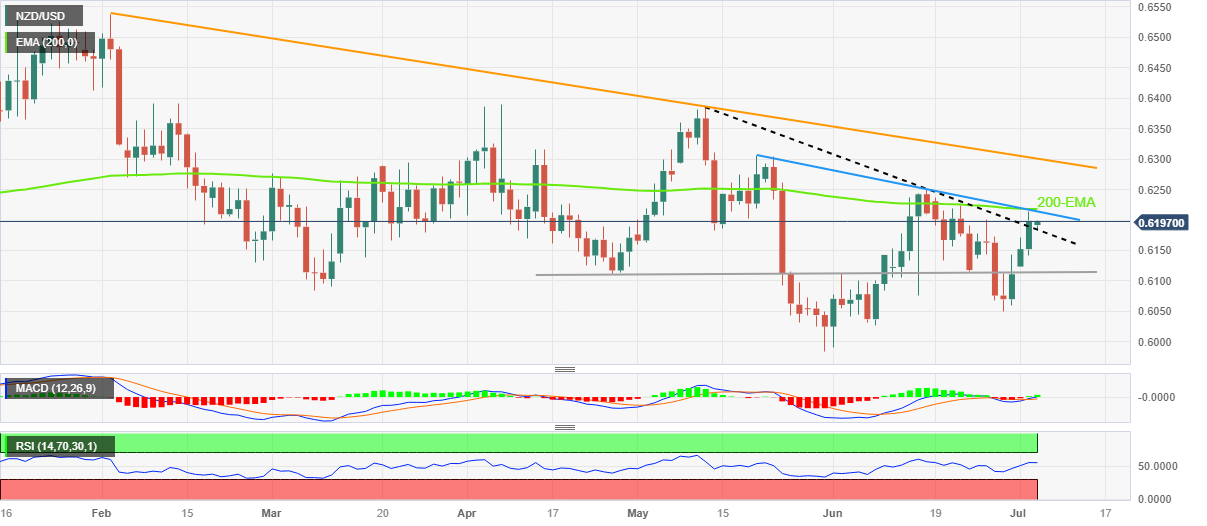
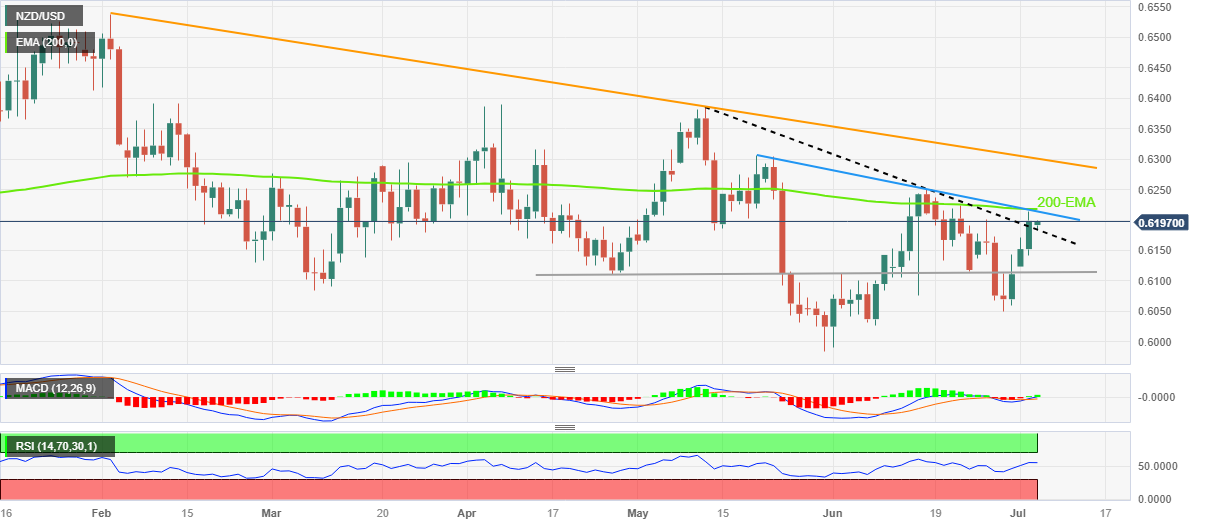
NZD/USD justifies the previous day’s upside break of a two-month-old resistance line while printing a four-day winning streak near the 0.6200 round figure. In doing so, the Kiwi pair remains mildly bid near the highest levels in a fortnight amid early Wednesday morning in Auckland.

Not only the trend line breakout but the latest bullish MACD signals and the upbeat RSI (14), not overbought, also keeps the Kiwi pair buyers hopeful.

However, a convergence of the 200-Exponential Moving Average (EMA) and a six-week-long falling trend line, close to 0.6220 at the latest, tests the NZD/USD buyers. Also acting as a short-term upside filter is the previous monthly high of 0.6250.

Above all, a downward-sloping resistance line from early February, around the 0.6300 threshold by the press time, becomes crucial for the NZD/USD bulls to cross for conviction.

On the contrary, a downside break of the previous resistance line stretched from early May, surrounding 0.6180, can recall the intraday sellers of the pair.

Following that, 10-week-old horizontal support and the yearly bottom marked in May, near 0.6110 and 0.5990 in that order, will be the key to watch for the NZD/USD bears.

NZD/USD: Daily chart

Italian service sector growth continues to slow in June

Italian service sector growth continues to slow in June

Italy’s service sector continued to expand during June. However, amid reports that client uncertainty and increased interest rates were weighing on sales, activity rose at the slowest rate in four months. Confidence in the future remained positive, and firms took on extra staff though also at a slower rate compared to May. Disinflationary pressures were apparent as signalled by concurrent falls in input and output price inflation. The headline index from the report, the HCOB Italy Services PMI Business Activity Index recorded 52.2 in June. Although indicating another period of above trend growth, the index was down

GlobalDairyTrade auction results: Slip sliding away

GlobalDairyTrade auction results: Slip sliding away

Dairy auction prices fell sharply overnight continuing the downward trend that started in March 2022. While prices fell across all product categories, there were some marked differences. Key whole milk powder (WMP) prices were just a shade weaker, falling by just 0.4%. However, milk fat prices were sharply lower, with prices for butter and butter milk powder dropping by 10.3% and 11.4%, respectively. Meanwhile prices for cheddar cheese and skim milk powder dropped 3.1% and 6.0%. Although a significant drop, the result was still better than expected. We had expected WMP to fall by about 4%, with the futures market

USD/JPY Stuck in a Rut at Sub-145 as Intervention Risk Lingers

USD/JPY Stuck in a Rut at Sub-145 as Intervention Risk Lingers

It is a busier Tuesday session for the USD/JPY. The services sector was in the spotlight, with Services PMIs from China and Japan drawing interest.

Service sector activity in Japan slowed more than expected in June, with the PMI falling from 55.9 to 54.0 versus a prelim 54.2. Notably, demand conditions remained robust, with outstanding business rising at the second-fastest rate on record. While firms continued to report elevated inflationary pressures, input price inflation softened to a 15-month low.

Trading Derivatives carries a high level of risk to your capital and you should only trade with money you can afford to lose. Trading Derivatives may not be suitable for all investors, so please ensure that you fully understand the risks involved, and seek independent advice if necessary. A Product Disclosure Statement (PDS) can be obtained either from this website or on request from our offices and should be considered before entering into a transaction with us. Raw Spread accounts offer spreads from 0.0 pips with a commission charge of USD $3.50 per 100k traded. Standard account offer spreads from 1 pips with no additional commission charges. Spreads on CFD indices start at 0.4 points. The information on this site is not directed at residents in any country or jurisdiction where such distribution or use would be contrary to local law or regulation.

The Caixin Services PMI from China followed a similar theme, with the PMI falling from 57.1 to 53.9.

The US Session

It is a quiet day ahead on the US economic calendar. US factory orders will be in focus ahead of a busy second half of the week. After the disappointing ISM Manufacturing PMI numbers, an unexpected fall in factory orders would test the appetite for the dollar.

However, despite weaker economic indicators, the markets are still betting on a July Fed rate hike.

According to the CME FedWatch Tool, the probability of a 25-basis point July Fed rate hike stood at 86.2% versus 86.8% on Monday. Significantly, the chances of the Fed lifting rates to 5.75% in September stood at 19.0%, down from 20.8% on Monday.

Investor sentiment toward a September move could significantly change later this week. The all-important ISM Non-Manufacturing PMI survey and the US Jobs Report will need consideration.

USD/JPY Price Action

Daily Chart

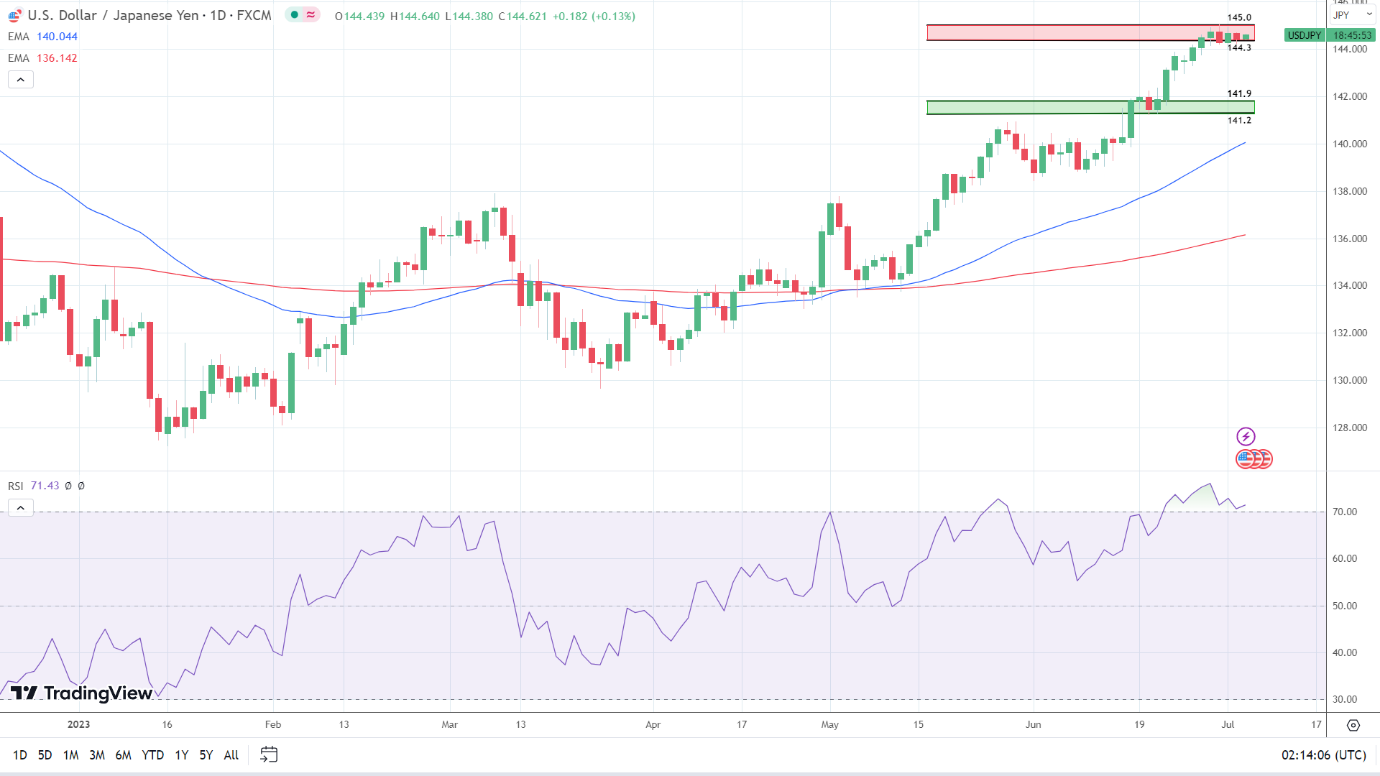
The Daily Chart showed a sustained USD/JPY breakout from the psychological 144 support level despite disappointing PMI numbers and China-US tensions. The USD/JPY remained above the 200-day (136.142) and 50-day (140.043) EMAs, signaling bullish momentum over the near and long term.

Notably, the 50-day EMA continued to pull away from the 200-day EMA and reflected bullish momentum despite the Tuesday pullback.

Looking at the 14-Daily RSI, the 71.30 reading signals oversold territory, suggesting a return to sub-144. However, a hold above the lower level of the 144.3 – 145.0 resistance range should support a return to 145.

USD/JPY Daily Chart sends bullish signals.
USDJPY 050723 Daily Chart

4-Hourly Chart

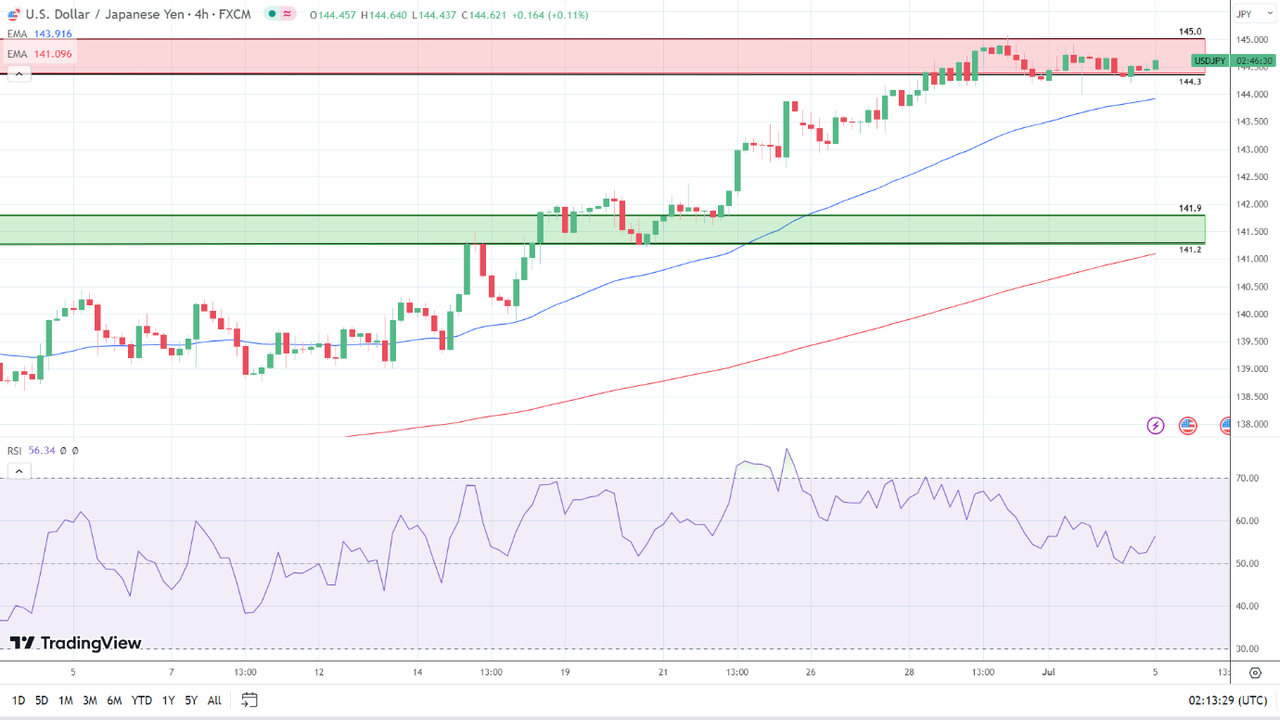
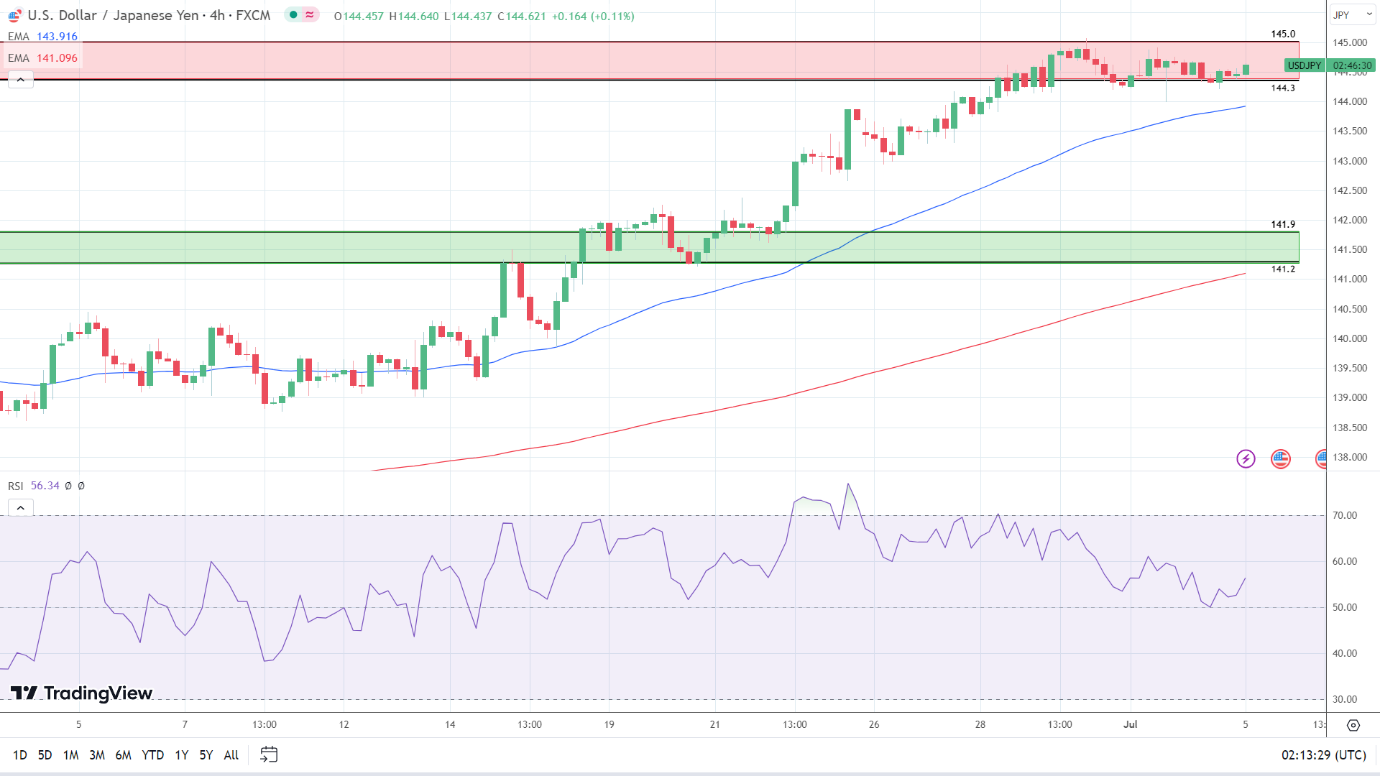
Looking at the 4-Hourly Chart, the USD/JPY faces strong resistance at the 145 psychological level. The USD/JPY remained above the 200-day (141.096) and 50-day (143.916) EMAs. Significantly, the 50-day EMA pulled further away from the 200-day EMA, signaling another run at the upper level of the resistance range of 144.3 – 145.0.

The 14-4H RSI reading of 56.34 indicates a moderately bullish stance, with buying pressure outweighing selling pressure. Significantly, the RSI aligns with the EMAs, also signaling another run at 145.

4-Hourly Chart is bullish.
USDJPY 050723 4 Hourly Chart
China squeezes key metal supplies in chip war escalation

China squeezes key metal supplies in chip war escalation

In a chip war twist, China will restrict exports of the niche metals gallium and germanium and certain of their compounds in retaliation against US and Japan export bans on sending advanced chips and chip-making equipment to China.

Beginning August 1, Chinese chemical suppliers must apply for government licenses to export 38 products including gallium nitride (GaN) and germanium dioxide (GeO2), China’s Ministry of Commerce said in a statement on July 3.

The metals are used in chipmaking, communications equipment and various defense items. Gallium is used in compound semiconductors, which when combined with various other elements are often used to improve transmission speed and efficiency in mobile phone screens, solar panels and radars.

Germanium is used in fiberoptic communication cables, night-vision goggles and the solar cells that are used to power many satellites. US imports of gallium metal and gallium arsenide wafers in 2022 were valued at only about US$225 million, according to US trade data.

China is by far the world’s top source of both metals, accounting for 94% of gallium supply and 83% of germanium, according to a European Union study released this year.

Some analysts have already estimated the impact of China’s bans will be limited as the US and Japan can import the materials from other countries or produce them domestically, although at considerably higher costs.

Chinese commentators said China’s export controls aim at slowing the pace of development of US and Japanese chipmakers, a bid to create the time and space for Chinese players to catch up in the critical race to forge ever smaller chip sizes.

“China is always committed to keeping the global industrial and supply chains secure and stable, and has always implemented fair, reasonable and non-discriminatory export control measures,” Chinese Foreign Ministry spokesperson Mao Ning said in a media briefing on Tuesday.

USD/TRY climbs to fresh tops near 26.1000 post-CPI

USD/TRY climbs to fresh tops near 26.1000 post-CPI

Further depreciation of the Turkish currency lifts USD/TRY to new all-time highs near 26.1000 on Wednesday.

USD/TRY: Rally appears unabated so far

On Wednesday, the USD/TRY continued its weekly rebound and surpassed the 26.0000 hurdle, as negative sentiment towards the Turkish lira persisted.

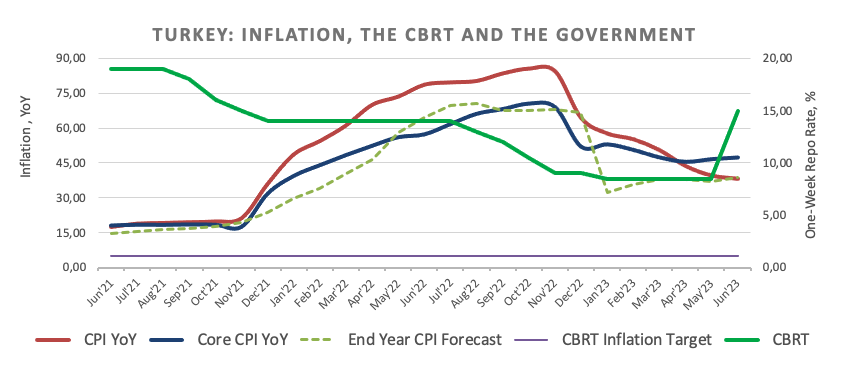
Despite the release of inflation figures in Türkiye, which showed a 3.92% MoM increase in June and a 38.21% rise over the past twelve months, the FX market did not react significantly. These figures came in lower than expected and indicated that disinflationary pressures remained in place last month. Additionally, Producer Prices rose 6.5% MoM and 40.42% YoY.

As the lira falls off the cliff, market participants are increasingly skeptical about the newly appointed economic team’s ability to reverse the trend and restore credibility to both the government and the central bank.

Furthermore, investors are concerned about national lenders spending approximately $1B to support the domestic currency earlier this week.

What to look for around TRY

USD/TRY now seems to have resumed the uptrend following a brief consolidation period of several sessions.

In the meantime, investors are expected to closely monitor upcoming decisions on monetary policy. By appointing Mehmet Simsek and Hafize Gaye Erkan, both former Wall Street bankers, to oversee the country’s finances, President R. T. Erdogan seems to suggest a possible move away from heavy state intervention in favor of letting the market dictate the fair value of the currency.

Although it remains uncertain whether Mr. Erdogan’s preference for combating inflation through lower interest rates will allow Simsek and Erkan’s orthodox approach to monetary policy to thrive, the news of their appointment has been so far cautiously welcomed by market participants.

In a broader sense, price action around the Turkish currency is expected to continue to revolve around the performance of energy and commodity prices, which are directly tied to developments from the Ukraine conflict, broad risk appetite trends, and dollar dynamics.

Key events in Türkiye this week: CPI, Producer Prices (Wednesday).

Eminent issues on the back boiler: Persistent distrust over the CBRT credibility/independence. Absence of structural reforms. Bouts of geopolitical concerns.

USD/TRY key levels

So far, the pair is gaining 0.48% at 26.0739 and faces the next hurdle at 26.0813 (all-time high July 5) followed by 27.00 (round level). On the downside, a break below 23.4189 (weekly low June 21) would expose 21.6268 (55-day SMA) and finally 20.4611 (100-day SMA).