US reliance on China’s capital goods rules out decoupling

US reliance on China’s capital goods rules out decoupling

The bad news is that America hasn’t invested much in manufacturing during the past 20 years. The worse news is that most of the manufacturing capital equipment that America uses came from imports.

Not only does the US have a US$1 trillion trade deficit, but about $300 billion of that deficit comes from imports of capital goods, namely goods that make other goods.

Federal subsidies for chip fabrication plants and green energy have recently bulked up the numbers for factory construction, but orders for capital equipment remain depressed. The subsidy-driven increases in factory building help explain an enormous surge in US imports of capital goods.

America’s dependence on foreign capital goods reached an all-time high in 2022, as capital goods imports exceeded domestic production of capital goods for home use, according to Asia Times’ calculations.

To reduce its $1 trillion trade deficit, the US would have to invest in capital goods. But it would need to import most of these capital goods, which means that the trade deficit would have to increase in the short term in order to shrink in the long term.

Bets for Soaring UK Interest Rates May Unravel Over 30 Hours

Bets for Soaring UK Interest Rates May Unravel Over 30 Hours

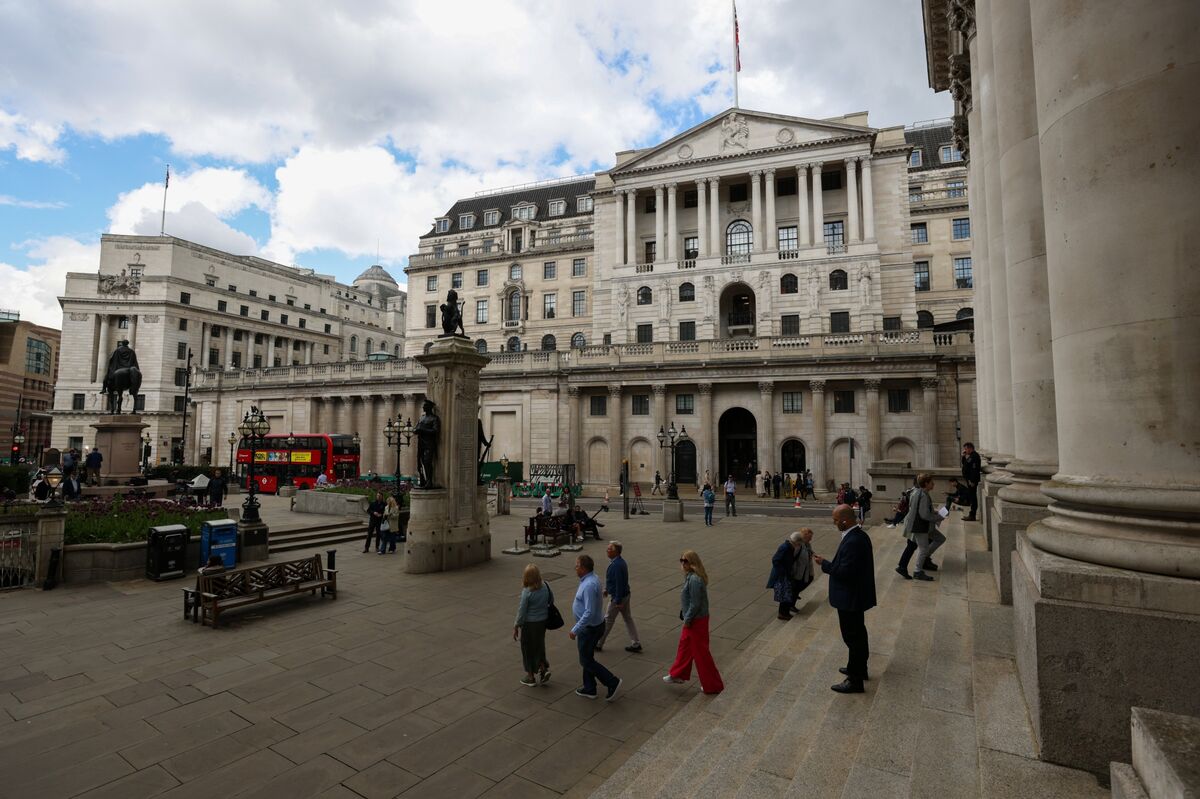
Britain’s bond market is approaching an inflection point, with inflation data and a Bank of England decision set to shape the outlook for traders after yields rose to the highest level since 2008.

Those two events, due over 30 hours starting Wednesday morning, could bring a halt to upward momentum in interest-rate bets. Official data is expected to show inflation slowed to its lowest in 14 months, while investors are pricing in a 13th consecutive rate hike from the BOE to bring wage-price pressures under control.

BlackRock Inc., Invesco Asset Management and Royal London Asset Management are already dipping back into the market. They argue — along with many economists — that traders are anticipating more hikes than the BOE is likely to deliver, and it’s an opportunity to lock in some of the highest bond yields in the developed world.

“The market’s pricing of five more hikes from the BOE is very unlikely,” said Alexandra Ivanova, a fund manager at Invesco. “The Bank has a lot of constraints making it unable to deliver on these expectations. Growth is one of them, and inflation is almost certainly a structural issue.”

Britain has the worst inflation problem in the Group of Seven nations but the outlook is improving, thanks largely to a sharp drop in electricity and natural gas prices as well as slower growth in the cost of food.

Economists expect the inflation rate to decelerate to 8.4% in May from 8.7% in April. BOE officials see inflation easing further for the rest of the year.

The release will loom large over the Monetary Policy Committee’s thinking as it prepares to set rates on Thursday. The median estimate in a Bloomberg survey is for a quarter-point increase to 4.75%, the highest since 2008.

“The BOE’s near-term messaging will depend heavily on the inflation print,” said Bruna Skarica, an economist at Morgan Stanley. She is penciling in a 25 basis-point hike, yet doesn’t anticipate “overly hawkish messaging” from the MPC ahead of the August forecasting round.

The market is less sanguine. Traders drove up rate expectations over the last few weeks after labor market data showed an unexpected tick down in unemployment, indicating wage pressures will continue for some time.

They now see four additional hikes until the end of the year and attribute a small chance of final move to 6% in early 2024, which would be the highest since the turn of the century.

For some investors that means a turning point in interest rates is near. They are moving to lock in returns, betting yields may not rise much further.

Invesco bought long-duration gilts last week, when yields surged to the highest since 2008. BlackRock recently ditched a long-held underweight position, while Royal London Asset Management also used the selloff to buy UK government bonds.

What Bloomberg Economics Says …

“There is some speculation among investors that a string of hotter-than-expected pay and inflation data could prompt the Bank of England to opt for a 50-basis-point hike at its June meeting. We think that’s unlikely. Rate expectations have already moved materially higher — the central bank doesn’t need to provide a further impulse with a hawkish surprise. Our base case is for a 25-bp move.

—Dan Hanson and Ana Andrade, Bloomberg Economics. Click for the PREVIEW.

Another issue the market must weigh is that the tightening priced in now would be a disaster for what’s an already fragile economy.

The BOE anticipates medium-term growth around 1%, far lower than the rate of inflation and tightening a cost-of-living crisis. Rates anywhere near 6% would squeeze the economy further, with more than 1 million households due to refinance their mortgages this year.

That all points to a stagnating economy with slower price growth, opening the door for the BOE sometime this year to halt its quickest series of rate hikes in four decades.

Still, if inflation keeps pushing higher there’s likely more pain in store for bond holders. The rate has surprised on the upside in each of the three previous reports.

“It’s hard to say they are not cheap at the moment,” said Stuart Cole, chief macro economist at Equiti Capital in London. “But there is probably room for them to cheapen a bit further still. If we get a strong CPI number, then I think we will see yields tick higher once more.”

Pairs in Focus This Week – AUD/USD, EUR/USD, USD/JPY, GBP/USD, NASDAQ 100, Gold, DAX, Hang Seng

Pairs in Focus This Week – AUD/USD, EUR/USD, USD/JPY, GBP/USD, NASDAQ 100, Gold, DAX, Hang Seng

AUD/USD

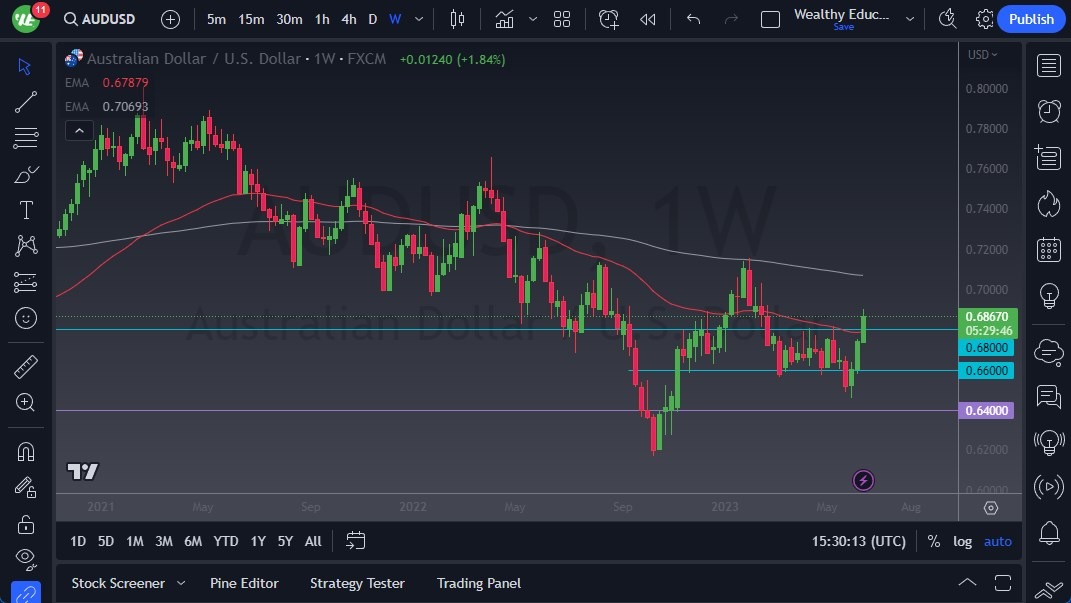
The AUD/USD has rallied rather significantly during the course of the week, breaking above the 0.68 level. The market threatened the 0.69 level on Friday but did pull back a bit. At this point, it does make a certain amount of sense we get a short-term pullback, but if we can hold the 0.68 level on some type of bounce, it’s likely that this market will try to get to the 0.70 level above. On the other hand, if we were to take out the bottom of the weekly candlestick, then the Aussie would more likely than not drop toward the 0.66 level.

AUD/USD

EUR/USD

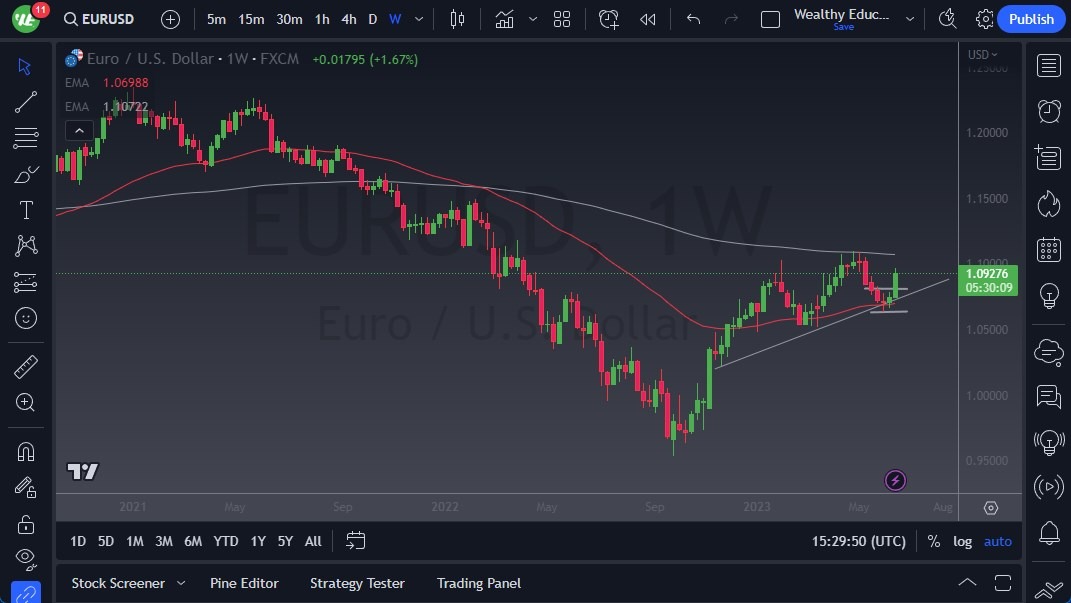
The EUR/USD has rallied during the course of the trading week, breaking above the 1.09 level after the ECB raised interest rates, while the Federal Reserve chose to hold interest rates. All things being equal, the 1.10 level above is a psychological barrier that people will be paying attention to. That being said, it looks like we are starting to show a little bit of exhaustion on Friday, so I do think that a short-term pullback is likely. However, I do not expect a big move in the short term as I think we are still stuck in a range.

EUR/USD

USD/JPY

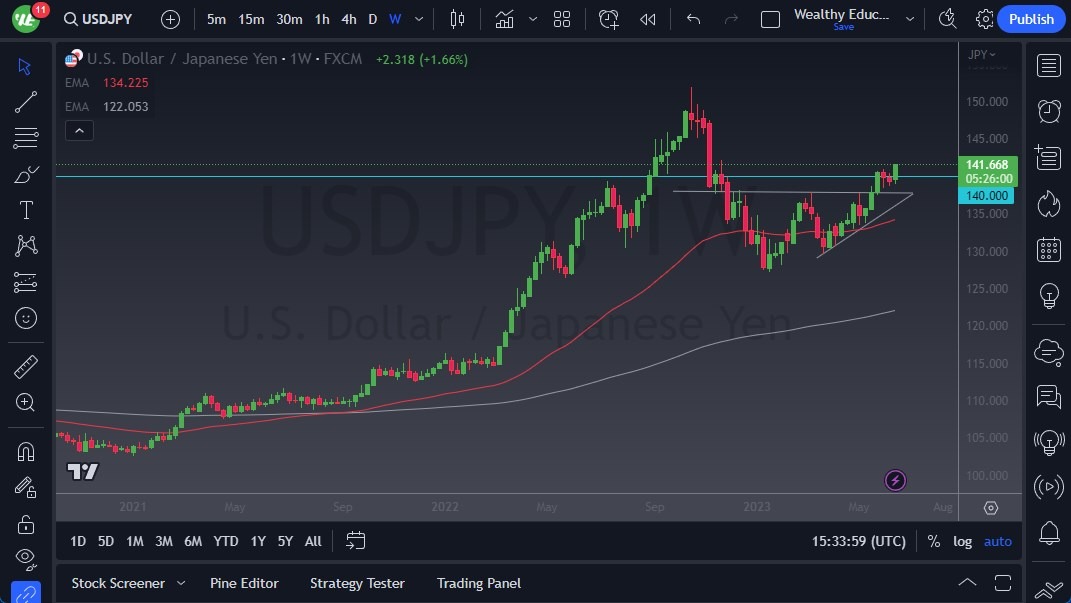
The USD/JPY has rallied significantly during the course of the week, as we continue to see a lot of very bullish behavior. The ¥140 level is going to be psychologically important, but the real support is going to be down at the ¥138 level. The ¥138 level is the top of an ascending triangle, and therefore it should be a massive “floor in the market.” As long as the Bank of Japan remains this loose with monetary policy, I just don’t see how the trajectory does anything but go higher. In fact, the “measured move” suggests that we could be going as high as ¥148 based upon the ascending triangle, and perhaps even the massive “W pattern.”

USD/JPY

GBP/USD

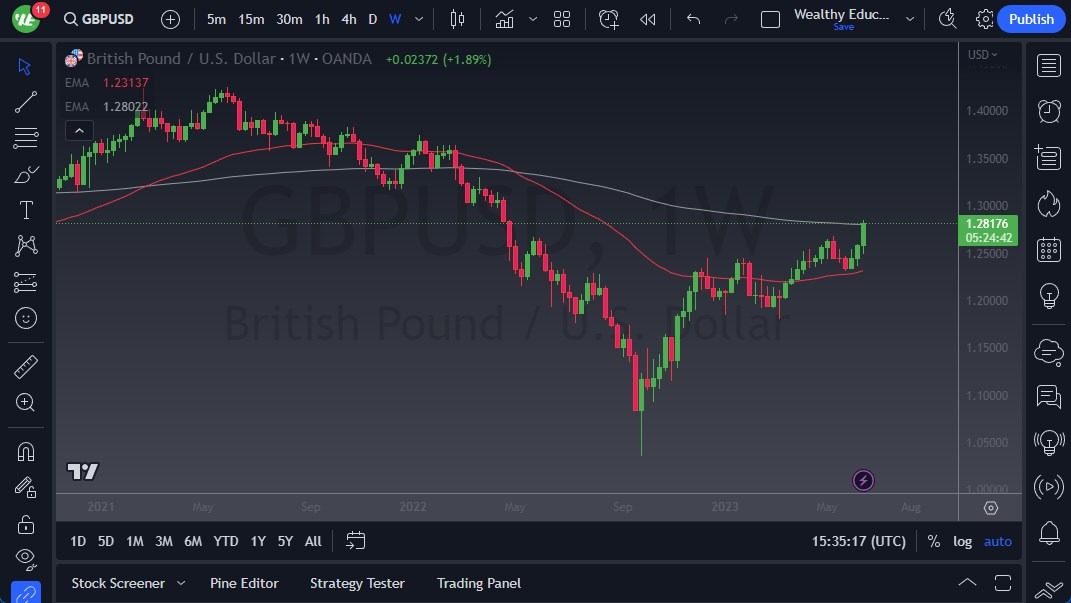
The GBP/USD has rallied significantly during the week as well, as it has been a rout against the US dollar. At this point, the market is likely to continue to go to the upside, with a target of 1.30 above. Short-term pullbacks will offer buying opportunities, but you will be better served waiting for some type of value to appear. After all, the selling off of the US dollar is still fresh, and of course might even be a little overdone in the short term.

GBP/USD

NASDAQ 100

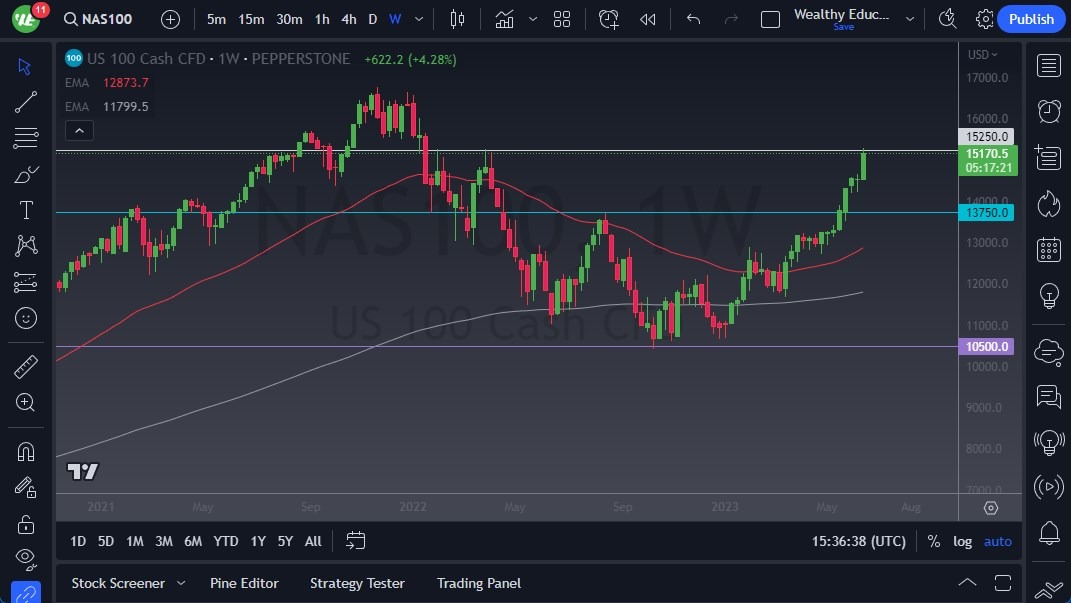
The NASDAQ 100 has shot straight up in the air during the course of the trading week, testing the crucial 15,250 level. This is an area that has been a major resistant barrier previously, and therefore I think you will have to pay close attention to it. If we break above there, then we could go much higher, perhaps looking to the 16,000 level. Short-term pullbacks at this point continue to be buying opportunities from what I can see, even though it’s obvious to me that we are overbought. Quite frankly, this is a massive “FOMO market.” Keep in mind that the NASDAQ 100 is driven higher by about 7 stocks, so unless Tesla and the other start falling, this market will be squeezed higher.

NASDAQ 100

Gold

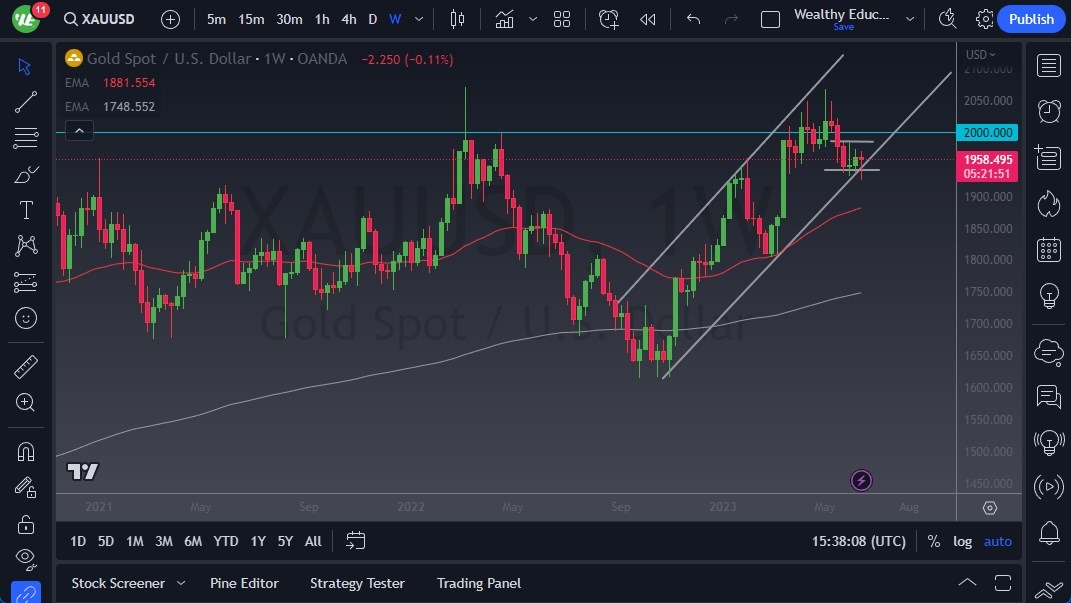
Gold markets initially fell during the trading week but turned around to show signs of life and form a massive hammer. This hammer was based around the $1950 level, an area that has been important multiple times. With that being the case, I think we’ve got an opportunity to get a little momentum in the market to the upside. If we can break above the $2000 level, then it’s likely that gold will start racing toward that high again, threatening the “triple top.” That being said, I think in the short term gold is more likely than not to stay in this $50 range, so if you are a short-term trader, this might be a good market for you.

Gold

DAX

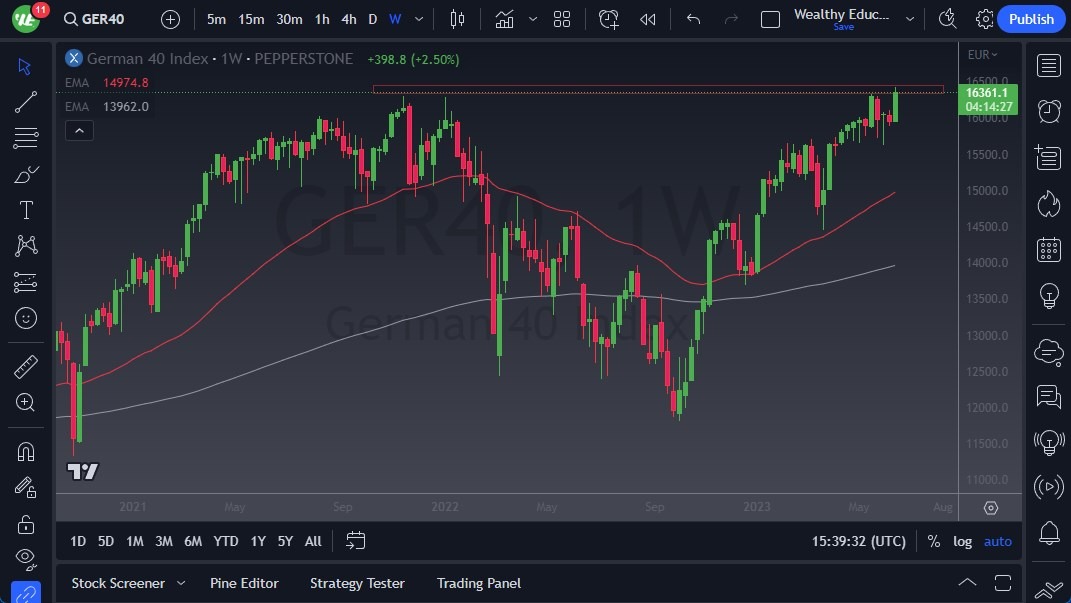
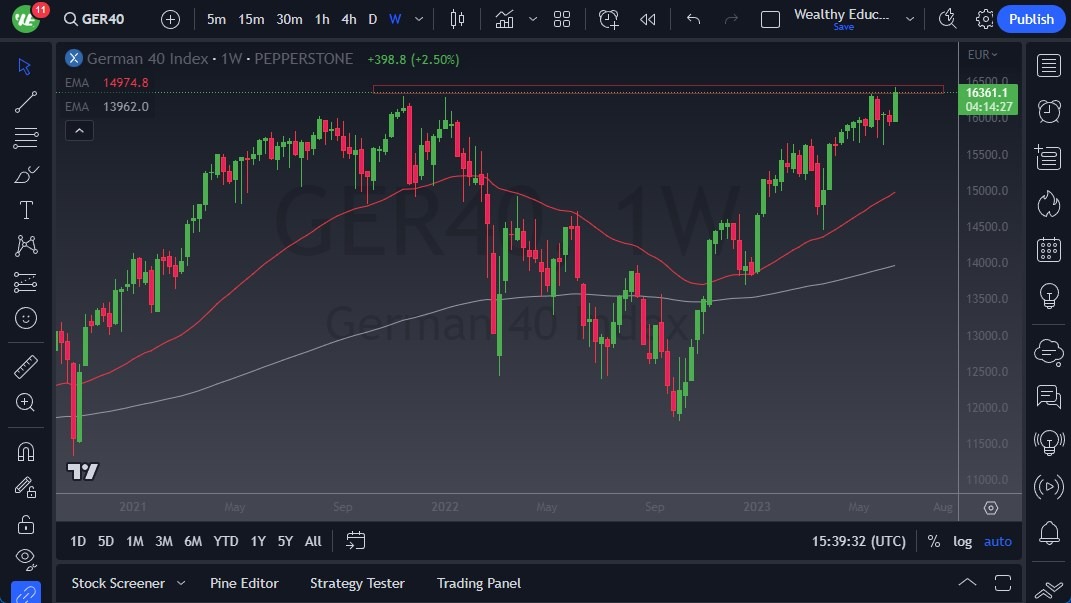
The DAX rallied during the course of the week, reaching highs again, and even breaking out to a fresh, new high. At this point, it looks like the DAX is ready to continue going higher, and a break above the top of the weekly candlestick certainly is very bullish. It’s worth noting that even though the European Central Bank raised rates during the course of the week, it seems as if the stock market in Frankfurt simply chose to ignore this. We have seen a lot of bullish pressure recently, and I think that will continue to be the case going forward. This will be especially true if the Euro starts to lose a little bit of strength.

DAX

Hang Seng (Hong Kong 50)

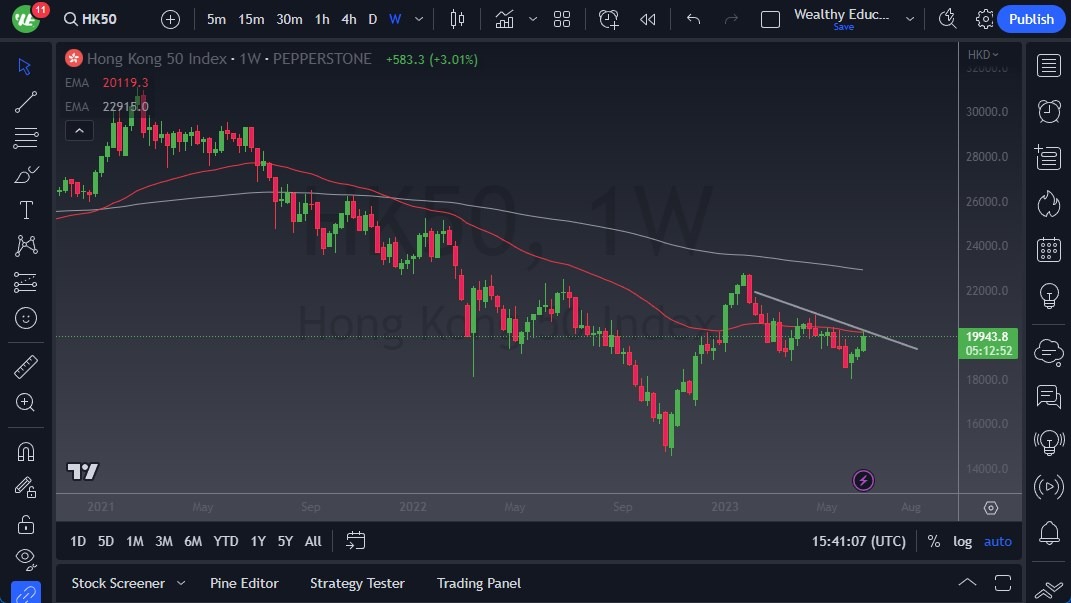
The Hong Kong 50 has had a rather bullish week, touching the 50-Week EMA near the HK$19,950 level. Having said that, we are right at the convergence of not only the 50-Week EMA, but also a short-term downtrend line. The question now is whether or not this and of course the HK$20,000 level will offer enough resistance to keep the market from breaking out. If the market were to break above HK$20,000, then you could see a bigger move, perhaps up to the HK$22,000 level. In that vicinity, you would be testing the 200-Week EMA.

On the other hand, if the market fails in this area, it’s very likely that the HK 50 will go looking toward the HK$18,000 level again, as it has been in a downtrend for a couple of years now. Furthermore, some of the data coming out of China is starting to deteriorate.

Hang Seng

China’s Big-City Homeowners Cash Out as Wealth Dream Fades

China’s Big-City Homeowners Cash Out as Wealth Dream Fades

Chinese homeowners are losing conviction in their decades-long belief that property is a reliable store of wealth, undermining even coveted markets like Shanghai and adding pressure on authorities to find new sources of economic growth.

Asking prices in the financial hub have slumped for three straight months, falling to the lowest level since before China emerged from Covid lockdowns at the end of last year, according to data compiled by Centaline Group.

Despite surging inventory, transactions in the city tanked by one third to about 16,000 units in May compared with March, the Economic Observer reported this month.

Interviews with homeowners, real estate agents and analysts suggest the downturn has been fueled by waning faith that property will always be one of China’s safest investments.

While that shift in mindset has in some ways been welcomed by policy makers seeking to rein in speculative buying, the risk of a deeper-than-desired slump is rising at a time when the broader economy is losing momentum. Longer term, authorities may struggle to replace real estate as a key driver of growth and bulwark of the nation’s vast middle class.

“Selling pressure is really piling up here” in Shanghai, said Jun Li, chief investment officer at Power Sustainable (Shanghai) Investment Management, a Canadian financial firm. “It seems homeowners have reached a consensus that the market has peaked.”

Cashing Out

Song, a banker who recently sold his apartment in Shanghai’s prestigious Jing’an district for about 10 million yuan ($1.4 million), said he views this as one of the last windows to cash out of the property boom.

The 35-year-old still owns other properties in China with his family, but wants to reduce exposure to the sector due to expectations of property taxes and a prolonged slowdown in the sector. He asked to be identified by his last name for privacy reasons.

His experience is matched across the country. Existing home prices in 100 cities recorded the biggest decline in May since at least 2022, according to data compiled by real estate research firm China Index Academy.

“Shanghai has the most sluggish existing-home market in China right now,” said Yan Yuejin, a research director at E-house China Research and Development Institute. “Across the nation, supply and demand in the secondary market have also deteriorated.”

Homeowners in the southern metropolis of Shenzhen have cut prices to the lowest since October 2016, according to data compiled by Centaline Group.

People are seeking to sell due to concerns about the economic outlook, financing needs for cash-strapped businesses and unemployment, Li said.

In Hangzhou, the home base for Alibaba Group Holding Ltd., a seller in the suburbs cut asking prices by 17% after failing to find a buyer in six months, according to a housing agent surnamed Gong, who requested to be identified by her last name because she wasn’t authorized to speak publicly.

The weakening sentiment in China’s real estate sector is prompting policy makers to weigh new support measures to keep the economy afloat, Bloomberg reported this month.

Regulators are considering reducing down payments in some non-core neighborhoods of major cities, lowering agent commissions on transactions, and further relaxing restrictions for residential purchases.

Different Cycle

The days of roaring demand are unlikely to come back any time soon, according to Goldman Sachs Group Inc. analysts, who said China could experience an “L-shaped” real estate market.

This “cycle is different from previous rounds, as policymakers appear very determined not to use the property sector as a short-term stimulus tool,” Goldman analysts wrote in a June 11 note. “We believe the policy priority is to manage the multi-year slowdown rather than to engineer an up-cycle.”

Read More: China Home-Price Growth Weakens as Housing Recovery Falters

Longer term, China is experiencing a structural shift due to its aging population, and limited scope for moving more people into cities. The country’s urbanization rate is expected to peak at about 75%, up from 64.7% in 2021 — all of which is weighing on sentiment.

Such pessimism is increasingly showing in Shanghai, as tough Covid measures in the last three years and weakening confidence in China’s economic outlook pushed homeowners and tenants — many of whom are expats — to pack and leave.

Shanghai Exodus

Favored by foreign companies, Shanghai was home to a quarter of China’s expatriate population before 2022. The city saw an exodus after the lockdown that kept nearly 25 million people confined to their homes for more than two months.

About 25% of Germans living in the city left in the fallout, while the number of French and Italian citizens registered with their governments each fell by 20%, according to a report by the Shanghai chapter of the European Union Chamber of Commerce early this year.

In Lianyang, a downtown neighborhood popular with expats and financiers in Shanghai, residential prices have slid 15% to 20% from record highs in mid-2021, according to a local property agent who asked to be identified by her surname Liu, because she wasn’t authorized to speak about the matter publicly.

Yi, a 31-year-old Shanghai resident, sold her suburban home in April for 4 million yuan, representing a steeper-than-expected 11% discount to her initial asking price. Second-hand inventory reached a record-high at 200,000 units that month, according to the Economic Observer.

She was in urgent need of cash and requested to be identified by her last name for privacy reasons. “It’s a buyers’ market now,” she said.


GBP/USD: Longs stretched but acceleration to 1.30 may gather momentum depending on Wednesday’s CPI – SocGen

GBP/USD: Longs stretched but acceleration to 1.30 may gather momentum depending on Wednesday’s CPI – SocGen

GBP/USD pauses after a 1.95% gain last week. Economists at Société Générale analyze GBP outlook ahead of the UK Consumer Price Index (CPI) data and the Bank of England (BoE) meeting this week.

A hawkish split with some members preferring 50 bps for the first time since January is not impossible

The acceleration in UK core inflation to a new high of 6.8% in May and wages ex-bonuses to 7.2% YoY in April sparked a dramatic repricing of the implied BoE terminal rate in the past two weeks from 5% to 6%. Whether we ultimately get there remains to be seen, but the bank could double down in the statement that tighter policy is required to rein in second-round effects. Compared to the UK, core inflation in the Eurozone and the US is 5.3%.

A hawkish split with some members preferring 50 bps for the first time since January is not impossible if core CPI surprises to the upside on Wednesday, the day before the rate decision.

We are mindful of technically stretched levels in Sterling and profit talking, but won’t rule out further appreciation just yet of GBP/USD towards 1.30 and depreciation of EUR/GBP towards 0.85 and 0.8475 (1.18 GBP/EUR).

USD/JPY flirts with YTD peak, bulls now await sustained move beyond 142.00 mark

USD/JPY flirts with YTD peak, bulls now await sustained move beyond 142.00 mark

The USD/JPY pair reverses an intraday dip to the 141.45 area and steadily climbs back closer to its highest level since November 2022 touched earlier this Monday. Spot prices trade just below the 142.00 mark during the early European session and seem poised to prolong the recent well-established bullish trajectory witnessed over the past three months or so.

The Japanese (JPY) continues to be weighed down by a big divergence in the monetary policy stance adopted by the Bank of Japan (BoJ) and other major central banks, including the US Federal Reserve (Fed). This, along with a modest US Dollar (USD) strength, acts as a tailwind for the USD/JPY pair on the first day of a new week, though slightly overstretched conditions hold back bulls from placing fresh bets and capping the upside.

It is worth recalling that the BoJ on Friday held its short-term interest rate target at -0.1% and made no changes to its yield curve control policy. The BoJ also kept intact its view that inflation will slow later this year, underscoring its focus on supporting a fragile economic recovery on the back of global uncertainty. In contrast, the US central bank, albeit decided to leave its interest rates unchanged, signalled that borrowing costs may still need to rise by as much as 50 bps by the end of this year. This, in turn, is seen lending some support to the Greenback and the USD/JPY pair.

That said, the incoming softer US macro data raised questions over how much headroom the US central bank has to keep raising rates and fueled speculations that the Fed is nearing the end of its policy tightening cycle. This, along with worries about a global economic downturn and a softer risk tone, lends some support to the safe-haven JPY. Apart from this, thin trading volumes on the back of a US bank holiday warrant some caution before placing aggressive bullish bets ahead of Fed Chair Jerome Powell’s two-day congressional testimony on Wednesday and Thursday.

Investors will closely scrutinize Powell’s remarks for clues about the future rate-hike path, which will play a key role in influencing the near-term USD price dynamics and provide a fresh directional impetus to the USD/JPY pair. Nevertheless, the aforementioned fundamental backdrop suggests that the path of least resistance for spot prices is to the upside. Hence, any corrective decline is more likely to attract fresh buyers and remain limited.

EUR/USD stays on the back foot below 1.0950, ECB-speak eyed

EUR/USD stays on the back foot below 1.0950, ECB-speak eyed

EUR/USD is trading on the defensive below 1.0950 in early Europe this Monday. The pair is weighed down by the US Dollar bounce and risk aversion, as investors digest US-Sino headlines amid mounting Chinese growth fears. ECB-speak will be in focus. US markets are closed on account of Juneteenth.

EUR/USD extended its weekly rally and reached its highest level since May 11 at 1.0962 on Friday before retreating modestly. Hawkish European Central Bank (ECB) rhetoric allows the Euro to outperform its rivals but the technical outlook points to overbought conditions in the near term.

The ECB raised its key rates by 25 basis points (bps) in June as expected. The policy statement revealed that Eurosystem staff revised core inflation projections for 2023 and 2024 higher. In the post-meeting news conference, ECB President Christine Lagarde all but confirmed one more 25 bps hike at the next meeting.

“Bearing a material change to our baseline, it is very likely the case that we will continue to raise rates in July, which probably doesn’t come as a surprise,” Lagarde told reporters. She also downplayed softer HICP readings from the Euro Area and reiterated that inflation is projected to remain “too high for too long.”

Lagarde’s hawkish tone, combined with upward revisions to inflation forecasts, fuelled EUR/USD’s rally on Thursday.

On the other hand, the US Dollar stayed under persistent selling pressure after disappointing Initial Jobless Claims data, which came in at 262,000 in the week ending June.

Ahead of the weekend, the University of Michigan’s Consumer Sentiment Survey for June will be featured in the US economic docket. With the Federal Reserve’s (Fed) blackout coming to an end on Friday, Fed officials are likely to comment on the policy outlook as well. The CME Group FedWatch Tool shows that markets are pricing in a 25 bps Fed rate increase in July. In case policymakers try to steer markets toward a rate increase at the next policy meeting, the USD could stage a rebound, causing EUR/USD to edge lower.

Nevertheless, ECB policymakers don’t seem to be wasting anytime to reassure investors about their intentions to stick to tight policy, allowing the Euro to hold its ground. ECB policymaker and Bundesbank Chief Joachim Nagel said that inflation risks are still tilted to the upside and Governing Council member Gediminas Šimkus noted that he wasn’t expecting a rate cut early next year.

Asia Day Ahead: Wall Street Rally Pauses Ahead of Series of Fedspeak

Asia Day Ahead: Wall Street Rally Pauses Ahead of Series of Fedspeak

With the conclusion of the recent Federal Open Market Committee (FOMC) meeting, a series of hawkish Fedspeak is lined up on the horizon. We have a glimpse from Fed Governor Christopher Waller and Richmond Fed President Thomas Barkin last Friday, with persistent core inflation still at the top of their minds and that more tightening may need to be done.

Nevertheless, market participants continue to have their doubts, with interest rate futures firmly in the camp that the Fed will head towards its final phase of tightening with one last 25 basis-point (bp) move in July and rate cuts as early as next year. All eyes will be on Fed Chair Jerome Powell, who will have the opportunity to justify his hawkish stance with his testimony to the US Senate Banking Committee this week. Sticking to his usual script may potentially have limited impact in swaying rate expectations and he will have to provide greater conviction that his guidance at the Fed meeting is more than just a jawbone.

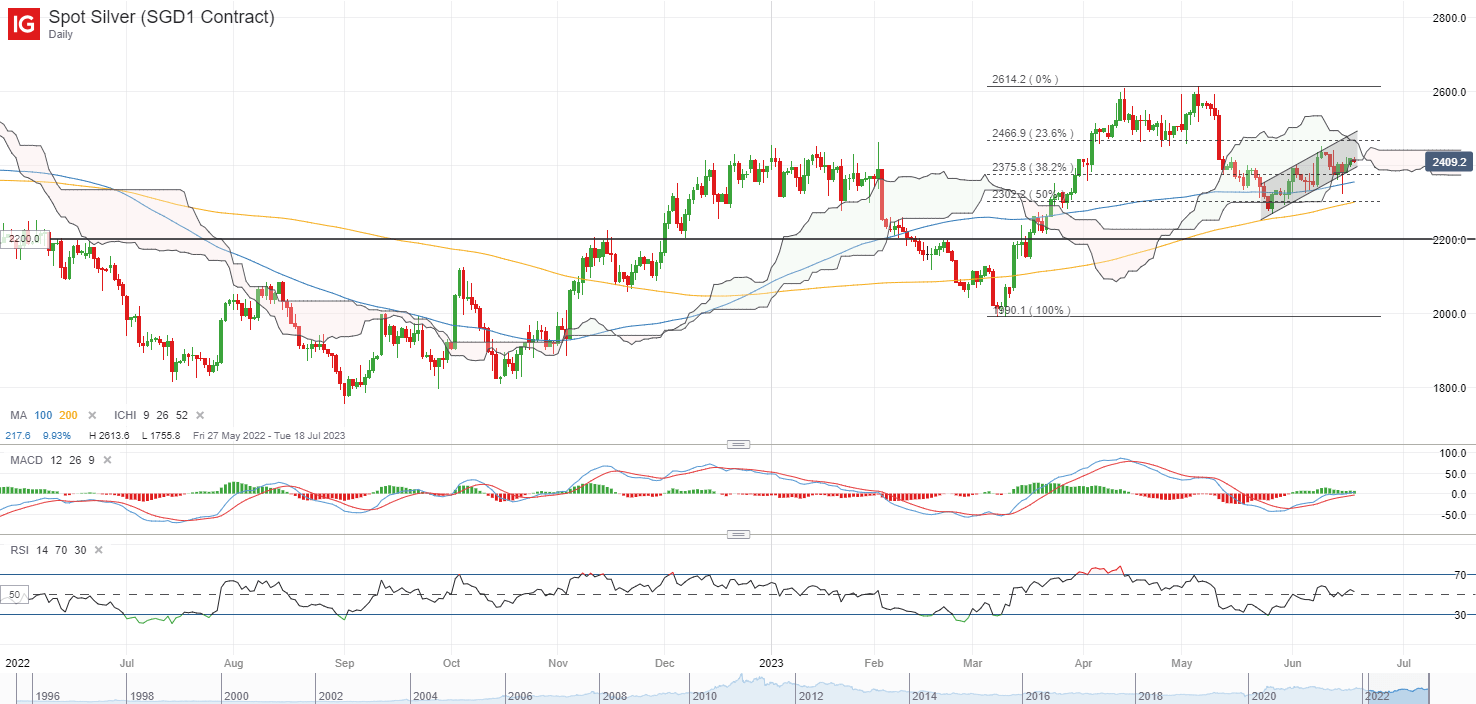
US market will be off for the Juneteenth holiday today, which could bring a quiet start to the new trading week for global markets. Treasury yields largely held firm last Friday, with the two-year and ten-year yields up 8 bp and 5 bp respectively, allowing the US dollar some slight reprieve following recent post-Fed sell-off. Perhaps one to watch will be silver prices, which saw some dip-buying with a long-tailed candle last week. Thus far, buyers have managed to defend a key support confluence at a lower trendline of a rising channel pattern (US$23.80 level), along with the lower edge of its Ichimoku cloud on the daily chart. That may leave the US$24.70 level on watch as the next resistance to overcome, while on the other hand, any breakdown of the channel pattern may place the US$23.00 level in sight.

image1.png

Asia Open

Asian stocks look set for a mixed open, with Nikkei -0.38%, ASX +0.24% and KOSPI -0.70% at the time of writing. US Secretary of State Antony Blinken’s visit to Beijing has been on the radar, with extended “candid” and “constructive” talks on Sunday at least showing some willingness to cooperate, although whether that will lead to any actual positive outcomes still awaits to be seen. Any inaction on that front could still see any optimism fizzle out eventually.

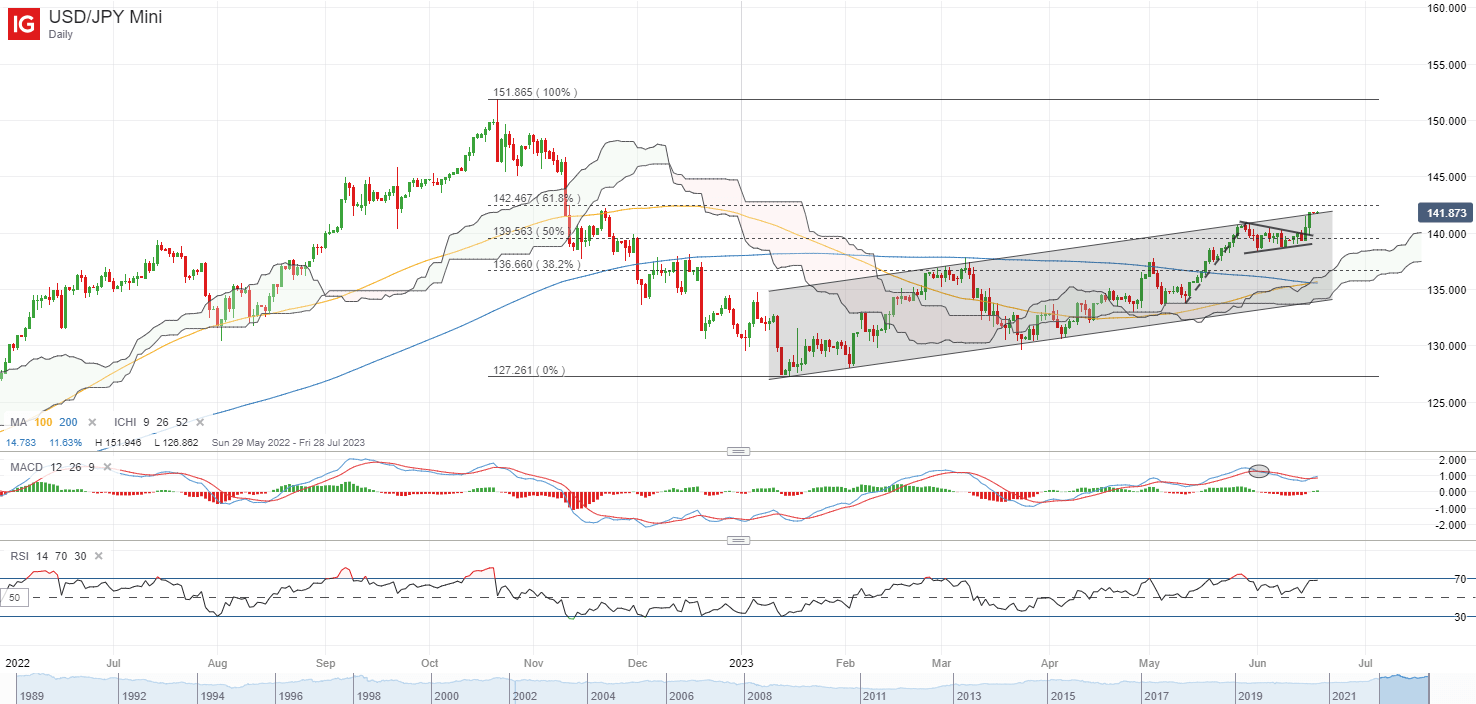
To conclude last week, the Bank of Japan (BoJ) has kept rates on hold in a widely-expected move, with its yield curve control held unchanged as well. Any tweak to its yield curve control policy will likely come as a surprise in the likes of that in December last year, but at least for now, maintaining their view that inflation will slow over the coming months seem to suggest that it will take some time. The USD/JPY is back to retest an upper channel trendline resistance currently, with a bullish crossover formed between its 100-day and 200-day moving average (MA). Any successful move past the channel resistance may then leave the 145.20 level on watch next.

image2.png

On the watchlist: GBP/USD at 13-month high ahead of Bank of England (BoE) meeting this week

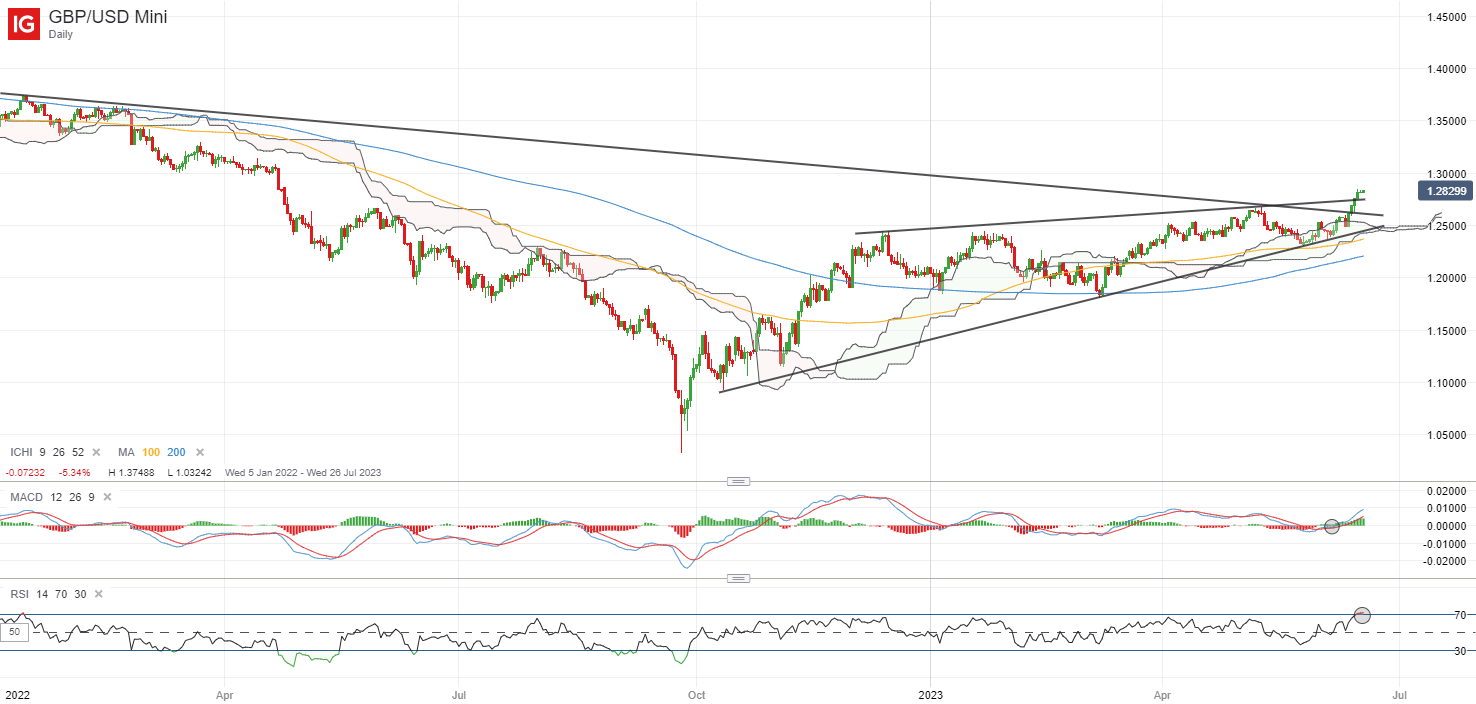
Ahead of the BoE meeting this week, more persistent pricing pressures in the UK has led markets to price for another relentless grind higher in interest rates from the BoE, with 125 bp worth of tightening expected over the coming months. In the Governor Andrew Bailey’s own words, inflation is ‘taking a lot longer’ than hoped to come down, as UK April core inflation rose to the highest since records began in 1992 (6.8%).

This contrasts with broad expectations for one last 25 bp hike from the Fed in July, paving the way for GBP/USD to push to its 13-month high on the Fed-BoE policy divergence. Further validation from the BoE this week that rates will go higher-for-longer may provide room for more upside in the GBP.

Recent upmove for the pair has marked a break above a rising wedge pattern on the daily chart, along with a key downward trendline resistance in place since June 2021. Its RSI hangs above the key 50 level, while an increasing MACD points to building upward momentum. The formation of higher highs and higher lows suggest that the overall trend remains up, placing the 1.316 level on watch next for a retest. On the downside, a series of support lines remain in focus to potentially underpin a higher low (200-day MA, Ichimoku cloud, lower wedge trendline), with immediate support at the 1.265 level.

image3.png