Yen Falls to 7-Month Low as Traders Shift Focus From Fed to BOJ

Yen Falls to 7-Month Low as Traders Shift Focus From Fed to BOJ

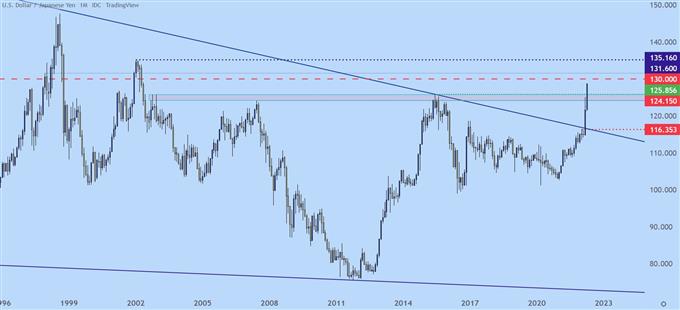
The yen weakened to its lowest since November against the dollar as traders shifted their focus from a hawkish Federal Reserve to Friday’s Bank of Japan policy decision.

The relatively hardline stance from Fed officials on Wednesday stands in sharp contrast to BOJ policymakers who have stuck with monetary easing even as most global peers tighten, a disparity that favors the US currency. The Fed projected borrowing costs will go higher than previously seen, while almost all of the economists surveyed by Bloomberg see the BOJ leaving its ultra loose policy unchanged Friday.

The Japanese currency fell 1% to around 141.50 per dollar, even after Chief Cabinet Secretary Hirokazu Matsuno said that excessive movements weren’t desirable. Last month when the yen weakened to similar levels, top currency official Masato Kanda said that the government would take action if needed, after an unscheduled meeting between the BOJ, Ministry of Finance and Financial Services Agency.

“The trend for the yen to weaken amid no policy change by the BOJ, in combination with a more hawkish Fed, is likely to continue for a while,” said Tsutomu Soma, a bond and currency trader at Monex Inc. “The authorities may verbally intervene as the yen continues to weaken but actual intervention is unlikely as there’s some benefit from it for the nation, such as higher stock prices.”

The benchmark US Treasury yield climbed 4 basis points to 3.83% in Asia trading Thursday, with its Japanese counterpart little changed at 0.42%. The widening gap between the two played a huge part in pushing the yen to a three-decade low last year.

Demand for the dollar was also likely influenced by Japanese importers, who typically buy the greenback on trading days that are a multiple of five such as the 10th, 15th and 20th of any month.

Looking ahead to Friday, BOJ officials likely see little need to adjust their yield curve control program given some improvement in the functioning of the bond market, according to people familiar with the matter. Governor Kazuo Ueda said earlier this month that the BOJ has consistently stated it will maintain easing until its price goal is achieved in a stable manner, feeding further into speculation the central bank will stay pat in coming months.

BOJ’s Ueda Likely to Hold With Bond Market on His Side for Now

Last year, the yen weakening toward 146 per dollar triggered Japan’s first intervention to prop up the currency since 1998, though in the build up to that there were repeated official warnings about direct action. The Japanese currency has fallen more than 7% this year.

“A sustained break above 141 opens the door for levels above 142 to be tested and potentially quite quickly,” said Rodrigo Catril, strategist at National Australia Bank Ltd. in Sydney. “Intervention is unlikely to do much to arrest yen weakness, it merely offers an opportunity to reset shorts.”
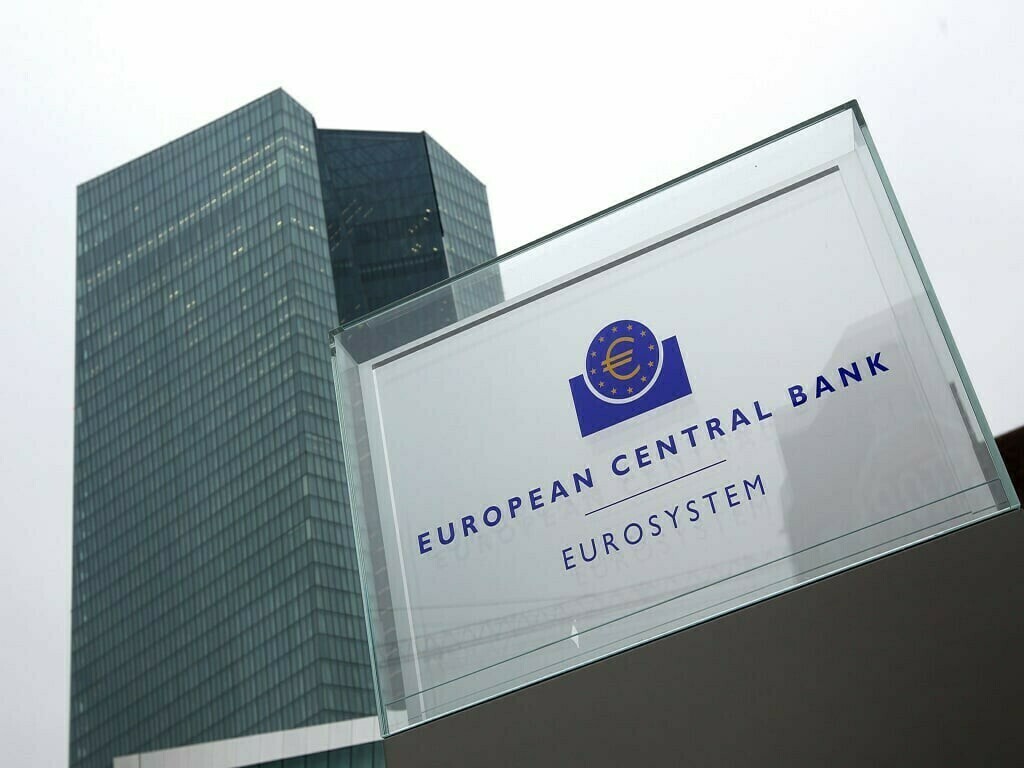
ECB tipped to hike rates again, as Fed hits pause

ECB tipped to hike rates again, as Fed hits pause

FRANKFURT: The European Central Bank is expected to again hike interest rates on Thursday and signal that the fight against inflation is not over yet, analysts said, even as the eurozone falls into recession.

With inflation slowing but still three times above the ECB’s two-percent target, there is little doubt the Frankfurt institution will raise borrowing costs for an eighth consecutive time.

A 0.25-percentage-point hike “looks like a done deal”, Capital Economics economist Jack Allen-Reynolds said.

More interesting to investors will be any clues from president Christine Lagarde at her afternoon press conference in Frankfurt about how much higher rates will go – or if a pause might be on the horizon.

The Federal Reserve, which began lifting rates earlier than the ECB, on Wednesday opted to stand pat after 10 straight increases.

But the US central bank also indicated that further rate rises could be needed this year.

The ECB embarked on an unprecedented campaign of monetary tightening after Russia’s war in Ukraine sent food and energy prices soaring, raising its interest rates by 3.75 percentage points since last July.

Another 25-basis-point hike on Thursday would take the ECB’s closely watched deposit rate to 3.50 percent.

‘No evidence yet’

Eurozone inflation eased to 6.1 percent in May year on year, from a peak of 10.6 percent in October, mainly thanks to rapidly declining energy prices.

But closely watched core, or underlying, inflation – which strips out volatile food and energy prices – decelerated only slightly to 5.3 percent, from 5.6 percent in April.

“There is no clear evidence that underlying inflation has peaked,” Lagarde warned earlier this month, stressing that the ECB still had “ground to cover” on rates.

Like all central banks, the ECB has to walk a fine line in raising interest rates sufficiently to dampen demand and contain inflation, without provoking a sharp economic slowdown in the process.

Higher borrowing costs have already led to a plunge in demand for credit from households and companies, recent data showed, suggesting the ECB’s moves are having an impact.

No pause in sight as ECB eyes next rate hike

But the eurozone economy has proved less resilient than initially thought.

Revised data last week showed that the economy in the 20-nation currency union shrank by 0.1 percent for two straight quarters at the end of 2022 and the start of 2023, meeting the technical definition of a recession.

While still mild, the surprise winter recession has cast doubt on more optimistic predictions for 2023.

‘Heated summer debate’

The ECB will unveil its latest economic forecasts on Thursday, likely to show a downward revision for growth.

The recent disappointing economic data and slowing inflation could strengthen the case of the “doves” among ECB policymakers against tightening much further, analysts said.

But the “hawks” may point to strong wage growth in the eurozone and stubbornly high core inflation to warn against taking the foot off the gas too early.

Senior policymakers including Lagarde have also expressed concern about corporate profits worsening inflation, suggesting some companies were raising prices even as their costs have come down.

Berenberg economist Holger Schmieding predicted “a heated summer debate” between the hawks and the doves, but said “a final rate hike” of another 25 basis points at the next meeting in July seemed likely.

The ECB “will play it safe and follow up with another interest rate hike in July”, agreed Fritzi Koehler-Geib, chief economist at public lender KfW.

EUR/USD: ECB will have to out-hawk the Fed to tempt buyers to reload longs – SocGen

EUR/USD: ECB will have to out-hawk the Fed to tempt buyers to reload longs – SocGen

Economists at Société Générale discuss EUR/USD outlook ahead of the European Central Bank (ECB) Monetary Policy Decision.

ECB could tempt buyers on Euro dip after gains fizzled out following Fed pause

The ECB will have to out-hawk the Fed today to tempt buyers to reload EUR/USD longs.

The pair understandably wavered after the Fed decision but a 25 bps hike today by the ECB and prospect of another increase in July and possibly September means the policy rate and bond yield differentials will narrow, provided the Fed holds fire.

Downside risks to the currency outlook stem essentially from the rally in risk assets fizzling out and European economic growth languishing compared to the US.

The technical recession and stagflationary backdrop do not quite enhance the appeal of the single currency or European risk assets (making abstraction of relative valuations), but in a FX regime where rate differentials are governing the price action, there is a tactical case for EUR/USD to target higher levels.

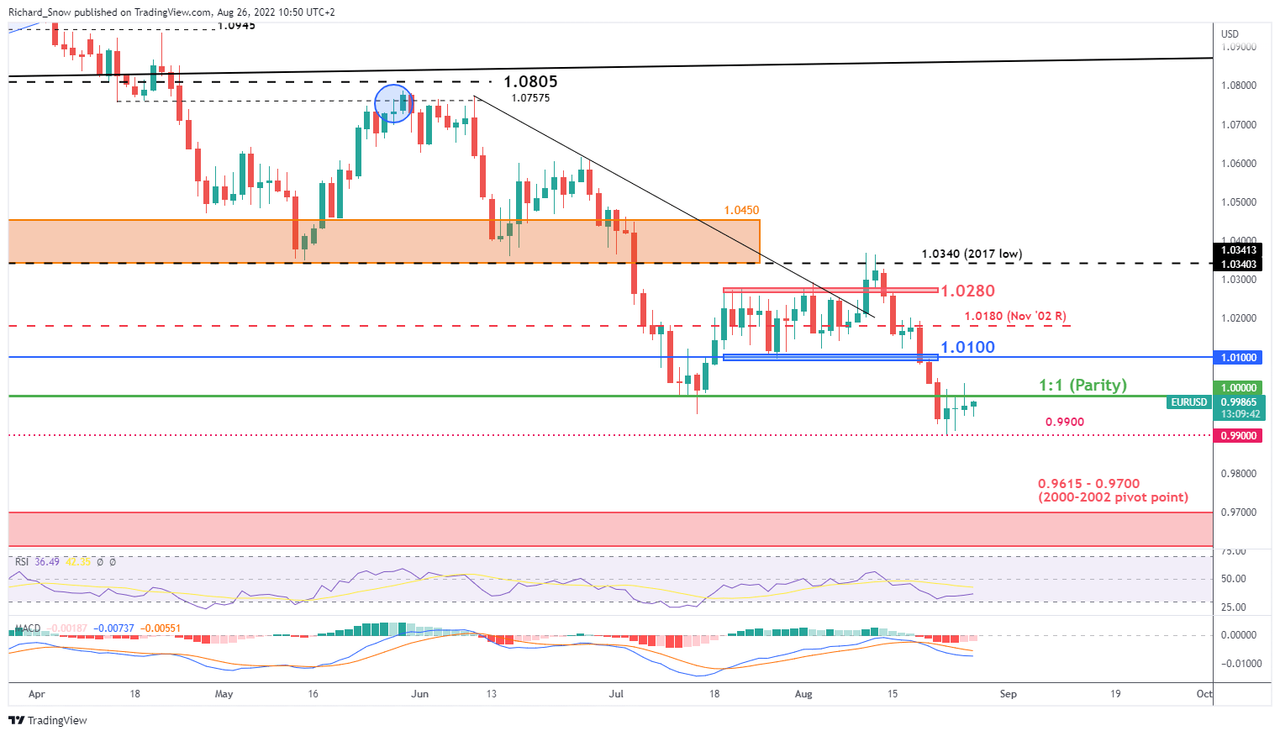
EUR/USD trades with modest losses above 1.0800 ahead of ECB

EUR/USD trades with modest losses above 1.0800 ahead of ECB

EUR/USD is trading under pressure while defending 1.0800, following an early uptick to the 1.0850 region. The pair consolidates losses, as the US Dollar bulls take a breather after the Fed’s hawkish pause-led upswing. All eyes remain on ECB policy announcements.

The EUR/USD rose again, posting its highest daily close in a month above 1.0800, despite the US Dollar’s recovery triggered by the hawkish hold from the FOMC. Attention now turns to the European Central Bank (ECB) meeting and upcoming US data, which could become more relevant given Fed Chair Powell’s statement that the July meeting will be a ‘live’ meeting.”

The ECB will have its Governing Council meeting on Thursday. It is expected to hike interest rates by 25 basis points. The key for the Euro will be the language used in the statement and ECB President Lagarde’s comments during the press conference. Probably, she will repeat that they are not done raising rates. If the meeting turns out to be ‘dovish’, with signals of a potential pause, the Euro could suffer.

The US dollar recovered ground after the Fed meeting, during which the central bank kept interest rates unchanged but signaled that it is not done hiking rates. The hawkish tone weighed on Treasury bonds and boosted the greenback. Fed Chair Jerome Powell stated that the July meeting will be a “live meeting”, keeping more rate hikes on the table. According to their projections, most FOMC members see another 50 basis points of tightening by year-end

During the Asian session, markets will continue to digest the Fed’s decision and will likely be the key driver until the ECB meeting. Also, key economic data from the US is due on Thursday, particularly Retail Sales, Jobless Claims, and the Philly Fed Index.

New Zealand Dollar Dips on Soft GDP Data. Where to for NZD/USD?

New Zealand Dollar Dips on Soft GDP Data. Where to for NZD/USD?

The New Zealand Dollar fell in response to GDP today after a stellar run higher on the back of a sliding US Dollar. The S&P/NZX 50 equity index is slightly in the green so far today.

The quarterly number was in line with expectations, but the annual read saw some downward revisions.

1Q quarter-on-quarter GDP came in at -0.1% as forecast and against the previous -0.7% that was revised down from -0.6%. Prior quarters also saw downward revisions.

Annual GDP to the end of March was 2.2% rather than the 2.6% anticipated and 2.2% previuosly.

Prior to the GDP data, the real estate institute of New Zealand (REINZ) revealed that house sales slipped -0.4% year-on-year to the end of May. A notable improvement on the April figure of -15. 3%.

Yesterday, Statistics New Zealand data revealed food prices rose by 0.3% month-on-month in May against 0.5% previously. This made for an increase of 12.1% year-on-year to the end of May, slightly below the prior of 12.5% which was the highest read in 36 years.

Earlier in the week, Statistics New Zealand also revealed that there were net 72,300 migrant arrivals in the year ended in April. This was composed of 98,400 migrant arrivals of non-NZ citizens and 26,100 migrant departures of NZ citizens.

The addition might go some way to alleviate the tight labour reflected by the historically low unemployment rate of 3.4%.

All of this stacks up for a delicate dance that the RBNZ will need to trot in order to avoid a deep recession when they next meet on July 12th. The general criteria for a recession is defined as two consecutive quarters of negative growth.

Annual CPI is running at 6.7% and while there has been a deceleration, it is stubbornly high at a time when economic activity is slowing down. The overnight index swaps (OIS) market is pricing no more hikes by the bank this year, leaving the overnight cash rate (OCR) at 5.50%.

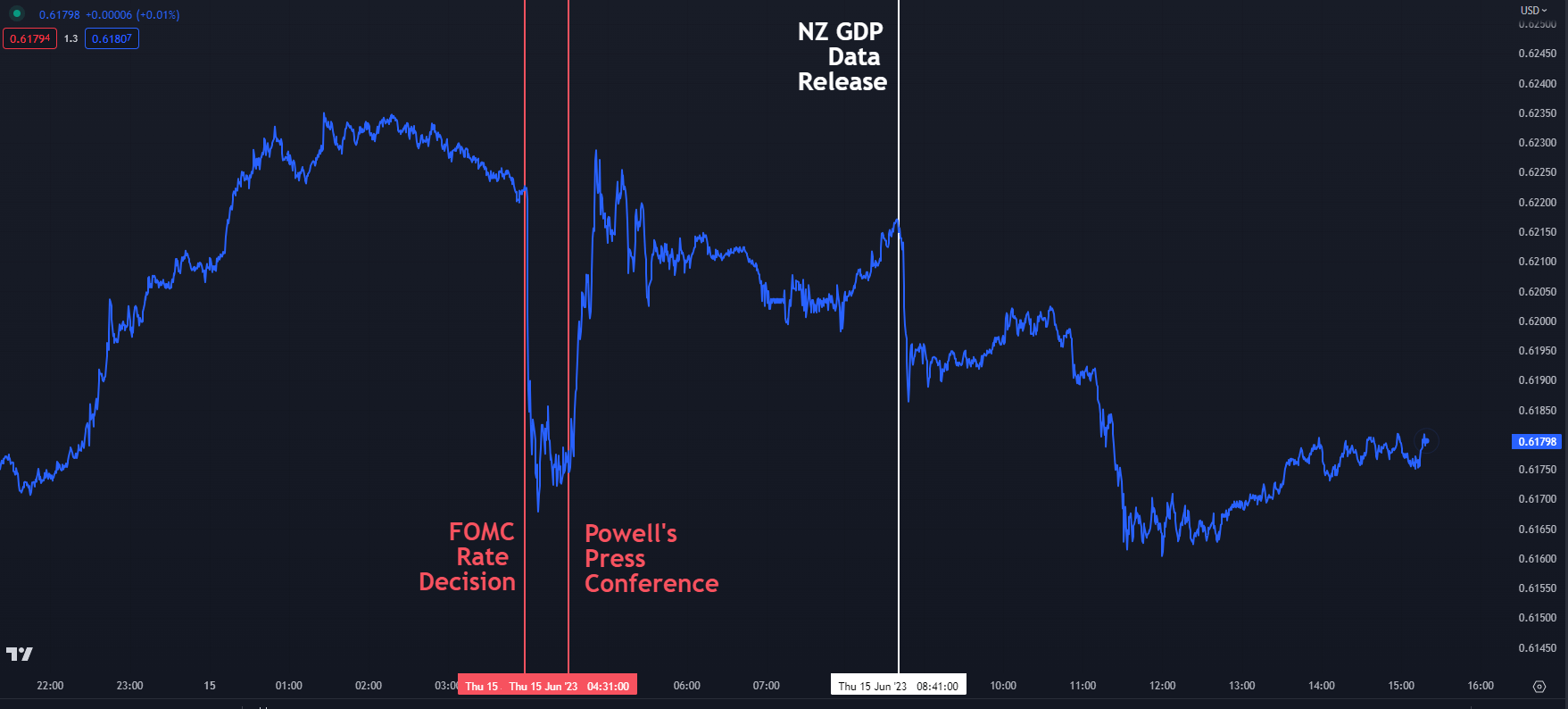
For the New Zealand, Dollar, sways in the US Dollar might continue to impact direction, judging by the reaction to last night’s Federal Open Market Committee (FOMC) meeting.

The Fed left rates unchanged, and the ensuing statement appears to have been interpreted as remaining hawkish with a lift in the so-called dot plot. Not long after, Fed Chair Jerome Powell spoke at the press conference and his remarks seem to have been seen with a dovish spin.

The next FOMC is July 26th and there is a mountain of data points between now and then that the market will need to take onboard, as well as Fed commentary along the way.

NZD/USD REACTION TO THE FED DECISION AND NZ GDP


High-for-longer rate outlook as takeaway from FOMC meeting: Gold, Copper, US dollar

High-for-longer rate outlook as takeaway from FOMC meeting: Gold, Copper, US dollar

Market Recap

The conclusion of the June meeting has seen the Federal Reserve (Fed) keeping rates on hold at 5.00%-5.25% in a widely-anticipated move, but there is less conviction for markets that today’s move will mark the end of its tightening campaign.

A hawkish takeaway came from the Federal Open Market Committee (FOMC) dot plot, with peak rate for 2023 revised to 5.6% from previous 5.1%, which suggests another 50 basis-point (bp) of tightening by the end of this year. Rate forecasts for 2024 and 2025 were revised upwards as well, which seems to put a high-for-longer rate outlook on the horizon. The justification may come on the back of some persistence in inflationary pressures, with the Fed’s core PCE forecasts seen higher at 3.9% for 2023 compared to the 3.6% expected in March.

Comments from Fed Chair Jerome Powell seem to add to the hawkish equation, saying that Fed rate cuts are a ‘couple years out’, at a time when broad market expectations were pricing for rate cuts by the end of the year. With July meeting being deemed as a ‘live’ meeting from the Fed Chair, it will leave any rate decision to just a handful of inflation and labour data ahead. Current Fed funds futures continue to lean towards a 25 bp move in July, but its pricing for terminal rate at 5.25%-5.5% are still less hawkish than what the Fed has guided, which leaves any further recalibration on watch.

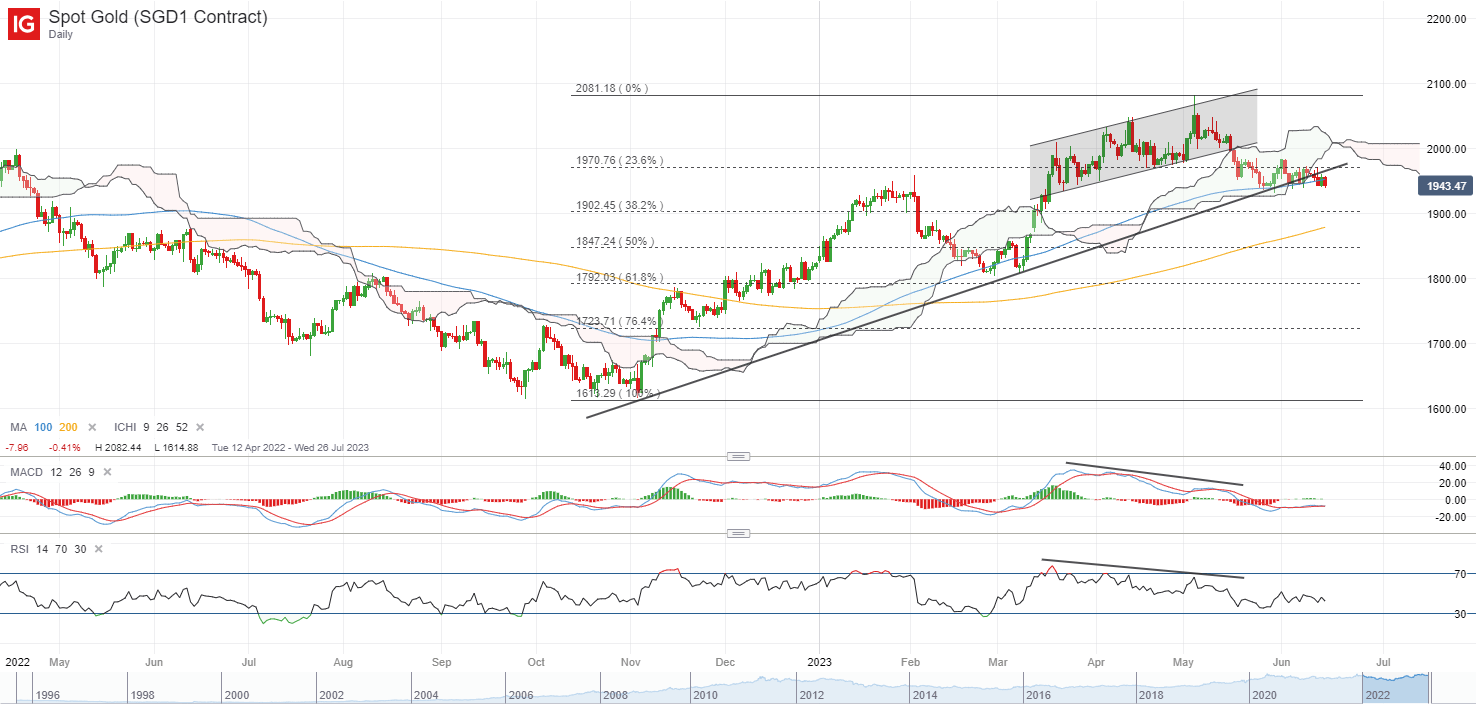
Treasury yields were on a mixed tone, reflecting some indecision in the aftermath of the FOMC meeting. On the other hand, a high-for-longer rate outlook has not been well-received by gold prices, which saw a sharp paring in initial gains overnight. Intermittent bounces over the past one month have failed to find much of a follow-through, with prices hovering back near its two-month low around the US$1,940 level. Any breakdown to a new lower low may be in sight, which could reinforce its near-term downward bias. Its Relative Strength Index (RSI) continues to trend below the key 50 level, while a key trendline support in place since November 2022 has been invalidated, reflecting sellers in control for the present.

image1.png

Asia Open

Asian stocks look set for a slight positive open, with Nikkei +0.17%, ASX +0.31% and KOSPI +0.30% at the time of writing as market participants continue to digest the latest FOMC meeting. The economic calendar this morning has seen first-quarter gross domestic product (GDP) read from New Zealand dragging the country into a technical recession. A 0.1% decline quarter-on-quarter in 1Q, following a 0.7% decline in 4Q, is likely to provide further justification that the Reserve Bank of New Zealand (RBNZ) is done with tightening, which translates to some downward pressure on the NZD.

The day ahead will bring focus to Australia’s employment data, followed by a series of economic data out of China (industrial production, retail sales, fixed asset investment). Recent cuts to China’s short-term borrowing costs may drive hopes of a similar adjustment to the one-year MLF rate later today, with the upcoming economic data likely to add to the recent series of downside surprises and reinforce a low-for-longer growth outlook in China. All three above-mentioned data are expected to display some moderation in year-on-year growth from April.

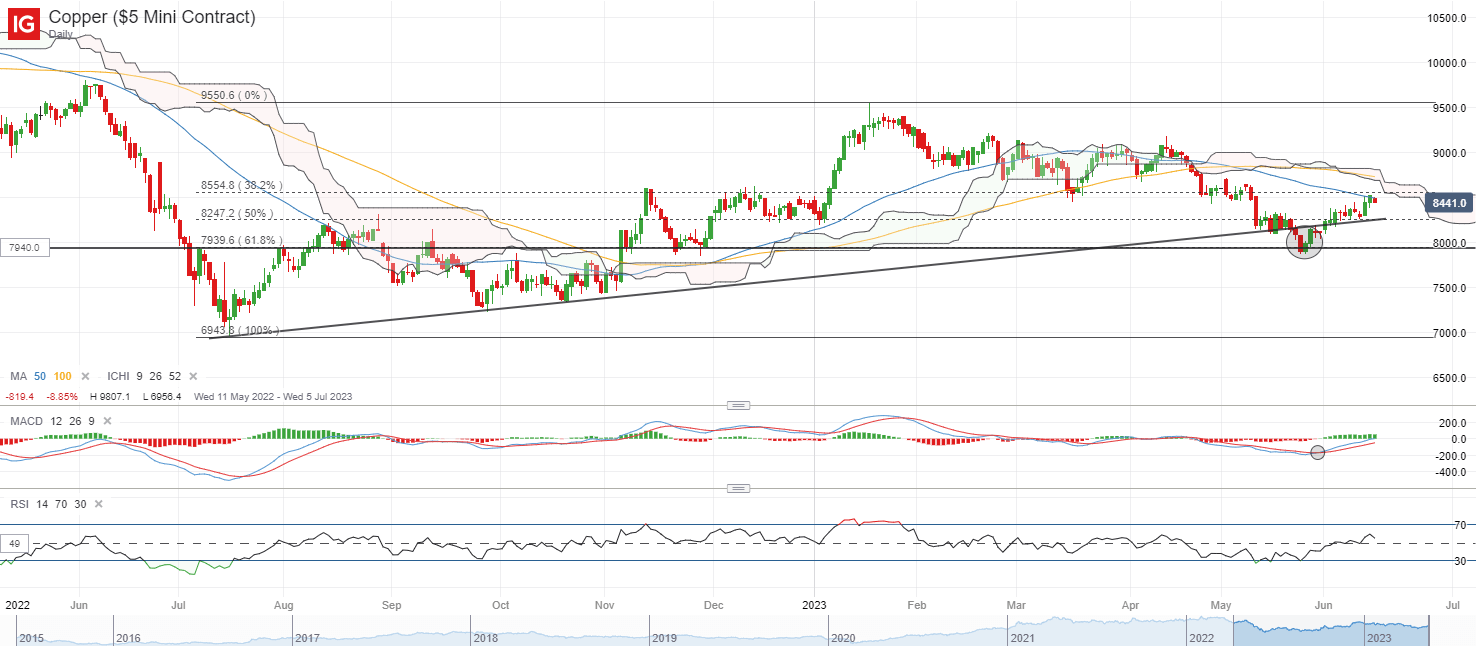
Copper prices have managed to recover more than 8% since finding support at the US$7,940/tonne level. A reclaim of the RSI above the 50 level, along with a bullish crossover on moving average convergence/divergence (MACD) may point towards some upward momentum in the near term. That said, immediate resistance still stands at the US$8,600/tonne level for now. Greater conviction for a more sustained upside may have to come from a move above the Ichimoku cloud to signal an upward trend in place. On any downside, the US$8,250/tonne level may bring some support from an upward trendline in confluence with a Fibonacci retracement level.

image2.png

On the watchlist: Knee-jerk reaction in the US dollar but more signs needed

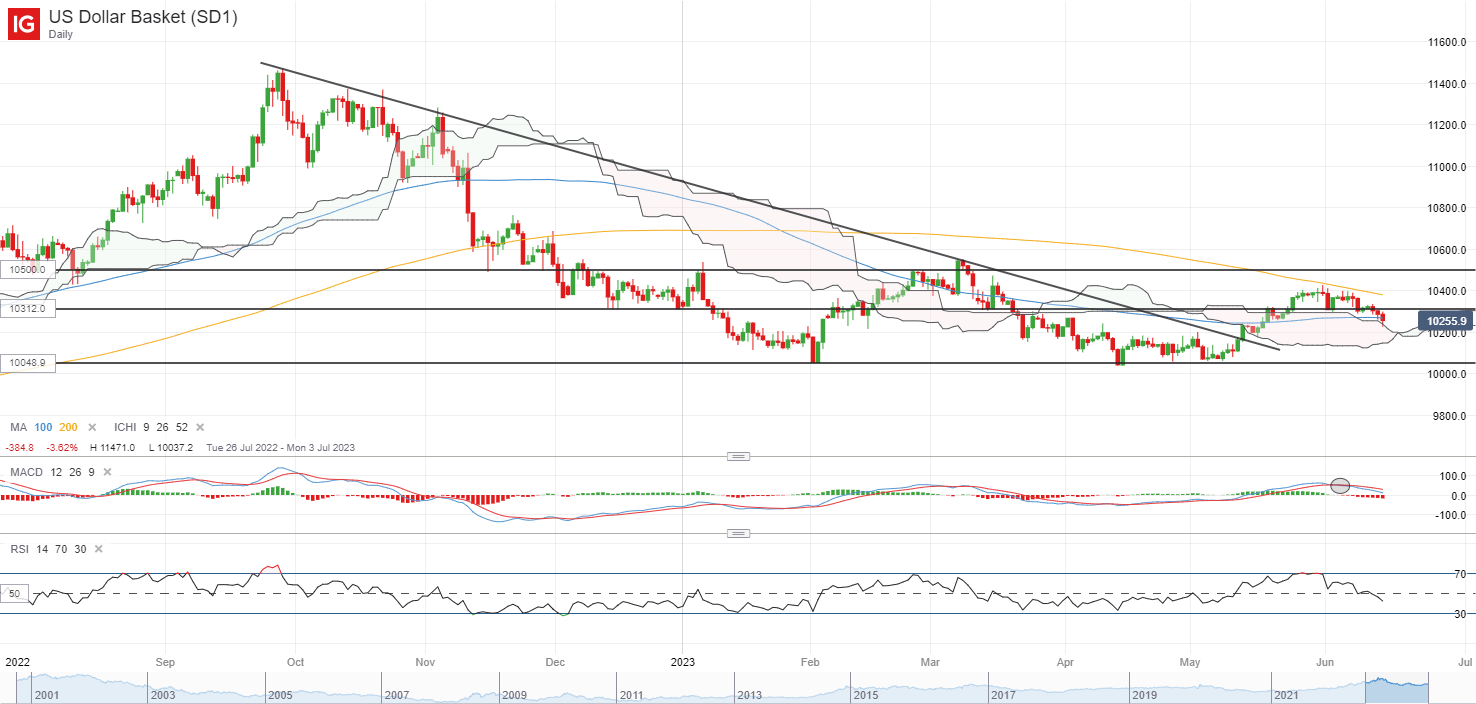
The FOMC meeting has brought about some volatility in the US dollar overnight, with the release of the dot plot triggering a 0.5% knee-jerk reaction mid-day before some gains were pared during the Fed press conference. Greater conviction for the bulls may have to come from an overturn of the lower-highs-lower-lows formation on the four-hour chart since the start of the month, with immediate resistance to overcome at the 103.12 level.

For now, its RSI has headed below the key 50 level, along with a declining MACD, which calls for the need of a significant build-up in upward momentum to provide some conviction for the bulls as well. Any failure to tap on the hawkish tone from the FOMC meeting for any move higher over subsequent days could point towards ongoing exhaustion, which could place its May bottom in sight for a retest next.

image3.png


Australian Dollar Steadies on Jobs Data While China Slows. Where to for AUD/USD?

Australian Dollar Steadies on Jobs Data While China Slows. Where to for AUD/USD?

The Australian Dollar reversed early losses on Thursday after a solid jobs report that saw a dip in the unemployment rate which could reignite price pressures that might see the RBA’s July meeting become a little more interesting.

The unemployment rate was 3.6% in May against the 3.7% anticipated and prior. 75.9k Australian jobs were added in the month, which was notably above the 17.5k expected to be added and -4.3k previously.

Of note was the full-time boost of 61.7k and the nudge higher in the participation rate to 66.9% from 66.7%.

The RBA hiked rates by 25 basis points (bp) earlier this month to 4.10%. Before today’s numbers, the overnight index swaps (OIS) market ascribed about a 20% chance of a hike in the cash rate by the RBA at its July monetary policy meeting. They now see a bit over 40% probability of a 25 bp lift.

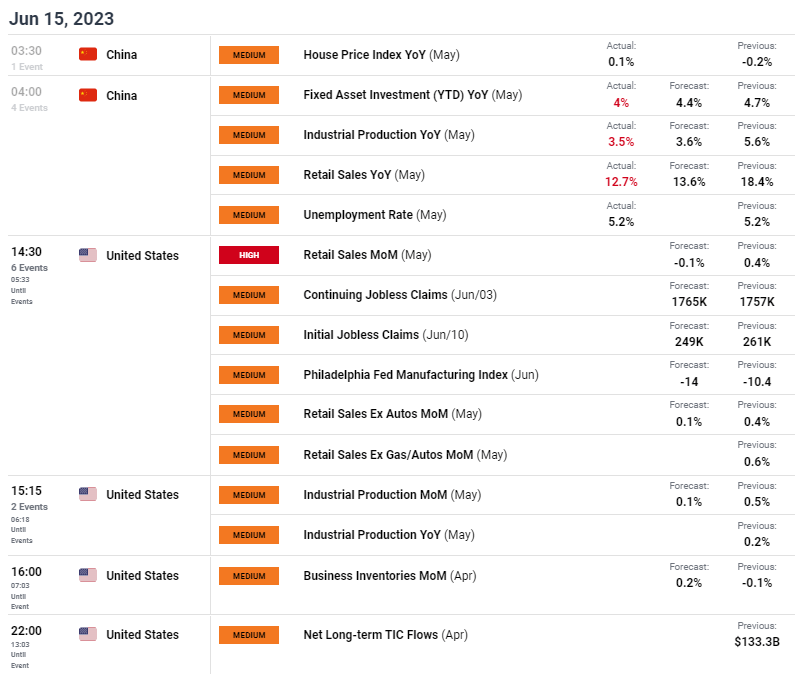
For the Aussie Dollar though, the robust domestic data was offset to an extent by weak Chinese numbers. Year-to-date industrial production was 3.6% to the end of May rather than the 3.9% anticipated, although the year-on-year figure was in line at 3.5%.

Retail sales year-on-year were 12.7%, missing estimates of 13.7% and 18.4% prior. Fixed-asset investment growth was 4% year to date, weaker than forecasts of 4.4%. The surveyed unemployment rate in urban areas was unchanged at 5.2% as expected.

On Tuesday, the People’s Bank of China (PBOC) gave markets a slight boost when they cut the 7-day reverse repo rate from 2% to 1.9%. Then today they cut the rate on the 1-year medium-term lending facility to 2.65% from 2.75%.

The sluggish economic performance of the world’s second-largest economy has led to speculation of further stimulus measures from Beijing.

The overnight decision by the Federal Open Market Committee (FOMC) to keep its target rate unchanged followed by the subsequent statement and press conference provided some fireworks for AUD/USD.

Looking ahead, the factors that may play a role in AUD direction could be the pricing of an RBA rate move, Fed speak around more hikes and the economic outlook for China if there is a notable change in policy there.

Japanese Yen Drops After FOMC: Price Setups in USD/JPY, AUD/JPY, GBP/JPY

Japanese Yen Drops After FOMC: Price Setups in USD/JPY, AUD/JPY, GBP/JPY

Higher for longer US interest rates, broadly improving risk appetite, and the surprise interest rate hikes last week by the Reserve Bank of Australia and the Bank of Canada reinforce the broader bearish setup for the low-yielding Japanese yen against some of its peers.

To be sure, the recent yen’s weakness continues to be more pronounced against currencies where central banks are in rate hiking mode, including the RBA, BOC, BOE, and ECB, but less so central banks have paused (Fed) or where central banks have indicated that rates are at a peak (NZD). For more discussion see “Making Sense of Japanese Yen’s Recent Slide: Is it the Start of a Renewed Leg Lower?”, published June 1, and “Japanese Yen Week Ahead as Fed Skip Bets Grow: USD/JPY, EUR/JPY, AUD/JPY”, published June 5.

The US Federal Reserve kept interest rates unchanged on Wednesday but indicated that the hiking cycle is not over and that rates may need to rise by as much as 50 basis points on slower-than-expected moderation in inflation and resilience of the US economy. Key focus now shifts to the Bank of Japan’s meeting on Friday – the Japanese central bank is expected to reaffirm the bearish bias for JPY by maintaining its ultra-loose monetary policy along with no changes to the yield-curve control policy.

The BoJ Governor Kazuo Ueda has reiterated the central bank will patiently maintain the easy monetary policy as there is some distance to sustainably achieving its 2% inflation target. Data released last week showed Japan’s economy grew more than expected in the January-March quarter, supported by domestic spending and a buildup in inventories.

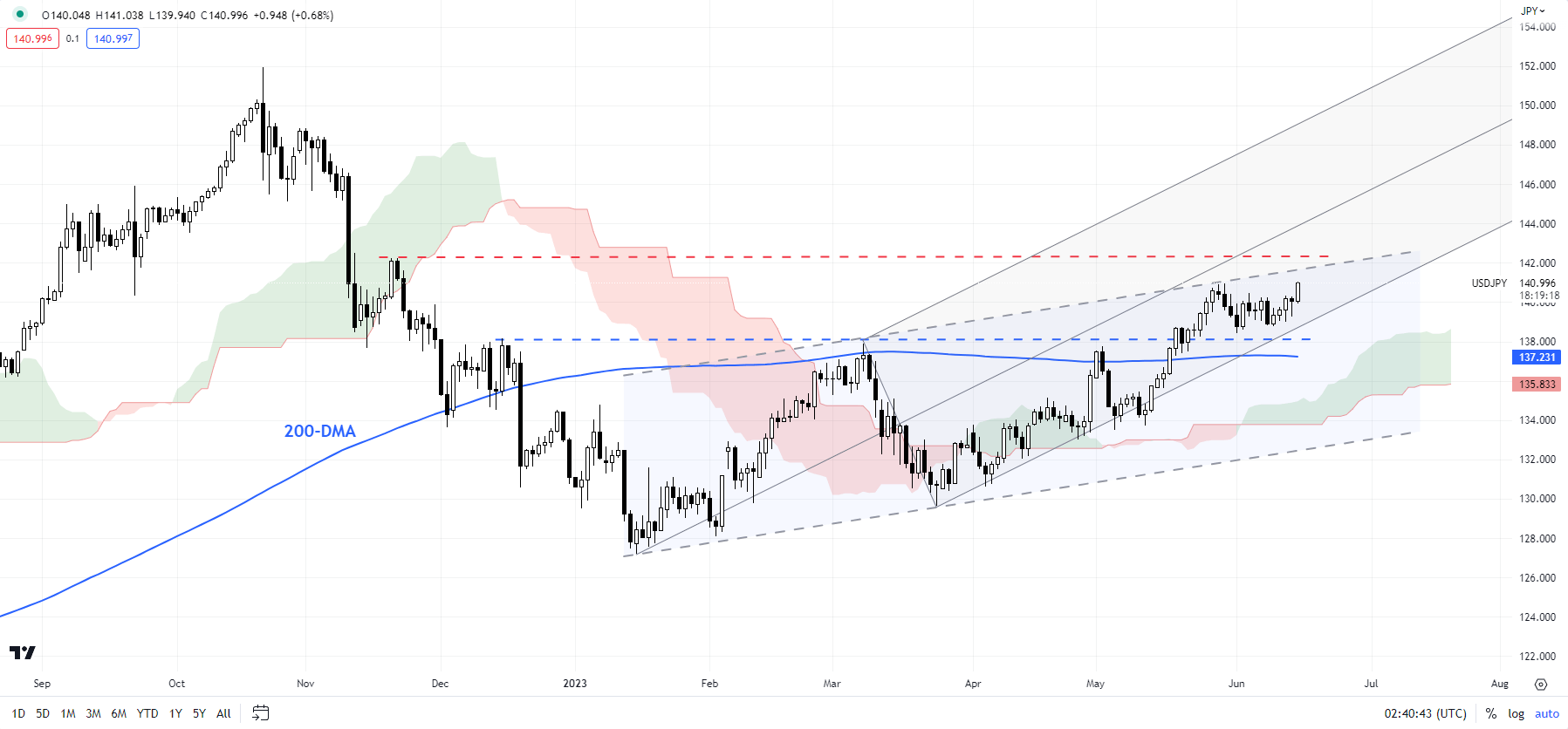
USD/JPY Daily Chart

image1.png

USD/JPY: Running into crucial resistance

USD/JPY is once again retesting a stiff converged resistance: the upper edge of a rising channel from early 2023, coinciding with the end-2022 high of 142.25. Above the area, there is another hurdle on the median line of a pitchfork channel from January (at about 143.75). There is no sign of a reversal of the uptrend, and the rebound this month from crucial support at the March high of 137.90 points to upside risks for USD/JPY. The pair would need to break below the early-June low of 138.50 for the bullish pressure to fade.

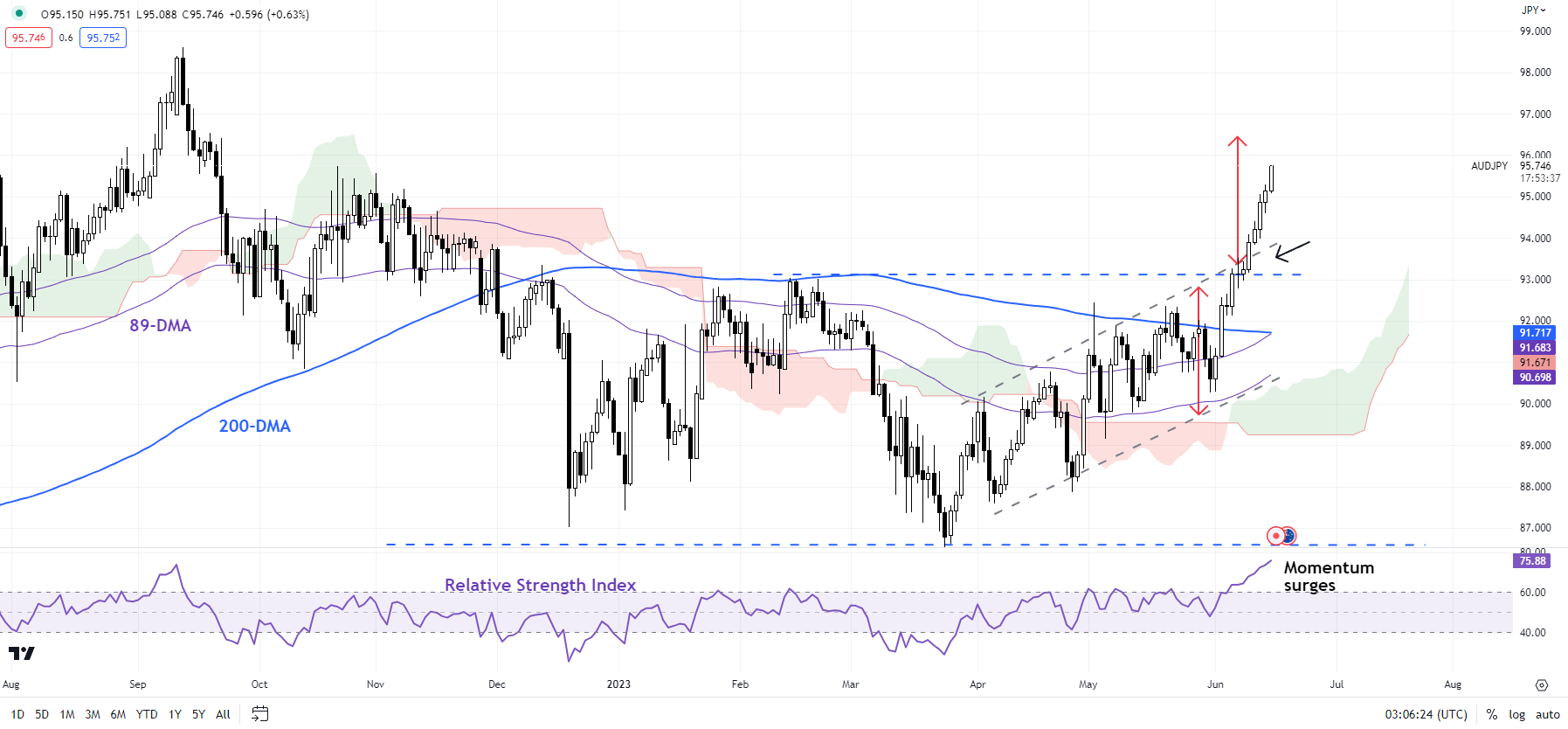
AUD/JPY Daily Chart

image2.png

AUD/JPY: Cracks above a key ceiling

AUD/JPY has broken above a tough converged barrier on the 200-day moving average, coinciding with the February high of 93.00. The break has taken place on strong momentum, suggesting that the rally may have legs, potentially toward 96.50, the price objective of the rising channel since April.

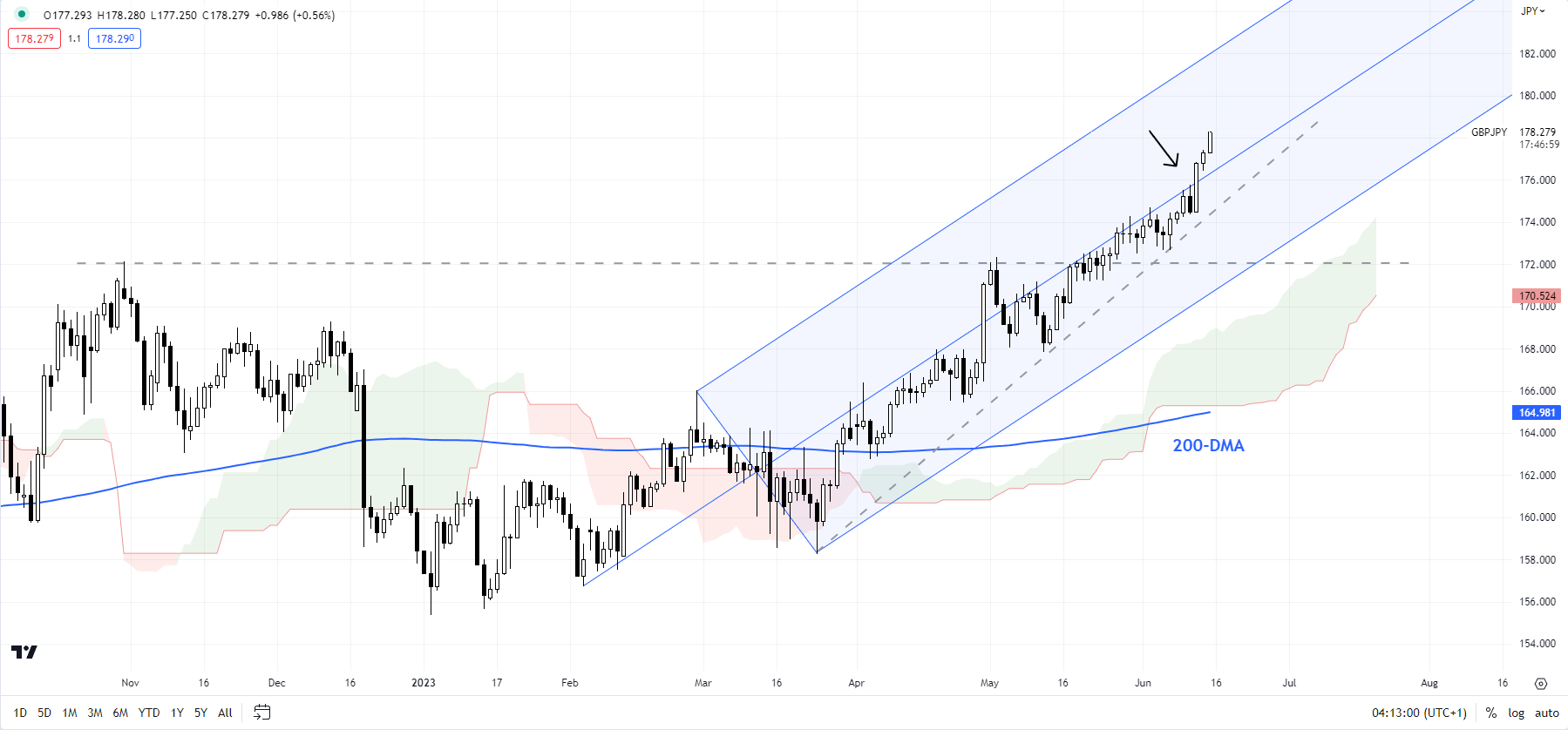
GBP/JPY Daily Chart

image3.png

GBP/JPY: Shifts to a higher gear

GBP/JPY’s break above the median line of a pitchfork channel since February indicates the cross has shifted to a higher gear. The median line had served as stiff resistance in recent weeks and the break above reflects an acceleration in gains. Having said that, the cross is looking overbought pointing to some consolidation/minor retreat in the near term. The next resistance is on the upper edge of the channel (now at about 181.75).

Crude Oil Prices Stifled by Chinese Economic Data & Stronger USD

Crude Oil Prices Stifled by Chinese Economic Data & Stronger USD

CRUDE OIL FUNDAMENTAL BACKDROP

Crude oil remains relatively depressed this Thursday morning after a drop yesterday post-FOMC. The Federal Reserve decided to keep rates on hold; however, central bank guidance was rather hawkish considering the lead up to the announcement was on the bearish side after US CPI and PPI data showed slowing inflationary pressures. The revised dot plot now reflects two further rate hikes for the year but money markets are yet to price this in (refer to table below) with possibly one additional rate hike expected. Incoming data will be required for further clarity around the stat of the US economy.

This morning began with the world’s second largest consumer of crude oil (China) releasing key demand-side data including industrial production and retail sales (see economic calendar below). Both metrics missed estimates and heightened fears around a slowing Chinese economy and subsequently less overall demand for crude oil. Similar sentiments could be echoed should US retail sales later today come in lower as expected. That being said, the USD may slip should this come in line or miss estimates potentially providing some support for crude oil prices. Jobless claims data will also be in focus after recent labor data exhibited a slight unwind of the recent very tight and robust environment.

ECONOMIC CALENDAR (GMT +02:00)

image2.png

TECHNICAL ANALYSIS

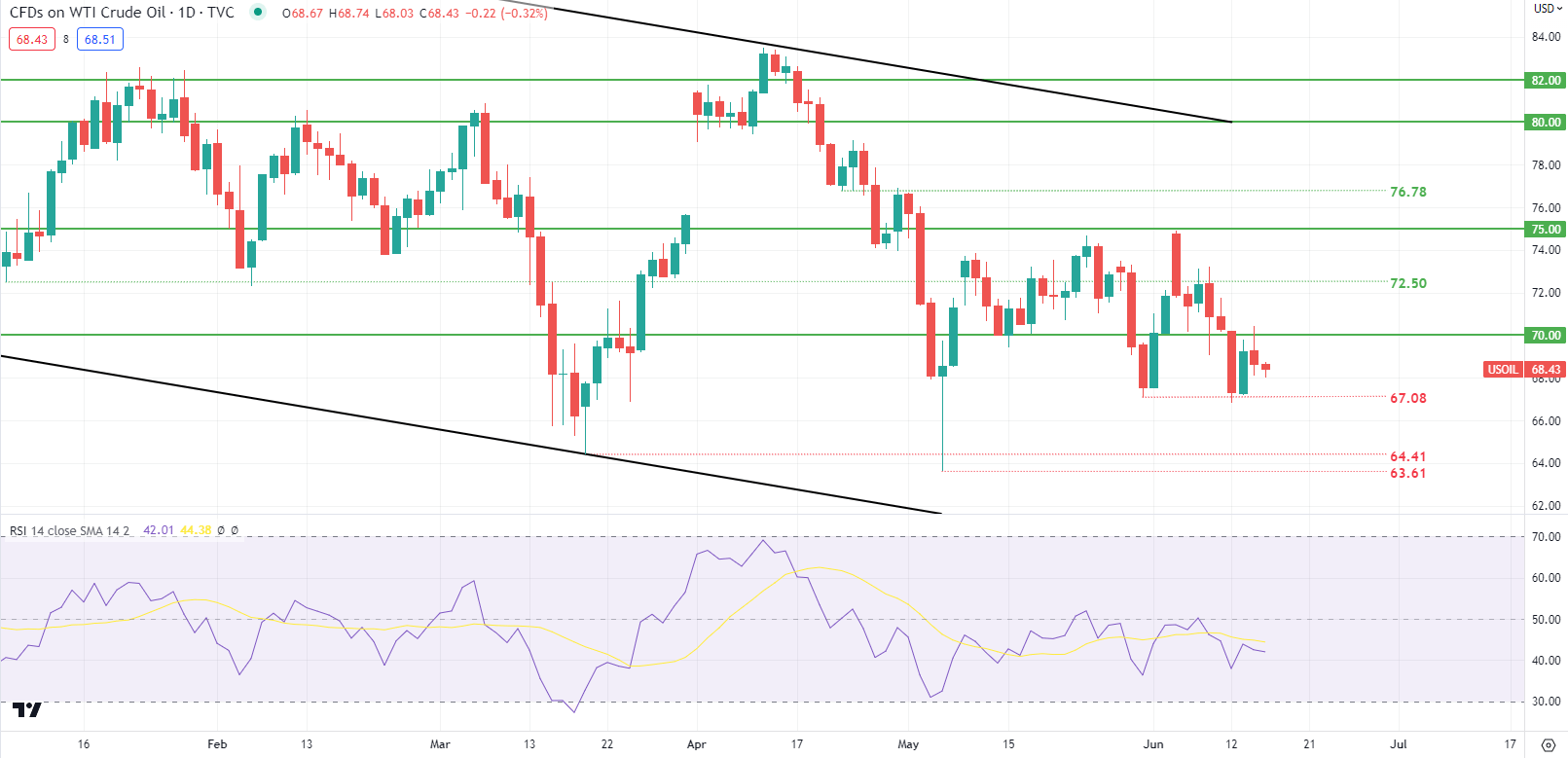
WTI CRUDE OIL DAILY CHART

image3.png

Price action on the daily WTI crude chart above shows prices below the 70.00 psychological handle but firm support has been shown around the 67.08 swing low. Another test could weaken the structure and see bears breakout and test subsequent support zones.

Key resistance levels:

  • $72.50
  • $70.00

Key support levels:

  • $67.08
  • $64.41
  • $63.61

IG CLIENT SENTIMENT: MIXED

IGCS shows retail traders are NET LONG on Crude Oil, with 85% of traders currently holding long positions (as of this writing). At DailyFX we typically take a contrarian view to crowd sentiment; however, due to recent changes in long and short positioning we arrive at a short-term cautious disposition.