
EUR/USD advances as US Dollar slumps ahead of US NFP

EUR/USD advances as US Dollar slumps ahead of US NFP

EUR/USD jumps above 1.0850 in Friday’s European session and revisits a four-month high. The major currency pair exhibits strength as the US Dollar (USD) weakens ahead of the United States (US) Nonfarm Payrolls (NFP) data for February, which will be published at 13:30 GMT. The US Dollar Index (DXY), which tracks the Greenback’s value against six major currencies, extends its losing streak for the fifth trading day and slumps to a four-month low of around 103.60.

The Greenback has remained on the backfoot as investors have become increasingly concerned over the United States (US) economic outlook due to uncertainty over President Donald Trump’s tariff agenda. Market participants believe that the pressure of higher tariffs will be borne by US importers, who would pass on the impact to consumers. Such a scenario would diminish their purchasing power and, eventually, the domestic demand.

On Thursday, Trump announced tariff relaxations on a number of products, which come under the purview of the United States-Mexico-Canada Agreement (USMCA) until April 2, the same day when he is expected to introduce reciprocal tariffs. The US President imposed 25% levies on Canada and Mexico on Tuesday but provided a one-month exemption on automobiles after discussing with the big three US carmakers on Wednesday.

The US NFP report is expected to show that the economy added 160K fresh workers, higher than the 143K recorded in January. The Unemployment Rate is seen steady at 4%. Meanwhile, Average Hourly Earnings, a key measure of wage growth, is anticipated to have risen steadily by 4.1% year-on-year. Month-on-month wage growth measure is estimated to have grown at a slower pace of 0.3%, compared to 0.5% in January. The official labor market data will significantly influence market expectations for the Federal Reserve’s (Fed) monetary policy outlook.

Technical Analysis: EUR/USD rallies above 1.0850
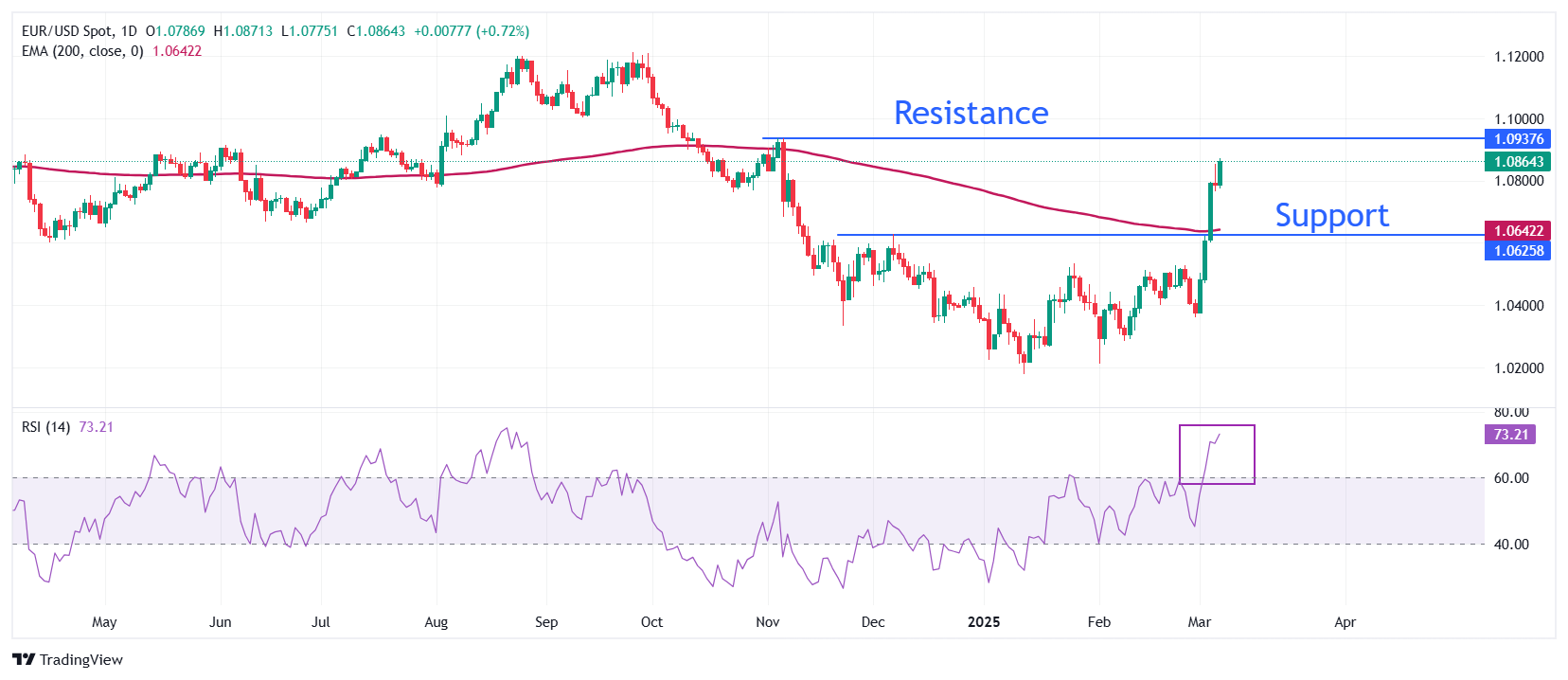
EUR/USD surges to over 1.0850 on Friday after a decisive breakout above the December 6 high of 1.0630 earlier this week. The long-term outlook of the major currency pair is bullish as it holds above the 200-day Exponential Moving Average (EMA), which trades around 1.0640.

The 14-day Relative Strength Index (RSI) jumps above 70.00, indicating a strong bullish momentum.

Looking down, the December 6 high of 1.0630 will act as the major support zone for the pair. Conversely, the November 6 high of 1.0937 and the psychological level of 1.1000 will be key barriers for the Euro bulls.

gold-bar-and-dollar-bills-42586628_XtraLarge

Gold consolidates further while weekly gains look to be set

Gold’s price (XAU/USD) ticks up slightly and consolidates for the third day in a row this week. The rally in Bullion stalls after US President Donald Trump shielded off all goods from Mexico and Canada that fall under the USMCA trade agreement from its freshly baked tariffs that got implemented earlier this week. Meanwhile, US equity markets trade below where they were on President Trump’s inauguration day.

On the rates side, traders got some support from Federal Reserve (Fed) official Christopher Waller, who said on Thursday that he wouldn’t support lowering interest rates in March but sees room to cut two, or possibly three, times this year. This coincides with what markets expected, with June being the first pivotal moment for the Fed to cut interest rates this year.

Technical Analysis: Small pause

Bets on interest rate cuts by the Federal Reserve are now starting to get support from the central bank’s policymakers. This should support Gold’s price throughout the year, though it might not be enough to push Gold to fresh all-time highs for now. For that, a fresh catalyst, such as new tariffs or another page in the trade war book, would need to occur.

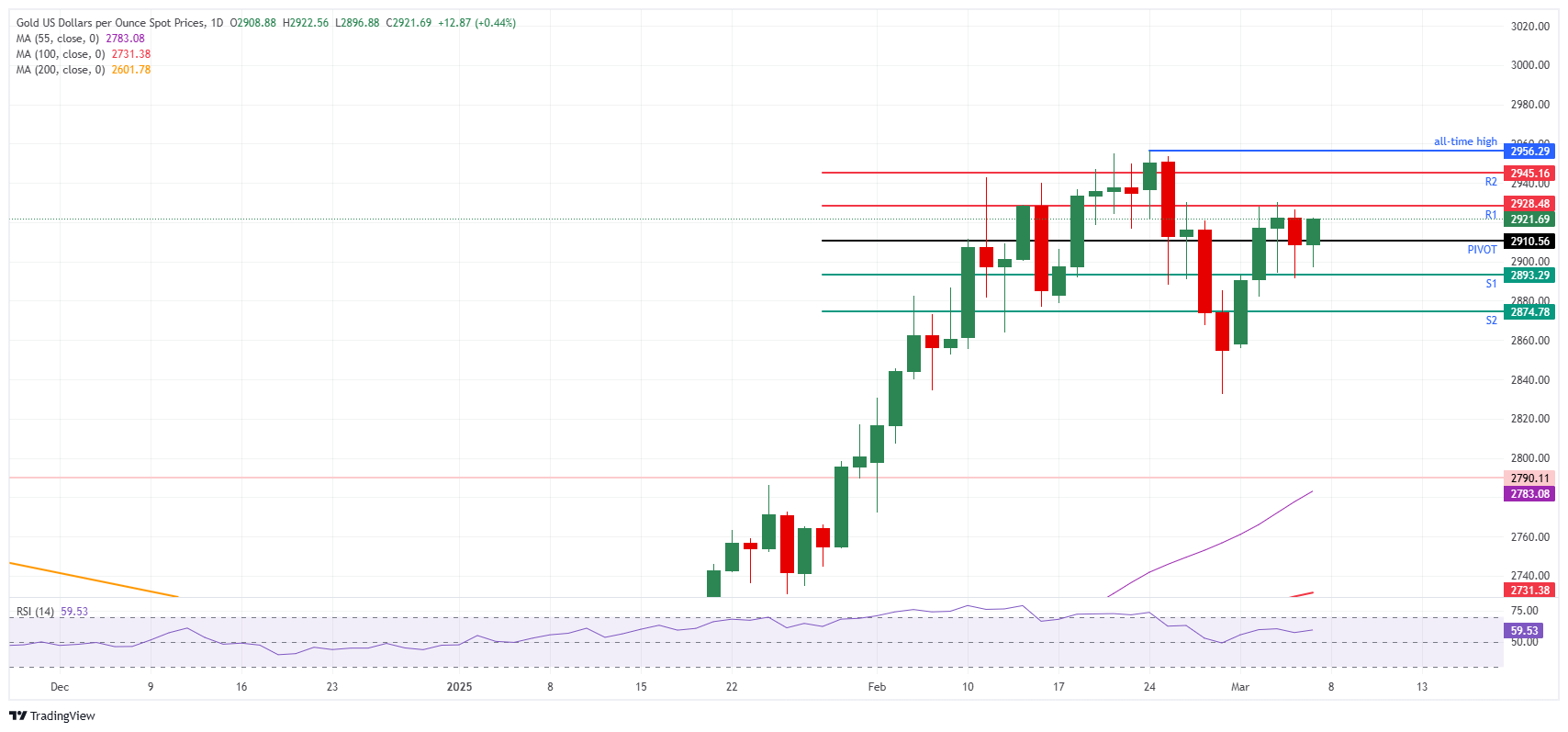
While Gold trades near $2,917 at the time of writing, the daily Pivot Point at $2,910 and the daily R1 resistance at $2,928 are the key levels to watch for on Friday. In case Gold sees more inflows, the daily R2 resistance at $2,945 will possibly be the final cap ahead of the all-time high of $2,956 reached on February 24.

On the downside, the $2,900 psychological big figure and the S1 support at $2,893 acts as a double support barrier. If Bullion bulls want to avoid another leg lower, that zone must hold. Further down, the daily S2 support at $2,874 should be able to catch any additional downside pressure.

XAU/USD: Daily Chart

XAU/USD: Daily Chart

mmty

USD/CAD: US postpones the imposition of tariffs on Canada

The United States has once again postponed the imposition of tariffs on Canada until April 2nd. Coupled with the continuous weakening of the US Dollar (USD) and the stabilization of oil prices, the Canadian Dollar (CAD) continued to rise, by 0.30% on Thursday, against the US dollar, OCBC’s FX analysts Frances Cheung and Christopher Wong note.

USD/CAD to trade in a wider range between 1.4194-1.4793

“The temporary tariff deferral only applies to Canadian export products that meet the requirements of the Canada-United States-Mexico Agreement, and approximately 62% of Canadian imported products may still face a 25% tariff.”

“Canada stated that it will not lift the tariffs previously imposed on US goods worth CAD 30 billion but agreed to postpone the second round of retaliatory tariffs worth CAD 125 billion until April 2nd. It is expected that the currency pair will continue to be volatile in the short term, with two-way trades.”

“Pay attention to the trading range of 1.4300-1.4542, and a wider range is between 1.4194-1.4793.”

images

EUR/USD climbs to multi-month highs above 1.0850

EUR/USD gathers bullish momentum and trades at its highest level since early November above 1.0850 on Friday. The US Dollar struggles to shake off the bearish pressure as investors await February employment data, allowing the pair to stretch higher.

The Relative Strength Index (RSI) indicator on the 4-hour chart stays near, suggesting that EUR/USD remains technically overbought.

On the upside, first resistance could be spotted at 1.0900 (static level, round level) ahead of 1.0940 (static level from November) and 1.1000 (round level, psychological level). Looking south, supports could be spotted at 1.0800 (round level, static level), 1.0760 (static level) and 1.0730 (200-day SMA).

Following the March policy meeting, the European Central Bank (ECB) decided to lower key rates by 25 basis points (bps), as widely anticipated. In its policy statement, the ECB repeated that future interest rate decisions will be based on “the assessment of inflation outlook in light of incoming economic and financial data, dynamics of underlying inflation, and strength of monetary policy transmission.” While speaking to reporters in the post-meeting press conference, ECB President Christine Lagarde said that they will remain data-dependent and make decisions on a meeting-by-meeting basis. Amid a lack of fresh clues on the ECB policy outlook, EUR/USD spent the day fluctuating in a relatively tight range.

Nonfarm Payrolls (NFP) in the US are forecast to rise by 160,000 in February, following the disappointing 143,000 increase recorded in January. A reading close to 200,000 could support the US Dollar (USD) with the immediate reaction. Investors could also see that as an opportunity to book some profits, triggering a downward correction in EUR/USD.

On the other hand, a disappointing jobs report could feed into concerns over an economic downturn in the US and make it difficult for the USD to hold its ground. According to the CME FedWatch Tool, markets are currently pricing in about 50% probability of a Federal Reserve policy hold in May, suggesting that the USD is facing a two-way risk heading into the event.

mail

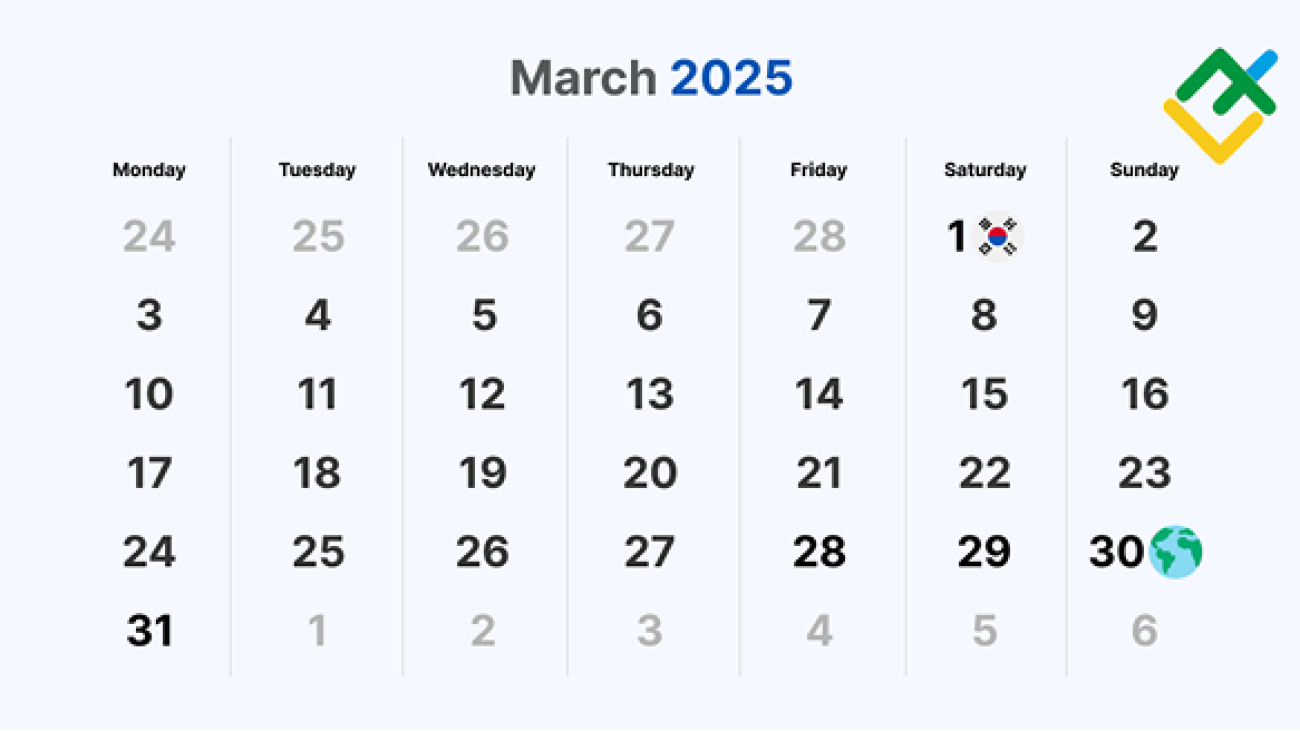
World stock market holidays: March 2025

LiteFinance has updated its trading schedule for March 2025 due to international holidays and weekends, and you are advised to check the new schedule on their website for any additional changes.

Note

  • Review the updated trading schedule on LiteFinance’s website. here
  • Contact LiteFinance’s support team for any questions. here
World stock market holidays
We would like to inform you about the changes in LiteFinance’s trading schedule during this month due to the upcoming international holidays and weekends on stock exchanges.
You can find out about changes to the trading schedule on our website.
This information is for reference only and is subject to change. Please check the current schedule in the Company news section on the official website for any additional changes.
You can always find the trading schedule for each trading instrument in the Info on the instrument section in your Client Profile.
Should you have any questions, please contact our support team.
dollar

CAD holds range on the day

So, the 25% tariff regime might have had a very short shelf life after all and we might be looking at low double digit border tariffs now, Scotiabank’s Chief FX Strategist Shaun Osborne notes.

Market awaits developments

“That’s still not great, only relatively less painful. But it might be about where markets have priced broader tariff risks into the Canadian Dollar (CAD) at this point which means downward pressure on the CAD may ease as we assess the outlook for additional tariffs moving forward. The CAD has gained little in overnight trade after rallying into the close yesterday and may struggle to push much higher while tariff uncertainty persists.”

“A rebound in risk appetite and narrower US/ Canada spreads are modest tailwinds for the CAD but rightsizing spot to its estimated fair value equilibrium (currently 1.4224) may have to wait for clarity on what the ultimate tariff regime facing Canada looks like. Note markets have pared expectations for next week’s BoC policy decision somewhat, pricing in 18-19bps of cuts, from all but fully pricing in a 1/4 -point cut yesterday.”

“Spot has swung sharply between 1.4370 and 1.4545 since the start of the week, defining near-term ranges. Those ranges are holding this morning, with the market reluctant to lean too hard on USD/CAD. A break under 1.4350/70 should drive spot lower, potentially towards 1.4200/50 on a range extension trade, however.”

nm

GBP pulled through 200-day MA by softer USD tone

Pound Sterling (GBP) is enjoying the ride provided by the generally softer USD and the additional tow from the EUR lifting its European peers, Scotiabank’s Chief FX Strategist Shaun Osborne notes.

Sterling gains push through Cable’s 200-day MA

“UK PMI data was left largely unchanged from the preliminary reports; February Services activity was marked down a tenth to 51.0 while the Composite index was left unchanged at 50.5.”

“Sterling gains have pushed through Cable’s 200-day MA (1.27896) and retracement resistance at 1.2764 (50% Fib of the September/January decline). Look for support on dips to the upper 1.27s from here and a further push on towards 1.29.”

mun

Silver Price Forecast: XAG/USD climbs to $31.80-$31.85 zone; upside potential seems limited

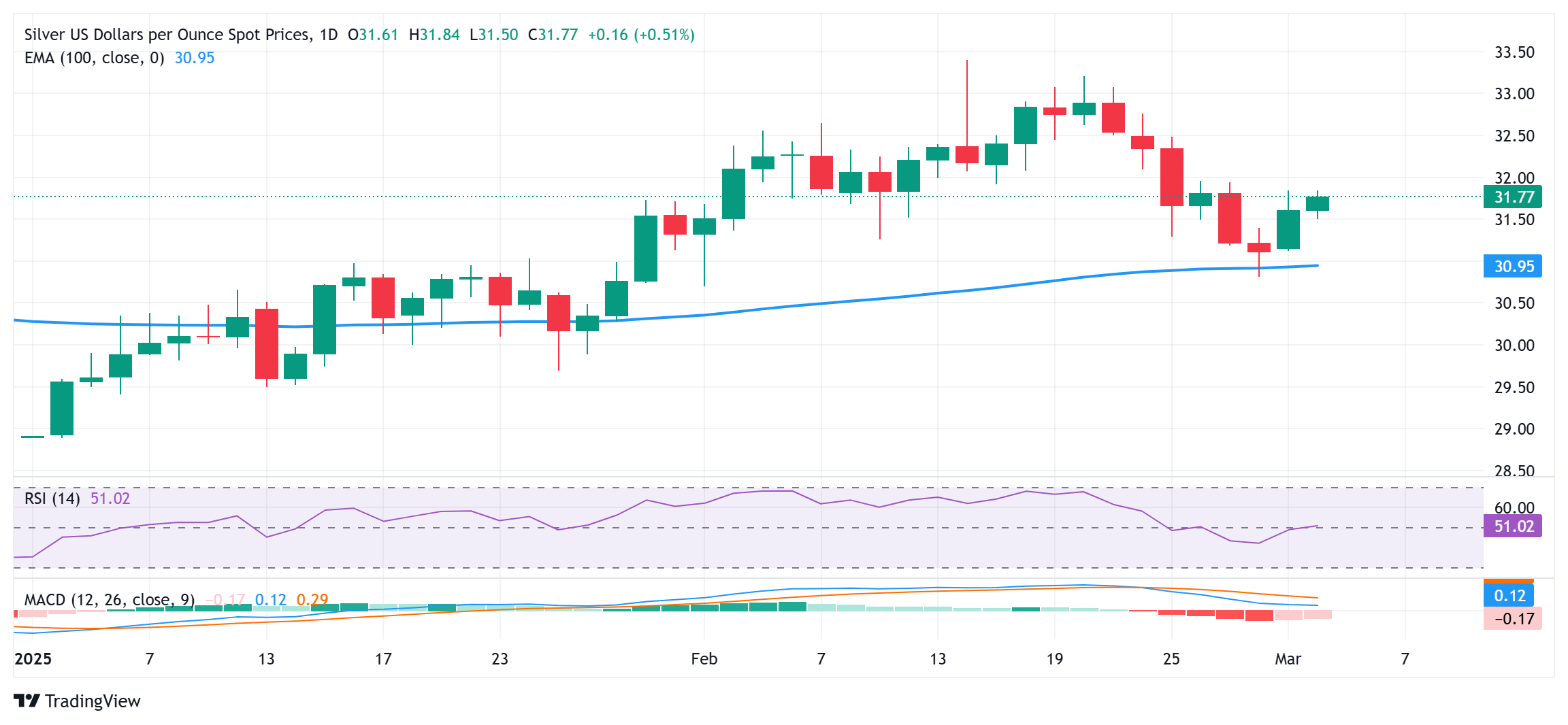
Silver (XAG/USD) attracts buyers for the second straight day on Tuesday and moves further away from a nearly four-week low, around the $30.85-$30.80 region touched last Friday. The white metal climbs to the $31.80-$31.85 region during the first half of the European session, back closer to the overnight swing high, and seems poised to appreciate further.

From a technical perspective, the XAG/USD showed some resilience below the 100-day Exponential Moving Average (EMA) last Friday. The subsequent move up validates the near-term constructive outlook for the commodity. That said, oscillators on the daily chart are yet to confirm a positive bias and warrant some caution before positioning for any further appreciation.

Hence, any further move up is likely to confront some resistance near the $31.65 region ahead of the $32.00 mark. Some follow-through buying beyond the latter could trigger a short-covering rally and lift the XAG/USD to the $32.40-$32.45 hurdle. Bulls might then aim to surpass the $33.00 round-figure mark and test the February monthly swing high, around the $33.40 area.

On the flip side, the daily trough, around mid-$31.00s, now seems to protect the immediate downside ahead of the $31.20 area and the $31.00 mark. The latter coincides with the 100-day EMA pivotal support, which if broken decisively will be seen as a key trigger for bearish traders and make the XAG/USD vulnerable to accelerate the fall towards the $30.25 support zone.

The downward trajectory could extend further toward the $30.00 psychological mark en route to the $29.55-$29.50 horizontal support. The XAG/USD could eventually drop to the $29.00 round figure and December 2024 swing low, around the $28.80-$28.75 area.

XAG/USD daily chart

fxsoriginal

mmm

EUR/USD treads water below 1.0500 amid risk-off mood

EUR/USD trades with caution below 1.0500 in the European session on Tuesday. The pair struggles as traders refrain from placing fresh bets on escalating global tariff war and US recession fears, fuelling a risk-off market environment. The focus remains Trump’s tariffs and Fedspeak.

EUR/USD is testing the critical 1.0500 barrier, reversing much of last week’s leg lower.

Should the pair stage a recovery, the first resistance appears at the monthly peak of 1.0528 (February 26), just before the YTD high of 1.0532 (January 27). Further up, traders will watch the 1.0572 Fibonacci retracement (of the September–January slide) and the December 2024 peak of 1.0629.

On the downside, immediate support lies at the weekly low of 1.0359 (February 28), followed by another weekly low of 1.0282 (February 10) and the February low of 1.0209 (February 3). Down from here comes the 2025 bottom of 1.0176 (January 13).

Momentum indicators offer mixed signals, as the Relative Strength Index (RSI) near 55 suggests a pick-up in the bullish momentum, while the Average Directional Index (ADX) near 12 indicates an overall weak trend.

EUR/USD staged a noticeable comeback on Monday, advancing more than a cent from Friday’s two-week lows and reclaiming the area beyond 1.0500 the figure on the back of a pronounced retracement in the US Dollar (USD).

The deep decline in the Greenback prompted the US Dollar Index (DXY) to abandon the area of recent highs and recede to the 106.50 zone amid declining US yields across the curve and steady jitters surrounding US tariffs.

Tariff tensions and geopolitical hopes

Trade issues remained centre stage as President Trump announced last week that 25% tariffs on imports from Canada and Mexico would take effect on March 4. Tariffs can influence currency markets in different ways: if they stoke inflation, the Federal Reserve (Fed) may lean toward tighter monetary policy, which often boosts the USD. However, a significant slowdown in economic activity caused by prolonged trade barriers could push the Fed to adopt a more dovish stance. In Europe, any US move to impose tariffs on EU goods carries the potential to weaken the Euro (EUR) and thus weigh on EUR/USD.

However, the geopolitical factor returned to the scene on Monday, as talks over a potential peace deal in the Russia-Ukraine war lifted spirits and lent much needed oxygen to the riskier assets, all following the disastrous Trump-Zelenskyy meeting at the White House last week.

Central banks in the spotlight

The Fed recently held its policy rate steady at 4.25%–4.50%, citing robust US growth, steady inflation, and a healthy labour market. Fed Chair Jerome Powell has emphasised that it is too soon to consider rate cuts given ongoing inflationary pressures and strong employment figures. Other Fed officials have echoed these concerns, particularly as trade disputes could boost consumer prices and complicate the inflation outlook.

Meanwhile, the European Central Bank (ECB) is expected to lower its main rate by 25 basis points at its meeting on Thursday, as it aims to stimulate sluggish eurozone growth.

Following the bank’s latest event, ECB President Christine Lagarde rejected calls for a larger 50-basis-point cut, choosing to remain data-dependent. Despite the uncertainty surrounding trade, she expressed confidence that inflation will reach the ECB’s target by 2025, implying that any additional easing will be measured.

Short-Term Outlook

For now, EUR/USD remains caught between shifting trade policies, contrasting central bank moves, subdued eurozone growth, and political developments in Germany. Until there is greater clarity on tariffs or a clearer stance from both the Fed and the ECB, the pair may continue to trade within a range.

usdchef

USD/CHF strengthens to near 0.8950 despite weak US economic data, tariff worries

The USD/CHF pair edges higher to near 0.8950, snapping the four-day losing streak on Wednesday during the early European trading hours. The US Dollar (USD) recovers from an 11-week low despite weak US economic data and tariff worries from US President Donald Trump.

The cautious stance from the US Federal Reserve (Fed) helps limit the USD’s losses. Richmond Fed President Thomas Barkin said late Tuesday that he will follow a wait-and-see approach regarding central bank interest rate policy until it is clear inflation is returning to the Fed’s 2% goal. Meanwhile, Chicago Fed President Austan Goolsbee stated on Monday that the US central bank needs greater clarity before considering interest rate cuts.

However, the soft US Conference Board’s Consumer Confidence Index could weigh on investor sentiment and exert some selling pressure on the Greenback. The US Consumer Confidence Index dropped to 98.3 in February from 105.3 in January, its largest fall since August 2021. The result added to other weak data, pushing expectations toward two quarter-point interest rate cuts by the Fed this year, with the next likely coming in July, according to the CME FedWatch tool.

The uncertainty and ongoing Russia-Ukraine conflicts could boost the safe-haven currency like the Swiss Franc (CHF). Russian President Vladimir Putin said on Monday that Europe’s participation in Ukraine peace talks will be needed eventually but Moscow first wants to build trust with Washington, adding that a deal to end the conflict may still be far off.