NZD/USD: With the AUD leading the Kiwi, RBA meeting is key by association – ANZ

NZD/USD: With the AUD leading the Kiwi, RBA meeting is key by association – ANZ

The Kiwi ended June higher as the USD slipped, likely supported by month-end portfolio rebalancing flows. Tomorrow’s RBA decision will be key, economists at ANZ Bank report.

NFP on Friday, a key input into the July Fed decision

Rebalancing flows undoubtedly favoured the Kiwi, with the NZD up just 0.9% in June vs the S&P 500’s 6.5% gain, implying that investors wanting to maintain portfolio weightings would have sold US stocks and the USD. So the question is, was that a one-off flow, or can this bounce be sustained? Let’s see.

This week is another quiet one on the local data front, but with the AUD leading the Kiwi, tomorrow’s RBA meeting (we expect a hike) is key by association. We also get US Nonfarm Payrolls on Friday, a key input into the July Fed decision (we expect a +25 bps hike).

EUR/SEK: Riksbank has to pursue a more attractive monetary policy to see a stronger Krona – Commerzbank

EUR/SEK: Riksbank has to pursue a more attractive monetary policy to see a stronger Krona – Commerzbank

On Thursday, the Riksbank disappointed with its decision. Ulrich Leuchtmann, Head of FX and Commodity Research at Commerzbank, analyzes the Riksbank policy outlook and its implications for the Swedish Krona (SEK).

Thedéen does not have the funds to intervene

Riksbank governor Erik Thedéen does not have the funds to intervene. And empty threats are not only unproductive, but counterproductive.

One can only recommend to the Riksbank to pursue a more attractive monetary policy from the FX market’s point of view if it wants to see a stronger Krona.

EUR/USD struggles for a firm intraday direction, consolidates in a range above 1.0900 mark

EUR/USD struggles for a firm intraday direction, consolidates in a range above 1.0900 mark

The EUR/USD pair struggles to gain any meaningful traction on the first day of the new week and oscillates in a narrow trading band through the Asian session. Spot prices, however, manage to defend the 1.0900 mark, though remain below the 200-hour Simple Moving Average (SMA) resistance, warranting caution before positioning for an extension of Friday’s goodish rebound from a two-week low.

The shared currency continues to draw some support from rising bets for another 25 bps lift-off by the European Central Bank (ECB) in July and turns out to be a key factor lending some support to the EUR/USD pair. The preliminary report published by Eurostat showed that the annual Euro Zone Harmonised Index of Consumer Prices (HICP) decelerated from 6.1% to 5.5% in June. That said, the Core HICP rose by 0.3% MoM and edged higher to the 5.4% YoY rate, reaffirming expectations for more rate hikes by the ECB in the coming months.

That said, the emergence of some US Dollar (USD) buying, supported by the Federal Reserve’s (Fed) hawkish stance, is holding back bulls from placing aggressive bets around the EUR/USD pair and acting as a headwind. It is worth recalling Fed Chair Jerome Powell reiterated last week that borrowing costs may still need to rise as much as 50 bps by the end of this year. Moreover, the current market pricing indicates a nearly 85% chance of a 25 bps lift-off at the July FOMC meeting and the bets were reaffirmed by Friday’s mixed US PCE Price Index.

In fact, the Bureau of Economic Analysis reported that the annual PCE Price Index decelerated to 3.8% in May from 4.3% in the previous month. Additional details showed the Core PCE Price Index, excluding the volatile food and energy components, ticked down to 4.6% during the reported month from 4.7% in April. The gauge, however, remains well above the Fed’s 2% target and supports prospects for further policy tightening. This remains supportive of elevated US Treasury bond yields, which lend support to the USD and cap the EUR/USD pair.

Apart from this, worries about economic headwinds stemming from rapidly rising borrowing costs warrant some caution for bullish traders ahead of this week’s important macro releases, starting with the US ISM Manufacturing PMI on Monday. The focus, meanwhile, will remain glued to the FOMC meeting minutes on Wednesday, which will be followed by the closely-watched US monthly employment details – popularly known as NFP. This will play a key role in influencing the USD and provide a fresh directional impetus to the EUR/USD pair.

Asia Day Ahead: Lighter Start to the Week but Risk-On Prevails

Asia Day Ahead: Lighter Start to the Week but Risk-On Prevails

The second quarter has concluded with a further pull-ahead in risk sentiments last Friday, with the S&P 500 closing at its highest level in 14 months while the Nasdaq has turned in its second consecutive quarter of gains. Improving market breadth lately suggests that market gains have been broadening out, as a pushback in economic data against recession fears brought traction towards other economically sensitive sectors for some catch-up performance. The equal-weighted S&P 500 index is at its highest since February this year.

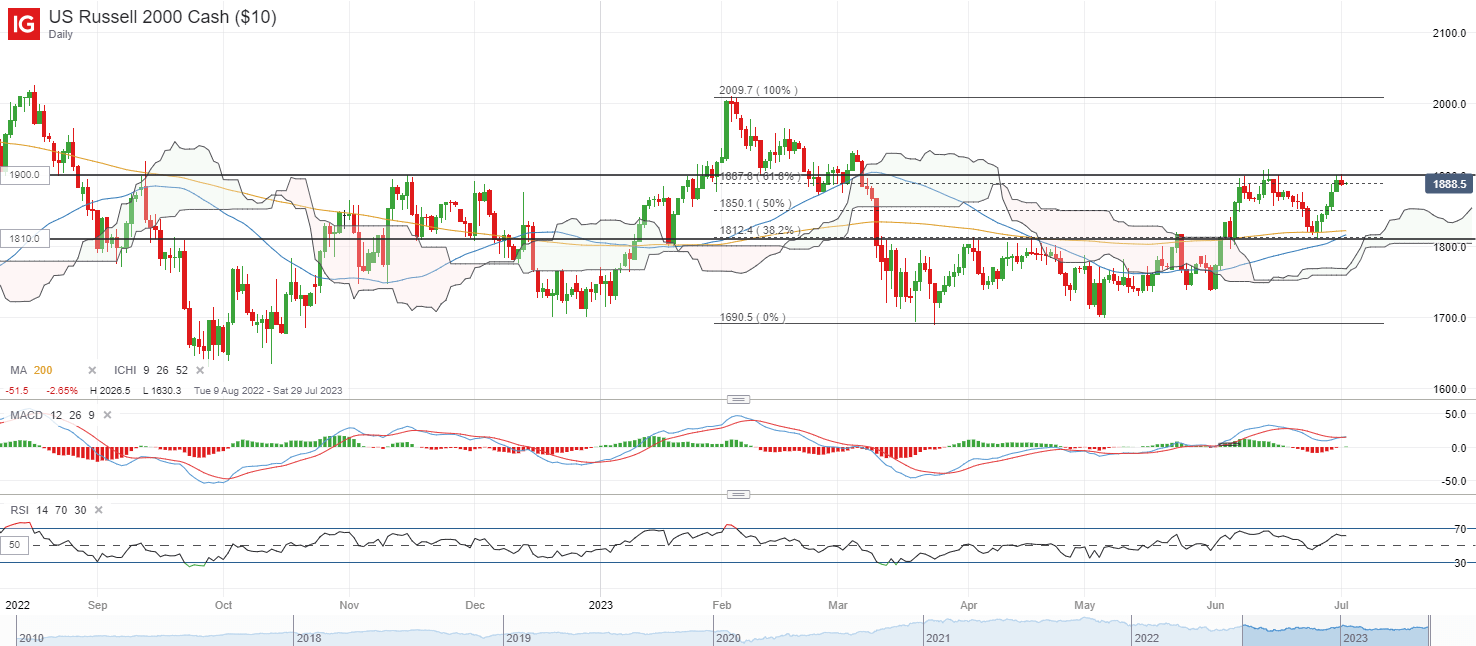
Small-cap stocks have been seeing some signs of life as well, with the Russell 2000 index back to retest its recent June 2023 high at the 1,900 level. Thus far, its Relative Strength Index (RSI) has retained above the 50 level, along with the formation of a new higher low last week, which kept the overall upward bias intact. The 1,900 level will serve as immediate resistance to overcome. Reclaiming this level could anchor in a new higher high and potentially pave the way for the index to retest the key psychological 2,000 level next, where its year-to-date high resides.

image1.pngOn the economic data front, market participants seem to take comfort in a lower-than-expected read from the US core PCE price index (4.6% versus 4.7% consensus), but more notably, the core services ex-housing component has come in at a new 10-month low on a month-on-month basis. Being highlighted previously by the Federal Reserve (Fed) as a gauge for inflation persistence, promising progress on that front has allowed the Fed more room to consider a rate pause after the July meeting. Fed funds futures continue to price for one last 25 basis-point rate hike from the Fed to conclude the hiking cycle.

The US dollar did not take the US inflation data well last Friday, turning in 0.45% lower despite some resilience in US Treasury yields. That allowed gold prices to see some relief (+0.53%) from recent sell-off, while silver prices are attempting to defend its 200-day moving average (MA) with some dip-buying towards the end of last week. Ahead, the US Independence Day holiday tomorrow may put a lighter trading session to start the week, with some focus on the US ISM manufacturing PMI data release tonight.

Asia Open

Asian stocks look set for a positive open, with Nikkei +1.35%, ASX -0.01% and KOSPI +1.13% at the time of writing. Following a retracement from previous overbought technical conditions, the Nikkei has formed a new higher low on the daily chart, with long-legged candles pointing to some dip-buying at around the 32,300 level. The index is just 1% away from June 2023 high, which may leave any formation of a new higher high on watch over the coming days to reiterate its overall upward trend.

Across the region, a series of PMI data was met with some hits and misses, particularly with Japan’s factory activities falling back into contractionary territory in June (49.8 versus previous 50.6) while South Korea’s PMI also marked a deeper contraction (47.8 versus previous 48.4) as a reflection of the global economic slowdown. The day ahead will leave China’s Caixin PMI reading in focus. Following the subdued read in the official manufacturing PMI last week, the Caixin PMI is expected to reinforce the lacklustre economic conditions in China, which may support more to be done by authorities.

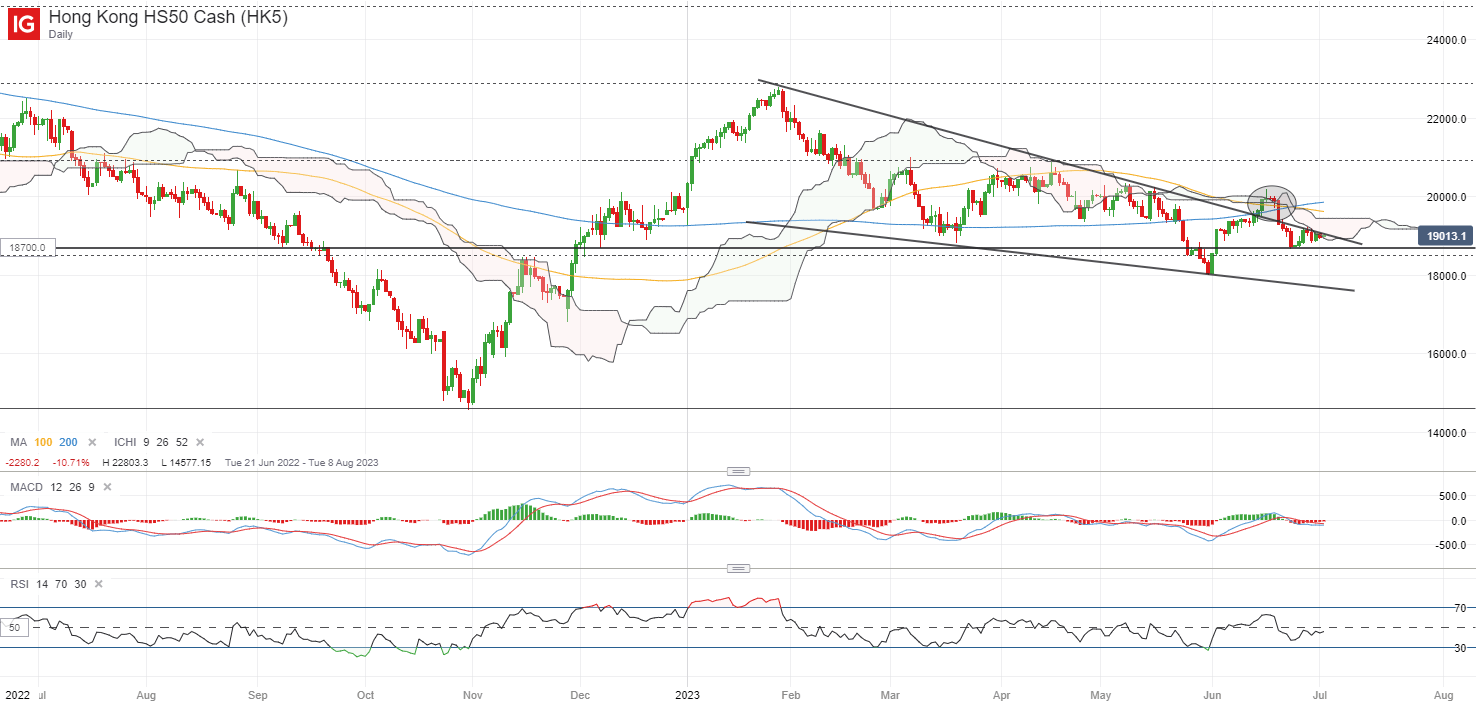
Thus far, the Hang Seng Index remains exhausted, with its RSI back below the 50 level while a descending wedge pattern stays in place after a short-lived attempt for a breakout. On the upside, it seems that a series of resistance need to be overcome to reflect greater control from buyers, particularly the psychological 20,000 level, where the upper edge of the Ichimoku cloud resides on the weekly chart.

image2.pngOn the watchlist: AUD/USD on watch ahead of RBA’s interest rate decision this week

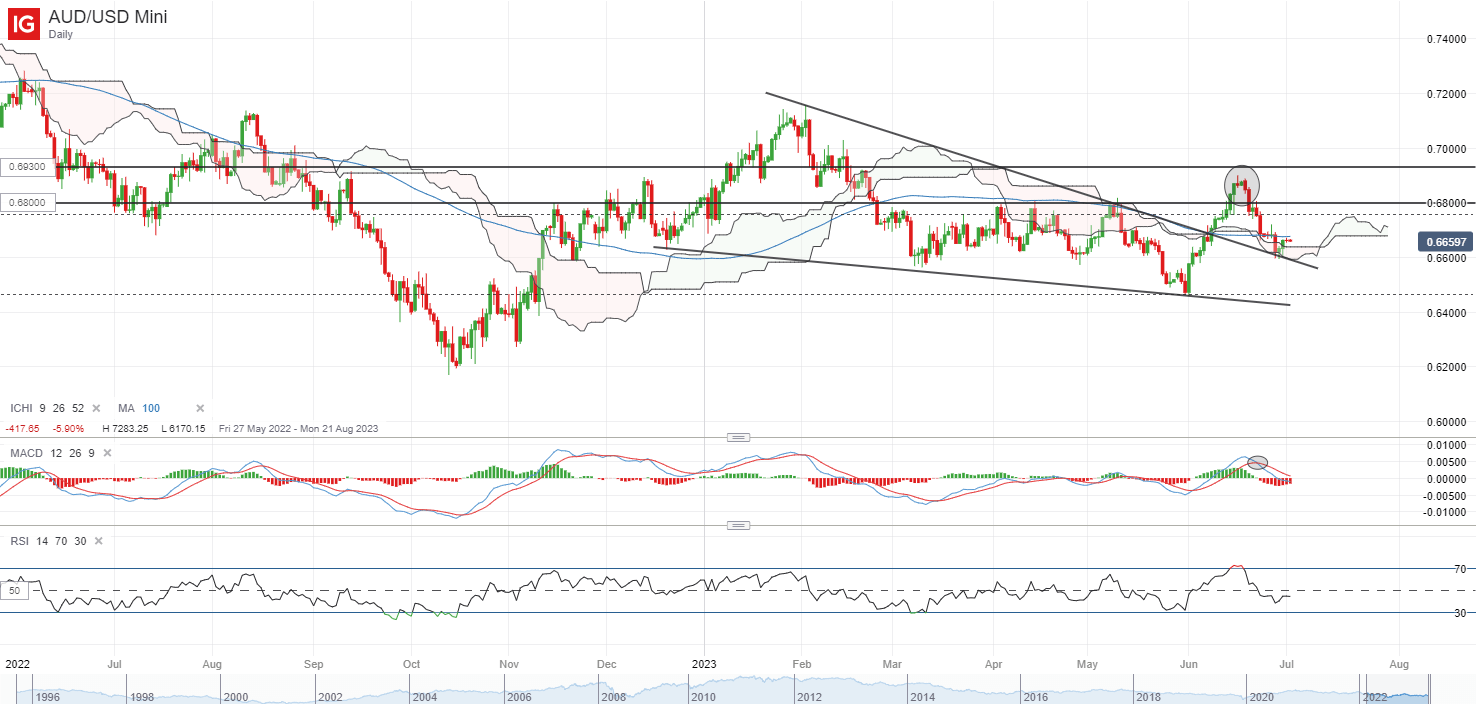
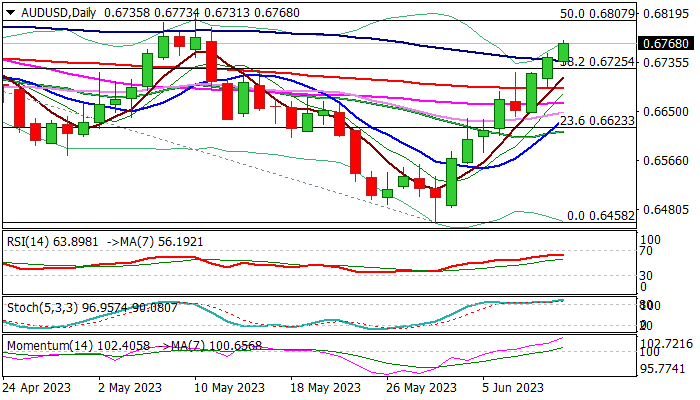
The AUD/USD has managed to touch its three-month high in mid-June, only to have a dovish surprise in the Reserve Bank of Australia (RBA) meeting minutes trigger a sharp retracement back below the 0.680 level. The strong pushback against previous hawkish expectations has forced a move back below its key 100-day MA for the pair, with the RSI hovering below the 50 level.

As the RBA meeting looms tomorrow, a significantly lower-than-expected Australia’s inflation data last week has left expectations leaning towards a rate pause but it may likely be a close call, with market still pricing for any pause to be a temporary move as compared to the end of tightening. The AUD/USD is currently back to retest a downward trendline support on the daily chart at the 0.660 level but much awaits. A series of resistance may have to be overcome to provide conviction of bulls taking back control, which includes its 100-day MA and the 0.680 level of resistance.

image3.pngFriday: DJIA +0.84%; S&P 500 +1.23%; Nasdaq +1.45%, DAX +1.26%, FTSE +0.80%

Australian Dollar Buoyed by Solid Data Locally and in China. Higher AUD/USD?

Australian Dollar Buoyed by Solid Data Locally and in China. Higher AUD/USD?

The Australian Dollar found firmer footing before retreating today with growth-orientated assets generally moving higher to start the week.

Australian building approvals for May rose by a whopping 20.6% month-on-month, well above the 3.0% anticipated and -8.1% prior.

Interest rate markets are placing a low probability of a hike from the RBA tomorrow, but these numbers could spice up the monetary policy meeting. The Aussie Dollar bumped higher on the news but struggled to run on with it.

APAC equities are a sea of green, following on from Wall Street’s solid gain seen on Friday. Some positive economic news out of North America gave markets the boost ahead of a holiday-impacted start to the week there.

Today, China’s Caixin PMI manufacturing data also added to the uptick in mood, coming in at 50.5 rather than the 50.0 forecast.

Washington announced that US Treasury Secretary Janet Yellen will visit China this week in further signs of a potential thawing in the sometimes-frosty relationship between the two largest economies.

Crude oil has had a quiet session as it continues to recover from a test lower last week. The WTI futures contract is near US$ 70.50 bbl while the Brent contract is a touch above US$ 75 bbl.

Likewise, spot gold has barely moved as it trades near US$ 1,920 at the time of going to print. Higher Treasury yields seen on Friday might undermine the precious metal if they continue north.

Looking ahead, a series of European PMIs could hold the market’s attention ahead of US ISM manufacturing figures. The full economic calendar can be viewed here.

AUD/USD TECHNICAL ANALYSIS

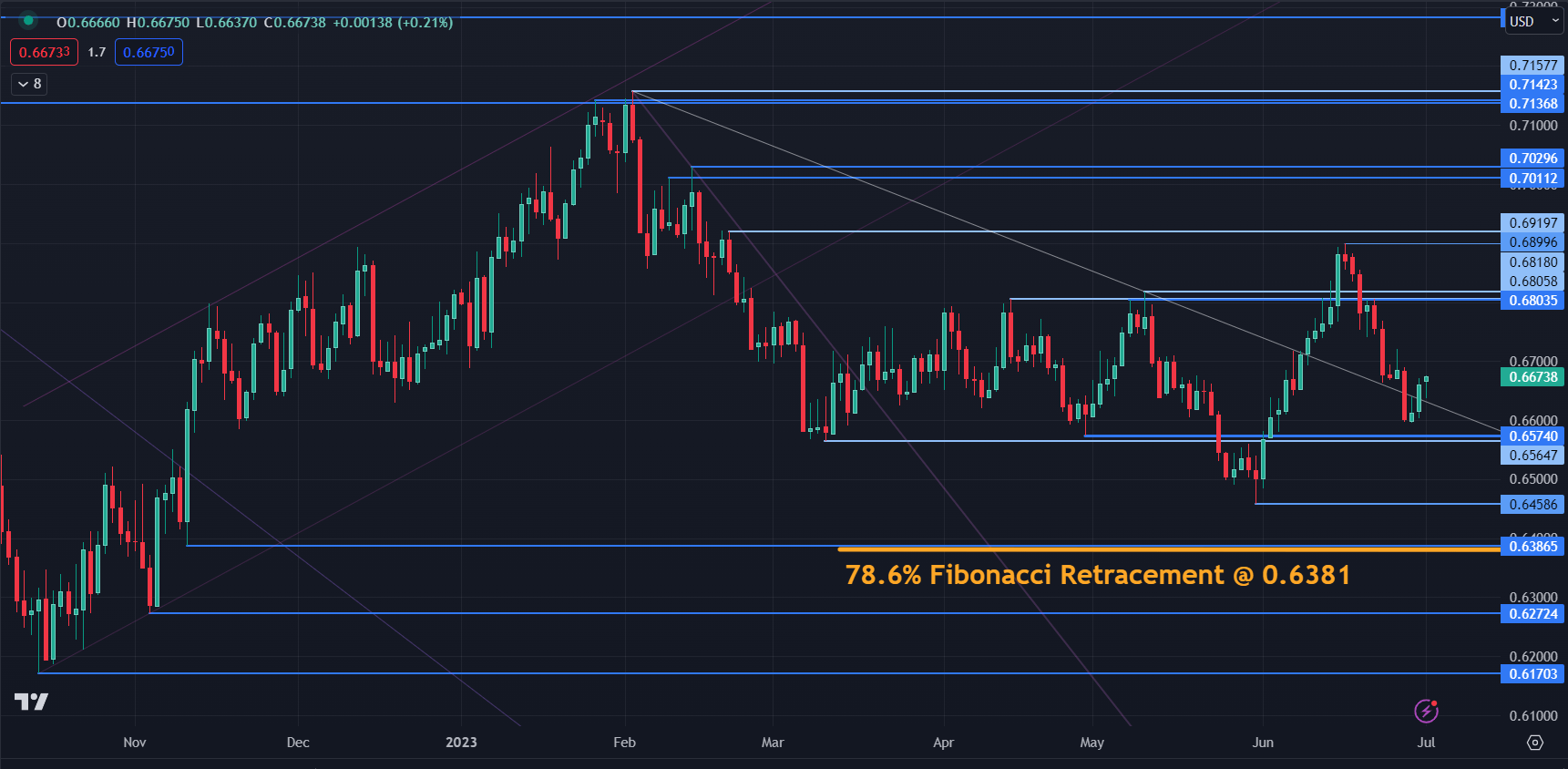
AUD/USD remains range-bound today after failing to penetrate breakpoint support levels toward the end of last week.

Those levels at .6574 and 0.6565 might continue to provide support ahead of the late May low of 0.6458.

Further down, support may lie at the prior low of 0.6387 and the nearby Fibonacci level of 0.6381. The latter is the 78.6% Fibonacci Retracement of the move from the low of 0.6170 to the peak of 0.7158.

On the topside, resistance could be at a potential breakpoint resistance zone in the 0.6800 – 0.6820 area.

Further up, resistance could be at the previous peaks of 0.7011 and 0.7030 ahead of a cluster zone in the 0.0.7137 – 0.7157 area.

image1.png


China’s manufacturing activity shrinks again, casting a shadow on recovery hopes

China’s manufacturing activity shrinks again, casting a shadow on recovery hopes

China’s factory activity in June contracted for a third month, while non-manufacturing activity was at its weakest since Beijing abandoned its strict “zero Covid” policy late last year.

The latest data points to a patchy recovery in the world’s second-largest economy as the growth momentum fizzles.

The official manufacturing purchasing managers’ index (PMI) came in at 49.0 in June — compared to 48.8 in May and 49.2 in April — according to data from the National Bureau of Statistics released on Friday. June’s reading was in line with the median forecast in a Reuters poll.

Friday’s figures also showed China posting its weakest official non-manufacturing PMI reading this year, coming in at 53.2 in June — compared to 54.5 in May and 56.4 in April. A PMI reading above 50 points to an expansion in activity, while a reading below that level suggests a contraction.

“Economic momentum is still quite weak in China. Recent data shows the global economy is slowing, which will likely put further pressure on external demand in the coming months,” said Zhang Zhiwei, Pinpoint Asset Management’s president and chief economist.

“On the other hand, the government’s growth target of 5% this year is quite modest given the low base last year. It is not clear if the weak economic data would push the government to launch aggressive stimulus measures soon,” he added.

U.S. dollar climbs above 145 yen, highest level in 7.5 months

U.S. dollar climbs above 145 yen, highest level in 7.5 months

The U.S. dollar briefly rose above the 145 yen line Friday in Tokyo, reaching a level not seen since last November, as the Japanese currency was sold in anticipation of a further widening in the interest rate differential with the United States. The U.S. Federal Reserve has raised key interest rates to fight stubborn inflation, in contrast to the Bank of Japan which has continued its policy of quantitative easing while keeping rates at ultralow levels.

Employment and unemployment (provisional estimates) – May 2023

Employment and unemployment (provisional estimates) – May 2023

In May 2023 the number of employed people rose, while unemployed persons decreased and inactive ones were substantially stable.

On a monthly basis, the increase of employment (+0.1%, +21 thousand) concerned men, people in the 25-34 age group and those aged 50 and over, while a decrease was recorded for women, the youngest (15-24) and those aged 35-49. Overall, the employment rate rose to 61.2% (+0.1 p.p.).

In the last month, the fall of unemployed persons (-1.7%, -34 thousand) involved men, people in the 25-34 age group and those aged 50 and over. The unemployment rate declined to 7.6% (-0.1 p.p.), the youth rate rose to 21.7% (+0.9 p.p.).

In May, the substantial stability in the number of inactive persons, aged 15 to 64, was the result of a growth among women and those aged 35 and over and of a decrease among men and those aged 25-34. The inactivity rate remained unchanged at 33.7%.

In the period March-May 2023, with respect to the previous quarter (December 2022-February 2023), employment increased (+0.5%, +120 thousand).

In the last three months, a drop was registered for both unemployed persons (-1.6%, -33 thousand) and inactive people aged 15-64 years (-0.6%, -74 thousand).

Compared with May 2022, the number of employed persons rose by 1.7% (+383 thousand), the growth concerned both genders and all age groups except 35-49 years; the employment rate showed an increase of 1.1 p.p. .

On a yearly basis, the rise of employed people was accompanied by a decrease of both unemployed (-4.8%, -98 thousand) and inactive persons aged 15-64 (-2.7%, -351 thousand).

EUR/USD remains pressured near 1.0850 ahead of Eurozone inflation data

EUR/USD remains pressured near 1.0850 ahead of Eurozone inflation data

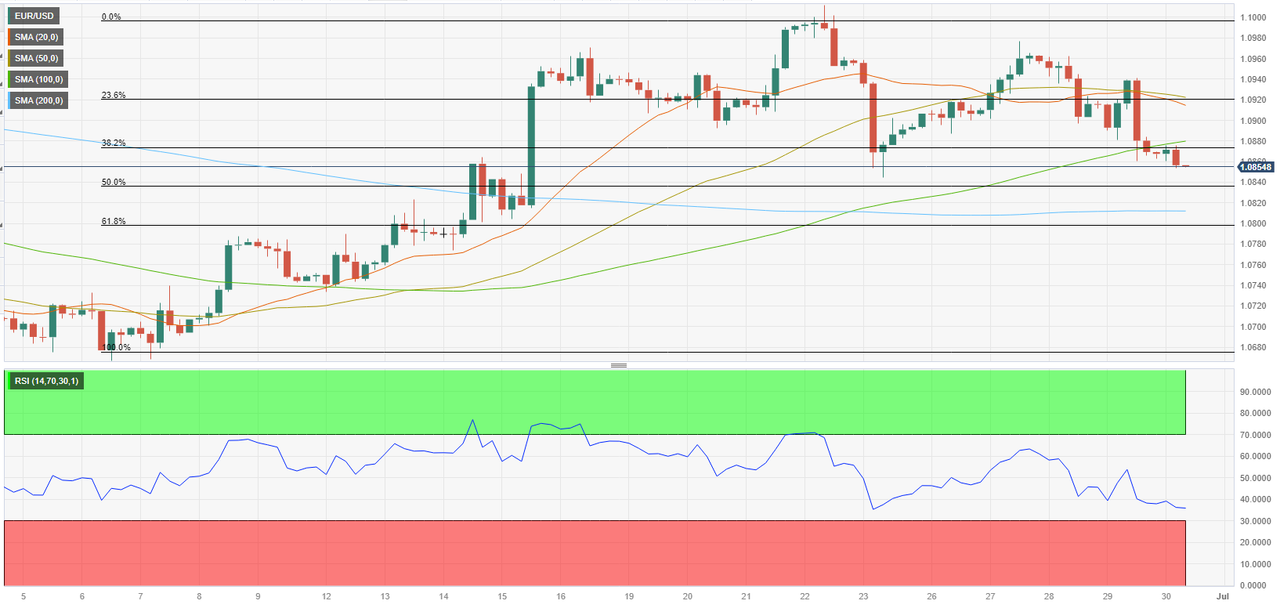
EUR/USD is holding lower ground near 1.0850, hanging at the weekly low early Friday. Economic woes act as a headwind for the Euro, though subdued USD demand lends support. Traders also seem reluctant ahead of the key inflation figures from the Eurozone and the US.

EUR/USD suffered large losses on Thursday as the US Dollar continued to gather strength against its rivals on robust macroeconomic data releases. The pair trades below 1.0900 early Friday as investors stay on the sidelines while waiting for key inflation data.

The Core Harmonized Index of Consumer Prices (HICP) in the Eurozone is forecast to rise 0.7% in June, up sharply from the 0.2% increase recorded in May. Following the hot inflation figures from Spain and Germany earlier this week, a strong HICP growth in the Eurozone shouldn’t be surprising. Hence, the Euro could continue to weaken on a smaller-than-forecast increase but could find it difficult to rebound unless there is a significant upside surprise in the monthly Core HICP.

In the second half of the day, the Personal Consumption Expenditures (PCE) Price Index, the Fed’s preferred gauge of inflation, will be featured in the US economic docket.

On Thursday, the annualized Gross Domestic Product (GDP) growth for the first quarter got revised higher to 2% from 1.3% in the US Bureau of Economic Analysis’ previous estimate. Additionally, the number of first-time applications for unemployment benefits fell nearly 30,000.

As data from the US highlight the resilience of the economy, the Federal Reserve (Fed) could continue to stay focused on taming inflation. The CME Group FedWatch Tool shows that markets are currently pricing in a less than 40% probability of the Fed raising the policy rate by a total of 50 basis points in the remainder of the year. Hence, an increase of 0.5% or higher in the monthly Core PCE Price Index could attract hawkish Fed bets and provide a boost to the USD.

It’s also worth mentioning that the market volatility could rise toward the end of the European session amid quarter-end flows. Inter-market correlations could weaken heading into the weekend, distorting the impact of the data releases on the pair.

Asia Day Ahead: Economic Resilience Well-Received in US; Key Inflation Data Looms

Asia Day Ahead: Economic Resilience Well-Received in US; Key Inflation Data Looms

A significant upward revision in the final read for US first-quarter gross domestic product (GDP) data (2.0% versus 1.4% forecast) adds to the list of positive economic surprises in the US lately, with economic resilience aiding to calm some nerves around recession concerns, at least for now. That paved the way for some catch-up performance in riskier small-cap stocks overnight, with the Russell 2000 outperforming its counterparts to close 1.2% higher.

Banking stocks also stole the limelight, with all 23 lenders acing the Federal Reserve’s (Fed) annual stress test by proving their resilience in weathering a severe recession scenario. The results provided a positive lead-up to their earnings releases in a few weeks’ time, which saw renewed market traction on the prospects of a potentially higher shareholder payout.

Thus far, the Financial Select Sector SPDR Fund has not fully recovered from its pre-SVB levels, with the index trading within a rising wedge pattern in its aftermath. The Relative Strength Index (RSI) has managed to hold above the 50 level, which kept the near-term bias to the upside. The next test for buyers will be at the 33.70-33.90 level, which marked a resistance confluence zone, particularly from its 200-day moving average (MA) and upper wedge trendline resistance. Overcoming this level may pave the way towards the 35.00 level next.
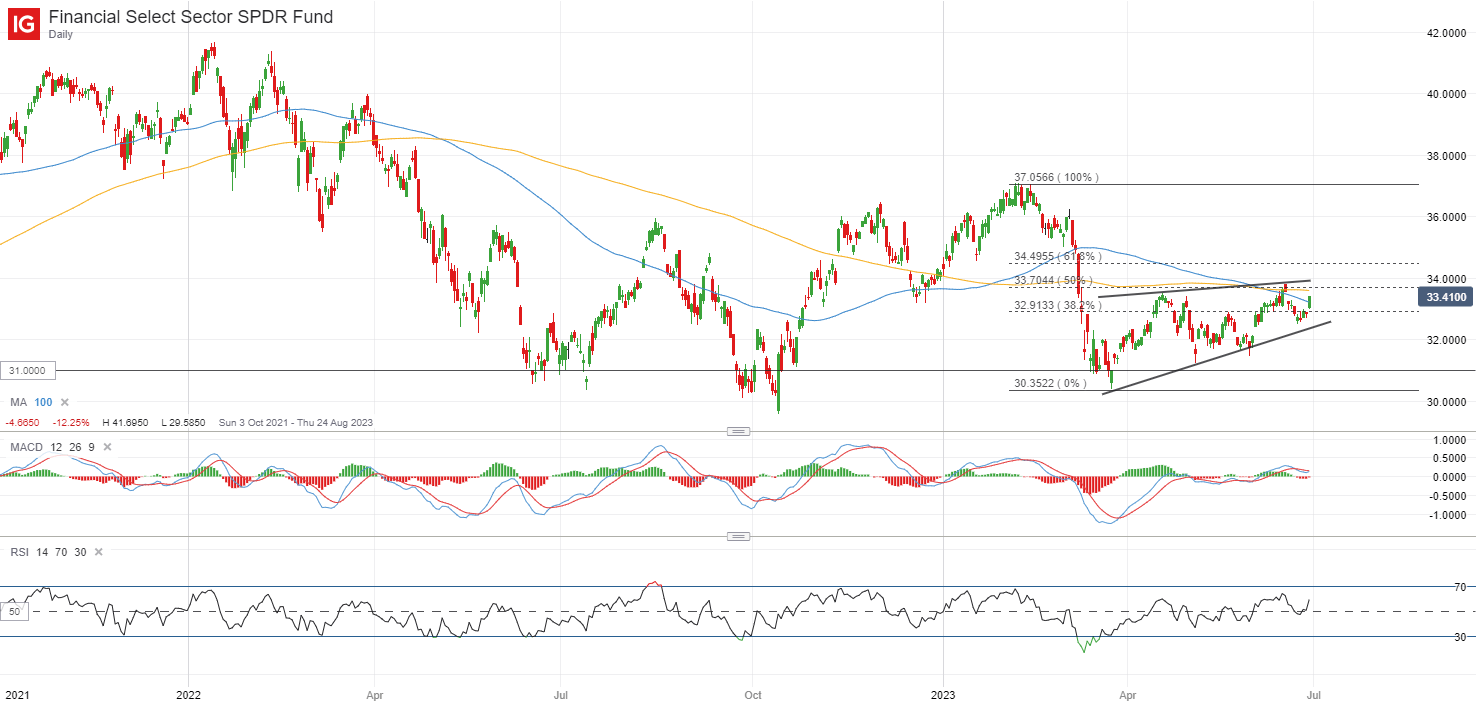
image1.png

Source: IG charts

Treasury yields jumped as rate expectations saw a hawkish recalibration in the aftermath of a brighter US economic profile. The two-year yields surged close to 15 basis-points (bp) to a new three-month high, while the 10-year also saw a similar move to retest its recent June high, keeping a lid on the rate-sensitive Nasdaq.

The day ahead will leave all eyes on the US core PCE price index release later today. Being the Fed’s preferred gauge of inflation, the inflation data has not seen much progress since the start of the year, in contrast with the US Consumer Price Index (CPI). Another set of stubborn inflation read could reinforce a high-for-longer rate outlook and push back against rate-cut prospects, further validated by indications of a stronger US economy lately.

Asia Open

Asian stocks look set for a downbeat open, with Nikkei -0.69%, ASX -0.38% and KOSPI +0.14% at the time of writing. Despite recent jawboning of currency intervention from Japanese authorities, doubts largely remain for any follow-through action as the USD/JPY continues to edge higher over the past week, alongside US dollar strength. The pair is just 0.5% away from the 145.80 level, where a softer round of yen-buying (US$19.7 billion) was conducted in September 2022, which failed to provide much conviction for markets at that time.

This morning, Tokyo’s softer-than-expected core CPI (3.2% versus 3.3% forecast) will likely reinforce the Fed-BoJ policy divergence once more and add to the downward pressure for the JPY. We may see further ramp-up of intervention talks by Japanese authorities ahead, but unless they translate to concrete action, it may seem difficult to stem the increase in the pair. Even in the event of an intervention, the 2022 attempts suggest that the amount of yen-buying matters.

The USD/JPY will face a key test of resistance at the 145.80 level, as caution may intensify on the prospects of intervention while technical conditions trend in overbought territory. But given the higher-highs-higher-lows since the start of the year anchoring an upward trend in place, any sell-off could still be looked upon as a retracement, which leave the 142.50 level on watch for immediate support.
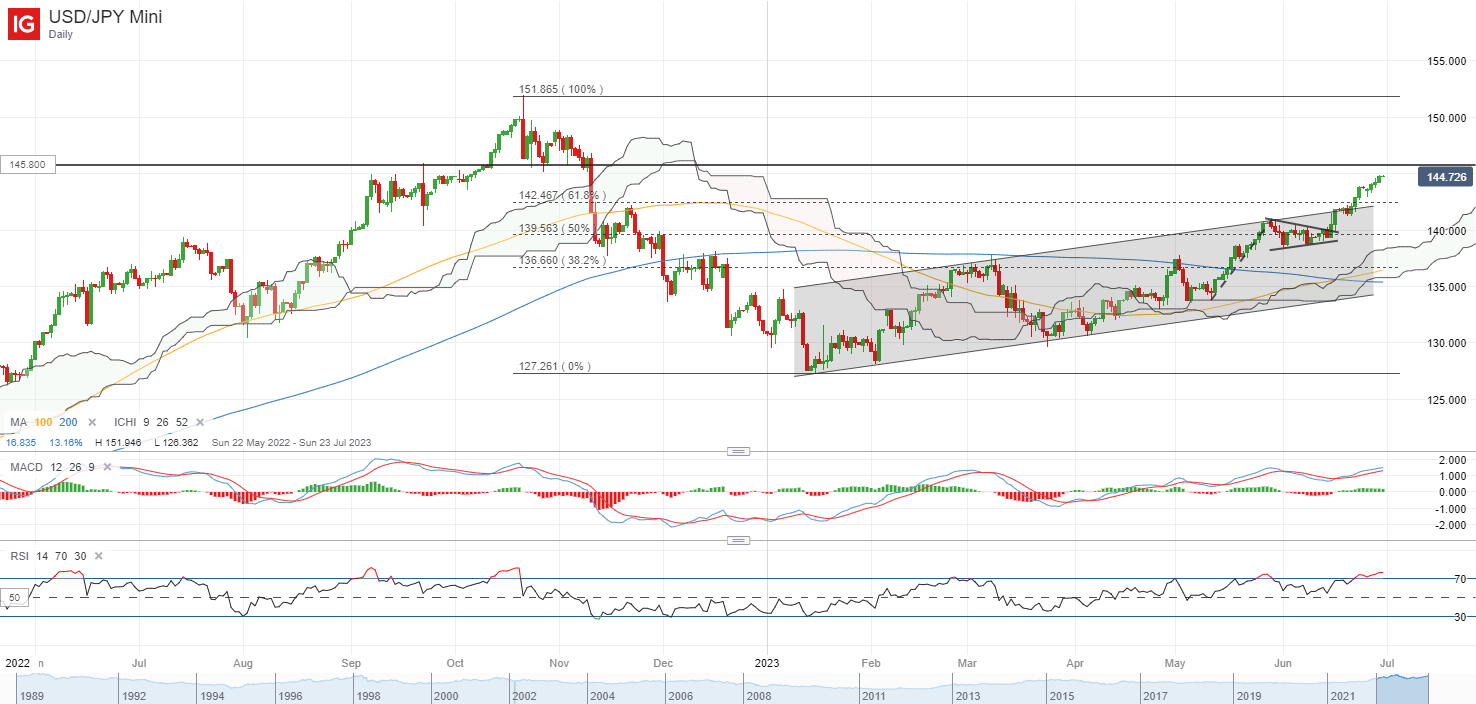
image2.png

Source: IG charts

Ahead, China’s NBS PMI figures will be on the radar. A more subdued reading in the June PMI figures remains the broad consensus (49 versus previous 48.8), which could likely reinforce views that more needs to be done. A sustained turnaround in the data will be warranted to provide greater conviction that the worst is over.

On the watchlist: US dollar on watch ahead of US core PCE price index release

The US dollar has been edging higher in the lead-up to the US PCE price index release today, tapping on some resilience in Treasury yields lately as positive economic surprises this week point to a high-for-longer rate outlook. Its 100-day MA has been reclaimed overnight, after being supported off its Ichimoku cloud on the daily chart. Buyers are also seeking to take greater control, with a bullish crossover on MACD and a move in RSI back above the 50 level, but validation will have to be sought from a more persistent set of inflation readings to further support US dollar strength.

The 103.12 level may serve as immediate resistance to overcome ahead, with a move above this level potentially paving the way to retest the 105.00 level next. On the other hand, failure to reclaim the level could leave its 2023 year-to-date lows on watch at the 100.50 level.
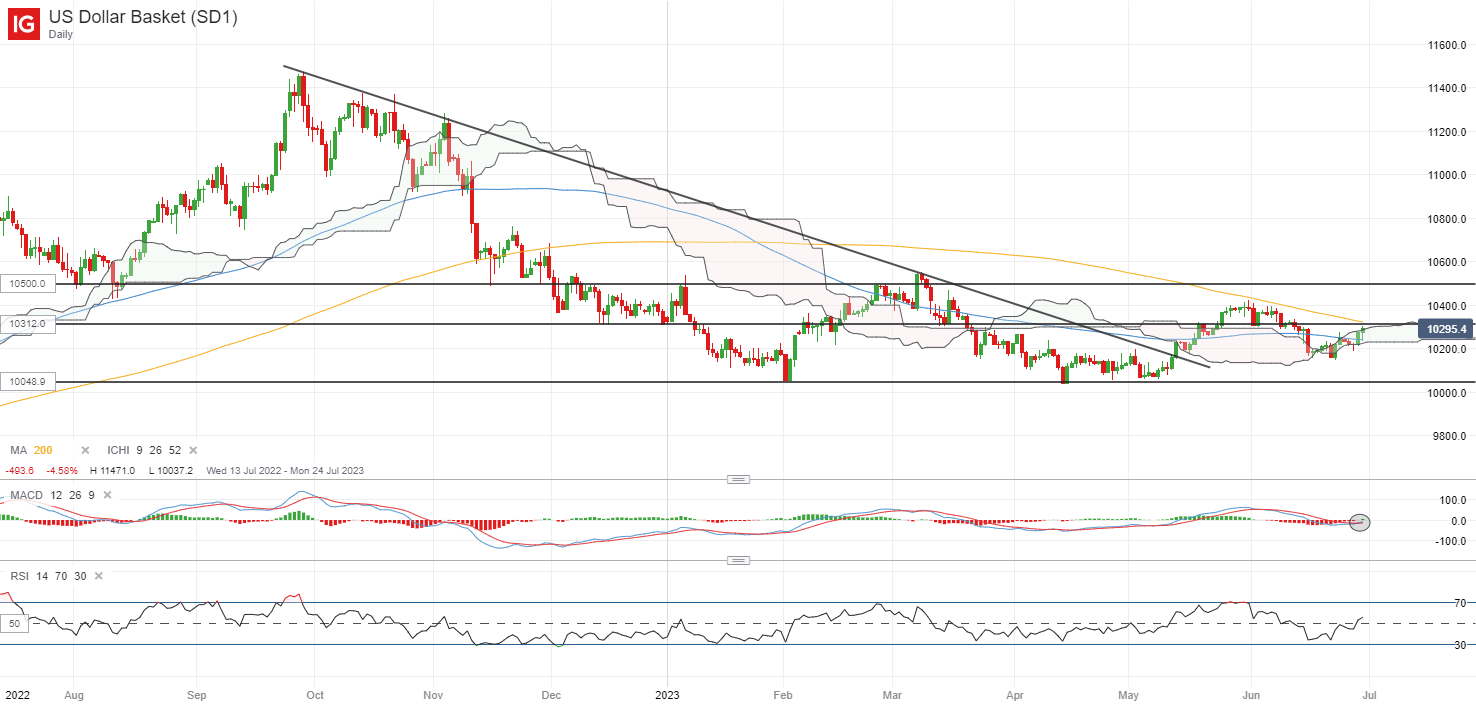
image3.png

Source: IG charts